EN


A salivary gland surgery scar is the thin incision line left under the jaw after part of an enlarged submandibular gland is removed; at MINE it is about 2.5–2.8 cm long and sits in the first natural crease under the chin.
If you want a sleeker jawline but keep putting off surgery, the scar is probably the reason. Will people notice it? How long will it stay red? And when does it start to look like an ordinary crease?
I’m Dr. Lee Sung-wook, a board-certified plastic surgeon at MINE in Gangnam, Seoul. In my clinical experience, fear of the scar is the most common reason patients hesitate. This article covers one thing only: the scar itself — where it goes, why it stays thin, how it changes month by month, and how to care for it. For the procedure as a whole, from diagnosis to recovery, see our complete guide to submandibular gland removal surgery.
What Is a Salivary Gland Surgery Scar, and Why Does It Form?
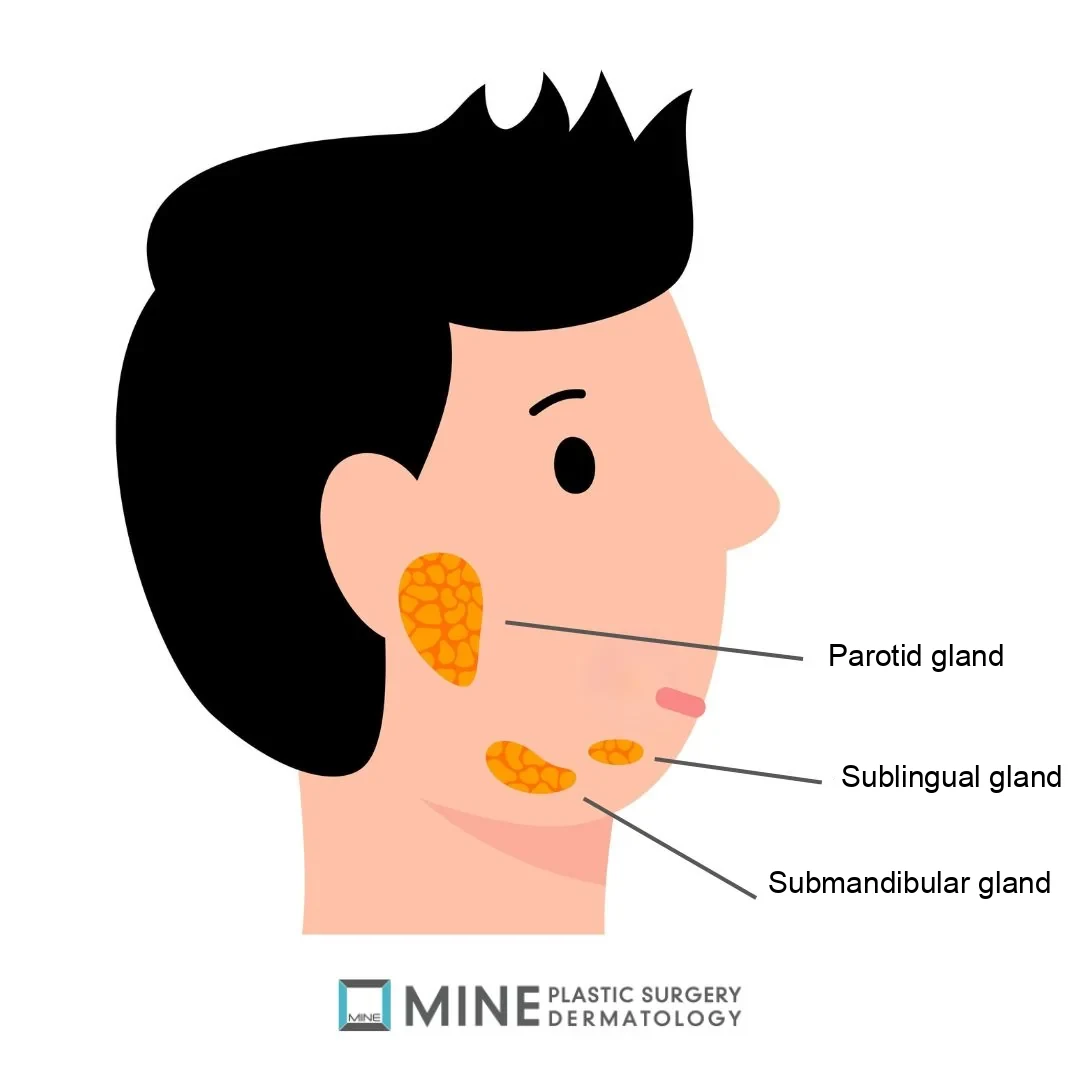
Salivary gland reduction removes only the part of the submandibular gland (the salivary gland that sits just under the jawbone) that bulges below the jawline. Because the gland is reached through the skin, there will always be an incision — and every incision heals with some kind of scar. You can read how the procedure itself works on our page about salivary gland reduction at MINE.
Every Incision Heals With a Scar — the Goal Is an Inconspicuous One
When skin is cut, the body closes the gap by laying down new collagen (the protein that gives skin its strength). That repair tissue is the scar, and the line under your jaw forms the same way. It never becomes identical to the skin around it, so the honest goal is not a scar that “disappears” but one that is hard to notice in daily life. The MedlinePlus overview of scars explains this healing process in plain language.
What many patients don’t realize is that a fresh scar and a mature scar look very different. The pink, slightly firm line you see in the first weeks is not the final result. Your scar keeps changing for more than a year.
Four Factors That Decide How Visible It Becomes
- Location and direction. An incision that follows a natural skin crease hides inside that crease.
- Length. A shorter incision leaves less scar to fade.
- Closure technique and tension. How the wound is stitched decides whether the line stays thin or spreads.
- Your own skin. A tendency toward keloids or raised scars, and your skin tone, both affect healing.
Of these, tension is the one surgeons talk about most. Plastic surgery textbooks identify mechanical tension on a wound — the pulling force across the cut edges — as a major cause of hypertrophic scars (raised, thick scars). That is why incision placement and stitching technique matter as much as the gland removal itself.
Dr. Lee’s Key Point: The final look of a salivary gland surgery scar depends far more on where the incision is placed and how it is closed than on luck.
Who Should Plan Extra Scar Care Before Surgery?
Most people heal with a fine salivary gland surgery scar. Still, some patients benefit from a scar plan that starts before the operation. Please tell your surgeon at consultation if any of the following applies to you.
Keloid or Hypertrophic Scar History
A keloid is a scar that grows beyond the original wound edges; a hypertrophic scar is raised but stays within them. If you have had either after piercings, vaccinations or earlier surgery, it does not automatically rule out surgery. It does mean we check your scar history carefully and plan prevention from day one — starting silicone as soon as the wound allows and, if a scar begins to thicken, considering an early steroid injection. The American Academy of Dermatology on keloid treatment describes the main options in more detail.
Darker Skin Types and Pigmentation Risk
Early scars on the face and neck can darken (hyperpigment) when exposed to sunlight. In people with medium to darker skin tones, this brown discoloration tends to be more noticeable and can take a long time to settle. Careful sun protection while the incision line is still pink is therefore especially important. A scar management textbook also cites research in Asian patients in which daily silicone gel sheeting for 3 months after surgery reduced the redness and pigmentation of newly revised surgical scars.
Smoking and Other Healing Factors
Smoking narrows small blood vessels and reduces the oxygen reaching a healing wound, which can slow closure and worsen the scar. If you smoke, stopping before and after surgery helps. Conditions that affect healing in general, such as poorly controlled diabetes, are also worth mentioning at consultation.
Where the Incision Goes: Scar Locations Compared
The single biggest decision for how visible a salivary gland surgery scar will be is where the surgeon places it. Different clinics use different approaches, and the difference shows when you look up.
MINE Approach: 2.5–2.8 cm in the First Crease Under the Chin
When you lower your head, a soft fold forms under your chin. At MINE, the incision is about 2.5–2.8 cm and follows this first crease under the chin, so it is hard to see from the front. This length is MINE’s standard. Through this short opening we remove only the protruding part of the gland.
Because the incision line already lies where a natural fold forms, it tends to blend in as it matures and starts to look like an ordinary skin crease. From the front or at a normal conversational angle, most people will not see it. When you tilt your head back, a thin line in the crease may be visible, especially in the first months.
Other Approaches and Why Their Scars Show More
Other clinics may place a vertical incision in the middle under the chin, or a longer line lower down toward the neck. The gland can be reached this way, but these scars are more exposed. Even a slight upward glance can reveal this kind of scar, which can become a new source of stress after surgery.
| Approach | Location | Length | From the front | When looking up | Note |
|---|---|---|---|---|---|
| First crease under the chin (MINE) | Natural fold under the chin | About 2.5–2.8 cm (MINE standard) | Barely visible | Thin line in the crease, fading over time | Follows a natural skin line |
| Vertical midline under the chin | Center of the under-chin area | Varies | Usually hidden | More visible | Runs across natural creases |
| Lower, longer neck incision | Upper neck, below the jaw | Longer | May be visible | More visible | More scar to fade, more exposed |
Following the Skin’s Natural Lines
Skin has built-in lines of tension, known as Langer’s lines or relaxed skin tension lines. Think of them as the grain in a piece of wood: a cut along the grain closes neatly, while a cut across it tends to pull open. Wrinkles and creases usually run along these lines. An incision placed along them is under less tension, heals finer and looks like a natural crease.
Dr. Lee’s Key Point: A short incision in the first crease under the chin is the starting point for a scar that is hard to see from the front.
How Surgical Technique Keeps the Scar Thin
Many patients assume the size of a salivary gland surgery scar depends only on incision length. In reality, the way the wound is closed matters just as much.
Layered Closure: Deep Dermal Stitches First, Then the Surface
Skin has layers. The dermis (the deeper, stronger layer of skin) holds most of the strength, and the epidermis (the thin outer layer) forms the surface you see. At MINE, we close the dermis first with fine absorbable stitches, then align the surface edges precisely. This layered closure means the outer stitches only have to bring the edges together, not hold the wound shut.
Spreading Tension So the Scar Doesn’t Widen
Tension pulling on a healing wound is a leading cause of thick, widened scars. When the deep layer carries that load, the surface is left almost tension-free, and the incision can stay as a fine line instead of spreading over the following months. The crease location helps too, because a natural fold is already a low-tension area.
Stitch Removal at Around 5–7 Days
Stitches are usually removed around 5–7 days after surgery. Removing them at the right time avoids the small cross-hatch marks that stitches can leave when they stay in too long. After removal, the wound is still delicate, so follow your aftercare instructions closely for the next few weeks.
Dr. Lee’s Key Point: Minimal incision plus precise layered closure — that combination is what keeps the scar thin.
Salivary Gland Surgery Scar Timeline: From Stitches to 18 Months
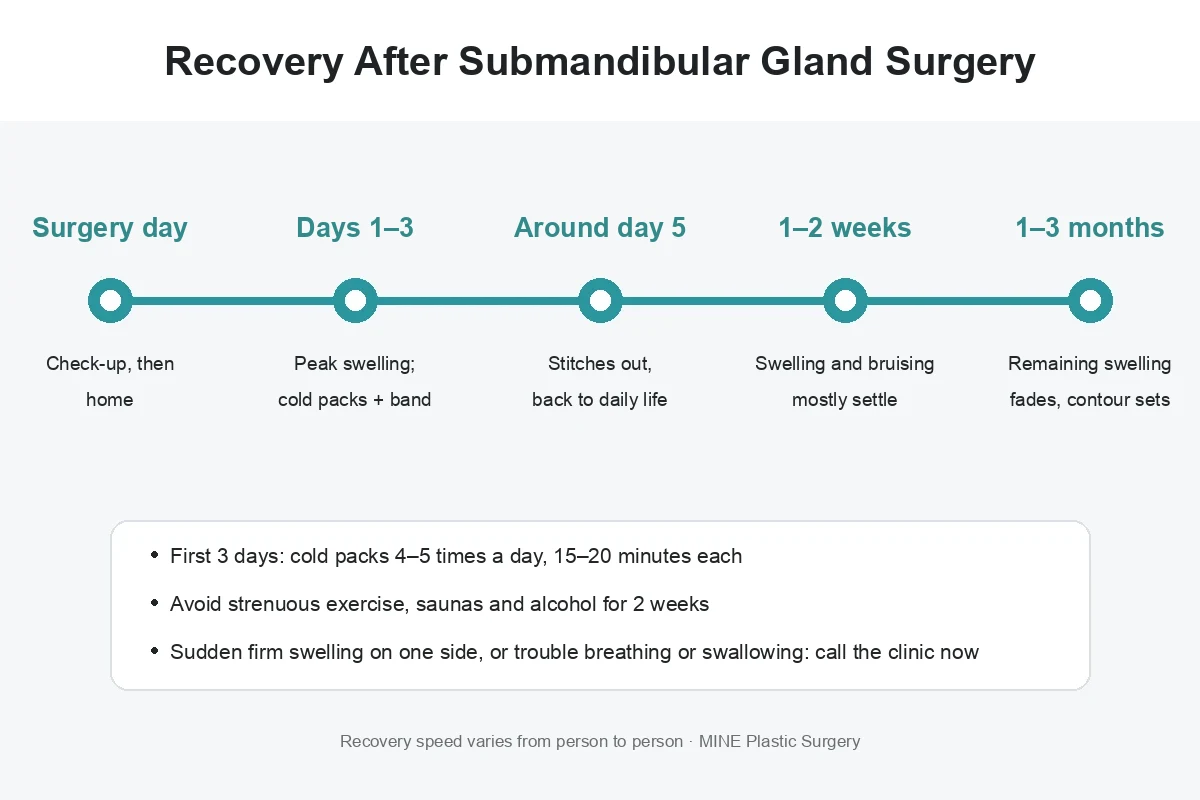
Knowing what is normal at each stage prevents a lot of worry. Swelling and bruising in the jaw area are a separate topic and usually settle within a couple of weeks; for daily-life recovery, see our full recovery guide for submandibular gland surgery. Here we follow the scar itself.
| Time after surgery | What the scar looks like | What to do |
|---|---|---|
| 5–7 days | Stitches come out; thin closed line | Keep clean and dry; follow aftercare instructions |
| 2–3 weeks | Wound fully closed | Start silicone sheet or gel if your surgeon agrees |
| 1–3 months | Pink, slightly raised, firm, sometimes itchy — normal “immature scar” | Silicone daily, sun protection, gentle massage once healed |
| Around 6–7 months | Redness fades noticeably | Continue sun protection |
| 12–18 months | Scar matures, closer to surrounding skin color and texture | Final assessment of the scar |
Weeks 1–3: Stitches Out and the Wound Closes
In the first days, your incision line is closed but fragile. After stitch removal at about 5–7 days, the surface keeps sealing, and by around 2–3 weeks the wound is usually fully closed. This is the point at which silicone treatment can begin.
Months 1–3: Why the Scar Looks Worse Before It Looks Better
This stage surprises many patients. Between one and three months, the scar often becomes pinker, a little raised and firm, and it may itch. Doctors call this the normal “immature scar” phase, when the body is still building and reorganizing collagen. It does not mean something has gone wrong. It is simply the busiest period of healing.
Months 6–18: Fading and Maturation
In most patients, the redness fades within about 7 months. The scar then keeps softening and flattening, and scar textbooks note that most scar remodeling is complete 12 to 18 months after surgery. By then, a well-placed scar usually sits in the crease as a fine line close to your natural skin tone. That is why we judge the final scar at 12–18 months, not at the first follow-up.
Dr. Lee’s Key Point: A pink, firm scar at two months is normal. Give it time — the redness usually fades around 6–7 months, and the scar keeps maturing over 12–18 months.
Scar Care After Salivary Gland Surgery: Silicone, Sun Protection, Massage
Surgery sets the foundation, but the months after surgery shape the final result. Good scar care after salivary gland surgery rests on three habits: silicone, sun protection and gentle massage.
Silicone Sheets or Gel: When to Start and How Long
Clinical guidelines recommend silicone gel or sheeting, worn 12 hours or more a day for two to six months, as first-line scar prevention. In practice, we suggest starting once the wound has fully closed, usually around 2–3 weeks after surgery, and continuing for at least 2–3 months — often up to 6 months. For how often to change sheets or apply gel, follow the product instructions or your surgeon’s advice.
How does it work? Silicone covers the scar like a breathable seal and keeps the outer skin properly hydrated. This normal moisture level signals the deeper skin cells to slow down excess collagen production, which helps keep the scar flatter and softer. Results vary from person to person, but it is the most widely recommended first step for a salivary gland surgery scar.
The neck moves constantly when you talk, eat and turn your head, so sheets can lift at the edges. Gels tend to work better where movement makes sheets hard to keep on, so a gel may be the more comfortable choice here.
Daily Sun Protection While the Scar Is Pink
A new scar burns and darkens more easily than normal skin. Protect your salivary gland surgery scar every day while it is still pink — at least 6 months, and ideally through the first year. Use a sunscreen of SPF 30 or higher and reapply when you are outdoors. A wide-brimmed hat or a collar that shades the area helps too, as long as it does not rub the line.

Gentle Massage Once the Wound Has Fully Healed
Light massage can start around 3–4 weeks after surgery, once the wound (which usually closes at 2–3 weeks) has had time to settle and your surgeon gives the OK. It helps soften the scar. Use clean fingertips and gentle circular or along-the-line movements for a few minutes, as your surgeon advises. Do not massage an open or scabbed wound.
Small Habits That Help Healing
Avoid smoking during the healing period. Good sleep and a balanced diet with enough protein support normal wound repair. That is all most patients need to add — there is no special scar diet.
Dr. Lee’s Key Point: Silicone, daily sunscreen and gentle massage at the right time give your scar the right conditions to fade.
What to Avoid — and When to Call Your Surgeon
Habits That Can Make the Scar Worse
- Picking or peeling scabs before they come off on their own
- Over-cleaning with harsh antiseptics, which can irritate the line
- Scratching or rubbing an itchy scar
- Tight collars, scarves or necklaces pressing on the incision
- Unprotected sun exposure while the scar is pink
Signs That Need a Check-Up
Contact the clinic if you notice increasing redness, warmth, swelling or discharge around your incision line, which can suggest infection. Also get checked if the edges open, or if after about three months the scar keeps getting thicker or spreads beyond the original line. These can be early signs of a hypertrophic scar or keloid, and early treatment works better than waiting. Other surgical risks, such as nerve injury or bleeding, are rare; we discuss them in our article on whether salivary gland removal is worth it.
If the Scar Still Shows After 6 Months
Sometimes a salivary gland surgery scar is still noticeably red or raised at six months. There are options. Scar management references list steroid injection and silicone as the most recommended treatments for raised scars and keloids. Laser treatment started in the first weeks after stitch removal has also been shown to reduce the amount of scar tissue that eventually forms. If a mature scar remains wide or uneven, surgical scar revision can be considered. We assess each scar before suggesting any of these; you can learn more about scar revision options at MINE.
Salivary Gland Surgery Scar FAQ
Will a salivary gland surgery scar disappear completely?
No surgical scar disappears completely, because the body repairs a cut with scar tissue. With an incision in the first crease under the chin and careful layered closure, however, the scar usually fades over time until it is hard to tell apart from the surrounding skin. The realistic goal is a scar that is inconspicuous, not invisible.
How long does it take for the scar to fade?
The redness usually fades noticeably around 6–7 months after surgery, and the scar keeps maturing over 12–18 months. Between one and three months it often looks pinker, firmer and slightly raised. This is a normal stage of healing, not a sign that the result will stay that way.
How visible is the scar when I look up or tilt my head back?
From the front, the scar is barely visible because it sits in the natural crease under the chin. When you tilt your head back, you may see a thin line in that crease, especially in the first months. As the scar matures, it tends to look like an ordinary skin fold.
When can I start using silicone sheets or gel?
Start once the wound has fully closed, usually around 2–3 weeks after surgery, and only after your surgeon has checked it. Wear silicone for 12 hours or more a day for at least 2–3 months, often up to 6 months. Follow the product instructions or your surgeon’s advice for changing sheets or applying gel.
Can I have salivary gland surgery if I’m prone to keloids?
A tendency to keloids does not automatically rule out surgery, but it must be discussed at consultation. We review your scar history and plan prevention in advance, such as starting silicone early and considering steroid injections if the scar begins to thicken. Close follow-up during the first months is important.
What can be done if the scar is still noticeable after 6 months?
Options include steroid injections for raised scars, laser treatment to reduce redness and texture, and surgical scar revision for a wide or uneven mature scar. The choice depends on the type of scar and your skin. Your surgeon should examine it first and then recommend the most suitable approach for you.
Talk to Dr. Lee About Your Scar Concerns
Every salivary gland surgery scar plan is personal. Your skin type, scar history, the size of the gland and the shape of your jaw and neck all affect where the incision should go and what aftercare you need. At consultation, I review these together with you and explain how your scar is likely to change over time.
If you live abroad, you can start with an online consultation by sending clear front and side-profile photos. Learn more about salivary gland reduction at MINE, or call us at +82-2-516-1175.
Written and reviewed by Dr. Lee Sung-wook, Board-Certified Plastic Surgeon, MINE Plastic Surgery & Dermatology | 813 Nonhyeon-ro, Gangnam-gu, Seoul | +82-2-516-1175
Sources: plastic surgery and scar management textbooks on wound healing, silicone therapy and scar treatment; MINE clinical experience.
※ This content is for informational purposes only and does not replace professional medical advice, diagnosis, or treatment. Individual results may vary, and side effects may occur. Please consult with a board-certified plastic surgeon for personalized advice.