EN
EN


Parotid gland botox is an injection of botulinum toxin into the lower part of the parotid gland to reduce the gland bulk that widens the back of the jawline. The parotid is the large salivary gland that sits in front of and below your ear and wraps behind the back edge of the jaw. Masseter botox, by contrast, targets the chewing muscle that sits over the jaw corner.
Many people come to us with the same story: “Masseter botox made my jaw corner softer, but my face still looks wide, almost round.” That leftover width is a real clue. It usually means something other than the chewing muscle is adding to the lower face, and the most common suspect is a salivary gland.
This guide is a practical way to tell the difference. It walks through what each injection targets, three simple checks you can do in a mirror, how the gland treatment is done, what the timeline looks like, and when swelling is a medical issue rather than a cosmetic one. If you want the detailed risks and recovery of gland injections, we cover those separately in our article on the side effects of salivary gland botox.
Table of Contents
- What Is Parotid Gland Botox, and How Is It Different From Masseter Botox?
- Which One Is Widening Your Lower Face? 3 Checks to Tell Muscle From Gland
- How Parotid Gland Botox Is Done — and Why It Is Often Paired With Masseter Botox
- When Will You See Results? Parotid vs Masseter Botox Timeline
- Safety Notes, and When a Swollen Parotid Is Not a Cosmetic Issue
- Parotid Gland Botox FAQ
- Not Sure Whether It Is Muscle or Gland? Start With a Diagnosis
What Is Parotid Gland Botox, and How Is It Different From Masseter Botox?
Both treatments use the same kind of medicine, so it is easy to assume they do the same job. They do not. One relaxes a muscle; the other quiets a gland. Where the needle goes, how deep it goes, and what you can expect in the mirror all follow from that difference.
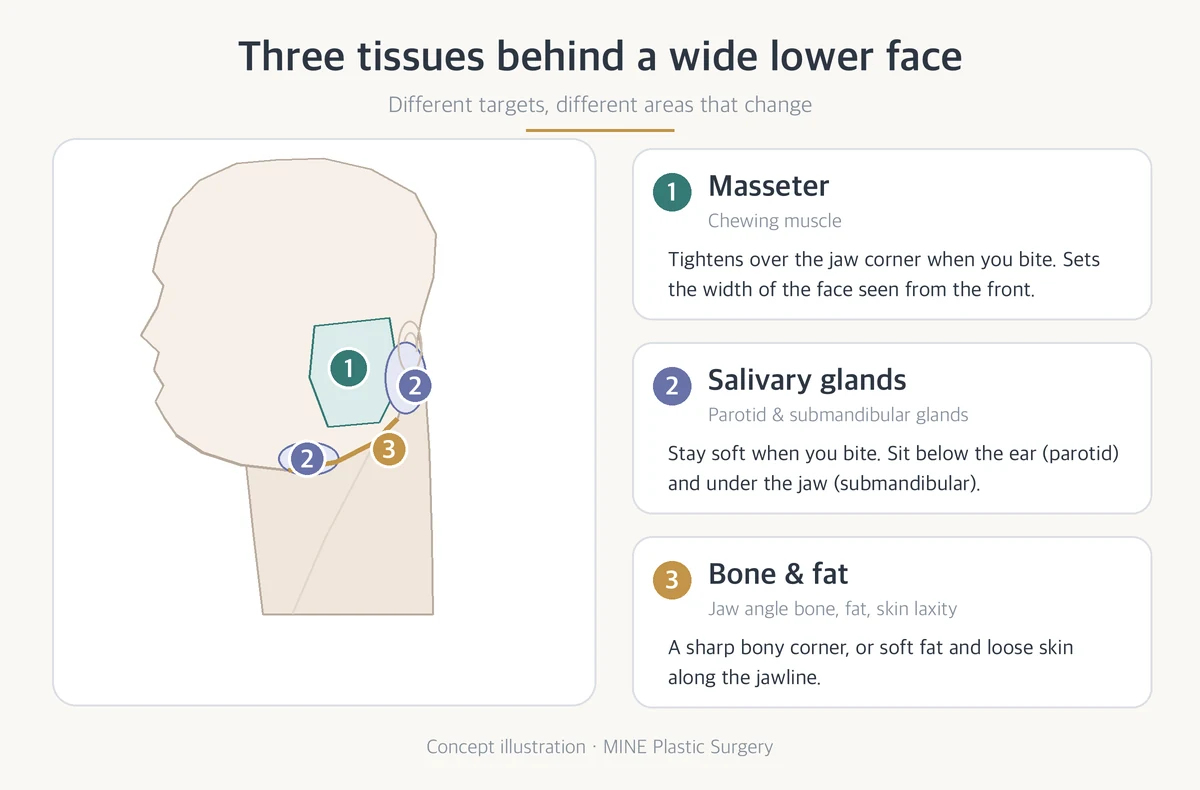
Two different targets: a chewing muscle vs a salivary gland
Masseter botox targets a chewing muscle, while parotid gland botox targets a salivary gland that sits further back, below the earlobe.
Anatomically, the masseter is a thick chewing muscle that starts at the cheekbone arch and attaches to the ramus (the vertical back part of the jawbone) and the mandibular angle (the jaw corner). It has a shallow layer and a deeper layer, and it is the muscle you feel tighten at the side of your face when you clench your teeth. In people who grind or chew hard, it can grow bulky and give the face a square look, which is why “square jaw” and “V-line” goals are so common in Asian aesthetic medicine.
The parotid gland is a different kind of tissue altogether. It is bordered by the cheekbone arch above, the earlobe behind, and the lower edge of the jaw below. When it is enlarged, it tends to sit further back, behind the ramus, and in some people it even wraps around part of the masseter. It makes saliva, so it is soft, not something that hardens when you bite.
Because the tissues are different, the medicine works differently. In a muscle, botulinum toxin blocks the nerve signal that makes it contract. A muscle that is used less gradually becomes smaller, a process called disuse atrophy. In a gland, the toxin turns down the nerve signal that tells it to produce saliva, and the gland becomes less active and somewhat smaller. Glands generally do not shrink as dramatically as a bulky muscle does, which is one reason expectations need to be set carefully. We explain this in more detail in our article on when salivary gland botox is not working.
The use of toxin for both problems is not new. A 2010 review by Wu in Facial Plastic Surgery Clinics of North America described botulinum toxin for both an enlarged masseter and parotid enlargement as a way to narrow lower facial width. A 2023 aesthetic dermatology reference describes parotid injection mainly as an adjunct (an add-on) to masseter treatment, used to enhance slimming and make the jaw angle look sharper.
Side-by-side comparison: masseter botox vs parotid gland botox
| Feature | Masseter botox | Parotid gland botox |
|---|---|---|
| Target tissue | Chewing muscle | Salivary gland |
| Where it sits | Over the jaw corner and the back part of the jawbone, in front of and below the ear | Below the earlobe and behind the back edge of the jaw; can extend below the jaw angle |
| How the toxin works on it | Relaxes the muscle; it shrinks from reduced use | Reduces saliva-making activity; the gland becomes less bulky |
| What changes in the mirror | Softer, less square jaw corner | Less fullness behind and below the jaw corner; a cleaner jaw angle |
| Typical role | Usually the main treatment for a square jaw | Often an add-on to masseter treatment when width remains |
Dr. Lee’s Key Point: The toxin may be the same, but a muscle and a gland are different targets. The injection site, the depth and what you can realistically expect all change depending on which tissue is causing the width.
Which One Is Widening Your Lower Face? 3 Checks to Tell Muscle From Gland
Before anyone talks about doses, the real question is what is making your lower face wide. Three simple checks will point you in the right direction. They narrow the possibilities; they do not replace an examination.
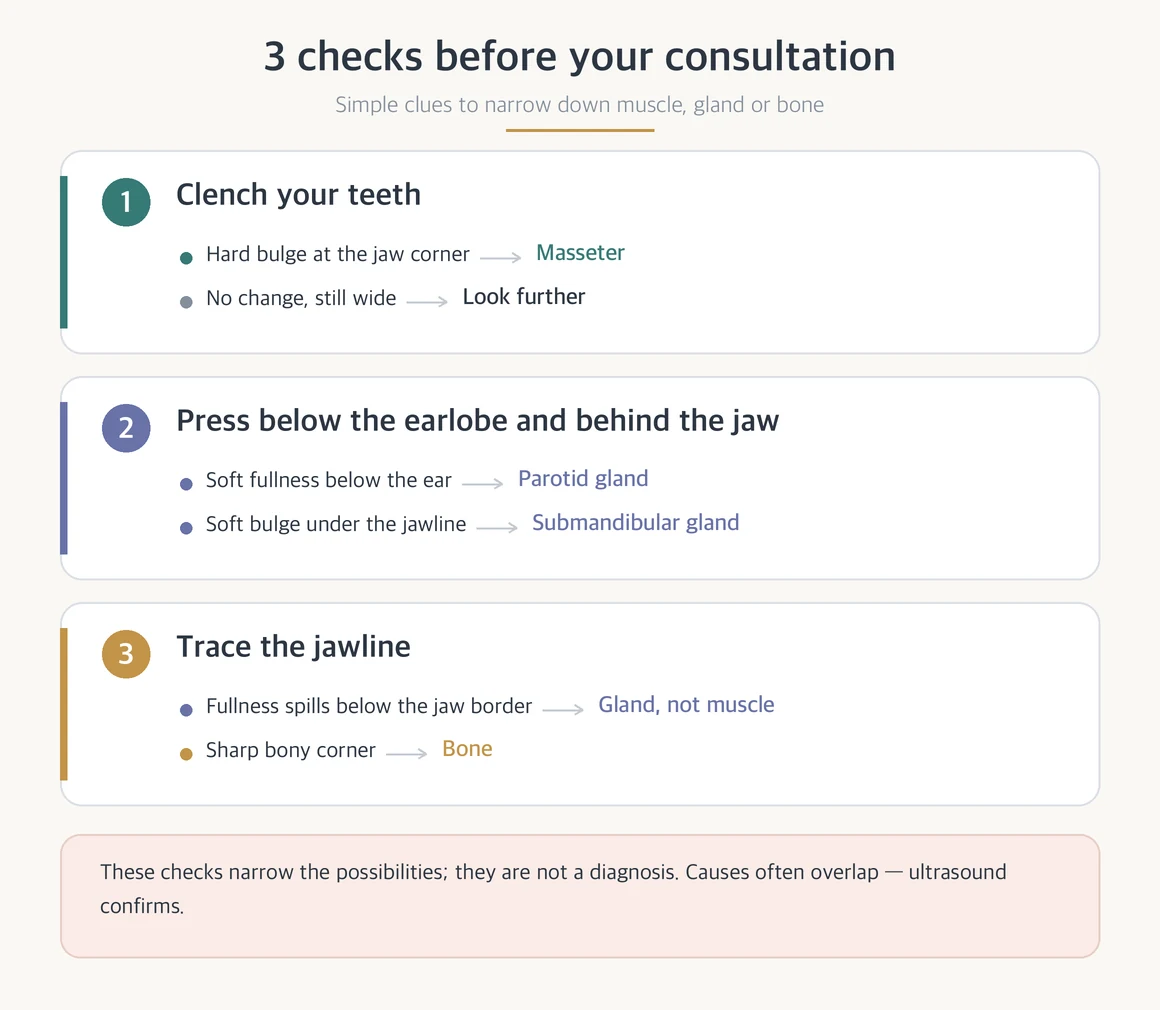
Check 1 — Location: jaw corner vs below the earlobe and behind the jaw
Look at your face straight on, then from a three-quarter angle. Masseter fullness sits on the jaw corner itself and on the flat back part of the jawbone, slightly in front of and below the ear. It gives a squared, boxy outline.
Parotid fullness sits further back. It shows up as a soft bulge just below the earlobe and behind the back edge of the jaw. The dermatology literature describes a prominent parotid as a diffuse swelling behind the back border of the jaw on each side, which can give a “bull neck” look, meaning the line from the ear down to the neck looks thick instead of tapered.
Check 2 — The clench test: does it pop up when you bite down?
Place your fingertips on the jaw corner and clench your back teeth firmly, then relax. Repeat a few times.
If a firm bulge rises under your fingers every time you bite, that is the masseter working. Now move your fingertips back, just below the earlobe and behind the jaw edge, and clench again. If the fullness there stays soft and does not change when you bite, it is much more likely to be gland tissue. The clench test is most useful for the parotid when you combine it with location: a soft fullness toward the back that does not change when you bite is a classic gland pattern.
Check 3 — The jaw-border rule: does the fullness spill below the jawline?
Run a finger along the lower edge of your jaw from the chin back toward the ear. The masseter usually does not extend below the lower border of the jaw, so fullness that spills below the jawline points away from muscle.
Surgeons use exactly this rule to tell an enlarged masseter from an enlarged parotid. If the bulge hangs below and behind the jaw corner, blurring the angle, a gland is the more likely cause. If instead you feel a sharp, hard corner of bone under the muscle, the width may be skeletal.
Here is a quick way to put the checks together:
- If you notice a firm bulge at the jaw corner that pops up when you clench → it points to the masseter muscle.
- If you notice a soft fullness below the earlobe and behind the jaw that does not change when you clench → it points to the parotid gland.
- If you notice a soft bulge under the jawline, closer to the chin side → it points to the submandibular gland.
- If you notice a hard, sharp corner you can feel beneath the muscle → it points to the jaw bone.
- If you notice fullness that mainly folds or sags when you look down → it points to fat or skin laxity.
Other causes that look the same: submandibular gland, jaw bone and fat
The parotid is not the only gland near the jaw. The submandibular gland sits under the jawline, toward the inside of the jaw. It lies deep, wrapped in a firm layer of tissue, with a floor-of-mouth muscle passing through it. When this gland is the main cause of an under-jaw bulge, toxin is one option and surgery is another; we explain the surgical route in our guide to submandibular gland reduction surgery.
If the width comes from the bone of the jaw angle, no injection will change it, because toxin cannot reshape bone. In that case, the conversation shifts to jaw reduction surgery. Fat and early sagging can also blur the jawline; these usually look worse when you tilt your head down and are treated with different approaches altogether.
Why an ultrasound check settles the question
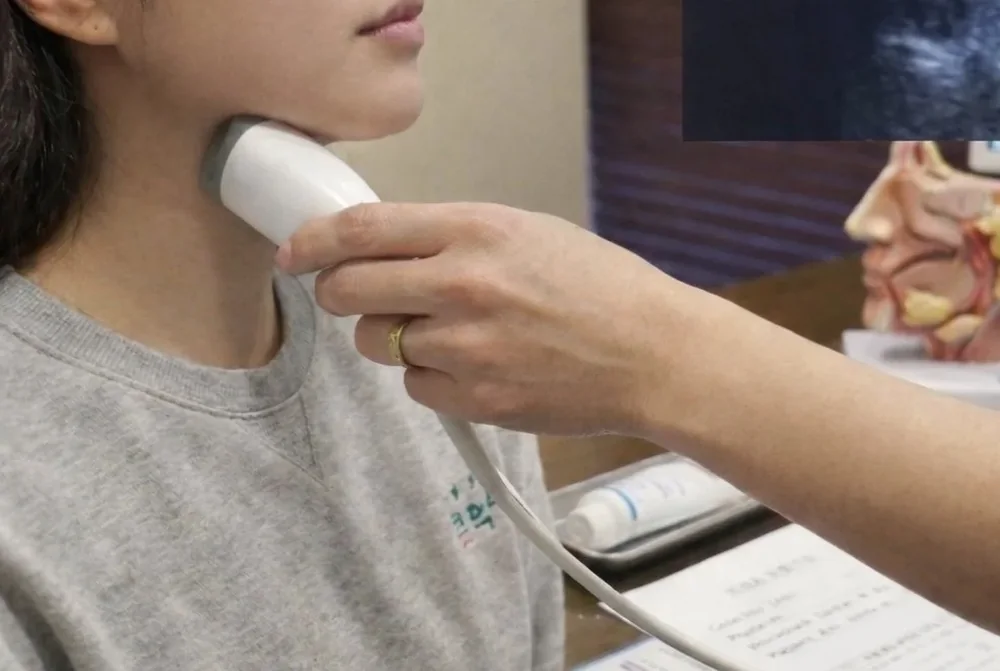
Self-checks are a starting point, not a diagnosis. In practice, two or three causes often overlap: a moderately bulky masseter, a slightly prominent parotid and a little soft tissue fullness, for example. Ultrasound lets the doctor see each layer, measure muscle and gland thickness, and confirm how deep each structure sits. That information decides whether you need masseter treatment, parotid gland botox, both, or something else entirely.
How Parotid Gland Botox Is Done — and Why It Is Often Paired With Masseter Botox
The treatment itself is quick, but planning matters more than speed. The parotid is a gland with an important nerve running through it, so placement and depth are the heart of a safe injection.
Where the injections go: the lower parotid beside the jaw angle
One published protocol places 3 to 4 injection points about 1 cm apart in the lower parotid, beside the jaw angle. In that textbook description, the doctor gently pinches the swollen lower part of the gland just outside and below the jaw corner and injects into it, using a dose similar to that used for masseter treatment (the example given is 20 to 40 units of onabotulinumtoxinA).
These figures are an illustrative example, not a fixed recipe. The number of points and the dose depend on the size of the gland on each side, how much masseter treatment is being done and your previous response to toxin. That is decided after an examination.
Depth matters: the facial nerve and the neck muscle nearby
The facial nerve, which moves the muscles of facial expression, runs through the parotid between its shallow and deep parts. The gland also sits close to the sternocleidomastoid (the neck muscle that turns your head). Published guidance warns that injecting too deep can let the toxin spread toward that neck muscle.
For this reason, parotid gland botox should be placed in the shallow, lower portion of the gland by an experienced injector, ideally with ultrasound guidance to confirm depth. No injection is completely risk-free, but careful mapping keeps the medicine where it is meant to work.
“My face still looks wide after masseter botox”: when the gland shows up
This is one of the most common reasons people look into parotid gland botox. When a bulky masseter shrinks, the tissue that was behind it can become easier to see. The clinical literature notes that a prominent parotid may become more apparent after masseter bulk has been reduced with toxin.
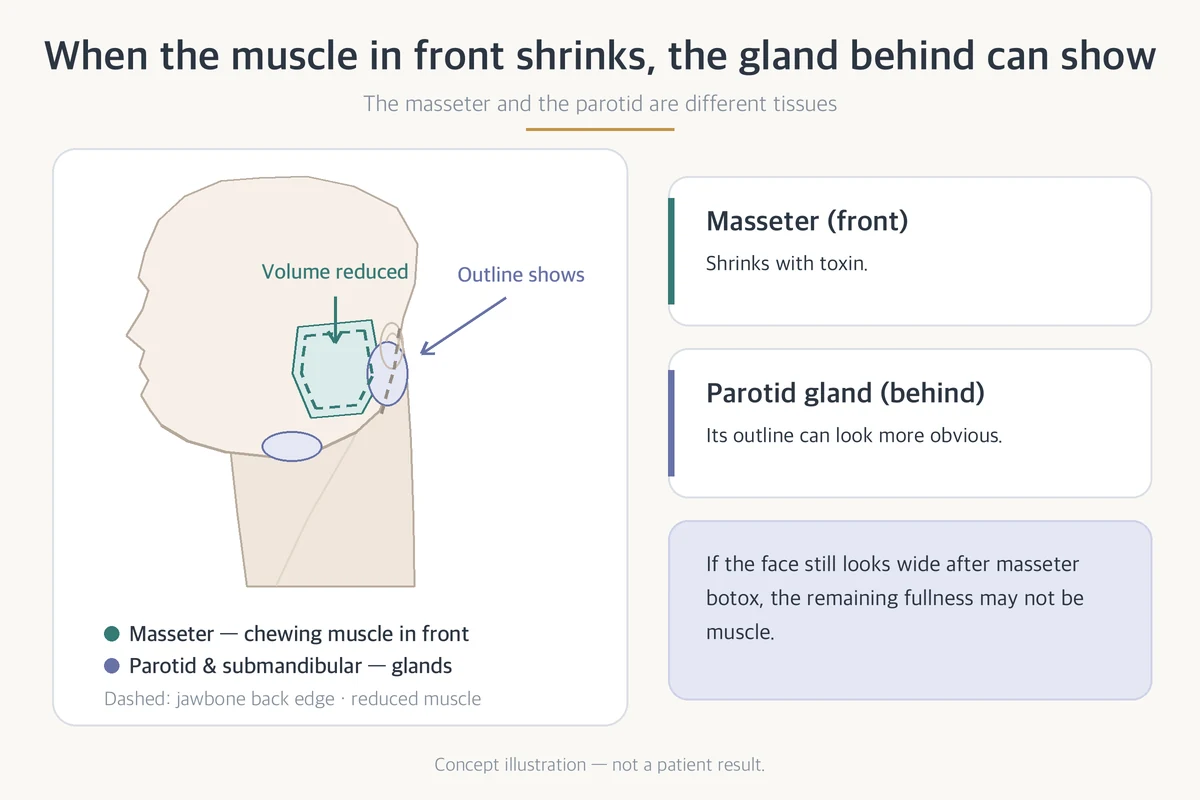
In my clinical experience, patients describe it this way: the jaw corner softens, but the lower face still looks wide or rounded toward the back. It does not mean the first treatment failed. It means the masseter was only part of the picture, and the remaining fullness may be gland tissue, which parotid gland botox is designed to address.
Same day or staged a few weeks later?
Both approaches are described in the clinical literature: parotid injection can be done at the same visit as masseter treatment or a few weeks afterward. Staging has one practical advantage: once the masseter has slimmed, it is easier to judge how much the gland is really contributing. Doing both at once saves a visit when the gland is clearly prominent from the start. Which approach suits you is decided at consultation.
When Will You See Results? Parotid vs Masseter Botox Timeline
Neither treatment works overnight. Both change gradually, and the gland and muscle follow slightly different clocks.
Downtime: what the first few days look like
Most people return to normal activities the same day. You may notice slight redness at the injection points or a small bruise, which usually fades within days. You can typically eat normally, though your doctor may suggest avoiding pressing or massaging the area for the first day so the medicine stays in place.
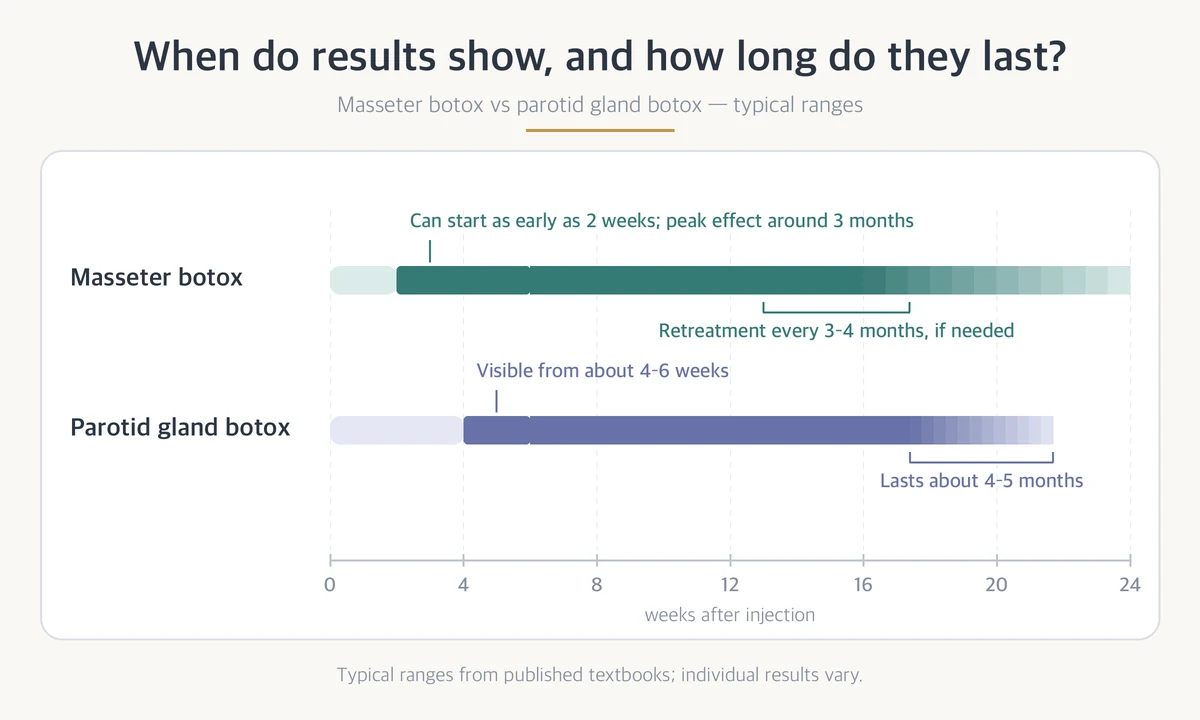
Onset and duration at a glance
Parotid gland botox usually takes 4 to 6 weeks to show results and lasts around 4 to 5 months, based on the experience reported in one aesthetic dermatology textbook.
Masseter results tend to appear sooner: a cosmetic dermatology textbook reports that the effect can be noticed as early as 2 weeks after injection, with the peak effect at around 3 months. One study cited there found that masseter volume reduction was still significant at 24 weeks, while another reported that the face gradually returned toward its original contour by about 6 months.
| Timeline | Masseter botox | Parotid gland botox |
|---|---|---|
| Visible change starts | Can start as early as 2 weeks; peak effect around 3 months | Around 4 to 6 weeks |
| How long it tends to last | Volume reduction still significant at 24 weeks in one study; contour drifted back by about 6 months in another | About 4 to 5 months |
| Typical retreatment interval | Every 3 to 4 months if needed | When fullness returns, often guided by the masseter schedule |
| Source type | Cosmetic dermatology textbook | Aesthetic dermatology textbook |
When to consider a repeat session
Published guidance suggests masseter retreatment every 3 to 4 months if needed. For the gland, a repeat session makes sense when the fullness behind the jaw starts to return. Because glands tend to shrink less than muscle, some people see a subtle rather than dramatic change. If the result feels smaller than you hoped, the next step is a reassessment of the cause, which we discuss in our article on when salivary gland botox is not working.
Safety Notes, and When a Swollen Parotid Is Not a Cosmetic Issue
Botulinum toxin in the lower face has a long track record, but each target has its own considerations. The risks differ because the tissues and their neighbors differ.
What is different about the risks of muscle vs gland injections
For the masseter, the main specific effect is weaker chewing. In one series cited by a cosmetic dermatology textbook, about 44% of patients noticed weaker chewing after masseter botox. For most people this is temporary and noticeable mainly with tough or chewy food.
For the parotid, the key issue is depth: the facial nerve passes through the gland and the head-turning neck muscle sits close by, so accurate placement matters. The submandibular gland lies deep, with the mylohyoid (a floor-of-mouth muscle used in swallowing) passing through it, so careless injection can affect swallowing. Dry mouth, swallowing discomfort, and recovery details are covered in our guide to the side effects of salivary gland botox.
Red flags: when parotid swelling needs a medical check first
Parotid enlargement that is purely a cosmetic concern usually affects both sides, is painless, and develops slowly over years. Swelling that behaves differently should be checked by a doctor before any cosmetic treatment.
When it is not cosmetic — see a doctor first if you notice:
- Swelling on one side only
- Pain, warmth, or fever
- A lump that feels hard or is growing quickly
- Swelling and pain that flare up at mealtimes
- Dry mouth or dry eyes alongside the swelling
These signs can point to parotid gland enlargement from infection, salivary stones, Sjögren’s syndrome (an immune condition that affects saliva and tear glands), or a growth, which need medical evaluation rather than toxin.
Parotid Gland Botox FAQ
Where is the injection site for parotid gland botox?
The injections go into the lower part of the parotid, just outside and below the jaw corner, under the earlobe. One published protocol uses 3 to 4 points about 1 cm apart. Because the facial nerve runs through the gland, depth matters, so ultrasound guidance and an experienced injector are recommended.
Why does my face still look wide after masseter botox?
When the masseter shrinks, a prominent parotid gland behind it can become more visible. The remaining width may also come from the submandibular gland, the jaw bone, or fat. The three checks above (location, clench test, and jaw border) plus an ultrasound examination show which tissue is responsible.
Can you get parotid gland botox and masseter botox on the same day?
Yes. Published guidance describes parotid injection either at the same visit as masseter treatment or a few weeks later. Staging makes it easier to judge the gland once the muscle has slimmed, while same-day treatment suits a clearly prominent gland. Your doctor will recommend one after examining you.
How long does parotid gland botox last?
In the published literature, results start to show at about 4 to 6 weeks and last around 4 to 5 months, though this varies between individuals. For comparison, masseter botox can start to show as early as 2 weeks and is often repeated every 3 to 4 months if needed.
How do I know if my wide jaw is muscle or salivary gland?
Muscle bulges firmly at the jaw corner when you clench. Gland fullness feels soft, sits below the earlobe or under the jawline, does not change when you bite, and may spill below the jaw border. An ultrasound examination confirms it, since causes often overlap.
Not Sure Whether It Is Muscle or Gland? Start With a Diagnosis
A wide lower face is rarely caused by one tissue alone, and treating the wrong one is the most common reason people feel disappointed. At MINE Plastic Surgery & Dermatology in Gangnam, Seoul, Dr. Lee Sung-wook, a board-certified plastic surgeon, starts with an examination and ultrasound to see whether the width comes from the masseter, the parotid, the submandibular gland, bone, or fat, and then explains the options that fit your anatomy.
If the bulge under your jawline turns out to be the main cause, you can read about our surgical option for that area on the page for salivary gland reduction at MINE. To book a consultation, call +82-2-516-1175 or use the consultation form on mineclinic.com.
Written and medically reviewed by Dr. Lee Sung-wook, Board-Certified Plastic Surgeon, MINE Plastic Surgery & Dermatology, Seoul. Last updated: October 7, 2026.
※ This content is for informational purposes only and does not replace professional medical advice, diagnosis, or treatment. Individual results may vary, and side effects may occur. Please consult with a board-certified plastic surgeon for personalized advice.