EN
EN

Table of Contents
Have you had salivary gland Botox but not seen the jawline change you were hoping for? If your salivary gland Botox is not working, you are not alone. Salivary gland Botox is a non-surgical injection treatment that temporarily shrinks enlarged submandibular or parotid glands to slim the lower face — but for a meaningful share of patients, the results are limited or short-lived because of the gland’s unique tissue structure.
In one survey of salivary gland Botox recipients, data suggests roughly 23% did not see a clear effect right after the procedure. That does not mean the treatment “failed.” More often, it reflects individual anatomy and the degree of gland enlargement — and it points to when a different approach, such as a surgical alternative, may make more sense.
Below, Dr. Lee Sung-wook, a board-certified plastic surgeon at MINE Plastic Surgery in Seoul, explains why salivary gland Botox does not always work, what the medical evidence says, and when submandibular gland partial resection becomes the better long-term option.
How Effective Is Salivary Gland Botox — and Why Does It Fail for Some?
To understand why salivary gland botox not working is a common complaint, it helps to know what kind of tissue is actually being treated. The reason it works differently from jaw-slimming Botox comes down to biology.
Salivary glands vs. jaw muscles: a different tissue, different response
Botox is best known for slimming a square jaw by relaxing the masseter (the large chewing muscle). In that case, the muscle shrinks from disuse, and the lower face can lose around 30% of its volume over time.
The salivary gland is a completely different story. It is secretory tissue — a fluid-producing organ, not a muscle. Botox mainly acts at the nerve-to-muscle junction, so when it is injected into a gland it works through a more indirect pathway. The practical result is a smaller change: studies and clinical experience point to roughly 10–15% volume reduction in the gland, compared with about 30% for the jaw muscle. That gap is exactly why some patients feel their salivary gland Botox is “not working” — the ceiling for change is simply lower.

What the research says about volume reduction (10–15% vs. 30%)
There is also an anatomical hurdle. Medical texts on minimally invasive facial procedures note that the submandibular gland sits deep in the neck, wrapped in a layer of deep fascia (the firm connective-tissue sheet that covers and separates muscles). Because the gland is tucked under this cover, an injection cannot always reach and saturate it evenly.
The same literature flags a safety point: the mylohyoid muscle (a thin muscle in the floor of the mouth that helps with swallowing) runs nearby, so the injection must be placed carefully to avoid affecting swallowing. In short, the salivary gland is harder to reach, harder to fully treat, and gives a smaller change than muscle — three reasons a single round of Botox may disappoint. If you want the foundational overview first, see our guide to the effects and side effects of salivary gland Botox.
In clinical practice, salivary glands are secretory tissue — so Botox typically achieves only about 10–15% volume reduction in the gland, compared with roughly 30% in the jaw muscle.
Salivary Gland Botox Not Working Over Time: The Main Reasons
Even patients who respond at first sometimes notice the effect fading faster than expected, or that repeat sessions do less each time. Understanding why salivary gland botox not working is the key to finding the right solution. Several factors explain this pattern.
Anatomical factors: gland size, distribution, and depth
Anatomy accounts for a large share of non-response. When a gland is unusually deep, very large, or diffusely enlarged (spread out rather than concentrated in one spot), injection alone struggles to reach all of it. The deeper and more spread out the tissue, the harder it is for the medication to make a visible difference.
Lifestyle triggers that keep the gland enlarged
Salivary gland enlargement is often driven by daily habits — binge eating, irregular meals, frequent vomiting, and heavy alcohol use can all keep the gland in a stimulated, swollen state. If those triggers continue, they work against the Botox, re-enlarging the tissue almost as fast as the injection can shrink it. Medical literature on salivary gland disorders specifically notes that when enlargement is tied to bulimia-related habits, Botox alone rarely brings full resolution and usually needs to be repeated.
Tolerance buildup with repeated high-dose injections
There is also the issue of diminishing returns. Botulinum toxin in the salivary gland generally takes effect within about two weeks and lasts on average two to three months, which means repeat injections are part of the plan. Over time, however, repeated high-dose sessions can make the body less responsive — the same dose does less, and the benefit shrinks. For some patients, this is the moment the treatment effectively stops working.
Medical literature notes that Botox effects in salivary glands last an average of 2–3 months, and complete, lasting resolution is rarely achieved with repeated injections alone.
What Is Submandibular Gland Partial Resection?
When salivary gland botox not working cases are confirmed after thorough evaluation, surgery offers a more permanent answer. Salivary gland reduction through partial resection removes the enlarged portion of the submandibular gland — a structural fix rather than a temporary one.
Who is a candidate: when surgery becomes the right next step
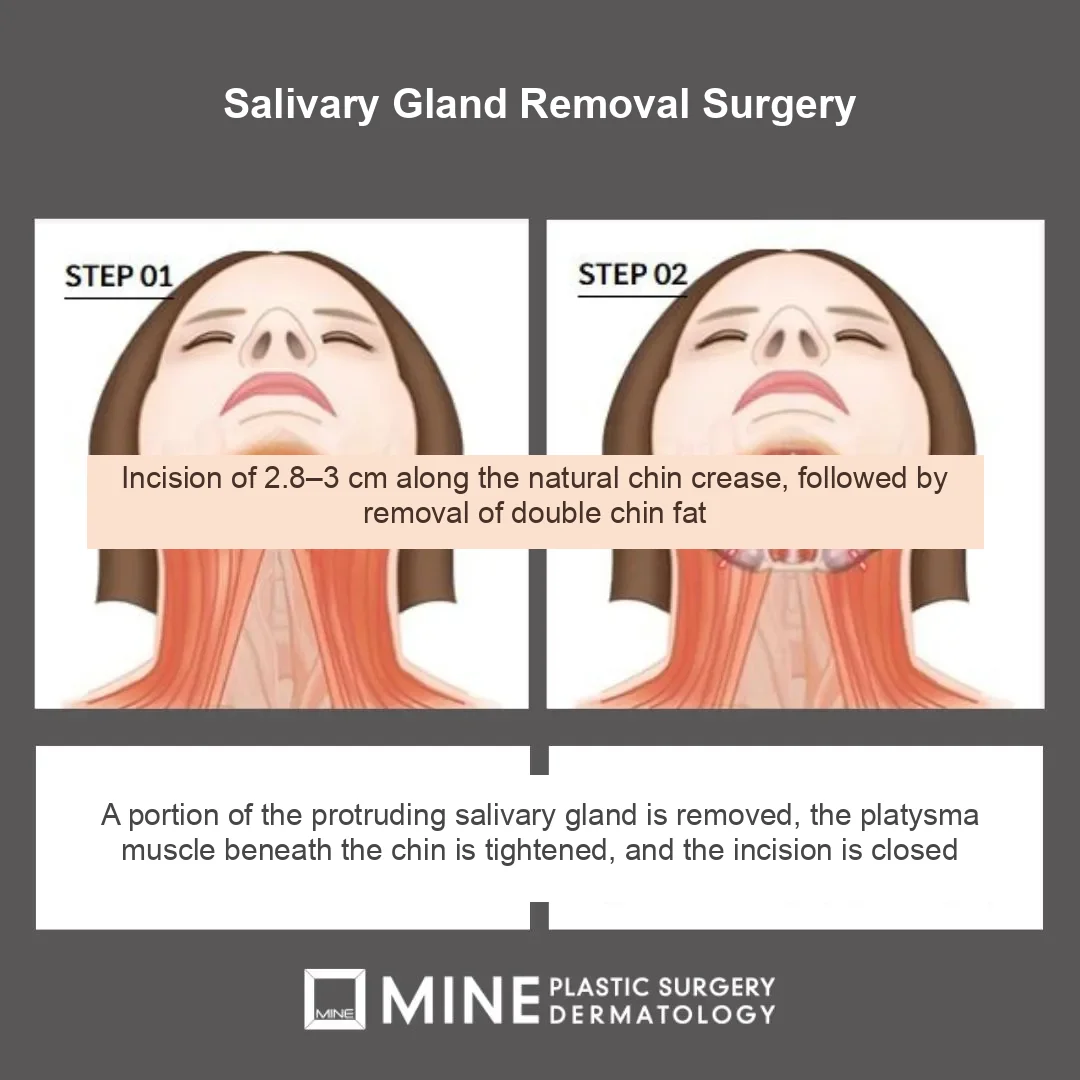
Partial resection is not a first-line treatment. Dr. Lee generally raises it as an option only after a patient has had three or more Botox sessions with limited effect, or when the enlargement is severe enough that injections were never going to be enough on their own. The goal is the opposite of “more is better” — it is to remove only the overgrown part of the gland while leaving healthy tissue in place.
That conservative approach matters for safety. Surgical literature shows that a conservative (partial) resection helps minimize the risk of a salivary collection, and that placing a small dose of botulinum toxin — about 5 units — onto the raw gland surface during surgery further lowers the chance of a salivary fistula (an abnormal leak of saliva) to roughly 2.4% of cases. Because side effects still matter, we always walk patients through the common side effects of submandibular gland reduction before any decision is made.
How the submental (under-chin) approach works
The surgery is done through a small incision of about 2–3 cm placed along the natural crease under the chin, so the scar stays hidden. The enlarged part of the gland is removed, and the result is a genuine structural reduction — not a temporary one. MRI imaging in published work confirms how real this change is: partial removal reduced submandibular gland volume from roughly 7.6 mL to 5.4 mL, a meaningful and lasting reduction that no single Botox session can match.
MRI imaging confirms that partial gland removal reduces submandibular gland volume from approximately 7.6 mL to 5.4 mL — a meaningful structural reduction.
Submental Incision vs. Traditional Facelift Approach: Key Differences
A common question is how this differs from older salivary gland surgery done through a facelift-style incision. The location and size of the scar are the biggest differences.
Scar placement and size comparison
A traditional facelift approach runs from the temple, in front of and around the ear. It gives the surgeon a wide field of view, but it leaves a longer scar in a more visible area. The submental approach instead uses a single 2–3 cm incision tucked into the natural crease under the chin. Because it follows a line that already exists, the scar is far less noticeable — and after about six months it typically settles into a fine line that is hard to spot in daily life.
Recovery timeline and downtime
The under-chin approach is also the same well-established route used for salivary gland surgery overall and for double-chin contouring, which keeps the operation efficient and recovery shorter. Most patients have their sutures removed at about one week and return to normal daily activities soon after, with swelling fully settling over the following few weeks.
How We Protect the Marginal Mandibular Nerve During Surgery
Any surgery near the jawline raises an understandable concern: nerve safety. This is one of the most important parts of the operation, and it is handled with specific, deliberate technique.
Why this nerve matters: lip movement and expression
The marginal mandibular branch of the facial nerve controls movement of the lower lip. If it is injured, the result can be asymmetry of the smile or lower-lip motion — which is exactly why this nerve is treated with such care during any procedure in the submandibular region.
Anatomical safety margins and intraoperative nerve monitoring
The protection strategy is built on a clear anatomical rule: keeping the dissection about 2 cm below the lower border of the jawbone (the mandible) stays clear of the nerve’s usual path. On top of that fixed safety margin, Dr. Lee uses a real-time nerve stimulator during surgery to confirm the nerve’s exact location as he works, which substantially lowers the risk of injury.
Maintaining a dissection boundary 2 cm below the mandible border protects the marginal mandibular nerve, which controls lower lip movement.
Recovery After Submandibular Gland Partial Resection
For patients who moved from salivary gland botox not working to surgical resection, knowing what the first month looks like helps plan around work and social commitments. Recovery is generally straightforward.
Day-by-day recovery: what to expect in the first 4 weeks
- Days 1–3: Mild swelling and bruising are normal. Ice packs help, and a soft-food diet is recommended.
- Week 1: Sutures are removed, and most patients resume their normal daily activities.
- Weeks 2–4: Swelling fully resolves and the final jawline contour becomes visible.
Post-op care instructions and restrictions
For the first two weeks after surgery, it is best to avoid vigorous chewing, very hot foods, alcohol, and smoking, all of which can irritate the healing area. Regular follow-up visits let the team confirm that healing is on track. Most patients return to normal daily activities within one week of submandibular gland partial resection.
Botox vs. Partial Resection: Which Is Right for You?
So how do you choose between the two? The honest answer is that they serve different patients at different stages.
Decision framework: starting with non-surgical options
Botox remains an excellent first-line option: it is non-surgical, recovery is quick, and the effect lasts roughly two to three months. For many people, that is enough — especially when enlargement is mild. Partial resection enters the conversation when salivary gland botox not working patterns have been confirmed over three or more sessions with limited benefit, or when the gland is significantly enlarged and unlikely to respond well to injections alone.
Long-term cost and convenience comparison
It also helps to think in time horizons. Botox means returning every three to six months for maintenance; partial resection is a one-time procedure with a lasting result. Your individual anatomy, lifestyle habits, and the outcome you want all factor into the right choice — which is best decided together with a specialist. For international patients, our salivary gland reduction for double chin in Korea guide covers what to expect when planning treatment abroad.
Frequently Asked Questions
Is surgery safe for salivary gland botox not working patients?
Yes — when performed by an experienced, board-certified surgeon. Complication rates are low; a salivary fistula occurs in roughly 2.4% of cases, and that risk can be reduced further with a small post-resection Botox injection onto the gland surface during the operation.
Will I have trouble swallowing or producing saliva after surgery?
No functional impairment is expected. Because only the enlarged portion of the gland is removed, the remaining submandibular tissue — along with the parotid and sublingual glands — fully compensates for saliva production. Day-to-day swallowing and oral health are not affected.
How visible is the scar after a submental incision?
The incision follows the natural crease under the chin, so it heals discreetly. By about six months after surgery, only a very fine line typically remains, which is usually not noticeable in daily life.
Can salivary gland botox not working patients expect permanent results from surgery?
Recurrence is very unlikely after partial resection. However, if the lifestyle triggers behind the original enlargement — heavy alcohol use, binge eating — continue, the remaining gland tissue can hypertrophy again. Maintaining healthy habits is an important part of keeping the result.
How many sessions before deciding salivary gland botox not working?
As a general guide, if you find salivary gland botox not working after three or more sessions with limited effect, that is the point at which a surgical alternative is worth discussing. Dr. Lee reviews each patient’s anatomy and Botox response history before recommending surgery, so the timeline is always individualized.
Considering Your Next Step?
For patients finding salivary gland botox not working despite multiple sessions, that does not mean you are out of options. A consultation with Dr. Lee Sung-wook can help determine whether submandibular partial resection is the right next step for your anatomy and goals. As a member of the global plastic surgery community (ISAPS), our team prioritizes evidence-based care and patient safety.
Contact MINE Plastic Surgery & Dermatology for a personalized evaluation. International patients are welcome to reach out via online consultation or KakaoTalk to discuss your case before traveling. MINE Plastic Surgery | 813 Nonhyeon-ro, Gangnam-gu, Seoul, Korea | +82-2-516-1175
Written and medically reviewed by Dr. Lee Sung-wook, board-certified plastic surgeon, MINE Plastic Surgery & Dermatology, Seoul.
※ This content is for informational purposes only and does not replace professional medical advice, diagnosis, or treatment. Individual results may vary, and side effects may occur. Please consult with a board-certified plastic surgeon for personalized advice.