EN



Re2O results are the gradual changes in pores, firmness, texture and hydration that appear after Re2O (Elravie Re2O), a skin booster that injects human-derived extracellular matrix (ECM) into the dermis. Skin may feel smoother within days, visible change usually starts around weeks 1–2, and it keeps building over 2–3 months.
Many people come to my consultation room after trying serum after serum: pores look larger, tone looks flat, makeup sits on top of the skin, and it still feels tight underneath. In most of these cases the problem is not what goes on the surface. The foundation under the surface has thinned.
I’m Dr. Lee Sung-wook, a board-certified plastic surgeon at MINE Plastic Surgery & Dermatology in Seoul. In this guide I’ll explain what Re2O results look like for each common skin concern, what happens week by week, and how to maintain the change once your first course is complete.
Table of Contents
Table of Contents
What Is Re2O, and Why Do Its Results Build Gradually?
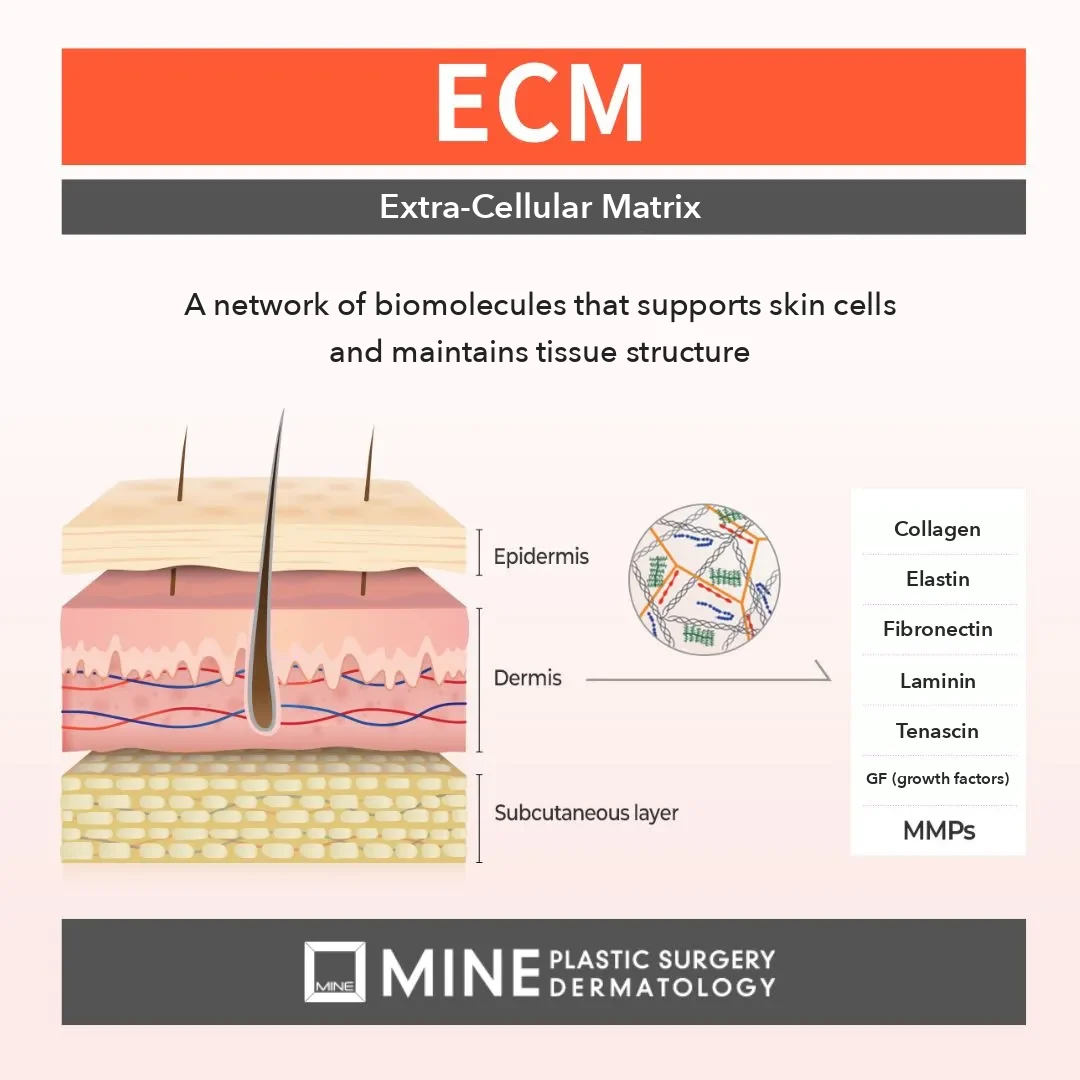
Re2O is an injectable skin booster that places micro-particles of human-derived ECM into the dermis, the thick supportive layer of skin beneath the surface. Instead of adding one ingredient, it supplies the skin’s own support structure in close to its natural form, which is why its effect builds over weeks rather than appearing overnight.
Human-derived ECM, not a single ingredient
Re2O is made from hADM (human acellular dermal matrix). That means donated human dermis from which the cells and fat have been removed, leaving only the protein framework behind. Earlier skin boosters typically used one main material, such as synthetic hyaluronic acid (HA), polynucleotides (PDRN, a DNA-derived repair ingredient) or porcine collagen.
The ECM itself is a mix of collagen, elastin, proteoglycans (water-holding proteins) and hyaluronic acid. Medical textbooks describe ECM as far more than filling material: it supports cells, gives them a surface to migrate along and settle on, and even passes signals between cells that influence how they grow and attach. Put simply, it is the skin’s framework and its communication network at the same time.
Acellular dermal matrix is not a new material in medicine. Reconstructive surgery textbooks describe sheets of it being used as grafts in burn care and breast reconstruction. Re2O uses it in a very different form, as fine particles injected into the dermis, so that surgical history tells us about the material itself rather than proving injection outcomes. If you’d like a deeper look at Re2O, which is sometimes written RE20, I’ve written separately about how the RE20 collagen booster works on aging skin.
A scaffold, not a replacement: why results take weeks
The injected ECM does not simply become new skin. I explain it to patients with a building analogy: Re2O is less like swapping out a wall and more like putting up scaffolding so the wall can be rebuilt. Your own fibroblasts (the cells that make collagen) use that scaffold to settle in and produce fresh collagen, and that process takes time.
This also explains why Re2O results look different from person to person. Cosmetic dermatology textbooks list the loss of dermal ECM proteins, together with thinning of the outer skin and slower cell renewal, as a core part of skin aging. How much rebuilding is possible depends on your starting skin thickness, the degree of laxity and how quickly your skin is aging.
For readers comparing options, it helps to see where Re2O sits among the main types of skin boosters, since each one works on a different part of the skin.
Re2O Results by Skin Concern
Re2O is not designed to erase one wrinkle. It works on the condition of the skin as a whole, so the Re2O results people notice depend on what was bothering them in the first place. These are the concerns I see most often in consultations.
Enlarged pores and rough texture
With Re2O, pores usually look less noticeable because the dermis around them becomes fuller, not because the openings themselves shrink. As dermal collagen declines with age, the skin around each pore loses support, so pores look wider and texture feels rougher. Re2O adds ECM to that thinned dermis from the inside. How far pores and texture change depends on your skin thickness and the type of pores you have, and we discuss realistic expectations before treatment.
Loss of firmness and fine lines
Fine lines caused by thinning skin respond differently from expression lines, because they come from reduced ECM rather than muscle movement. Collagen, elastin and the rest of the ECM decline slowly with age, and many people start to notice laxity and fine lines in their 30s and 40s. Re2O approaches this by encouraging the skin to make its own collagen.
Dermatology textbooks point out that components such as elastin are hard to replace by simply adding them from outside, so stimulating the skin to produce them itself is the more practical route. Botox, by contrast, relaxes the muscles behind expression lines, and fillers restore lost volume. These are different goals, and the degree of change in firmness still depends on how much sagging and thinning is present.
Dull tone and dehydrated skin
For tone and dehydration, Re2O results are usually noticed within 1–2 weeks. When the skin barrier weakens and the dermis holds less water, skin looks dull and makeup sits on top of it. Re2O contains hyaluronic acid and GAGs (glycosaminoglycans, sugar-based molecules that bind water), which help restore the water-holding environment of the dermis. Patients often tell me the tight, dry feeling underneath has eased by around day 3, though timing varies a lot.
Acne scars
Re2O can be considered for acne scars where the dermis has become thin or depressed. Scar research describes ECM as the scaffold that cells settle on during wound healing so that new tissue can form, and the approach to scars follows the same principle. For deeper scars, Re2O results are often better when it is combined with a laser treatment. If you’re not sure which kind of scar you have, this overview of the types of acne scars and how they are treated is a useful starting point.
When another treatment is a better fit
Re2O is not the right answer for every concern. If you want immediate volume, filler is usually more suitable. Deep expression lines respond better to Botox, and significant sagging often needs a lifting procedure such as HIFU. In consultation I first check skin thickness and the degree of laxity, then decide whether Re2O should lead, follow another treatment, or be skipped.
What Happens During a Re2O Session
A Re2O session is typically about 20–30 minutes of injection after 20–30 minutes of numbing cream, and most people return to normal activities the same day. Here is how the visit usually runs at MINE.
Consultation and skin assessment
Every Re2O treatment at MINE begins with a one-to-one consultation with me. I assess skin condition, thickness, pore size and firmness, then decide the amount, injection depth and focus areas. I always check three things:
- How quickly the skin springs back after a gentle press
- Whether enlarged pores sit mainly on the cheeks or around the nose
- Whether you’ve had other injections or laser treatment in the last 6 months
Two people of the same age can have very different dermal thickness, so the dose and depth change accordingly. We also take photos under the same lighting and angle at every session, so your Re2O results can be compared fairly after the third treatment.
Numbing and injection
- Numbing: A numbing cream is applied and left for 20–30 minutes to keep discomfort low.
- Cleansing and marking: The area is disinfected and the injection points are marked.
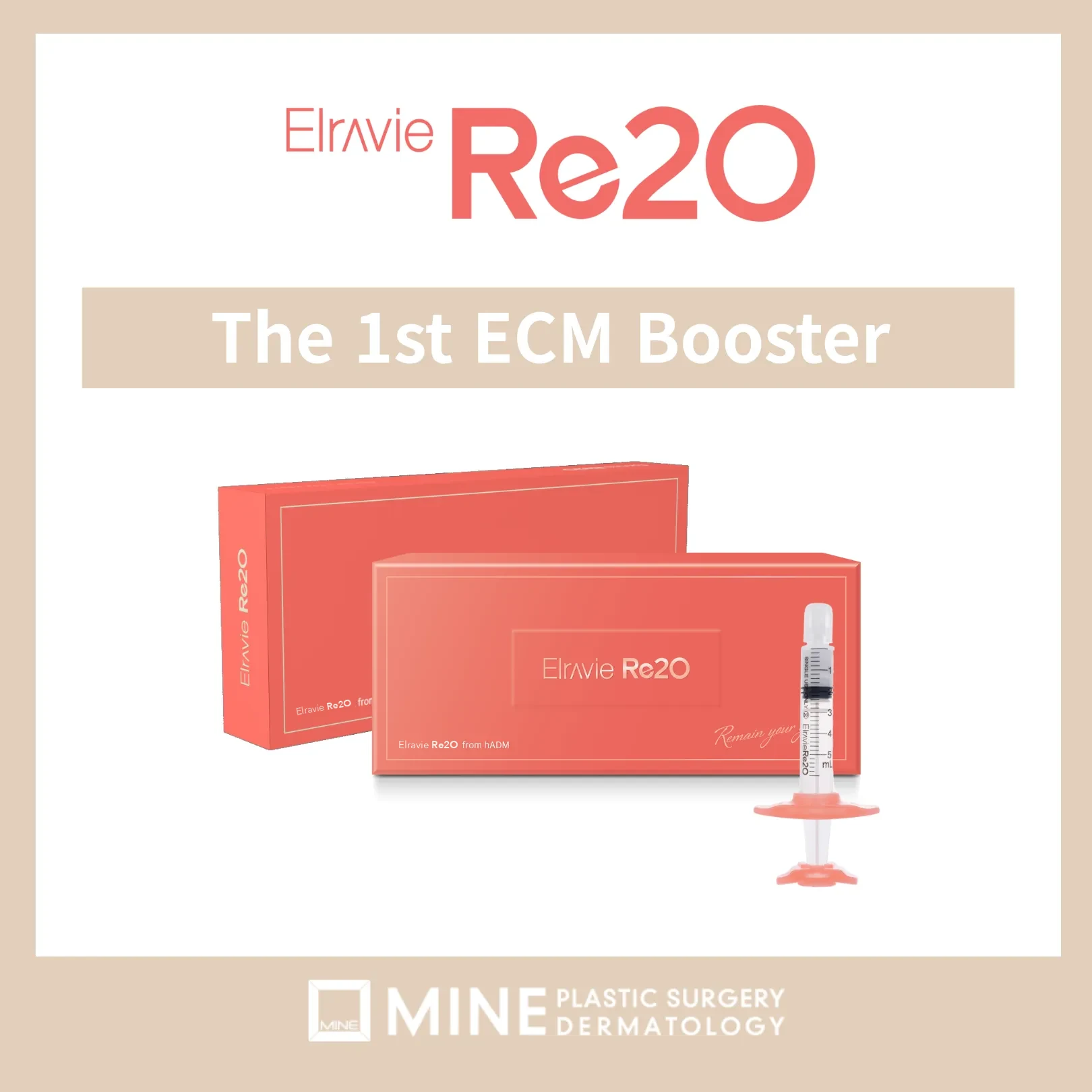
- ECM injection: Re2O is placed in the dermis with a fine needle or a cannula (a blunt-tipped tube). Injection takes about 20–30 minutes depending on the area.
- Calming: Small raised bumps (often called embossing) can appear right after injection, so the skin is soothed with light massage and cooling.
Depth matters as much as the product. Research on dermal fibroblasts describes 2 subtypes, superficial (papillary) and deep (reticular), and reports that they remodel a collagen matrix differently. That is why I adjust depth area by area rather than injecting everything at one level.
How many sessions you need
Re2O is typically planned as 3 sessions spaced 3–4 weeks apart. Some people notice a change after one session, but the course of 3 is what I usually recommend. For international patients, the schedule can be planned around your stay in Seoul during consultation, so tell us your travel dates early.
Re2O Results Timeline: Day 1 to Month 3
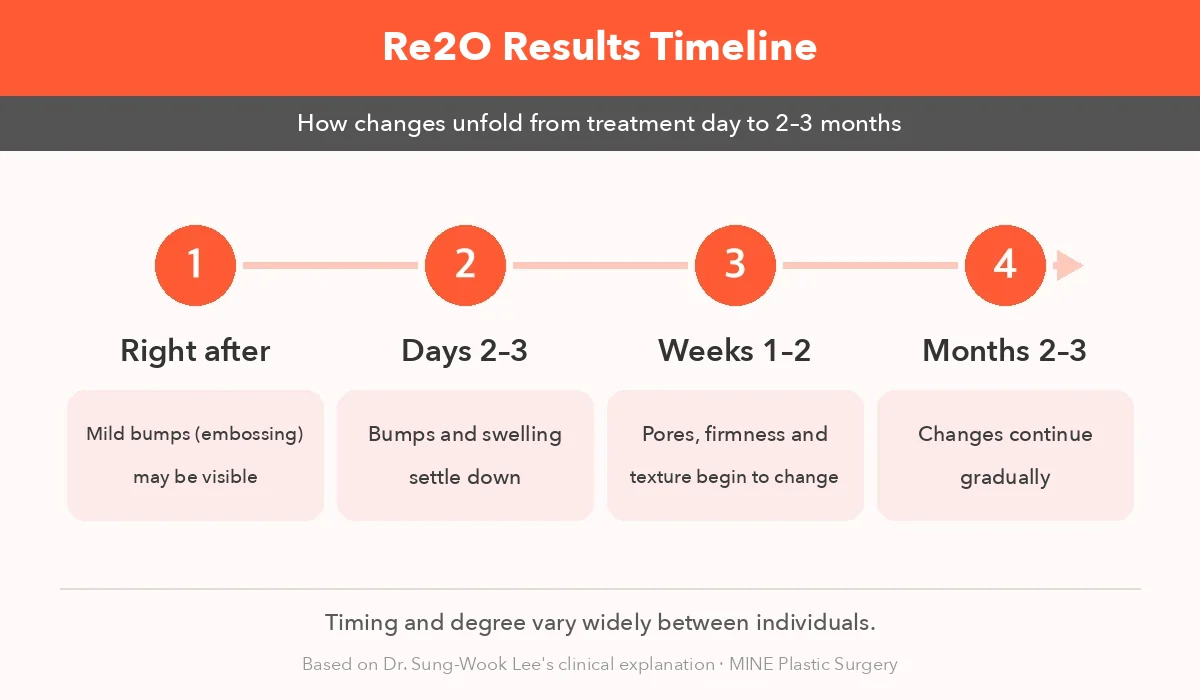
Re2O results appear in stages: bumps and swelling usually settle within 2–3 days, and pore, firmness and texture changes begin around weeks 1–2, then continue gradually over 2–3 months. The table below summarizes what most patients notice. Individual timing and degree vary widely.
| Time after treatment | What you may notice | What to do |
|---|---|---|
| Right after | Smoother, more hydrated feel; small bumps (embossing) are possible | Leave the area alone; wash after 3 hours |
| Days 2–3 | Bumps and swelling settle; tight, dry feeling eases around day 3 | Makeup from the next day; avoid heat |
| Weeks 1–2 | Changes in pores, firmness and texture begin | No scrubs or peels for the first week |
| Months 2–3 | Change continues gradually as new collagen forms | Complete the 3-session course; daily SPF |
Right after treatment
As the injected material settles into the dermis, the skin may already feel smoother and more hydrated. Small raised bumps at the injection points are common at this stage. This is not the final result; it simply shows where the product was placed.
Days 2–3
Bumps and swelling usually settle within 2–3 days. Around day 3, many patients mention that the skin feels less tight and that the barrier seems calmer.
Weeks 1–2
This is when visible Re2O results usually start: pores look less prominent, the skin feels firmer and texture becomes more even. The injected ECM is working as a scaffold, and fibroblasts in the dermis are being prompted to make collagen again.
Months 2–3
Change continues slowly over 2–3 months, especially across a 3-session course. How far density, pores and firmness improve depends on your original skin thickness and condition. Judging Re2O results too early, before this window, leads to a lot of unnecessary worry.
Aftercare in the first week
- Daily life: Most people return to normal activities the same day.
- Washing and makeup: Wash your face from 3 hours after treatment and wear makeup from the next day.
- Heat: Avoid saunas and very hot environments for 3–7 days.
- Alcohol and smoking: Avoid both for at least 3 days to 1 week.
- Scrubs and peels: Skip exfoliation and other irritating care for 1 week.
Precautions to Know Before Treatment
Like every medical procedure, Re2O carries some risk. Careful technique and aftercare lower that risk, but no one can promise it is zero. In consultation I review your skin condition, your history of allergies and any medications you take before deciding whether Re2O is suitable.
Because the material is human-derived, patients often ask whether they’re receiving “someone else’s tissue.” The material is protein framework from donated dermis, with cells and fat removed through a purification process the manufacturer calls AlloClean Technology. In Korea it is approved as a human tissue graft by Korea’s Ministry of Food and Drug Safety (MFDS) and regulated under the country’s Human Tissue Safety Act rather than as a medical device.
Reactions still differ between individuals, so please tell us about any allergies or prior reactions to injections. Temporary bumps and the short recovery course are covered in the timeline above.
How to Maintain Your Re2O Results
After the first 3 sessions, results are re-evaluated at 2–3 months and then maintained, typically every 6 months or 1–2 times a year. How long Re2O results last differs between individuals, so I set the schedule from your skin rather than a fixed formula.
Maintenance sessions
Dermatology textbooks describe the dermal ECM as a dynamic structure that is constantly broken down and rebuilt, with the enzyme MMP-1 breaking down type I and type III collagen. Aging medicine texts add that aging skin cells produce more of these ECM-degrading proteins. That is why, in my practice, the 3-session course is followed by maintenance roughly every 6–12 months rather than treated as a one-off.
I don’t book patients for a full year straight after their third session. Checking the skin again 2–3 months later and then deciding the interval fits real skin far better than a plan made in advance.
Planning Re2O with other treatments
Depending on your goals, Re2O can be planned alongside other treatments. My rule is simple: I combine treatments when they work on different layers or do different jobs.
- Rejuran: Rejuran supports repair of damaged cells, while Re2O provides the scaffold those cells build on. I usually separate them into different sessions.
- Juvelook: This PDLLA collagen booster stimulates collagen gradually, so I prefer to space it a few weeks apart from Re2O rather than inject both on the same day.
- Laser toning or fractional laser: Surface pigmentation and fine texture can be handled by laser while Re2O works on the deeper dermis.
- HIFU lifting: HIFU addresses sagging, while Re2O addresses the quality of the skin itself.
Order and spacing matter, so they are decided in consultation. For more detail on sequencing, see my notes on combining skin boosters such as Rejuran and Juvelook.
Home care that supports collagen
- Moisturize consistently: Serums or creams with hyaluronic acid help the skin while new collagen forms.
- Use sunscreen every day: Choose SPF 30 or higher. UV light breaks down collagen, so daily protection helps preserve your Re2O results.
- Support recovery from within: Good sleep, a balanced diet with enough protein and vitamin C, no smoking and moderate alcohol all support collagen production.
- Keep irritation low: Avoid scrubs, peels and exfoliation for the first week.
Frequently Asked Questions About Re2O Results
When will I see Re2O results?
Skin often feels smoother and more hydrated right after treatment, and the barrier tends to feel calmer around day 3. Visible changes in pores, firmness and texture usually begin around weeks 1–2 and continue gradually over 2–3 months. Timing varies considerably between people.
How long do Re2O results last?
There is no single number, because the dermal ECM is constantly broken down and rebuilt and everyone ages at a different pace. After 3 sessions, I re-evaluate the skin at 2–3 months and then usually suggest maintenance every 6 months or 1–2 times a year.
How many Re2O sessions do I need?
The usual plan is 3 sessions spaced 3–4 weeks apart. Some people notice a change after the first session, but the full course gives the scaffold time to work. The plan is adjusted to your skin condition and, for international patients, your travel schedule.
Does Re2O treatment hurt?
Because numbing cream is applied for 20–30 minutes first, most people find it very tolerable. It feels similar to other skin booster injections, with a brief sting as the needle goes in. If you’re sensitive to pain, you can ask about using a cannula (blunt-tipped tube).
What age can you start Re2O?
Skin condition matters more than age. Some people start in their late 20s or 30s with prevention in mind, while people in their 40s and 50s often focus on firmness and pores, and those over 60 on skin thickness and wrinkles. The decision is best made after a specialist examines your skin.
What should I do if I notice a small lump after Re2O?
A small lump can sometimes be felt where the product was placed too shallowly or gathered in one spot, and most soften and fade over time. Don’t press or massage it yourself. If it persists, contact the clinic that treated you so it can be examined and managed properly.
Planning Your Re2O Treatment in Seoul
At the end of each consultation I leave patients with three points. First, Re2O results depend on your concern: pores, firmness, tone and scars each respond in their own way and to a different degree. Second, change is visible from weeks 1–2, not on the day of treatment, and it builds over 2–3 months across 3 sessions spaced 3–4 weeks apart. Third, maintenance is planned after a check-up at 2–3 months, not booked in advance. Knowing these three things makes the waiting period much easier.

At MINE, we plan Re2O around your skin type, thickness and goals, including the order and spacing with other skin boosters or lasers. You can read more about Elravie Re2O treatment at MINE, or contact us through our online consultation form or by phone at +82-2-516-1175 (813 Nonhyeon-ro, Gangnam-gu, Seoul). Tell us your main skin concern, the treatments you’ve had before and your travel dates, and we’ll suggest a realistic plan.
Written and medically reviewed by: Dr. Lee Sung-wook, Board-Certified Plastic Surgeon, Representative Director of MINE Plastic Surgery & Dermatology
※ This content is for informational purposes only and does not replace professional medical advice, diagnosis, or treatment. Individual results may vary, and side effects may occur. Please consult with a board-certified plastic surgeon for personalized advice.