EN
EN


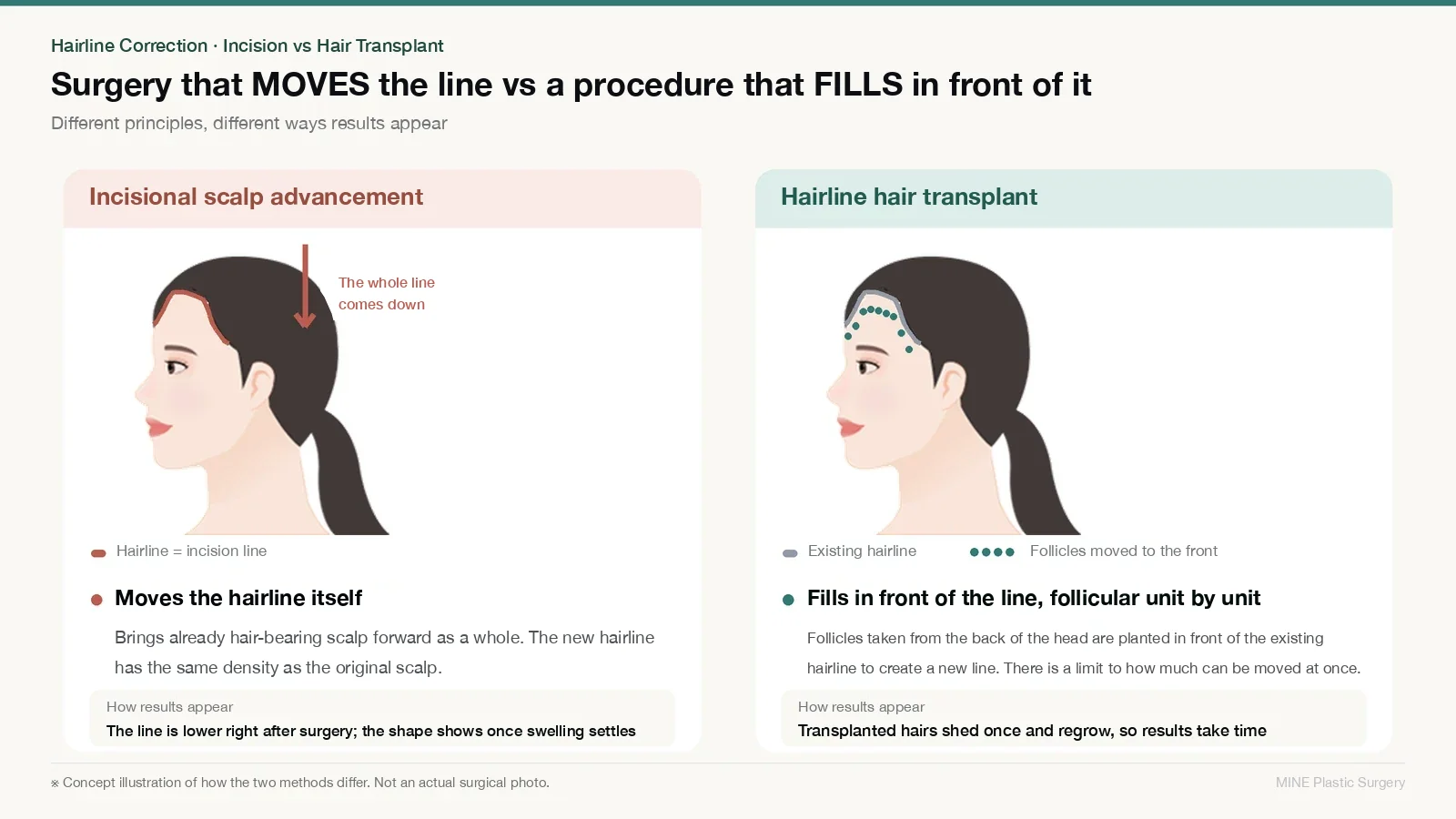
Hairline lowering vs hair transplant is a choice between two different fixes: hairline lowering surgery moves the whole hairline down by advancing the scalp, while a hair transplant fills in front of or along the existing line with follicles taken from the back of the head. Which one fits depends on why your forehead looks big in the first place, and there are three common causes.
Do you still reach for bangs before every photo? Most people with a large-looking forehead start by researching hair transplants. In my consultation room, though, the forehead usually turns out to look big for one of three reasons: a hairline that was set high from birth, a hairline that has receded with hair loss, or brows and forehead shape that make a normal hairline look high. The right answer is different for each.
“Should I get a hair transplant or a forehead reduction?” is a question I hear almost every week. So rather than treating hairline lowering vs hair transplant as a simple product comparison, this article walks through three things in order: how to sort out the cause, how the incision site decides which way the hairline moves, and why your scalp’s flexibility sets how far it can come down. If you are weighing your overall facial proportions, you may also want to look at our facial contouring procedures.
- Hairline Lowering vs Hair Transplant Starts With One Question: Why Does Your Forehead Look Big?
- Coronal vs Hairline Incision: Where the Cut Goes Decides Which Way the Hairline Moves
- How Far Can a Hairline Be Lowered? Scalp Laxity Sets the Limit
- When a Hair Transplant Is the Better Fit — and Where It Falls Short
- Choosing by Cause: Hairline Lowering, a Hair Transplant, or Both?
- What I Check in the Consultation Room Before Recommending Either
- Hairline Lowering vs Hair Transplant: Frequently Asked Questions
- Your Next Step: An In-Person Scalp and Hairline Assessment
Hairline Lowering vs Hair Transplant Starts With One Question: Why Does Your Forehead Look Big?
Two people can say the same thing — “my forehead is too big” — and have completely different problems. The real question in hairline lowering vs hair transplant is where the problem sits: in the height of the hairline, in the hair itself, or in the brows below it.
As a reference point, we often look at the face in thirds (forehead, nose, lower face) and use a length ratio of roughly 1:1:0.8 as a starting point for discussion. It is not a rule. A forehead height that looks comfortable depends on your face shape and how you style your hair.
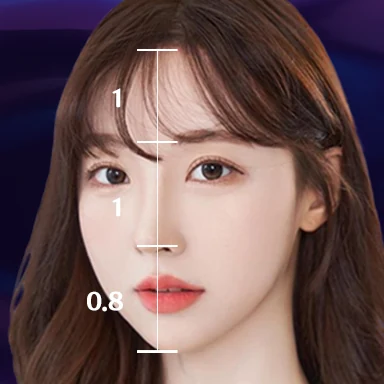
A Naturally High Hairline
Here the hair along the front is full and healthy, but the vertical distance from the brows to the hairline is simply long, and it has always been that way. Because hair density is not the issue, the conversation usually turns to moving the whole line down with a hairline incision.
A Hairline That Has Receded From Hair Loss
Your forehead did not use to look this big, but the corners have been deepening into an M shape or the front has been thinning. In this case the problem is less about height and more about density and shape. Hair loss may also keep progressing, so a hair transplant and medical hair-loss treatment come into the discussion first.
When the Brows or Forehead Shape Are the Real Cause
Low-sitting brows, a flat forehead, or one that bulges forward can all make a forehead look tall even when the hairline is at an ordinary height. In that situation the hairline may not be the problem at all, so I check brow position and forehead contour before talking about lowering anything. If your brows have dropped over time, here is a closer look at when a drooping brow calls for a forehead lift.
A 4-Step Mirror Check Before Your Consultation
You can get a rough sense of your own cause at home. It is not a diagnosis, but it shows where you are likely to land in the hairline lowering vs hair transplant decision.
- Compare old photos — Put a photo from your late teens next to a recent one. Has the hairline stayed in the same place, or has it moved back?
- Sweep your bangs back — Look at the hairs right along the edge. Are they thick and dense, or fine and sparse?
- Check the temple corners — Are the corners on both sides deeply recessed into an M shape?
- Gently lift your brows with your fingers — If your whole forehead looks noticeably different, brow position needs to be part of the assessment.
Dr. Lee’s Key Point: “My forehead is too big” can mean a height problem, a density problem, or a brow problem — and each one has a different answer.
Coronal vs Hairline Incision: Where the Cut Goes Decides Which Way the Hairline Moves
Online, every description of forehead-shortening surgery seems to say the same thing: “an incision is made in the scalp.” This is the detail most hairline lowering vs hair transplant comparisons skip: depending on where the incision goes, the hairline either rises or comes down.
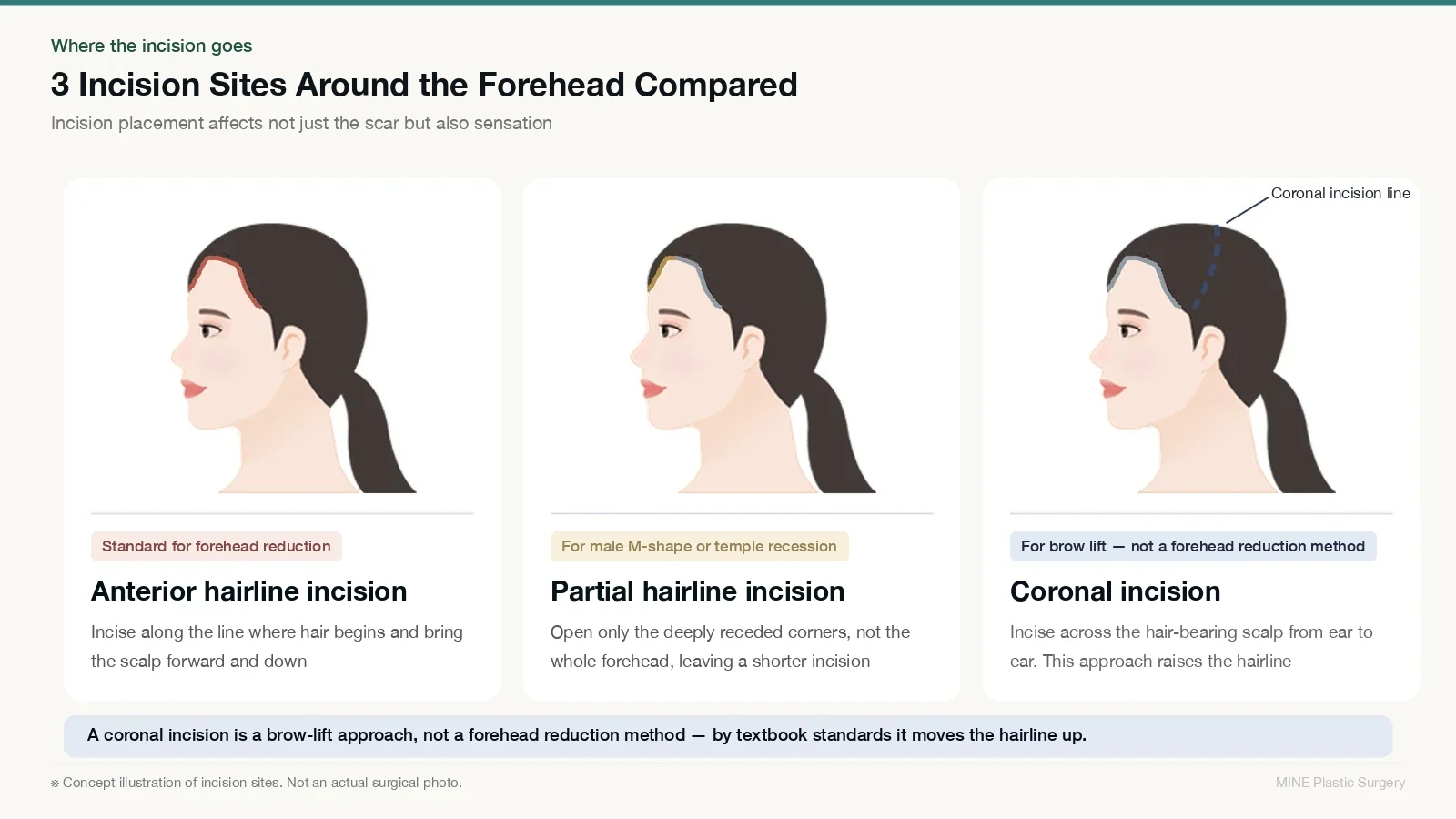
Coronal Incision: Built to Lift the Brows
A coronal incision runs across the hair-bearing scalp from just above one ear to just above the other. It is the classic approach for forehead (brow) lift surgery, which pulls drooping brows and forehead skin upward — the opposite of what you want if your goal is a shorter forehead.
Plastic surgery textbooks describe a coronal lift as removing about 1–3 cm of scalp at the sides, with little or none removed in the center, and they note that the front hairline inevitably rises as a result. The same textbooks list a long scar, possible lasting scalp numbness, and disturbed hair follicles among its drawbacks. That is why they advise using it cautiously, or not at all, in people who already have a high hairline, fine hair, or a tendency toward hair loss.
Hairline Incision Advancement: Built to Lower the Hairline
With hairline incision advancement, the incision follows the front edge of the hairline. A strip of forehead skin is removed, the scalp behind it is freed up, and the scalp is then brought forward and fixed in its new, lower position. Textbooks present this anterior hairline approach as the one used to bring an overly high hairline down.
Put simply: both are scalp incisions, but a coronal incision raises the hairline while a hairline incision can lower it. That is why the first thing to ask about any forehead-shortening plan is where the cut will be.
| Coronal incision | Hairline incision advancement | |
|---|---|---|
| Incision site | Inside the hair, ear to ear | Along the front edge of the hairline |
| Which way the hairline moves | Up | Can be brought down |
| Typical concern it suits | Drooping brows and forehead | A naturally high hairline, a tall forehead |
| Structural trade-offs | Long scar hidden in the hair; scalp may feel numb | Scar along the hairline; numbness may be greater than with a coronal incision because sensory nerves are cut closer to their source |
Textbooks also point out that when the incision goes through the full thickness of the scalp at the hairline, the sensory nerves running back over the scalp are cut nearer to where they start. That is why scalp numbness behind the incision can be more noticeable than after a coronal approach. How much feeling returns varies from person to person.
Beveled Incision: Protecting Follicles at the Scar Line
For most people considering a hairline incision, the scar is the biggest worry. To address it, the blade is angled to follow the direction your hair grows, so the follicles (hair roots) along the edge of the incision are preserved as much as possible.
Hair growing from those surviving follicles can then come up through and in front of the scar, helping to soften the line. To be clear, this does not make the scar disappear. How visible it ends up depends on your skin, your hair, and how you heal.
Dr. Lee’s Key Point: If you want a shorter forehead, where the incision goes decides whether the hairline moves down or up.
How Far Can a Hairline Be Lowered? Scalp Laxity Sets the Limit
“How many centimeters can you bring it down?” is the question I am asked most in hairline consultations, and the answer often settles the hairline lowering vs hair transplant question. Honestly, a photo cannot answer it. I need to feel your scalp.
It’s the Scalp That Moves, Not the Forehead You Remove
Most people assume the limit is how much forehead skin can be cut away. In practice, the limit is on the other side of the incision. Whatever forehead skin is removed, the scalp behind it must slide forward far enough to close the wound without strain.
If your scalp is soft and moves easily, there is more room to work with. If it is tight and barely shifts, there is less. When I push your scalp forward and pull it back during a consultation, this is exactly what I am checking: scalp laxity, or how freely your scalp moves over the skull.
What Dissection and Galeal Release Can Add — and Their Limits
The textbook approach is to free the scalp widely, often back past the crown, and then make small releasing cuts in the galea (the tough, fibrous sheet lying just under the scalp skin). These cuts let the scalp stretch forward a little further. The advanced scalp is then anchored to the bone so it holds its new position.
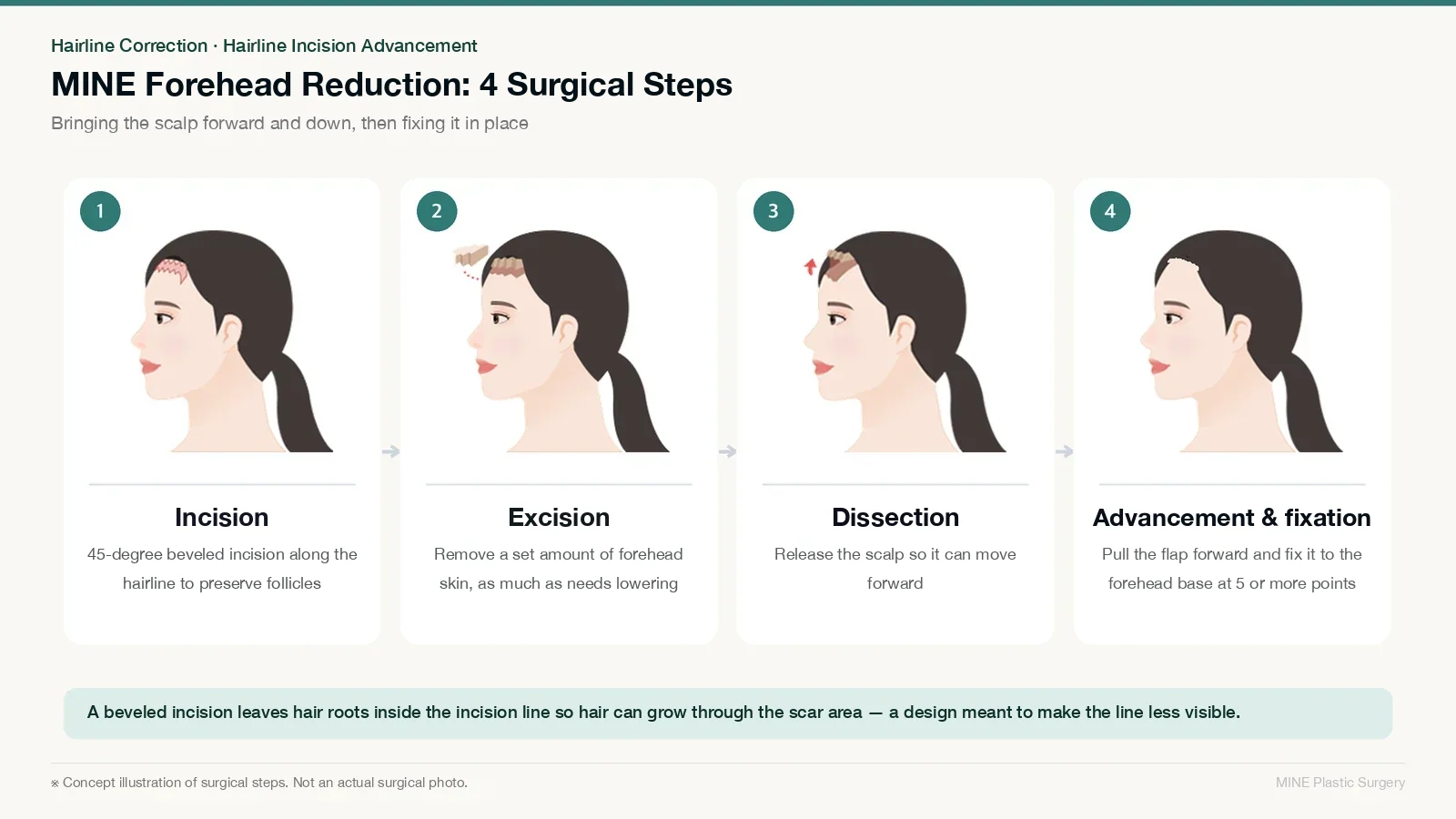
There are limits to how much this adds. Surgical textbooks recommend spacing galeal scoring cuts no closer than about 1 cm apart, because cutting too densely can compromise the scalp’s blood supply. Too much tension can also widen the scar or stress the hair around it. So the rule in hairline lowering is not “the lower, the better” but “as much as your scalp allows.”
There is a useful benchmark. In a 2025 study of 650 patients, the average forehead reduction removed 2.29 cm — about 28% of forehead length (de Azevedo Marques et al., Aesthetic Plastic Surgery 2025 (650 cases)). That is an average across many patients, not a promise that anyone can lower their hairline by the same amount. The same study concluded that there are limits to how much can be corrected in a single stage and to how well the temple areas can be corrected.
Options When the Scalp Is Tight
If your scalp is too firm to come down as far as you would like, textbooks describe tissue expansion as an alternative. A tissue expander is a balloon-like device placed under the scalp and filled gradually, slowly stretching the hair-bearing skin. When a hairline is very high, the expanded scalp can then be brought forward to meet the forehead at a lower line.
Other options include splitting the correction into stages rather than forcing it all at once, or using a hair transplant to refine whatever is left. Which approach fits is decided only after your scalp has been examined in person.
Dr. Lee’s Key Point: How far your hairline can come down is set by your scalp’s flexibility, not by how far you would like it to come down.
When a Hair Transplant Is the Better Fit — and Where It Falls Short
On the other side of the hairline lowering vs hair transplant comparison, modern hair transplantation moves hair in follicular units — the natural groups of one to three hairs that grow together. Whether the donor hair is taken as a thin strip from the back of the head and divided (FUT) or harvested one unit at a time (FUE), the principle is the same.
Plastic surgery textbooks credit follicular unit grafts, which move hair in groups of 1–3 hairs, with a more natural hairline density, less risk of a clumped “plug” look, faster healing, and smaller scars than older grafting methods.
Cases Where a Hair Transplant Fits Better
- The temple corners are recessed into an M shape and you want to refine the outline of the hairline.
- The front has thinned so the edge of the hairline looks blurry.
- The hairline has moved back because of hair loss.
In other words, an incision is the stronger tool for reducing the height of the forehead, while a hair transplant is the stronger tool for shaping the line and adding density along it.
Donor Supply and Progressive Hair Loss
A transplant redistributes hair you already have, taken from the back of the head, so the supply is finite. Filling a tall forehead densely takes a great deal of hair. For someone whose main issue is a high hairline, relying on a transplant alone usually runs into that limit.
Hair loss is the other factor. If it is still progressing, the transplanted hairs may stay while the native hair behind them keeps thinning, leaving a visible gap between the two zones. So for anyone with active hair loss, I discuss treatment to slow it alongside any transplant plan.
If You Still Aren’t Happy After a Hair Transplant
Hairline lowering vs hair transplant is not a contest between rivals; the two can work together. One textbook case describes a patient whose hairline had been grafted too low. The front row of grafts was removed, the forehead was advanced upward and fixed to the bone, and the removed hair was recycled — followed by two grafting sessions totaling 2,700 follicular units.
The reverse combination works too: shorten the forehead with an incision, then refine leftover temple corners with a transplant. Textbooks on scar care also note that follicular unit grafts can help camouflage scars in hair-bearing areas. If you have already had a transplant and the height of your forehead still bothers you, we can assess whether an incisional approach makes sense.
Dr. Lee’s Key Point: A hair transplant is best at drawing the line; an incision is best at reducing the height.
Choosing by Cause: Hairline Lowering, a Hair Transplant, or Both?
Here is the hairline lowering vs hair transplant comparison organized by cause. Treat each row as the direction to consider first; the actual decision is made after an examination.
A Cause-by-Cause Selection Table
| Cause | Consider first | Also assess | Keep in mind |
|---|---|---|---|
| Naturally high hairline | Hairline incision advancement | Scalp laxity, shape of the temple corners | Scalp flexibility sets how far it can come down |
| Hairline receded from hair loss | Hair transplant | Whether loss is progressing, family history, hair-loss treatment | More grafting may be needed if loss continues |
| Drooping brows or forehead shape | Examination of brow position and forehead contour | Re-check of hairline height | The hairline may not be the problem |
| High hairline plus M-shaped corners | Incision and transplant combined | Order and timing, decided individually | Weigh the trade-offs of both |
Planning Incision and Transplant Together
A combined plan turns hairline lowering vs hair transplant from an either/or into a division of labor: the incision reduces the vertical height of the forehead, and a transplant fills in the temple corners that advancement alone cannot reach. The 650-patient study above also flagged temple correction as a limitation of the incision, so splitting the job between the two methods can be a sensible plan.
Which comes first, and how long to wait in between, depends on your scalp and how active any hair loss is, so it is decided case by case. If drooping brows are the main cause, correcting brow position may come before anything is done to the hairline.
In men, the concern is often the temples receding more than the center. Textbooks describe designs in some men where only the temple areas are partially incised, reducing both the recessed corners and the excess forehead skin. The same sources stress that these incisions should be closed without tension so the scar is less noticeable — the same principle as letting scalp laxity set the limit.
What Each Option Asks of You: Scars, Sensation, Recovery
Every option comes with trade-offs. Hairline incision advancement leaves a scar along the hairline — no surgery can erase a scar — and textbooks name it as the main drawback. The scalp behind the incision may also feel numb for a while.
A hair transplant can leave scarring at the donor site, the amount of hair available is limited, and further sessions may be needed if hair loss continues. For details on the recovery period, how scars progress, and reported complications, see our guide to precautions after forehead and temporal lift surgery.
Dr. Lee’s Key Point: In hairline lowering vs hair transplant, the starting point is not “which procedure is best” but “which one matches my cause.”
What I Check in the Consultation Room Before Recommending Either
Before recommending either side of the hairline lowering vs hair transplant choice, I look at six factors. No single one decides the plan; I weigh them together.
Six Things Dr. Lee Checks
- Hairline height — the vertical distance from the brows to the hairline
- Hair-loss progression and family history — whether you are losing hair now, and whether relatives have
- Frontal density — whether the hair along the edge is thick enough
- Scalp laxity — how freely the scalp moves
- Brow position — whether low brows are making the forehead look taller
- Prior surgery — any previous scalp or forehead surgery, or hair transplant
If you can, bring front and side photos taken with your bangs swept back, plus any records of hair-loss treatment. They make it much easier to sort out the cause accurately.
When Hair-Loss Treatment Should Come First
If male-pattern hair loss is still progressing, or if frontal fibrosing alopecia is suspected (a type of hair loss in which inflammation around the follicles makes the front hairline retreat, leaving smooth, scar-like skin), the long-term result of any procedure can change. The 650-patient study likewise concluded that patient selection should be careful in these cases.
This does not mean surgery is ruled out. It means the order matters: assess and treat the hair loss first, then decide how to correct the hairline.
Dr. Lee’s Key Point: Old photos and your hair-loss history make it much easier to identify the real cause.
Hairline Lowering vs Hair Transplant: Frequently Asked Questions
How do I choose between hairline lowering and a hair transplant?
In hairline lowering vs hair transplant decisions, choose by cause. If the vertical height of your forehead is the issue, hairline incision advancement (forehead reduction) is usually considered first. If the problem is the shape or density of the hairline, or a hairline that has receded from hair loss, a hair transplant comes first. When both apply, the two can be combined. The final decision is made after an examination.
How far can hairline lowering surgery bring the hairline down?
Your scalp’s flexibility decides it. A study of 650 patients reported an average removal of 2.29 cm, about 28% of forehead length, but that is only an average and varies by person. If your scalp is tight, tissue expansion or a staged approach may be considered.
Why can’t a coronal brow lift make my forehead shorter?
A coronal incision is designed to lift the brows, so removing scalp behind it actually moves the front hairline up. To shorten the forehead, the incision is placed right along the front edge of the hairline instead.
Can I have hairline lowering if my hair is still thinning?
Get your hair loss assessed first. Even if the hairline is lowered with an incision, ongoing loss can make the area behind it look sparse again, so hair-loss treatment or a transplant may need to be planned alongside it. It is not a “no” — it is a question of order.
How is a naturally high hairline usually corrected in women?
Many women I see have plenty of hair along the front but a hairline that has always been high, so hairline incision advancement is usually what we discuss. If the temple corners look sparse, a transplant can be added for just those areas.
Your Next Step: An In-Person Scalp and Hairline Assessment
To sum up the hairline lowering vs hair transplant decision: start not with “which surgery is better” but with “why does my forehead look big?” If height is the problem, consider hairline incision advancement. If shape and density are the problem, consider a hair transplant. If it is both, consider combining them — and remember that your scalp’s flexibility sets how far the line can come down.
Hairline height, hair-loss status, and scalp laxity can only be judged in person, so I recommend a face-to-face consultation before you settle on hairline lowering vs hair transplant. You can read more about the procedure and our consultation process on our page for forehead reduction (hairline lowering) at MINE. To book a consultation with Dr. Lee Sung-wook in Seoul, call +82-2-516-1175 or use the online consultation form at mineclinic.com. Pricing is provided after an individual consultation.
Written and medically reviewed by Dr. Lee Sung-wook, Board-certified Plastic Surgeon (Korea), MINE Plastic Surgery & Dermatology, Seoul. Published October 7, 2026. Last reviewed October 7, 2026.
※ This content is for informational purposes only and does not replace professional medical advice, diagnosis, or treatment. Individual results may vary, and side effects may occur. Please consult with a board-certified plastic surgeon for personalized advice.