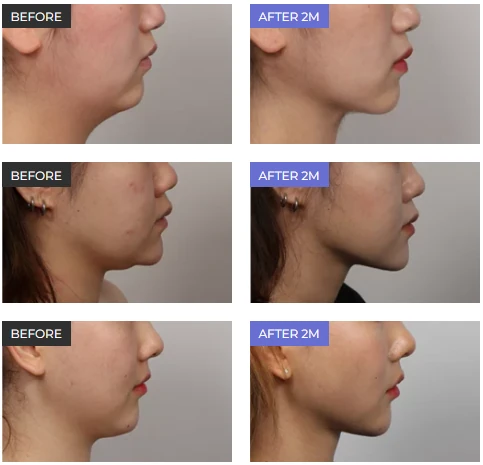
EN
EN


“Platysmaplasty not working” describes the feeling that the fullness under your chin hasn’t improved as much as you expected after neck muscle tightening surgery. In most cases it falls into one of two groups: you are still in the swelling phase, or a layer other than the muscle is still there.
The sentence I hear most often in follow-up appointments is “Doctor, I don’t think it worked.” When we talk it through, though, many of those patients are only two or three weeks out of surgery. On the other hand, if several months have passed and the fullness is still there, it is time to work out, step by step, what is left.
So if you are worried about platysmaplasty not working, this article answers three questions: is it too early to judge, what might remain if the fullness is still there after three months, and what should you bring to a follow-up visit? If you want to understand the procedure itself first, start with our complete platysmaplasty guide.
- What “Platysmaplasty Not Working” Usually Means
- When Can You Judge the Result? 4 Recovery Checkpoints
- Normal Healing vs. Warning Signs: When to Call Your Clinic
- Double Chin Still There After 3 Months? 6 Causes Beyond the Muscle
- Has the Platysmaplasty Loosened, or Is It Something Else?
- Before Your Follow-Up Visit: What to Bring and What Comes Next
- Frequently Asked Questions
- Get a Layer-by-Layer Assessment at MINE
What “Platysmaplasty Not Working” Usually Means
Concerns about platysmaplasty not working usually arise when the layer the surgery changes is different from the layer that is creating the fullness. The area under the chin is not one tissue. It is several layers stacked on top of each other.
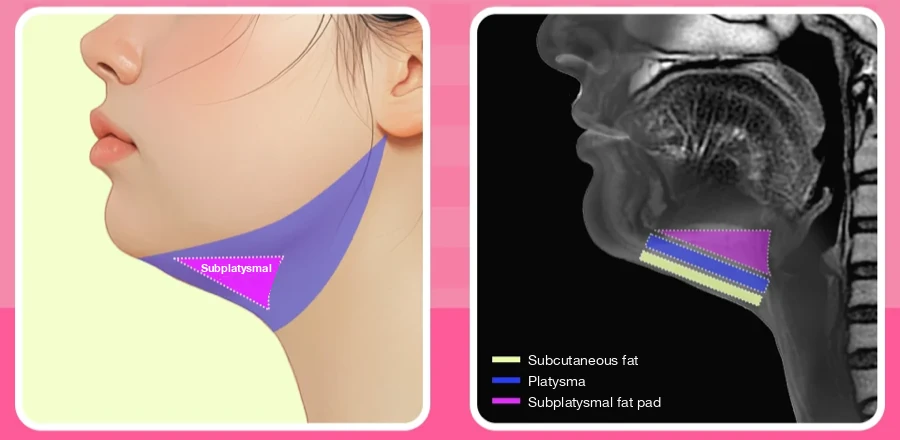
What muscle tightening changes — and what it doesn’t
Platysmaplasty gathers the loose inner edges of the platysma (the thin, sheet-like muscle that covers the front of the neck) and stitches them together at the midline. Think of a sagging hammock: pull both ends taut and it supports its load again. The surgery rebuilds that supporting “sling” under the chin.
The catch is that the muscle is not the only thing that makes the area full. Plastic surgery textbooks describe the under-chin region in layers: skin, fat just under the skin, the platysma, deep fat beneath the muscle, the digastric muscles (small paired muscles under the chin), the submandibular glands (salivary glands below the jaw), and the jaw and hyoid bone (a small U-shaped bone at the front of the neck).
According to textbook data, neck fullness breaks down to roughly 44% fat above the muscle, 30.7% fat beneath it and 24.5% submandibular glands. In other words, the muscle is the frame, not the contents. Tightening it alone addresses only part of the volume. In my clinic, residual fullness often comes from more than one layer at once.
Put simply, platysmaplasty rebuilds the shelf. It does not make the fat sitting on that shelf, or the glands hidden underneath it, disappear on their own.
Three situations behind worries about platysmaplasty not working
- Normal swelling and firmness — the tissues are still settling, so the contour hasn’t shown yet.
- A layer other than the muscle remains — deep fat, the digastric muscles or the glands, which muscle tightening alone does not change.
- Extra skin remains — the deeper layers are in order, but leftover skin hangs or folds.
These three call for very different responses. The first one simply needs time. The second and third need a proper examination.
Dr. Lee’s Key Point: When you are worried about platysmaplasty not working, the first question is not “what’s left?” but “how many weeks has it been since surgery?”
When Can You Judge the Result? 4 Recovery Checkpoints
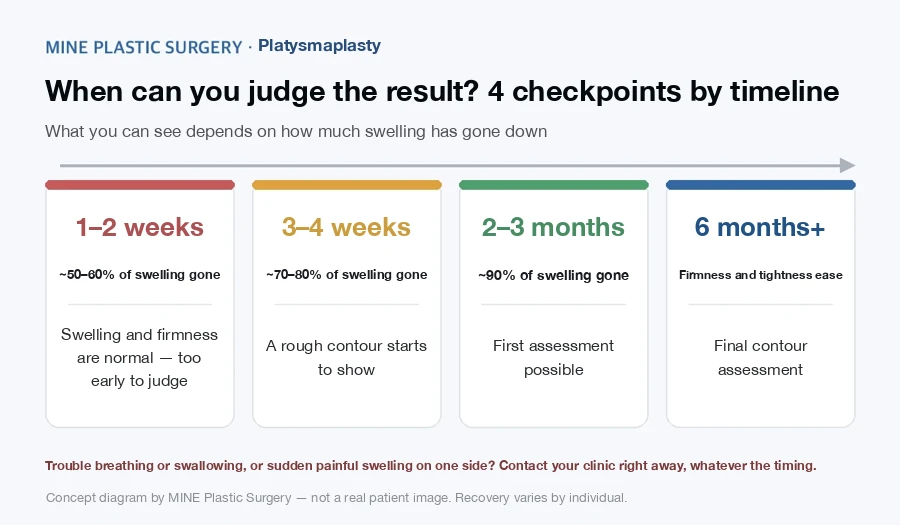
You can only judge whether your platysmaplasty really isn’t working once enough swelling has gone for the real contour to show. In my clinical experience, swelling after platysmaplasty typically peaks on days 3–5, is about 50–60% gone at 2 weeks, about 70–80% gone at 3–4 weeks and about 90% gone by 2–3 months, and the final contour is judged after 6 months.
Plastic surgery textbooks recommend evaluating neck results about 1 year after surgery, because the neck settles over months, not weeks. Swelling and scar tissue in this area simply take longer to calm down than many patients expect. So the honest answer to “what is the platysmaplasty recovery time before I can judge?” is: longer than it feels.
| Time since surgery | Swelling gone (approx.) | What you can judge |
|---|---|---|
| 1–2 weeks | About 50–60% | Too early — swelling and firmness are expected |
| 3–4 weeks | About 70–80% | A rough contour starts to show |
| 2–3 months | About 90% | First fair assessment |
| 6 months+ | Firmness and tightness ease | Final contour |
These figures reflect what I typically see in my practice. Individual recovery varies, and the general neck lift recovery picture described by the American Society of Plastic Surgeons neck lift recovery overview is a useful reference for what to expect in the early weeks.
1–2 weeks: swelling and firmness are expected
Normal: Swelling is worst around days 3–5, and roughly half of it is gone by about 2 weeks. The area under the chin may even look fuller than before surgery. That is common at this stage and is not a sign that your platysmaplasty isn’t working.
See your surgeon if: one side suddenly swells and hurts, or you have trouble breathing or swallowing. Call right away, whatever the timing.
3–4 weeks: a rough contour starts to show
Normal: With about 70–80% of the swelling gone, the jawline starts to appear. The area can still feel hard and lumpy to the touch — that is healing tissue, not a sign that the surgery has failed.
See your surgeon if: part of the area feels like a water balloon when you press on it.
2–3 months: the first fair assessment
Normal: With about 90% of the swelling gone, this is the first point where comparing with your pre-op photos makes sense. Now you can start asking whether the surgery truly fell short, and what, if anything, is left.
See your surgeon if: the fullness looks almost unchanged compared with before surgery. Book a follow-up to sort out the cause.
6 months and beyond: judging the final contour
Normal: Remaining firmness and tightness ease and the final contour settles. The final check is usually done after 6 months.
See your surgeon if: fullness still bothers you at this point. This is when the residual causes below are checked by examination.
For what to do and avoid at each stage, see our week-by-week double chin surgery recovery timeline.
Dr. Lee’s Key Point: Concluding that your platysmaplasty isn’t working before the 3-month mark is usually premature — the exception is the warning signs in the next section, which should never wait.
Normal Healing vs. Warning Signs: When to Call Your Clinic
The rule is simple: if things improve a little day by day, that is normal healing; if something appears suddenly or keeps getting worse, call your clinic. Most worries about platysmaplasty not working during recovery belong in the first group.
What normal healing feels like

After neck surgery, the tissue under the skin firms up as it heals and then softens slowly. Hard, uneven areas in the middle of recovery rarely mean the surgery hasn’t worked. In most cases the area is simply still healing. Swelling under the chin after neck lift or platysmaplasty usually peaks around days 3–5 and gradually eases, while firmness and tightness can take several months to fade.
Signs you should call your clinic right away
A seroma (clear fluid collecting under the skin) and excess skin are among the more common problems after neck surgery, and they are also common reasons for a second procedure. Use the table below to separate the normal range from signs that need a check.
| What you notice | Usually normal | Call your clinic now |
|---|---|---|
| Firmness, lumps | Even on both sides, slowly softening over time | Feels fluid-filled, like a water balloon (possible seroma or sialocele — a collection of saliva) |
| Swelling | Worst on days 3–5, then steadily easing | One side suddenly swells and hurts (possible hematoma — a collection of blood) |
| Tightness, stiffness | A pulling feeling when you bend or turn your head | Trouble breathing or swallowing |
| Skin color, temperature | Bruising that turns yellow and fades | Heat, redness or pus (possible infection) |
| Sensation, asymmetry | Numbness or a slight left–right difference that mostly recovers within months | One corner of the mouth moves clearly differently from the other |
This is not a full list of side effects. It covers only the signs that decide whether you can wait. If anything in the right-hand column applies, don’t wait for your next appointment — contact the clinic that performed your surgery straight away.
Dr. Lee’s Key Point: Firmness means you can wait. A fluid-filled feeling or rapid swelling on one side means you should not.
Double Chin Still There After 3 Months? 6 Causes Beyond the Muscle
If your double chin is still there after surgery once about 90% of the swelling has gone, something other than the muscle is likely left. At 2–3 months, if you are still concerned about platysmaplasty not working, we check these six causes one by one:
- Fat just under the skin (subcutaneous fat)
- Deep fat beneath the platysma
- Prominent front bellies of the digastric muscles
- Submandibular glands that become visible
- Excess skin
- Skeletal limits, such as a short chin or a low hyoid bone
A published examination method (Auersvald, 2018) explains how surgeons tell these apart. Gently pinching the under-chin area shows how much fat sits above the muscle. Feeling the area with the neck bent forward relaxes the front of the neck, so the deeper structures — deep fat, the digastric muscles, the glands and the hyoid — can be assessed. Ultrasound and your operative record fill in the rest.
1. Fat just under the skin (subcutaneous fat)
What you may notice: When you gently pinch under your chin, a soft, thick layer of fat comes up between your fingers. Skin folds stand out more when you look down.
How it’s checked: Your surgeon feels how thick the pinch is and, if needed, measures fat thickness on ultrasound. If only a small amount is left and your skin has good elasticity, liposuction is usually the first option considered. This is one of the simpler explanations for platysmaplasty not working as hoped.
2. Deep fat beneath the platysma
What you may notice: Not much pinches up, but the angle between your chin and neck looks round and blunt. This is common in people whose under-chin area has always looked full, even when they were young.
Textbooks are clear that fat beneath the muscle cannot be suctioned; it has to be removed directly through a small incision under the chin. If the muscle is tightened but this layer stays, the shelf is rebuilt but the cushion beneath it is still there, so the fullness can remain. In my experience, this is one of the most common hidden reasons for platysmaplasty not working as expected. You can read more on why fat beneath the platysma needs direct removal.
How it’s checked: Your surgeon reviews the operative record to see whether deep fat was treated, then separates the layers by touch and imaging. If this layer turns out to be the main cause, direct treatment through the under-chin incision is discussed at that point.
3. Prominent front bellies of the digastric muscles
What you may notice: Firm vertical ridges on either side of the midline just under the chin. They get harder when you swallow or open your mouth.
The digastric muscles are a small pair of muscles lying beneath the platysma. In some people their front portions add to the fullness under the chin. Surgical textbooks describe thinning the surface of these muscles (a “digastric shave”) in such cases. It is not something everyone needs, so the first step is an examination to see how much these muscles actually contribute.
How it’s checked: Feeling the area with the neck bent forward, and while you swallow, shows the width and firmness of the muscles.
4. Submandibular glands that become visible
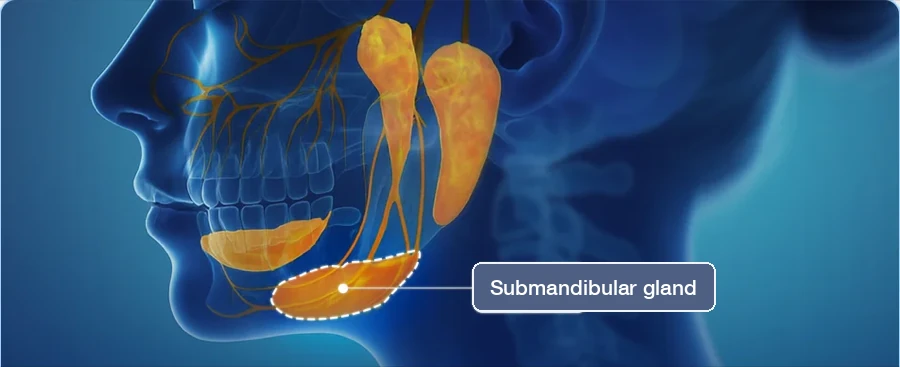
What you may notice: Round, firm lumps just below the jawbone on each side. Some patients feel these stick out more than before surgery.
Patients often worry about platysmaplasty not working when they notice this, but this kind of submandibular gland swelling after neck lift or platysmaplasty usually does not mean the glands have grown. They may simply have been exposed. Before surgery, the glands are often hidden behind neck fat and a loose muscle. Once fat is removed and the muscle is tightened, the outline behind them can show. Plastic surgery textbooks recognize prominent submandibular glands as a frequent cause of bulges that remain at the sides of the under-chin area after neck tightening.
Gland size can be reduced surgically (see submandibular gland reduction), but you should know the risks. In a 2015 study of 112 submandibular gland reductions (Mendelson et al., Plast Reconstr Surg 2015), minor complications occurred in 10.8% of cases, and all cases of sialocele and temporary nerve weakness (4.5% each) resolved within 3 months. The same study reported no patients with permanent dry mouth, while also noting a rare but serious risk: bleeding deep in the neck that can press on the airway.
How it’s checked: Examination and ultrasound tell fat from gland. Even if a gland is the cause, treating it is not automatic — the expected change is weighed against the risks above.
5. Excess skin
What you may notice: The deeper area feels neater, but when you lift your chin, thin skin hangs or creases. This is more common with age or after large weight changes.
There is a counter-intuitive point here. Textbooks explain that turning a rounded neck angle into a sharp one needs more skin, not less. Picture the slanted line running from chin to neck: bend it into a right angle, and one slanted line becomes two sides of a corner, which together are longer. So if you have a lot of extra skin, muscle tightening alone may leave it looking loose, and extending the plan to neck lift surgery may need to be considered. Here, the disappointing result comes from the skin, not from the muscle repair.
How it’s checked: Your surgeon looks at the skin with your head up and down and judges how much laxity remains after the deeper layers have settled.
6. Skeletal limits: a short chin or low hyoid bone
What you may notice: In profile, the chin sits back, or the line between chin and neck has always been low and blurred.
When the hyoid bone sits low or far forward, the angle between the chin and neck becomes blunter. Soft-tissue surgery cannot change bone position, so it limits how much change platysmaplasty can deliver. In this case, what looks like a failed platysmaplasty is really a bone limit. Textbooks also note that surgery through an under-chin incision mainly changes the side profile; it makes little difference from the front and does not correct jowls.
One more thing: “Can’t you just take out more?” is not the answer. Removing too much fat under the chin can leave thin skin looking uneven and make the jowls along the jawline stand out more.
Dr. Lee’s Key Point: Fullness that remains after surgery often has more than one cause. Checking layer by layer is what decides the next step.
Has the Platysmaplasty Loosened, or Is It Something Else?
Loosening is not the same as a platysmaplasty that never worked in the first place. Loosening after platysmaplasty means an under-chin line that clearly improved for a while and then sags again months later. It is different from a result that changed little from the start, and the two should be judged separately.

Patterns that suggest loosening
- A line that looked clearly better once the swelling went down sags again over several months.
- Vertical muscle bands at the front of the neck reappear when you lift your chin or pull the corners of your mouth down.
- Comparing old photos shows a clear “better, then back again” pattern.
Why loosening is less common than it seems
If there was little change from the very beginning, swelling or one of the residual causes above is a more likely reason for platysmaplasty not working than loosening. The neck is also an area where band correction is often not complete, and how much the bands improve varies with each person’s muscle strength and thickness, even with the same technique.
So the easiest way to tell a result that never took from a repair that has loosened is to ask: “When did it change?” Did it improve and then come back, or did it never change much? The answer points to different checks.
Dr. Lee’s Key Point: Date-stamped photos are the best evidence for telling loosening apart from a residual cause.
Before Your Follow-Up Visit: What to Bring and What Comes Next
If you are concerned about platysmaplasty not working, a follow-up visit is a layer-by-layer check of why the result differs from what you expected. It is not a verdict on whether the surgery “failed”; it is a chance to see exactly what is left.
Checklist to bring to your follow-up
- Pre-op photos — front and side, with your head raised and lowered.
- Operative record — which layers were treated, and whether deep fat or the glands were addressed.
- Timed photos — front and side at about 2 weeks, 1 month and 3 months, in the same lighting and from the same angle.
- Symptom notes — when firmness, a fluid-filled feeling, tightness or changes in sensation started, and how they have changed.
If you are having surgery in Korea, ask your clinic for an English copy of the operative record before you fly home — it makes any later check much easier if the result isn’t what you hoped for. For video follow-ups, consistent same-angle photos matter even more, because your surgeon cannot examine you by touch.
When is revision discussed?
As a rule, revision is discussed only after the tissues have fully settled — at least several months after surgery — and once examination has confirmed what is left. Operating again too early, while swelling remains, can make the picture harder to read, not easier. Depending on the reason for platysmaplasty not working, the right next step may not be revision at all.
Dr. Lee’s Key Point: With photos and records, it becomes far easier to pin down exactly what remains.
Frequently Asked Questions
When can I tell if my platysmaplasty worked?
A first fair assessment is possible at 2–3 months, when about 90% of the swelling is gone, and the final contour is judged after 6 months. Worries about platysmaplasty not working before then usually come down to swelling and firmness.
Why does my chin still feel hard and full one month after platysmaplasty?
At 3–4 weeks about 70–80% of the swelling is typically gone, and firmness and lumps are a common part of healing, not a sign that your platysmaplasty isn’t working. Call your clinic right away if the area feels fluid-filled, swells suddenly on one side, or feels hot.
Why do my submandibular glands look bigger after neck lift surgery?
Removing fat and tightening the muscle can reveal gland outlines that were hidden before, so the glands are usually exposed rather than enlarged. Examination and ultrasound can tell fat from gland.
How can I tell if my platysmaplasty has loosened?
Suspect loosening if a line that looked better after the swelling went down sags again over time, or if vertical neck bands reappear. That is different from little change from the start, so comparing timed photos is the most reliable check.
Should I have revision surgery right away if I see no result?
No. Even if it feels like your platysmaplasty isn’t working, wait until the tissues have settled, confirm what is left, and then decide with a specialist. Depending on the cause, a different approach may suit you better than revision.
Get a Layer-by-Layer Assessment at MINE
To sum up: if you are worried about platysmaplasty not working, first check how many weeks it has been. Before 3 months, it is usually still swelling. After that, if fullness remains, the next step is to work out which layer is responsible — deep fat, the digastric muscles, the glands, skin or bone structure. A fluid-filled feeling or rapid swelling on one side needs attention at any time.
Fat, muscle, glands and skin differ from person to person, so the assessment does too. I recommend an in-person consultation with Dr. Lee Sung-wook, Board-certified Plastic Surgeon, for a layer-by-layer assessment. International patients can start with a photo-based pre-consultation. To book, call +82-2-516-1175 or use the online consultation form at mineclinic.com.
Written and medically reviewed by Dr. Lee Sung-wook, Board-certified Plastic Surgeon (Korea), MINE Plastic Surgery & Dermatology, Seoul. Published October 8, 2026. Last reviewed October 8, 2026.
※ This content is for informational purposes only and does not replace professional medical advice, diagnosis, or treatment. Individual results may vary, and side effects may occur. Please consult with a board-certified plastic surgeon for personalized advice.