EN


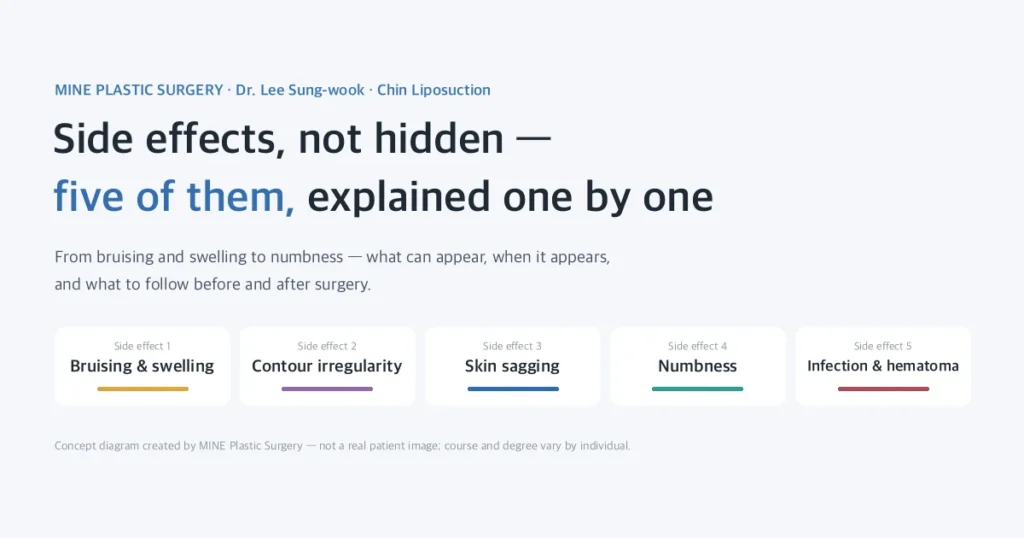
Chin liposuction side effects are the unwanted reactions that can follow removal of fat under the jaw with a thin cannula — most commonly bruising, swelling and temporary numbness, and less often contour irregularity, skin sagging, infection or a hematoma (a pocket of collected blood). Most are temporary. A few, such as lumpiness or loose skin, depend heavily on how the operation was planned before the first incision.
Maybe you first noticed it on a video call or in a side-profile photo: a jawline that looks fine head-on but blurs into the neck from the side. Dieting hasn’t touched it, and chin lipo starts to look like the obvious answer — until you start reading about what can go wrong.
“Are there any side effects?” is a question I hear in my consultation room several times a day. My honest answer is that every operation carries some risk. What matters is knowing exactly what those risks are and what lowers them. In this article I’ll focus on the side effects of liposuction itself: why each one happens, who is more prone to it, when a revision becomes necessary, and how the right diagnosis prevents most problems before they start.
What Are Chin Liposuction Side Effects?
To understand chin liposuction side effects, it helps to know exactly what the operation does — and what it doesn’t do.
How chin liposuction works, step by step
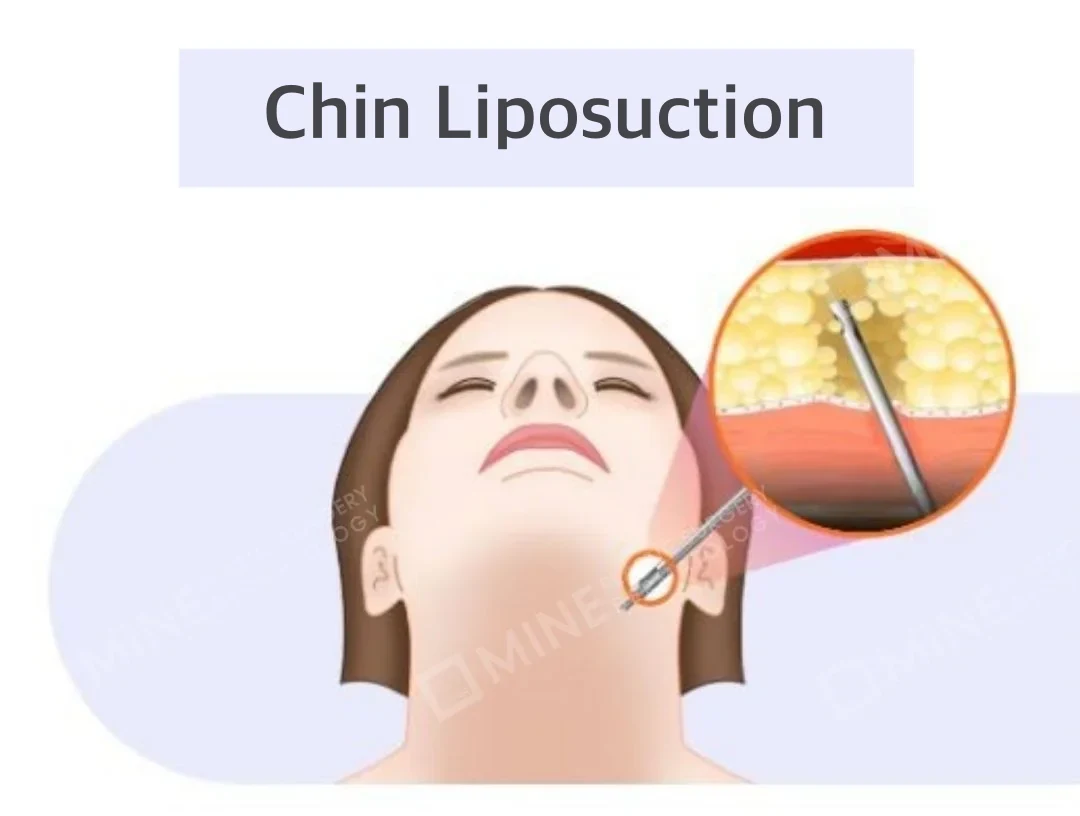
Chin liposuction (also called submental liposuction) removes the fat that sits just under the skin beneath your jaw. Through a tiny incision under the chin or behind the earlobe, a thin cannula (a narrow suction tube) is passed through the fat layer and the fat is suctioned out. Chin liposuction is done through a 3–5 mm incision, and the suction itself usually takes 30–60 minutes.
| Step | What happens | Approximate time |
|---|---|---|
| Design | Marking the area and planning how much fat to remove | 10–15 minutes |
| Anesthesia | Local anesthesia or IV sedation | 10–20 minutes |
| Suction | Fat removed through the cannula | 30–60 minutes |
| Closure | Incision stitched, compression band applied | About 10 minutes |
The operation is short, but in my experience the design stage decides the result. Where to start, where to stop and how much fat to leave behind is the judgment that separates a smooth jawline from an uneven one.
Why the area under the jaw is delicate
The space under your jaw is small, and it holds fine sensory nerves, blood vessels, a thin sheet of muscle across the front of the neck (the platysma) and the salivary glands. Nearly all chin liposuction side effects come from one of three sources:
- The cannula’s path through tissue — this causes bruising, swelling and temporary numbness.
- How much fat is removed, and how evenly — this decides whether you get lumps, sagging skin or visible muscle bands.
- The wound and fluid in the treated space — this is where infection, hematoma and seroma (a pocket of clear fluid) come from.
There is also a limit worth knowing from the start. Plastic surgery textbooks stress that liposuction removes only the fat above the platysma. It cannot tighten a loose platysma, remove fat lying beneath the muscle, shrink enlarged salivary glands or change the position of the jaw bone. Medical literature on minimally invasive neck surgery adds that dense, firm fat beneath the platysma is hard to remove with a cannula and makes the outcome less predictable.
For a neutral overview of how liposuction works across the body and its general risks, the American Society of Plastic Surgeons liposuction overview is a useful starting point.
Dr. Lee’s Key Point: Chin liposuction looks simple, but creating a natural curve from chin to neck depends on the surgeon’s judgment — and on choosing it only when fat is truly the problem.
Who Is More Likely to Get Chin Lipo Complications?
Chin lipo complications are not random. Many of them can be predicted from your anatomy before surgery, which is why the consultation is your first line of defense against chin liposuction side effects.
Good candidates: localized fat, good skin elasticity
Plastic surgery textbooks identify skin elasticity as the single most important factor in choosing who should have neck liposuction. The ideal candidate is relatively young, has skin that snaps back well, and has fat that is concentrated under the chin and along the jawline rather than spread across the whole neck. In these patients, the skin shrinks back onto the new contour on its own.
One textbook example shows a 40-year-old woman with fat under the chin who was treated with liposuction alone through a small chin incision, with her improved neck angle still in place 13 months later. What made her a good candidate was not her age alone but the combination of localized fat and skin that could contract.
Higher-risk profiles: 40+, poor elasticity, diffusely fat neck, men
The following profiles carry a higher chance of the longer-lasting chin liposuction side effects — sagging and irregularity:
- Age 40 and over, or noticeably reduced elasticity — the skin may not shrink enough once the fat is gone, so sagging becomes more likely.
- A diffusely fat neck — when fat is spread over the whole neck rather than collected under the chin, textbooks note that a smooth contour is harder to achieve and irregularities are more common.
- Men — male skin tends to be thicker and oilier and contracts less readily after fat removal, so results can be less dramatic.
None of this rules you out. It simply means the plan may need to change — for example, removing less fat or adding a tightening procedure.
When it isn’t fat at all: platysma, glands, bone
A double chin is not one problem. It can come from four different layers, and only the first one responds to liposuction:
- Fat under the skin — the layer liposuction treats.
- Loose skin and a lax platysma — the muscle sheet relaxes with age and the jawline softens.
- Enlarged submandibular glands — the salivary glands under the jaw can bulge and look like fat.
- Jaw and hyoid bone position — a short or set-back chin, or a low-sitting hyoid (the small U-shaped bone at the top of the neck), blunts the angle under the chin.

When the real cause is the gland or the muscle, removing more fat doesn’t fix it — and over-suctioning to compensate is exactly what creates the side effects described below. If the fullness comes from the glands, salivary gland reduction addresses the cause directly. In another textbook case, a 62-year-old woman with moderate skin laxity was treated not with liposuction alone but with fat removal combined with platysma tightening, because suction by itself would not have corrected her neck.
Dr. Lee’s Key Point: Many “side effects” are really misdiagnoses. When the cause is skin, muscle, gland or bone, more suction makes things worse, not better.
5 Chin Liposuction Side Effects, Explained
Below are the five chin liposuction side effects I discuss with every patient. For each one you’ll find what it is, why it happens, how long it lasts, how to prevent it and how it is fixed.
1. Bruising and swelling
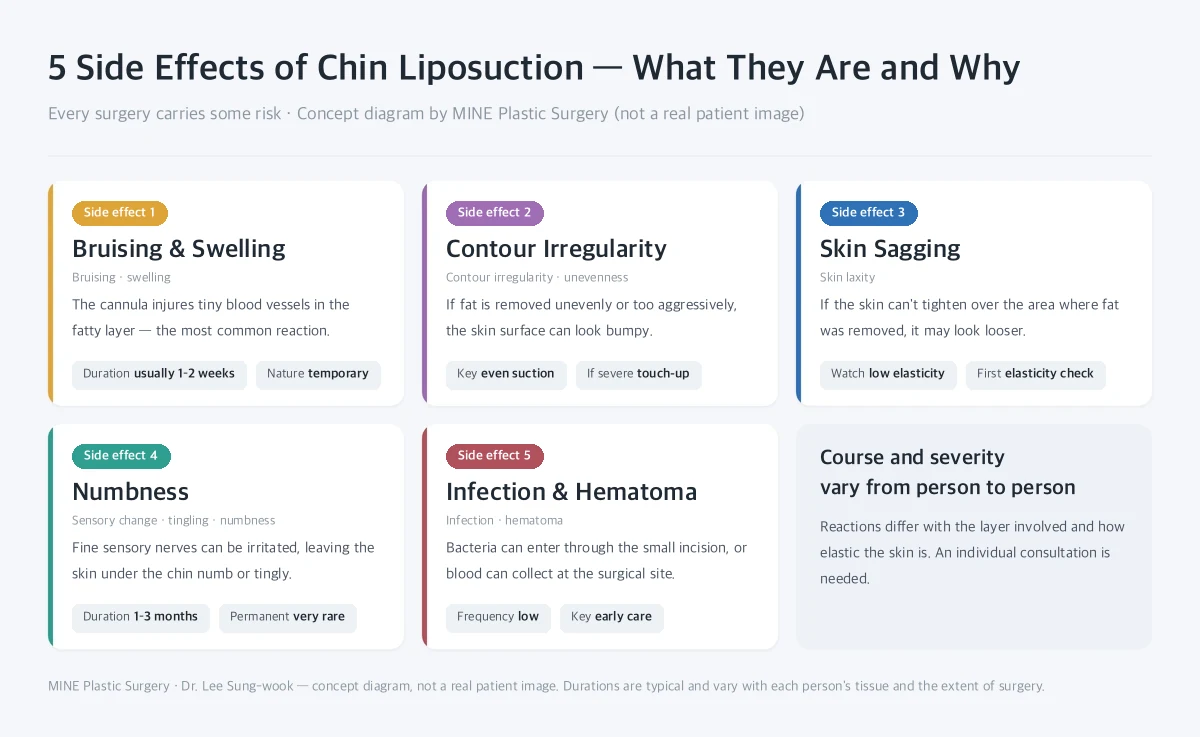
This is the most common of all chin liposuction side effects. As the cannula moves through the fat layer, tiny blood vessels are injured and blood seeps into the surrounding tissue.
- How long: Bruising and swelling after chin liposuction usually fade within 1–2 weeks.
- How much: It varies with your constitution and the size of the treated area.
- Prevention: Stopping blood-thinning supplements beforehand, wearing the compression band and keeping your head raised for the first few days.
- Fix: None needed — it is temporary and resolves naturally.
2. Contour irregularity and asymmetry
Of all chin liposuction side effects, lumpiness has the biggest effect on how satisfied patients feel. It happens when fat is removed unevenly, when too much is removed, or when the tissue heals stuck down to the layer beneath it (adhesion).
Over-resection deserves special mention. If too much fat is taken out, the thinned skin can reveal vertical bands of the platysma, and the neck can look hollow or “skeletonized.” Plastic surgery textbooks describe exactly this: aggressive fat removal under the chin produces harsh, unnatural contours. Their advice is to remove fat conservatively and leave a thin, even layer under the skin that hides the small dips and ridges of the structures beneath. That’s why I follow a simple rule in chin lipo: taking slightly less is better than taking too much.
Anatomy textbooks also note that in roughly 75% of necks the left and right platysma muscles overlap under the chin, while in the rest they leave a gap in the midline — one reason the muscle edges can show more in some necks once the fat cushion is gone. If your platysma is already visibly loose, combining liposuction with muscle tightening (platysmaplasty) usually gives a longer-lasting jawline than suction alone.
- Asymmetry: if one side loses more fat than the other, the complaint becomes “one side looks different” rather than lumpiness.
- Prevention: even suction technique, a conservative plan and a precise pre-op diagnosis.
- Fix: mild irregularities often improve as the tissue settles; more noticeable ones may need a touch-up (see the revision section below).
3. Skin sagging
Once the fat is gone, the skin has to shrink to fit the smaller space underneath. If it doesn’t have enough elasticity, it can hang loose instead — particularly in patients over 40 or anyone whose skin has lost its spring. Textbooks point out that liposuction under the chin, when done on its own, can lead to looser skin there over the long term.
- Who should watch for it: middle-aged patients and anyone with reduced skin elasticity.
- Prevention: a skin elasticity assessment before surgery is essential, not optional.
- Alternative: combining liposuction with a mini neck lift or a thread lift reduces the chance of sagging when elasticity is borderline.
4. Numbness and altered sensation
Fine sensory nerves under the chin can be irritated during suction, leaving the area feeling dull, tingly or numb for a while. This is fairly common and almost always temporary.
- How long: Numbness under the chin usually recovers within 1 to 3 months, and permanent sensory loss is very rare.
- The nerve to know about: the marginal mandibular nerve is a small branch that runs along the jawline and controls the muscle at the corner of the lower lip. Temporary weakness of this branch — which can make the smile look slightly uneven — is a recognized complication of neck surgery in general.
- Prevention: the risk is much lower when the surgeon knows the nerve’s course well and keeps the cannula in the correct layer.
5. Infection, hematoma and seroma
Bacteria can enter through the incision, or blood can pool in the treated area (a hematoma). Less often, clear tissue fluid collects instead (a seroma). Seromas are more likely when fat has been removed so aggressively that the protective tissue layer is stripped away. All three are uncommon, but early action makes a real difference.
- Warning signs: severe pain, warmth, or swelling that keeps getting worse instead of better.
- Prevention: a sterile surgical setting, a correctly worn compression band and proper aftercare.
- Fix: caught early, fluid can be drained and infection treated with antibiotics, and recovery is usually straightforward.
Dr. Lee’s Key Point: Most chin liposuction side effects are temporary. Skin sagging and contour irregularity are the two that depend most on accurate diagnosis and careful suction technique.
When Is Chin Liposuction Revision Needed?
Most patients get the result they want from a single operation. In the revision consultations I see, though, three patterns come up again and again: too little fat removed, too much fat removed, and an uneven contour. When people search for “chin lipo gone wrong,” it is almost always one of these. The fix depends entirely on which one it is — and it is these contour problems, not the temporary chin liposuction side effects like bruising, that lead to a second operation.
Under-resection: fat left behind
If fullness remains once the swelling has fully settled, the area that still has excess fat can be treated with additional, targeted suction. This is usually the simplest revision.
Over-resection: hollow neck and visible platysma bands
Fat that has already been removed cannot be suctioned back. Instead, hollows are filled with your own fat (autologous fat grafting) taken from another area. If the platysma bands have become visible, tightening the muscle (platysmaplasty) or a neck lift may be needed as well.
Asymmetry and adhesion
When one side is fuller, the fuller side can be touched up; when one side is hollower or the skin has healed stuck down, fat grafting can soften the depression. Either way, revision is judged only after the tissues have settled — not before the 1–3 month mark when the final contour appears.
Skin sagging: when to add a mini neck lift instead of more suction
This is the most important decision rule in chin revision: if the problem is loose skin, removing more fat makes it worse. Sagging skin needs lifting and tightening, not more suction. A neck lift repositions the skin and, when needed, tightens the platysma, which is something no cannula can do.
Dr. Lee’s Key Point: The right revision starts with naming the exact problem — too little fat, too much fat, uneven fat or loose skin. Each has a different fix.
How to Prevent Chin Liposuction Side Effects: 4 Steps
Most chin liposuction side effects can be reduced significantly with preparation. These are the four principles I emphasize with every patient.
1. Get a precise pre-op diagnosis
The amount and location of the fat, your skin elasticity, how loose the platysma is, the size of the salivary glands and the shape of your jaw and chin bone should all be assessed together. Only then can you choose correctly between liposuction alone, liposuction with a neck lift, or salivary gland reduction. Liposuction on its own is enough for some patients, but not a few need a combined approach. An ultrasound scan shows the fat, muscle and gland layers directly — here is why an ultrasound consultation matters before surgery.
2. Wear the compression band as instructed
The compression band is not an accessory. It limits bruising and swelling, discourages fluid from collecting, and helps the skin shrink evenly onto its new contour. Wear it all day for roughly the first 5 days, then only while sleeping for the following 2 weeks. I adjust the exact timing at each check-up based on how you’re healing.

3. Stop smoking and alcohol: 2 weeks before, 4 weeks after
Smoking reduces blood flow to the skin, slows wound healing and raises the risk of infection. Stop smoking at least 2 weeks before and for at least 4 weeks after chin liposuction, and avoid alcohol for the same period. Also stop aspirin, omega-3 and other supplements that affect blood clotting 2 weeks before surgery, because they increase bruising and the chance of a hematoma.
4. Keep every follow-up visit
Scheduled check-ups after surgery allow fluid collections, infection or early irregularities to be spotted and treated while they are still small. Most problems are far easier to manage when they’re caught early.
Dr. Lee’s Key Point: Prevention follows four steps: the right surgeon, a precise diagnosis, a tailored operation and thorough aftercare.
Recovery Timeline: Which Side Effects Are Normal and When
Knowing which chin liposuction side effects are expected at each stage helps you tell normal healing from something that needs attention. Recovery varies from person to person, but a typical course looks like this:
| Time after surgery | What you’ll notice | Daily life |
|---|---|---|
| Day of surgery | Mild pain, swelling begins | Same-day discharge |
| Days 1–3 | Bruising and swelling at their peak | Rest at home |
| 1 week | Stitches removed, swelling down by about 50–60% | Light daily activities |
| 2–3 weeks | Bruising mostly gone, new contour emerging | Return to social life |
| 1–3 months | Tissue settles, final contour appears | Normal activities including exercise |
Many patients ask whether they can go back to work after a week. If you can wear the compression band and a mask, most people return to desk work around day 5–7. Strenuous exercise and saunas should wait at least 4 weeks.
The final contour after chin liposuction settles at 1 to 3 months, so early firmness or slight lumpiness is not yet a verdict on your result. If you’re already post-op and unsure whether a particular symptom is normal, see our guide to double chin surgery side effects and when to call your surgeon.
Dr. Lee’s Key Point: Give your neck time. Judge the result at 1–3 months, not in the first two weeks.
Chin Liposuction Side Effects: Frequently Asked Questions
Are chin liposuction side effects permanent?
Most are not. Bruising, swelling and numbness are temporary and usually resolve within 1–3 months. Contour irregularity or sagging caused by over-resection can last, however, and may need correction — which is why the choice of surgeon and a conservative plan matter from the start.
How long does numbness last after chin liposuction?
Numbness or tingling under the chin usually recovers within 1–3 months as the small sensory nerves settle down. Permanent changes in sensation are very rare.
Can fat come back after chin liposuction if I gain weight?
Liposuction removes fat cells, so the same amount of fat is unlikely to return to the same spot. The cells that remain can still grow larger with significant weight gain, so keeping a stable weight helps preserve your result.
Will my skin sag after chin liposuction?
The risk is higher if you are over 40 or your skin elasticity is reduced. That’s why elasticity is assessed before surgery; if it is borderline, combining liposuction with a mini neck lift or thread lift is usually the safer plan.
Is a chin liposuction scar visible?
The incision is only 3–5 mm long and is placed in the natural crease under the chin or behind the earlobe. In most cases it fades until it is barely noticeable.
Which is better for me: chin liposuction or a neck lift?
They do different jobs. Liposuction removes fat; a neck lift tightens skin and muscle. If you’re younger with good skin elasticity, liposuction alone may be enough. If loose skin is part of the problem, a lift or a combined approach works better. The right choice is made at an in-person consultation.
Considering Chin Liposuction? Start With the Right Diagnosis
Chin liposuction is often described as a simple operation, but the area under the jaw is packed with nerves and blood vessels. Keeping chin liposuction side effects to a minimum depends on the whole process being done well: an accurate diagnosis of the cause, a tailored surgical plan, skilled and even suction, and structured aftercare.
Every neck is different in its skin quality, fat distribution and bone structure, so the right approach is different too. If a double chin is bothering you, the best next step is to talk it through with a board-certified plastic surgeon. You can learn more about chin liposuction at MINE or reach us through an online consultation.
※ This content is for informational purposes only and does not replace professional medical advice, diagnosis, or treatment. Individual results may vary, and side effects may occur. Please consult with a board-certified plastic surgeon for personalized advice.