EN


Has loose skin after pregnancy or weight loss been bothering you, yet you keep putting off a consultation because you’re worried about the scar? You’re not alone. In my clinic, the question I hear most often is simple: “Where will my tummy tuck scar be, and how long will it be?”
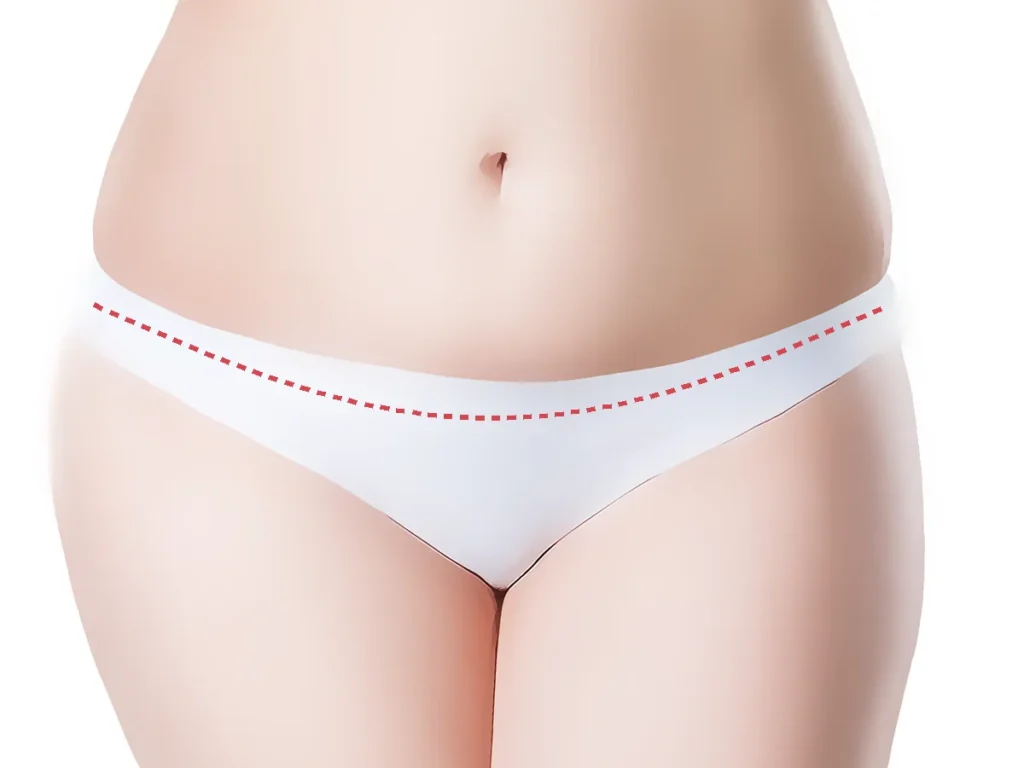
A tummy tuck scar is the suture line left after loose lower-abdominal skin is removed — a low horizontal line hidden under the underwear line and, in a full tummy tuck, a small ring around the belly button. Let me be honest from the start: there is no tummy tuck without a scar. What we can plan, to a large degree, is where that scar sits and how thin it heals.
This article focuses on the scar alone. For the procedure itself, see our full tummy tuck (abdominoplasty) guide. Here, I’ll walk you through the two places a scar forms, how a mini and a full tummy tuck differ, how the belly button scar is designed, and how the scar changes from the first month to a year and beyond.
What Is a Tummy Tuck Scar and Where Does It Form?
Why removing loose skin always leaves a suture line
A tummy tuck removes loose skin and fat from the lower abdomen and stitches together the stomach muscles (the rectus muscles) that pregnancy often pulls apart. Liposuction removes fat through tiny openings, but a tummy tuck actually cuts away skin. Wherever skin is removed, the edges have to be sewn back together, and that seam becomes the scar.
That’s why I tell every patient at consultation, “There is no such thing as a tummy tuck without a scar.” The good news is that the position and width of the scar are decided largely at the design stage, before the first incision is made.
Two scar sites: the low transverse line and the belly button ring
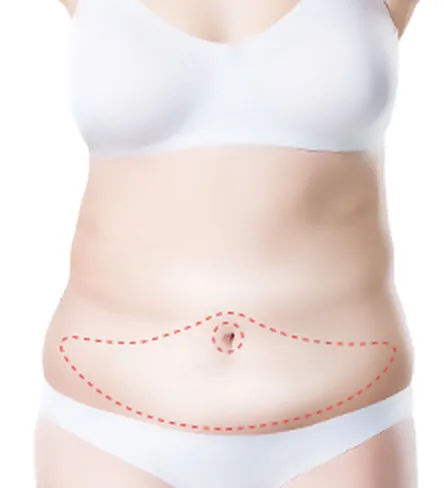
A tummy tuck scar forms in two possible places:
- The low horizontal (transverse) line: a line running sideways just above the pubic bone, at a height your underwear normally covers. Both mini and full tummy tucks leave this line.
- The ring around the belly button: a small circular scar along the rim of the navel, created when the belly button is reshaped in a full tummy tuck. A mini tummy tuck does not leave this scar.
What decides how long the scar is
There is no fixed length for a tummy tuck scar. The more loose skin there is, and the wider it spreads, the more skin has to be removed — and the further the line extends toward the hips. Two people having the “same” surgery can end up with very different scar lengths simply because their skin laxity is different.
Dr. Lee’s Key Point: A tummy tuck is not surgery that erases a scar. It is surgery that designs where the scar sits and how thin it stays.
Mini Tummy Tuck Scar vs Full Tummy Tuck Scar
A mini tummy tuck takes about 2 hours with same-day discharge; a full tummy tuck takes about 4 hours with a one-night stay recommended, and only the full version adds a belly button scar. Both are done under general anesthesia, and both usually include liposuction and repair of separated stomach muscles. The real difference is how much skin is removed.
Mini tummy tuck scar: short low incision, belly button untouched
A mini tummy tuck suits people whose loose skin or stretch marks are limited to the area below the belly button. Only that lower skin is removed and the navel stays where it is, so a mini tummy tuck scar is a single low line with no scar around the belly button. The incision is usually shorter than in a full tummy tuck.
Full tummy tuck scar: longer hip-to-hip line plus a navel scar
When the laxity continues into the upper abdomen, the upper skin has to be pulled down, which calls for a full tummy tuck. Because a wider band of skin is removed, the horizontal line runs further toward each hip. The belly button is also brought out through a new opening and reshaped, which adds the ring-shaped scar.
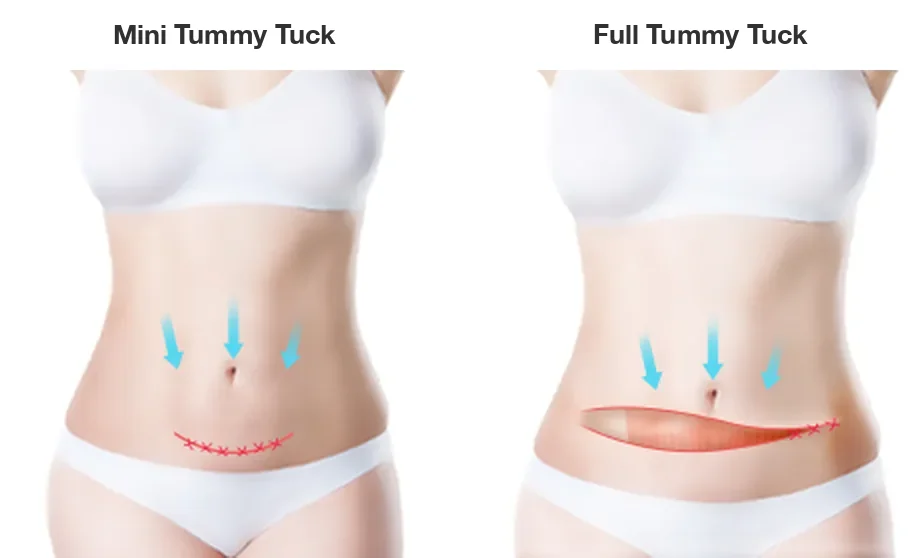
| Mini tummy tuck | Full tummy tuck | |
|---|---|---|
| Best suited for | Laxity/stretch marks limited to below the navel | Laxity/stretch marks across the whole abdomen |
| Scar position | Low transverse line (inside the underwear line) | Low transverse line, extending further toward the hips |
| Belly button scar | None (navel not moved) | Yes — ring around the reconstructed navel |
| Surgery time | About 2 hours | About 4 hours |
| Anesthesia / stay | General anesthesia · same-day discharge | General anesthesia · 1-night stay recommended |
Don’t choose “mini” just for a shorter scar
It’s tempting to ask for a mini simply because the scar is shorter. But if your upper abdomen is also loose, a mini tummy tuck leaves that skin behind, and the result may fall short of what you hoped for. The balance between scar length and result has to be judged by examining your skin in person. You can read more about the methods we use on our tummy tuck at MINE Plastic Surgery page.
Dr. Lee’s Key Point: Scar length is set by the extent of your loose skin, not by preference. Whether a mini is enough is something we decide at examination.
The Tummy Tuck Belly Button Scar: Why It Forms and How It’s Hidden
Why the navel is recreated in a full tummy tuck
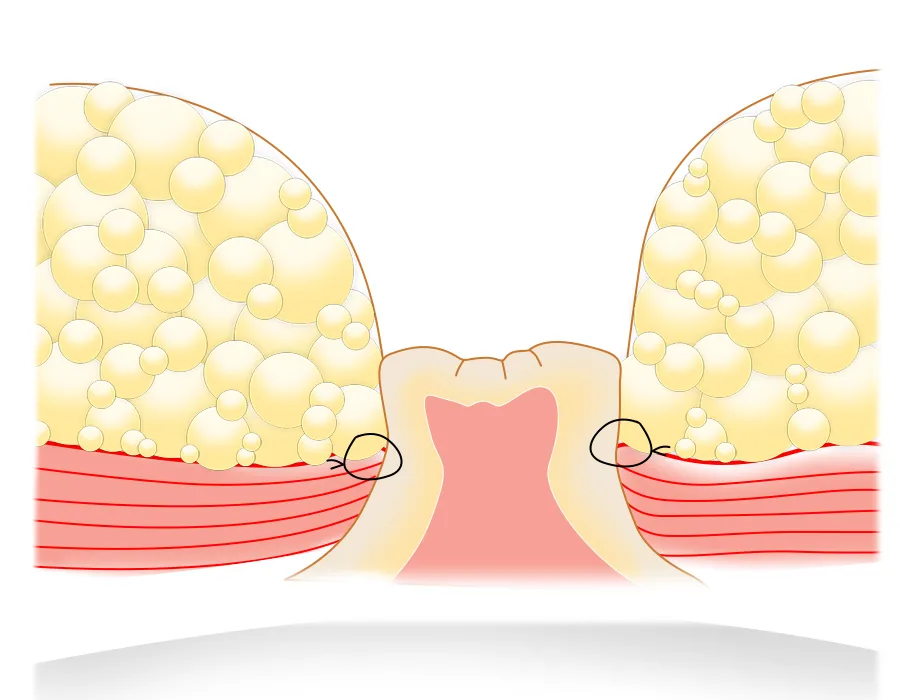
Your belly button isn’t just a dimple in the skin. It is attached to a short stalk that rises from the abdominal wall. In a full tummy tuck, the upper skin is pulled down, so the skin that used to surround your navel moves lower. The surgeon makes a new opening at the right height in the tightened skin, brings the original stalk through it, and stitches it in place. That stitch line is the tummy tuck belly button scar.
Hiding the suture line in the navel’s natural shadow
According to plastic surgery textbooks, the goal of this step is to anchor the stalk to the rectus fascia (the firm sheath that covers the abdominal muscles). This gives the navel a natural position and a slightly recessed, inward shape. When the belly button sits a little deeper, the suture line falls into its natural shadow and is much less noticeable from the front.
Avoiding a wide “trumpet” belly button
There is a detail that matters a great deal here. Textbooks warn that removing too much skin around the navel in one go can leave a widened, trumpet-shaped belly button. So the skin is trimmed gradually, a little at a time, checking the shape at each step.
Options if you’re keloid-prone or don’t want a navel scar
Plastic surgery textbooks also describe a variation that moves the navel without cutting around it. It is considered for people who don’t want a belly button scar, or who tend to form thick, raised scars (hypertrophic scars or keloids). According to the same textbook, this approach suits a relatively long distance between the navel and the pubic bone — about 14–18 cm, which means a navel that sits fairly high. Not everyone qualifies, so whether it’s an option for you is decided at examination.
Dr. Lee’s Key Point: What people notice is whether the belly button looks natural, more than how big the scar is.
Designing the Tummy Tuck Scar Below Your Underwear Line
Why the incision is planned low
The height of the incision has the biggest effect on how much a tummy tuck scar bothers you day to day. At MINE, we place the line where your underwear covers it. That doesn’t mean the scar disappears — it means it sits where clothing hides it.
Plastic surgery textbooks give an example of marking the lower incision about 7 cm above the vulvar commissure (the point where the outer labia meet at the front) so the scar sits low. Your actual line depends on your body shape and the clothes you like to wear, so it helps to bring your favorite underwear or swimsuit to the consultation.
Folding an existing C-section scar into one scar
Many patients already have a horizontal scar from a C-section. Surgical textbooks advise planning the lower incision so that an earlier transverse scar is included in the final tummy tuck scar. The old scar is either removed with the excised skin or lined up with the new incision, so you usually end up with one line rather than two. The exact method depends on how high the old scar sits.
If you already have a vertical scar running above and below the navel, textbooks describe a vertical abdominoplasty (a tummy tuck done with an up-and-down incision) as an exception. It is not the standard approach.
Spreading tension so the scar doesn’t widen
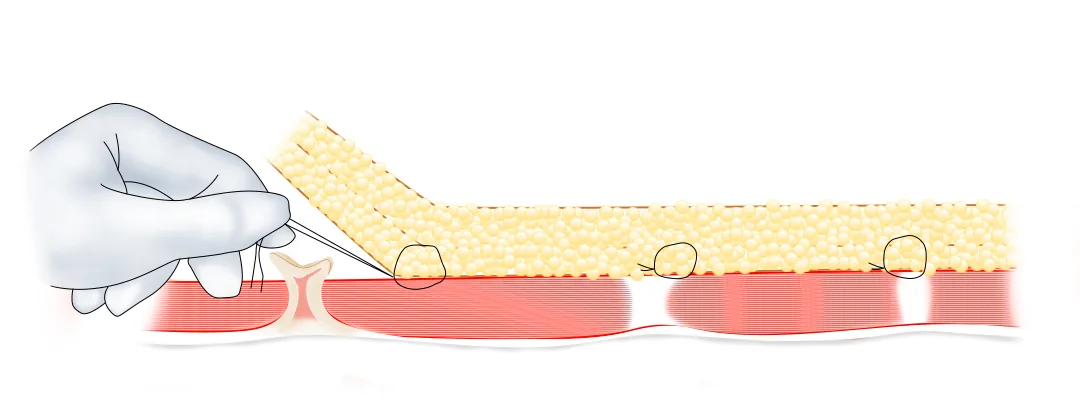
If only the skin edges were stitched, all the pull of the lowered skin would rest on that single line, and the scar could stretch wider over time. To prevent this, we use progressive tension sutures (PTS): internal stitches that fix the underside of the skin to the deeper layer at several points, a little like quilting. They spread the pull away from the skin closure. They also close the empty space beneath the skin, which helps prevent a seroma (clear fluid collecting under the skin).
Preventing dog-ears and a high-riding scar
Two more things are checked at the design stage: dog-ears (small bulges of skin at the two ends of the scar) and a scar that sits too high. Textbooks list lateral dog-ears, widened or hypertrophic scars, misplaced scars, and belly button problems as the common scar issues after abdominoplasty — which is exactly why they are planned for before surgery.
Dr. Lee’s Key Point: The height of the line, how the two ends are finished, and how tension is spread decide what your scar looks like a year later.
Tummy Tuck Scar Healing Timeline: 1 Month to 1 Year and Beyond
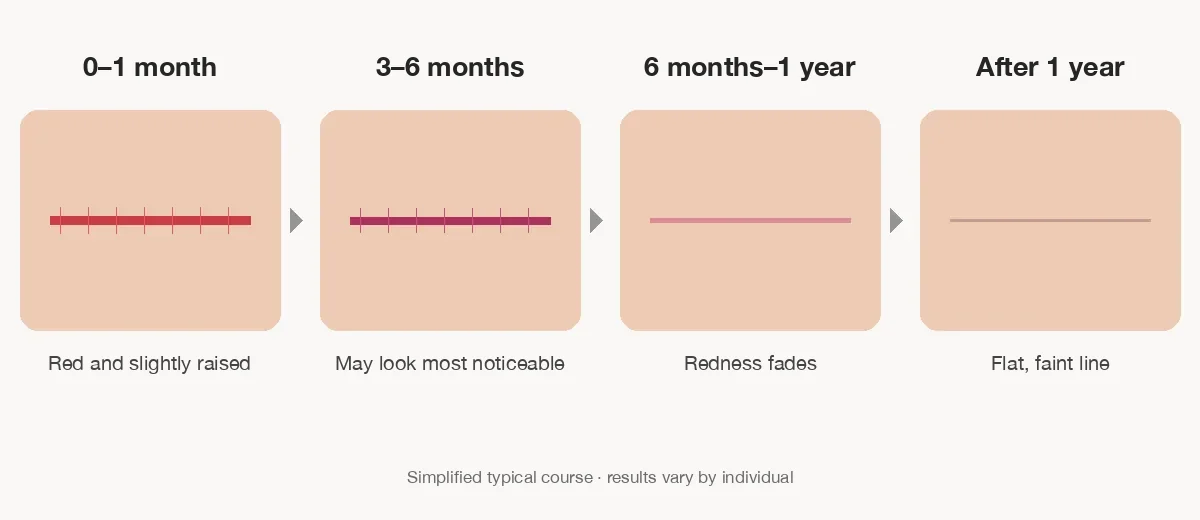
How your scar looks right after surgery is not how it will stay. A tummy tuck scar changes in color and thickness over many months. The stages below describe a typical course; every person heals a little differently.
Right after surgery to 1 month: red and firm
In the first weeks, the tummy tuck scar is red, slightly raised, and the area around it feels firm. This is a normal part of healing, and it’s far too early to judge how the scar will turn out.
3–6 months: when the scar looks its darkest — and hypertrophic warning signs
This is when the tissue inside the scar is being actively rebuilt, so a tummy tuck scar can look redder and darker than it did at first. Many patients feel most anxious at this stage. It is often normal. However, if the scar keeps rising, itches intensely, or seems to spread beyond the original stitch line, these can be signs of a hypertrophic scar (a thick, raised scar), and it’s worth having your surgeon take a look.
It also helps to know the difference between the two types of thick scar. Medical textbooks explain that a keloid grows beyond the edges of the original wound, while a hypertrophic scar stays within them. Regular follow-up visits are the most reliable way to tell which one is developing.
6 months to 1 year+: flattening and fading
The redness of a tummy tuck scar usually fades over 6 to 12 months, and by around one year most scars have calmed down considerably. As a scar matures, its small blood vessels gradually return toward those of normal skin, which is why the redness fades. According to scar textbooks, hypertrophic scars can keep maturing for a year or more and often flatten and soften substantially without treatment. That’s why we don’t rush into scar revision.
Color can last longer than redness. In a 2024 five-year follow-up study of surgical scars (J Plast Reconstr Surg), hyperpigmentation (brown discoloration) was still present in 79% of cases at five years. That study looked at breast scars, not abdominal ones, so the figure doesn’t apply directly — but it shows how scars continue to change over years, not weeks.
Possible scar problems and other side effects
To be straightforward about the risks, scar-related problems after a tummy tuck can include:
- A widened scar
- A hypertrophic scar or keloid
- Dog-ears at the ends of the scar
- A scar that sits in the wrong position
- Problems with the shape of the belly button
As with any surgery, general side effects such as inflammation, bleeding, seroma, and reduced sensation in the lower abdomen can also occur.
Scar care essentials
The heart of tummy tuck scar care is reducing the pull on the stitch line and avoiding irritation. Taping is usually continued for about 3 months after a tummy tuck. After that, scar ointment, scar laser treatment, a compression garment, and sun protection are added at the times your surgeon recommends.
Dr. Lee’s Key Point: A scar that looks darkest at 3–6 months is often following a normal course. Judge it at the one-year mark.
Before Your Consultation: 4 Tummy Tuck Scar Questions to Ask
The four questions
Asking these four questions at your consultation will help you picture your tummy tuck scar before surgery:
- Given how loose my skin is, is a mini or a full tummy tuck right for me?
- How high will the incision be, and where will its two ends sit?
- Does my belly button need to be recreated, and if so, how?
- Can my C-section scar, or another old scar, be included in the new one?
Personal factors: keloid tendency, smoking, weight change
The same surgery can leave different scars on different people. If past cuts or surgical wounds have healed thick and raised, you may be prone to keloids — please tell your surgeon. Smoking reduces blood flow to the skin, and textbook evidence shows smokers have wound-healing problems or infections in about 50% of cases versus 15% in non-smokers. Large weight gain or loss after surgery can also stretch the scar or shift its position. If you’re dealing with loose skin after major weight loss, reaching a stable weight first gives the scar the best chance of staying put.
When scar revision makes sense
As a rule, scar revision surgery is considered only after the scar has fully matured — generally around one year or later. As mentioned above, even a thick scar can flatten a great deal with time. Problems that don’t change with time, such as dog-ears or a misplaced scar, can be corrected partially once the scar has matured.
Dr. Lee’s Key Point: Pinching your skin and drawing the incision line before surgery is where scar prediction begins.
Tummy Tuck Scar FAQ
How long is a tummy tuck scar?
There is no fixed length — it is set by how far your loose skin extends. A mini tummy tuck leaves a relatively short, low line, while a full tummy tuck scar runs further toward the hips. The exact length is confirmed at consultation by pinching the skin and marking the incision.
Does a mini tummy tuck leave a belly button scar?
No. A mini tummy tuck doesn’t move the navel, so there is no scar around the belly button. If your loose skin reaches the upper abdomen, though, a mini may not be enough and a full tummy tuck may be recommended.
Will I get a second scar if I already have a C-section scar?
Usually not. The lower incision is adjusted so that the old horizontal scar becomes part of the final tummy tuck scar. If the existing scar is very high or unusually shaped, the approach may differ, so it needs to be checked in person.
When does a tummy tuck scar fade?
Redness usually fades over 6 to 12 months, and the scar keeps maturing for a year or more. Brown pigment can last longer than that, so keep protecting the scar from the sun.
Why does my tummy tuck scar look darker a few months after surgery?
Between 3 and 6 months, the tissue inside the scar is being actively rebuilt, so a red, slightly raised scar is common. Judge it at one year. If it keeps rising or the itching doesn’t settle, have it checked for hypertrophic scarring.
Summary
A tummy tuck scar forms in two places: a low horizontal line, and — in a full tummy tuck only — a ring around the belly button. Its length is set by how much loose skin you have, while the height of the line, how the ends are finished, and how tension is spread decide how it looks a year later. Most scars look their darkest at 3–6 months and then settle over a year or more.
Because the incision design depends on your skin laxity and any existing scars, I recommend an in-person consultation with me at MINE in Seoul before you decide. If you’d like to share your situation first, you can also send photos through an online consultation. To learn more about the procedure options, visit our tummy tuck at MINE Plastic Surgery page.
※ This content is for informational purposes only and does not replace professional medical advice, diagnosis, or treatment. Individual results may vary, and side effects may occur. Please consult with a board-certified plastic surgeon for personalized advice.