EN


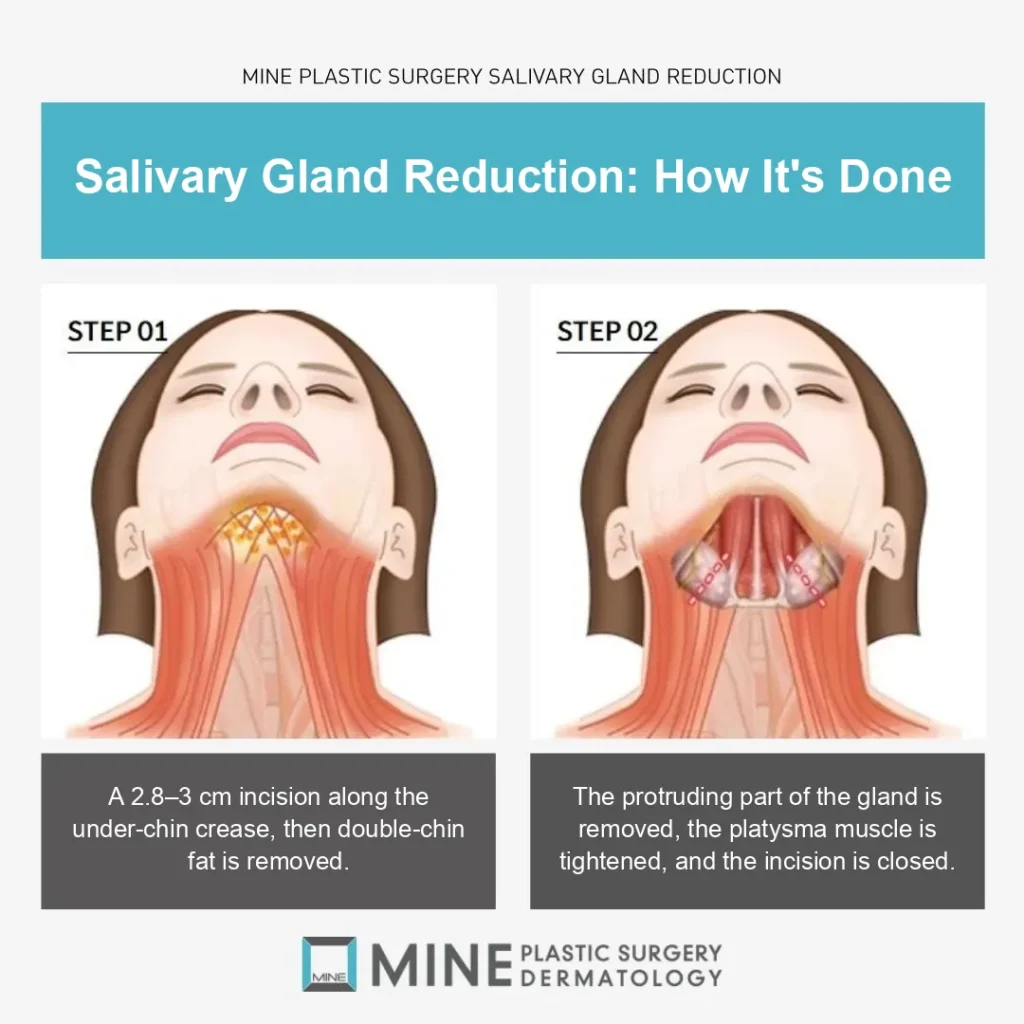
Cosmetic submandibular gland resection is a partial removal of the submandibular salivary gland — only the portion that bulges below the jawline — performed to refine the under-jaw contour, while the deeper part of the gland and its duct are left in place. It is a shaping procedure, not removal of the whole gland.
Two questions come up in almost every consultation I have about this surgery: “Is it safe to remove part of a salivary gland?” and “Where will the scar be?” Both deserve answers backed by published data.
This guide focuses on what matters most before you decide on cosmetic submandibular gland resection: what 11 pooled studies report about complications, how to tell a gland from fat or jaw bone, who should reconsider surgery, and how the nearby nerves are protected. The procedure and recovery are covered only briefly here, with links to our dedicated guides for the details.
What Is Cosmetic Submandibular Gland Resection?
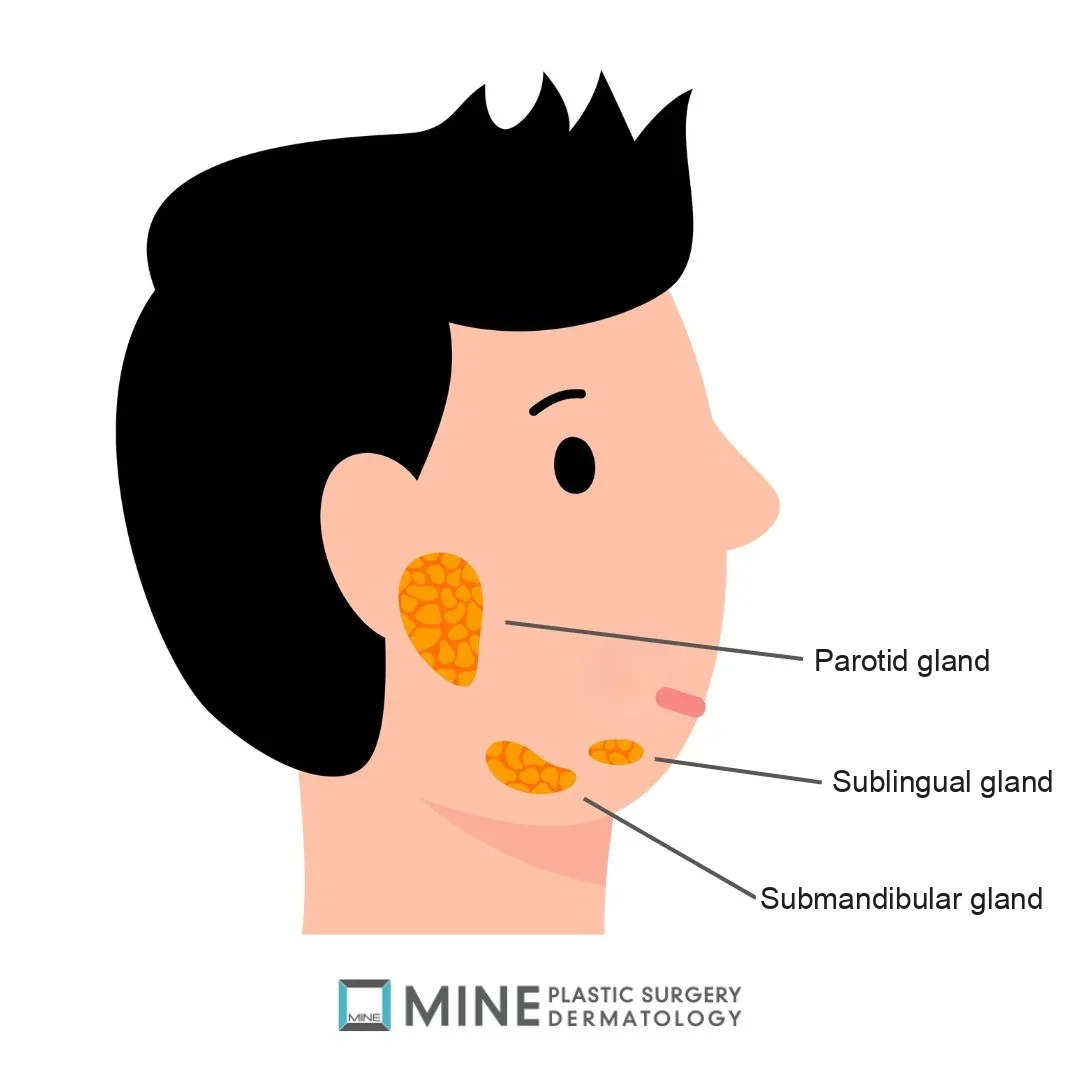
The three major salivary glands
Your body has three pairs of major salivary glands: the parotid glands in front of the ears, the sublingual glands under the tongue, and the submandibular glands just beneath the jawbone on each side. Cosmetic submandibular gland resection deals only with the submandibular pair. The parotid and sublingual glands are not touched.
Which part is removed — and which stays
Anatomically, the submandibular gland is a single lobe. In the aesthetic surgery literature, though, it is often described as having a superficial portion and a deep portion, with the dividing line being the mylohyoid muscle (the thin muscle that forms the floor of the mouth). Published reviews describe the superficial portion as the part removed during aesthetic procedures, because it is the part that adds visible volume to the jaw and neck.
In cosmetic submandibular gland resection, we remove only the section that sits outside that muscle and pushes down below the jawline. The deep portion and the duct (the tube that carries saliva into the mouth) stay where they are, so the gland keeps working.
Why does the gland show in the first place? Common reasons include:
- Natural size: some people simply have larger glands, so the under-jaw looks full even at a young age.
- Age-related descent: as the supporting tissues loosen, the gland drops and bulges below the jawline (doctors call this gland ptosis).
- Revealed after fat loss: after dieting or liposuction, the gland outline can become more visible, not less. Plastic surgery textbooks list the gland as a common cause of fullness that remains under the jaw after neck surgery.
- Jaw structure: a small or set-back chin makes the glands stand out more.
Gland, Fat, or Jaw Bone? Three Causes of a Heavy Under-Jaw
A heavy-looking under-jaw usually comes from one of three sources, and each one calls for a different approach. Let me say this plainly first: cosmetic submandibular gland resection does not make a square jaw smaller.
Quick comparison table
| Cause | Location and feel | Most visible angle | Usual options |
|---|---|---|---|
| Enlarged salivary gland | Just below the jawbone on both sides; a slightly firm lump | Side profile, or with the head tilted slightly down | Partial gland resection or salivary gland Botox |
| Double-chin fat | Center under the chin; soft and pinchable | Front view, or with the head tilted down | Liposuction or double chin surgery |
| Square jaw | At the angle of the jaw; hard bone | Front view | Facial contouring (jaw reduction surgery) |
If the fullness feels soft and sits in the middle, fat is the more likely cause. Our guide on how to tell a double chin from a salivary gland walks through that distinction in more detail.
Why ultrasound comes before surgery
In real patients, the gland, the fat and a loose platysma (the thin sheet of neck muscle under the skin) often overlap, so touch alone is not reliable. Before any cosmetic submandibular gland resection, we use ultrasound to check the position and size of the gland and the depth from the skin to the gland.
Dr. Lee’s Key Point: First find out whether the problem is bone, fat or gland. If fat is the only cause and the gland is removed, or the gland is the cause and only fat is taken out, the change you were hoping for will not appear.
Who Is a Good Candidate — and Who Should Reconsider
Signs you may be a candidate
Cosmetic submandibular gland resection may be worth discussing if:
- The bulges on both sides under the jaw stay the same even after weight loss.
- In side profile, a rounded fullness blurs the border between the jaw and the neck.
- An ultrasound confirms that the gland is enlarged or has descended.
- Salivary gland Botox gave only a small or short-lived change, or you would prefer an alternative to repeated injections.
- The gland outline became more visible after double chin liposuction or a lifting procedure.
Who should reconsider or be evaluated more carefully
Cosmetic submandibular gland resection needs a more careful look for:
- People who often have a dry mouth or have had salivary gland disease before.
- People whose under-jaw fullness comes mainly from fat or bone.
- People with bleeding or clotting disorders, or blood pressure that is not well controlled — because bleeding deep in the neck is the key risk of this surgery.
The main difference between Botox and surgery is duration: Botox temporarily reduces gland activity and wears off over several months, while cosmetic submandibular gland resection removes the protruding tissue itself.
What the Research Shows: Cosmetic Submandibular Gland Resection Complication Rates
When you look at risks, how often each complication happens and how long it lasts matter as much as the list itself. Here is what the published evidence says.
Pooled data from 11 studies (Aesthetic Surgery Journal, 2025)
A 2025 review in Aesthetic Surgery Journal screened 908 articles and pooled 11 studies that included 1,651 patients who had aesthetic submandibular gland resection, with a mean age of about 50. Temporary nerve injury, seen in about 4% of cosmetic submandibular gland resections, was the most frequently reported complication.
| Complication | Reported rate | What it means |
|---|---|---|
| Nerve injury | About 4.0% | Mostly temporary, such as weakness on one side of the lower lip; usually improves over time |
| Sialocele | About 1.3% | Saliva collecting where the gland was trimmed, causing swelling; often managed without surgery, for example by draining with a needle |
| Hematoma | About 1.2% | Blood collecting at the surgical site; some cases needed a second operation |
| Salivary fistula | About 0.8% | A small channel through which saliva leaks toward the skin |
| Dry mouth (xerostomia) | About 0.13% | A dry feeling in the mouth |
Neck firmness (induration) was also common in the studies that tracked it, and it was temporary. Remember that each complication was counted by a different subset of the studies, and rates vary between studies because techniques and patient groups differ. The numbers are a guide to scale, not a personal prediction.
A single-surgeon series: Mendelson (2015)
In a 2015 case series published in Plastic and Reconstructive Surgery, Mendelson analyzed 112 consecutive aesthetic gland reductions. Temporary lower-lip nerve weakness (4.5%) resolved within 3 months in every case, and sialocele (4.5%) also resolved by 3 months. No patient reported a permanent dry mouth.
The authors concluded that the overall complication rate was comparable to that of a neck lift with platysma tightening alone. The specific risk they singled out was bleeding deep in the neck, which can press on the airway — the reason we take hemostasis (stopping bleeding) so seriously during and after surgery.
How to read these numbers
After cosmetic submandibular gland resection, most reported problems are uncommon and temporary, but “uncommon” is not “never.” Swelling, bruising, temporary numbness under the jaw, brief asymmetry while the two sides heal at different speeds, and the incision scar are also part of normal recovery. For a closer look at each side effect and when to call, see our dedicated guide.
Three Nerves, One Safety Logic
Marginal mandibular, lingual and hypoglossal nerves
Three nerves run close to the area treated in cosmetic submandibular gland resection:
- Marginal mandibular branch of the facial nerve (the small nerve that moves the lower lip). Temporary one-sided lip weakness is the most frequently reported nerve effect.
- Lingual nerve (carries sensation from the tongue).
- Hypoglossal nerve (moves the tongue).
How the surgery is planned around them
The safety logic of cosmetic submandibular gland resection is simple: dissect inside the gland capsule (the thin membrane wrapping the gland), stay away from the paths of nerves and vessels, and remove only the portion below the mylohyoid muscle that actually shows. The deep portion, which lies closer to the lingual and hypoglossal nerves, is left in place.
Dr. Lee’s Key Point: What I am most careful about in this surgery is avoiding the paths these nerves take and removing only as much gland as is truly needed.
Cosmetic Partial Resection vs ENT Submandibular Gland Excision
ENT (ear, nose and throat) surgeons perform submandibular gland excision, also called sialadenectomy, to remove the entire gland when it is affected by chronic inflammation, stones or tumors. This is usually done through an incision on the side of the neck.
Cosmetic submandibular gland resection is different: it is a partial removal aimed at contour, and it preserves the deep portion and the duct. A different goal means a different scope and a different risk profile.
| Cosmetic partial resection | ENT submandibular gland excision | |
|---|---|---|
| Goal | Refine the under-jaw contour | Treat disease |
| Extent | Superficial portion that bulges below the jaw | Whole gland |
| Typical reason | Enlarged or descended gland | Chronic inflammation, stones, tumors |
| Function | Deep portion and duct preserved | Gland removed entirely |
A cosmetic consultation is not a substitute for an ENT evaluation. If you have a painful, swollen or hard lump under the jaw, please see an ENT specialist first.
How the Procedure Works at MINE (Brief)
At MINE, cosmetic submandibular gland resection starts with an incision of about 3 cm or less, placed along the first natural crease under the chin — the fold that forms when you tilt your head down. Placing it inside the crease keeps the scar relatively hard to see from the front, although how quickly it fades depends on skin type. The surgery takes about 2 hours under sedation (general anesthesia depending on your condition), you go home the same day, and about 3 follow-up visits are needed.
- Step 1: Incision and, if needed, contouring of the double-chin fat.
- Step 2: The gland is separated inside its capsule, only the protruding part is removed, and the deep portion with the duct is kept. The loose platysma is then tightened at the midline to support the under-jaw.
- Step 3: Careful hemostasis, layered closure and a compression band.
Because gland, fat and muscle often contribute together, all three are usually addressed through one incision. For the full picture, read our complete guide to salivary gland reduction surgery, and for a closer look at how much of the gland is actually removed, see our partial removal guide.
Recovery and Precautions at a Glance
Recovery timeline (individual results vary)
After cosmetic submandibular gland resection at MINE, the compression band is worn 24 hours a day for 7 days and stitches come out on day 7. Swelling peaks at 2–3 days and settles over 2–4 weeks; alcohol, saunas and strenuous exercise should be avoided for 1 month. If you are traveling from abroad, plan to stay in Seoul at least until your stitches come out on day 7.
| Time after surgery | What to expect and do |
|---|---|
| Days 1–3 | Swelling and bruising peak. Cold compress for 3 days including the day of surgery, then switch to warm compresses. |
| Days 1–7 | Compression band 24 hours a day. Daily activities are possible right away. |
| Day 7 | Stitches removed; sterile tape for 3 more days. |
| From day 8 | Wear the band at home and while sleeping. |
| Weeks 1–2 | Light walking can begin. |
| Weeks 2–4 | Swelling settles gradually. |
| 1 month | Alcohol, smoking, sauna and strenuous exercise can resume after this point. |
| 2–3 months | Firmness under the jaw softens. |
Before surgery, tell the team about diabetes, high blood pressure or clotting problems. Medicines and supplements that increase bleeding, such as aspirin and vitamin E, are usually stopped about 2 weeks before surgery as advised by your doctor, and avoided for 1 week after. For the full week-by-week recovery timeline, see our recovery guide.
When to call the clinic immediately
Contact the clinic right away if you notice sudden, hard swelling on one side of the neck, or any difficulty breathing or swallowing. These can be signs of bleeding and need prompt attention.
Frequently Asked Questions
Will I have less saliva after cosmetic submandibular gland resection?
Saliva comes from three pairs of major glands plus many minor glands, and only the superficial part of one gland pair is removed. In the 2025 pooled review, dry mouth occurred in about 0.13% of cases, and the 2015 Mendelson series found no permanent dry mouth. If you often have a dry mouth, tell your surgeon before deciding.
How long does the firmness under the jaw last?
Some firmness under the jaw is common after surgery. It usually lasts about 2 months and gradually softens from around the 3-month mark.
Can the gland grow back after it is removed?
Tissue taken out during the procedure does not grow back. However, the remaining gland can descend with age, and changes in skin, muscle or body weight can alter the under-jaw contour over time.
Does salivary gland surgery make a square jaw smaller?
No. Cosmetic submandibular gland resection treats soft tissue under the jaw. A square jaw is caused by bone at the angle of the jaw and needs a separate facial contouring evaluation.
Where is the scar, and how visible is it?
The incision is about 3 cm or less and sits in the first natural crease under the chin, so it is hard to see from the front. The scar fades over several months. If you tend to form keloids or thick scars, please mention it at your consultation.
When can I go back to exercise or drink alcohol?
Alcohol, sauna and strenuous exercise should wait 1 month. Light walking is usually fine after 1–2 weeks.
Bottom Line: Confirm the Cause Before Choosing Surgery
Cosmetic submandibular gland resection makes sense only when the gland is truly the cause of the fullness. If fat or bone is the main issue, a different approach will serve you better. In my practice, the two things that get the most attention are the diagnosis before surgery and bleeding control after it.
At MINE Plastic Surgery in Apgujeong, Gangnam, Seoul, board-certified plastic surgeon Dr. Lee Sung-wook checks the gland with ultrasound and reviews the findings with you in person before any surgery is planned. If you are considering cosmetic submandibular gland resection, please contact us to book a consultation: call +82-2-516-1175 or visit us at 813 Nonhyeon-ro, Gangnam-gu, Seoul.
Written and reviewed by Dr. Lee Sung-wook, Board-Certified Plastic Surgeon, MINE Plastic Surgery
※ This content is for informational purposes only and does not replace professional medical advice, diagnosis, or treatment. Individual results may vary, and side effects may occur. Please consult with a board-certified plastic surgeon for personalized advice.