EN


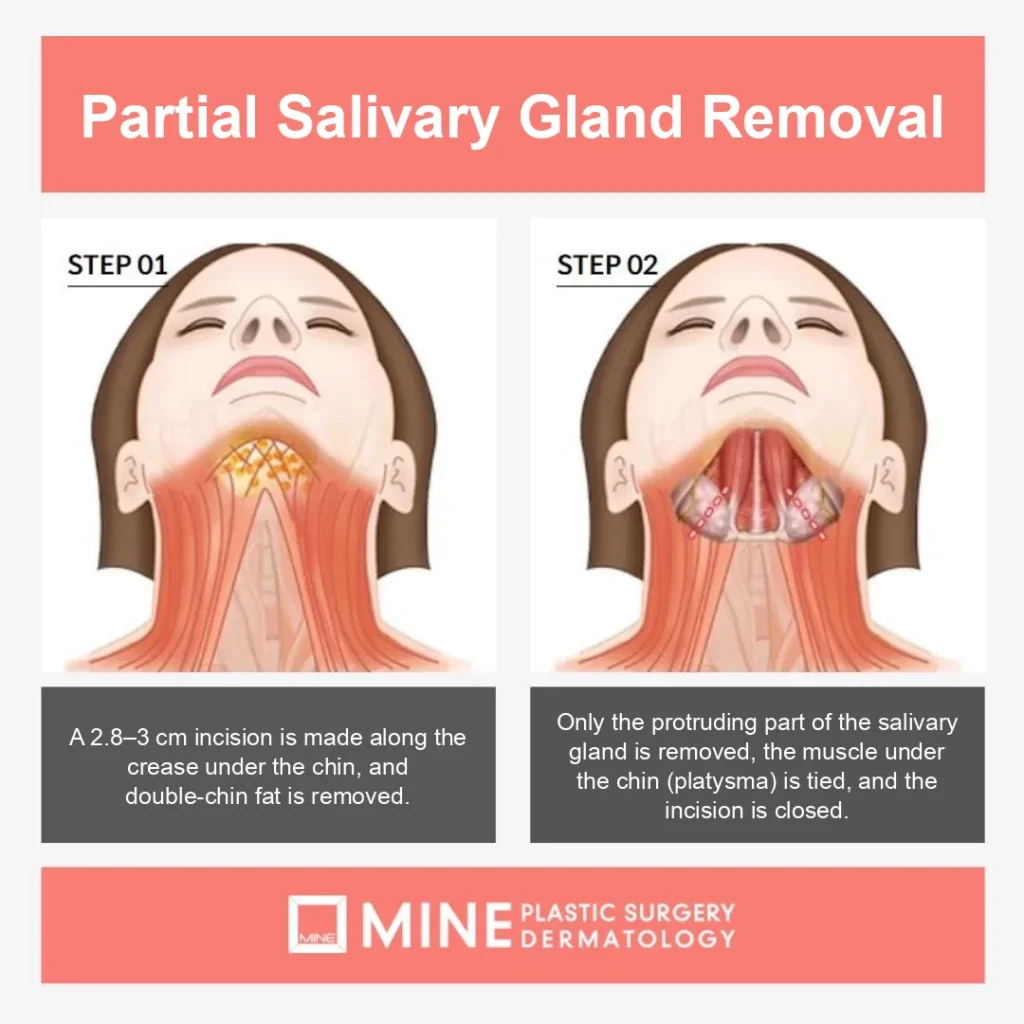
Partial salivary gland removal is a neck-contouring procedure in which a plastic surgeon removes only the part of the submandibular gland that bulges below the jawline, leaving the rest of the gland — and its saliva function — in place. It is the approach we use at MINE when an enlarged gland is spoiling the line between the jaw and the neck.
Many patients come to us after dieting, or even after double-chin liposuction, still seeing a firm bulge under the jaw. Quite often that bulge is not fat at all but an enlarged submandibular gland (the salivary gland that sits just under the jawbone on each side).
Once the gland is confirmed as the cause, the real question is no longer “should it be treated?” but “how much should come out?” This article answers that one question: how the amount is decided in partial salivary gland removal, and why the answer is almost never “all of it.” For a broader overview of the operation, see our complete guide to submandibular gland reduction.
Table of Contents
Table of Contents
What Partial Salivary Gland Removal Is — and How It Differs From Total Excision
You have three pairs of major salivary glands: the parotid glands in front of the ears, the submandibular glands under the jaw, and the small sublingual glands under the tongue. The submandibular gland is the second largest of the three. It sits in a small triangle-shaped space below the jawbone and empties saliva into the floor of the mouth through a duct about 5 cm long.
When the gland is large, it pushes the soft tissue under the jaw outward. In profile, the crisp angle between jaw and neck turns into a soft, rounded slope that looks like a double chin.
In head-and-neck surgery, removing the whole gland (total excision, or sialadenectomy) is the standard operation for disease such as tumors, chronic infection, or stones. Plastic surgery literature treats cosmetic contouring as a different job, one handled by partial salivary gland removal: the goal is to reduce the excess, protruding volume, not to take the gland away. A systematic review of partial submandibular gland removal for aesthetic indications (Benslimane et al., 2020) looked specifically at this partial approach.
Partial vs total excision at a glance
| Partial salivary gland removal | Total excision | |
|---|---|---|
| Goal | Smoother jaw-neck contour | Treat disease (tumor, infection, stones) |
| What is removed | Only the part bulging below the jawline | The entire gland |
| Saliva function | Remaining gland keeps working | That gland’s saliva is lost |
| Main trade-off | Saliva can briefly collect at the cut edge (sialocele) | Less resting saliva; risk of a hollow under the jaw |
| Typical use | Aesthetic neck and jawline contouring | Medical treatment |
Why the gland can’t simply be lifted back up
A common question is whether a surgeon could just stitch the gland higher instead of removing any of it. Plastic surgery textbooks address this directly: when the gland is examined during surgery, it is genuinely large, not just “droopy.” Trying to hold it up with sutures or by tightening the neck muscle does not work in the long run, because the problem is size, not position.
That is why textbook guidance recommends removing the protruding portion. At MINE we follow the same principle. We perform partial salivary gland removal through a small incision in the crease under the chin, and total removal is not part of our routine approach for contouring.
Who It Suits: Confirming the Bulge Is Really the Gland
Before planning partial salivary gland removal, we need to know whether the gland is the problem in the first place. A full look under the jaw can come from several sources, and in many patients it is a mix of more than one.
Gland, fat, platysma bands, or a short jaw?
Four things commonly shape the area under the chin:
- Fat — soft, pinchable fullness just under the skin or under the neck muscle.
- The submandibular gland — a firmer, rounded bulge just below the jawbone, usually toward the side.
- Loose skin and platysma — the platysma is the thin sheet of muscle across the front of the neck; when it loosens, bands and sagging appear.
- Jaw shape — a small or set-back jaw makes anything below it look more prominent.
In my clinical experience, many patients assume the bulge is weight-related when the gland itself is a large part of it. The reverse also happens. Some patients need only double-chin liposuction, while others benefit from a mini neck lift combined with gland reduction. Botox can shrink the gland temporarily, but it is a different decision from surgery.
What the ultrasound shows before surgery
We use ultrasound before surgery to see where each gland sits, how big it is, and what lies above it — skin, fat, and the platysma. This scan is what turns a general impression into a measured plan for partial salivary gland removal on each side.
How Much Gland Is Removed in Partial Salivary Gland Removal
There is no fixed percentage in partial salivary gland removal. The amount is tailored to each gland: how big it is, where it sits, and how far it pushes below the jaw. Two patients with the same-looking bulge can need quite different amounts removed. Here is how the decision is built.
Gland size and position on ultrasound
The ultrasound gives us the gland’s size and its relationship to the jawbone before the first incision. A gland that sits mostly behind and above the jaw line contributes little to the outline, even if it is large. A gland that hangs low contributes a lot, even if it is only moderately enlarged.
How far the gland protrudes below the jawline
In partial salivary gland removal, the target is the portion that drops below the line of the jaw and blurs the jaw-neck angle when you look at the face from the side. Gland tissue that sits higher, tucked under the bone, does not shape your profile, so it is left alone. In other words, we remove what you can see in profile and keep what you cannot.
Textbook descriptions of the technique explain why this can be done safely. The gland is wrapped in its own thin capsule (a covering layer). The surgeon opens the capsule on the lower, inner side, draws the protruding part down, and removes it in small, controlled pieces. The important nerves and vessels lie outside the capsule, and extra care is taken at the upper, outer part of the gland, which is closest to the nerve that moves the lower lip.
The surrounding tissue: fat, platysma, and skin
The gland is rarely the only player. If fat or a loose platysma adds to the fullness, we address those through the same incision — removing excess fat and tying the platysma together in the midline. Because the surrounding tissue is improved as well, less gland needs to come out to reach a clean contour. This is one of the quiet advantages of partial salivary gland removal: the gland does not have to carry the whole correction on its own.
Left and right are planned separately
The two glands are often different sizes, and one may sit lower than the other. Each side is therefore assessed and planned on its own. Removing the same amount from both sides sounds fair, but it can create the very asymmetry you are trying to avoid. Matching the result, not the amount, is the goal.
Why Total Removal Is Avoided for Jawline Contouring
If some removal helps the contour, it is natural to wonder why surgeons don’t simply take the whole gland and be done with it. There are two main reasons: saliva function and the structures that surround the gland.
Saliva at rest: what the submandibular glands do
According to salivary gland textbooks, the submandibular glands produce most of the saliva your mouth makes at rest — between meals and while you sleep. That resting saliva keeps the mouth comfortable, protects the teeth, and helps with speech and swallowing.
In research on benign submandibular tumors, removing the whole gland lowered resting saliva, while gland-preserving partial removal kept higher resting saliva and caused less facial deformity. That finding comes from disease surgery, but the logic carries over to cosmetic work: the more gland you keep, the more function you keep.
Some clinics do remove the whole gland for cosmetic reasons, which can lead to a dry mouth or reduced saliva. Our principle at MINE is partial salivary gland removal. Because you have three pairs of major salivary glands, removing part of one gland does not affect normal saliva production or swallowing. Some patients notice mild dryness for a short time right after surgery, and it settles.
More removal means working closer to nerves and vessels
Three nerves run close to the submandibular gland, each with a plain-English job:
- Marginal mandibular nerve — a branch of the facial nerve that moves the lower lip and the corner of the mouth.
- Hypoglossal nerve — moves the tongue.
- Lingual nerve — gives the tongue its feeling, and runs right alongside the gland’s duct.
The facial artery also lies next to the gland. Removing the deep and upper parts of the gland means working nearer to all of these. Deep bleeding is the most serious risk in this area, because swelling deep in the neck can press on the airway. Partial salivary gland removal stays with the lower, protruding portion, which keeps the work further from these structures.
For a fuller look at what happens to function after surgery, read about saliva, swallowing and taste after gland removal.
The Cost of Taking Too Much: Hollowing and Asymmetry
More removal does not mean a better jawline. Past a certain point, taking extra gland tissue starts to cause new problems rather than solve the old one.
A sunken area under the jaw
The area under the jaw needs some volume to look natural. If too much gland comes out, the skin can fall inward and leave a visible dip or hollow below the jawbone — the opposite of the smooth line the patient wanted. Removing the whole gland also means working closer to the marginal mandibular nerve, so over-removal adds risk as well as an unnatural look.
Left-right asymmetry
Asymmetry usually comes from one of two things: glands that were different sizes to begin with, or different amounts removed on each side. When it happens it is usually minor, and it can be corrected with a small revision if needed. Careful side-by-side planning before partial salivary gland removal is the main way to prevent it.
Why conservative is safer
There is a simple asymmetry in the decision itself. Removed gland tissue cannot be put back, while a small remaining bulge can still be addressed later. That is why we plan partial salivary gland removal conservatively: aim for the contour, and stop there.
What Partial Salivary Gland Removal Can and Can’t Do
Good results start with realistic expectations. Partial salivary gland removal does one thing well — it reduces a gland that protrudes below the jaw — and it has a few predictable limits and trade-offs.
Removed tissue doesn’t grow back
After partial salivary gland removal, the portion that was taken out does not regrow. If the area looks fuller years later after weight gain or with age, that change comes from the fat and skin around the gland, not from the gland coming back. Those changes can be handled with liposuction or a lifting procedure if needed.
The remaining gland still makes saliva — the sialocele trade-off
After partial salivary gland removal, the gland that remains keeps working, so saliva can sometimes collect at the cut surface and form a small fluid pocket under the skin, called a sialocele. In a 2015 plastic surgery case series of 112 patients, a sialocele appeared in 4.5% of patients and cleared within 4 weeks, and no patient developed permanent dry mouth. At MINE, a sialocele is managed with medication, compression, and diet; if it is large, the fluid is drawn off with a needle.
The same study found temporary lower-lip weakness in 4.5% of patients, all of whom recovered within 3 months. This reflects how close the marginal mandibular nerve runs to the upper part of the gland, and it is one more reason to stay with the lower, protruding portion.
What it won’t fix on its own
Partial removal does not tighten loose skin or remove fat by itself. That is why it is often combined with double-chin fat removal, platysma tightening, or a neck lift when those are part of the problem.
The Procedure Day in Brief
Partial salivary gland removal is a short operation. Here is what the day typically looks like:
- Final check: ultrasound review and a final consultation. You fast as instructed beforehand, usually from midnight.
- Anesthesia: sleep (sedation) or general anesthesia, depending on your situation, with an anesthesiologist on site.
- Incision: about 2.5–3 cm along the first natural crease under the chin, where it is hidden unless the chin is raised.
- Contouring: double-chin fat is removed, then only the protruding part of each gland, then the platysma is tied.
- Closure: the incision is closed in layers and a compression dressing is applied.
- Recovery room: about 1–2 hours of monitoring.
- Going home: same-day discharge with a companion.
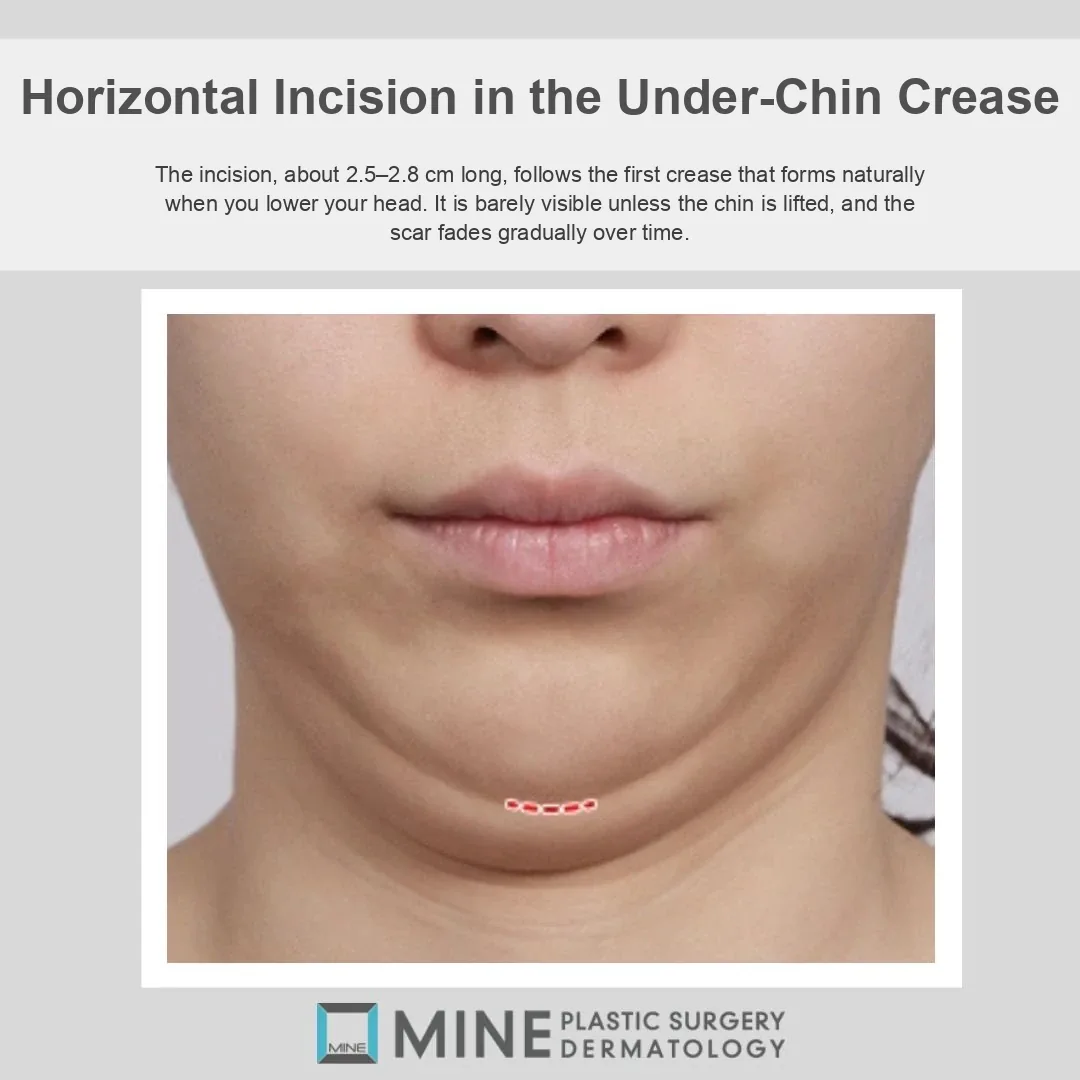
The operation usually takes about 1–2 hours, depending on how much is done and whether other procedures are combined. Our complete guide to submandibular gland reduction covers the technique in more detail.
Recovery and Aftercare: The Short Version
Recovery after partial salivary gland removal is usually straightforward if you follow the aftercare plan:
- A compression garment is worn 24 hours a day for the first 7 days (at least 3), then at home and during sleep from day 8.
- Stitches come out on day 7.
- Swelling peaks on days 2–3 and settles over 2–4 weeks; some firmness can last about 2 months.
- Daily activities can resume right away, light walking from 1–2 weeks, and strenuous exercise from 1 month.
- Avoid alcohol, smoking, and saunas for 1 month.
Call the clinic right away if you have a fever of 38°C or higher, sudden swelling, worsening pain, pus or a bad smell, an opening wound, or any difficulty breathing.
For the details, see our week-by-week recovery timeline and the full list of risks and when to call.
Partial Salivary Gland Removal: Frequently Asked Questions
How much of the salivary gland is removed in a partial removal?
There is no fixed percentage. Only the portion that protrudes below the jawline is removed, sized on ultrasound and by how the jaw-neck angle looks in profile. Each side is planned separately because the two glands are often different sizes, and gland tissue that does not affect your outline is left in place.
Will I still have enough saliva after partial salivary gland removal?
Yes, for normal daily life. You have three pairs of major salivary glands, and partial removal keeps most of the treated gland working. Some patients feel mild dryness for a short time right after surgery, which settles as healing progresses.
Why don’t surgeons just remove the whole gland?
Removing the whole gland lowers resting saliva, and research on gland surgery linked total removal with more facial deformity than partial removal. It also means working closer to nerves and vessels and can leave a hollow under the jaw. Total excision is generally kept for disease, such as tumors or chronic infection.
Can the salivary gland grow back after partial removal?
No. The removed portion does not regrow. If the area looks fuller later, it is usually because of weight gain or age-related changes in the surrounding fat and skin, which can be treated with liposuction or a lifting procedure.
What happens if too much gland is taken out?
Over-removal can leave a sunken area under the jaw and can contribute to left-right asymmetry. Minor asymmetry can usually be corrected with a small revision, but removed tissue cannot be replaced. That is why partial salivary gland removal is planned conservatively.
How long does partial salivary gland removal take?
The operation usually takes about 1–2 hours, depending on how much is done and whether it is combined with other procedures. After about 1–2 hours in the recovery room, most patients go home the same day with a companion.
Planning Your Consultation at MINE
The right amount for partial salivary gland removal depends on your individual glands, the tissue around them, and how the two sides compare. That decision is made after an ultrasound-based consultation with Dr. Lee Sung-wook, a board-certified plastic surgeon, who will also tell you if fat removal or a neck procedure would serve you better.
International patients can reach us through the online consultation form, WhatsApp, or email. Learn more about salivary gland reduction at MINE before your visit.
Written and reviewed by Dr. Lee Sung-wook, Board-Certified Plastic Surgeon
※ This content is for informational purposes only and does not replace professional medical advice, diagnosis, or treatment. Individual results may vary, and side effects may occur. Please consult with a board-certified plastic surgeon for personalized advice.