EN



Salivary gland Botox vs surgery is the choice between temporarily shrinking an enlarged submandibular (under-jaw) salivary gland with botulinum toxin injections every 4–6 months, and surgically removing only the part of the gland that bulges below the jawline in a single operation. Both aim at the same thing: a cleaner, sharper line under the jaw.
Many people assume a soft bulge under the jaw is fat, but it is often the gland itself. If you are not yet sure what is behind your bulge, start with our guide to the causes and signs of salivary gland hypertrophy.
This article focuses on the decision itself. You will find a full salivary gland Botox vs surgery comparison table, how many treatment sessions each path involves over five years, the staged plan we use in clinic, and what changes when the gland is not the only cause.
Table of Contents
Table of Contents
Salivary Gland Botox vs Surgery at a Glance
The two treatments work in completely different ways. One quiets the gland for a few months; the other permanently takes away the part that sticks out. Understanding how each works makes the rest of the salivary gland Botox vs surgery decision much easier.
How Salivary Gland Botox Shrinks the Gland
Your salivary glands make saliva when nerves send them a chemical signal called acetylcholine. Medical literature explains that botulinum toxin blocks this signal where the nerve meets the gland. With less work to do, the gland temporarily shrinks, a bit like a muscle that gets smaller when it is not used.
Clinical experience shows that salivary gland Botox usually starts to show at about 2 weeks, peaks at about 1 month, and lasts 4–6 months on average, with an individual range of roughly 3–8 months. The injection itself takes about 10–15 minutes, needs only local or topical numbing (or none), and you can return to normal life the same day.
Precision matters. A medical textbook on minimally invasive aesthetic techniques notes that the submandibular gland sits deep inside a layer of connective tissue (fascia), and a small muscle on the floor of the mouth (the mylohyoid) runs right through it. That is why the injection should be placed carefully by an experienced doctor, to avoid temporary swallowing discomfort.
How Partial Gland Removal Works
At Mine Plastic Surgery, the surgery is done through a short incision hidden in the natural crease under the chin. The surgeon exposes the gland, removes only the protruding portion, then tightens the platysma (the thin sheet of muscle in the front of the neck) before closing the skin. It is performed under sleep sedation or general anesthesia and takes about 1–1.5 hours.
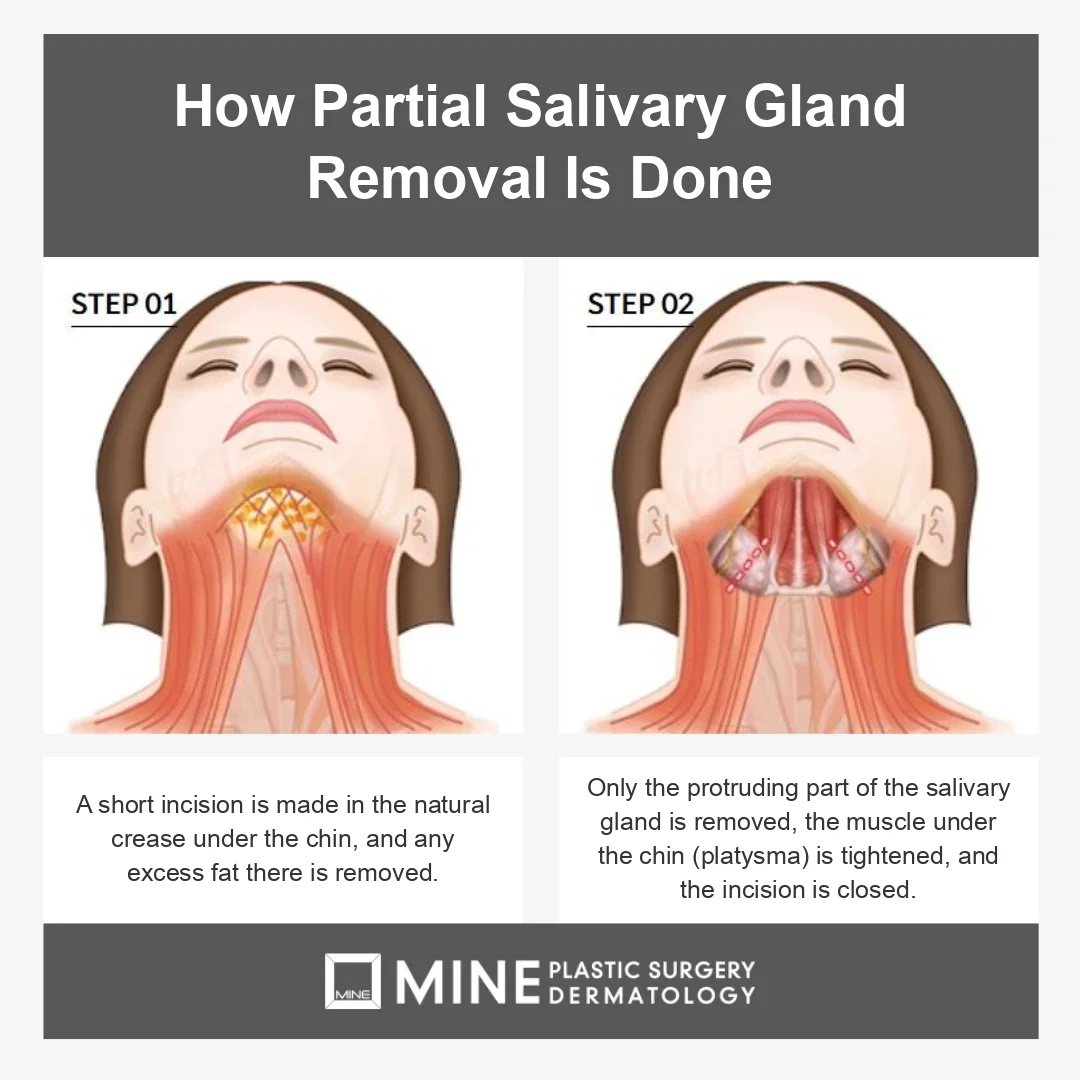
How much is removed is not a guess. Surgical literature describes a reference line drawn from the lowest point of a small muscle under the jaw (the front belly of the digastric) to the lower border of the jawbone; the part of the gland that bulges below that line is what gets removed. In one published MRI case, gland volume fell from 7.6 mL to 5.4 mL six months after surgery.
Side-by-Side Comparison Table
Here is the salivary gland Botox vs surgery comparison in one table:
| Factor | Salivary gland Botox | Partial gland removal |
|---|---|---|
| Method | Non-surgical injection | Surgery through a short under-chin crease incision |
| Anesthesia | Local, topical, or none | Sleep sedation or general anesthesia |
| Procedure time | About 10–15 minutes | About 1–1.5 hours |
| How long results last | 4–6 months on average | The removed portion does not grow back |
| Repeat treatment | Needed regularly | Not needed for the treated gland |
| Return to daily life | Same day | Social return in about 1–2 weeks |
| Scar | None | Small scar hidden in the under-chin crease |
| Burden over time | Each session is light, but sessions add up | One operation, no repeat sessions |
| Best fit by severity | Mild to moderate bulge | Moderate to severe bulge |
| Degree of jawline change | Moderate | Clear, lasting change |
| Risk level | Low | Moderate (general surgical risks) |
Key takeaway: In salivary gland Botox vs surgery, Botox is quick and temporary, while partial removal is a one-time operation whose effect on the treated gland stays.
Who Each Option Suits: Matching the Choice to Severity and Lifestyle
There is no single right answer. The better choice depends on how large the bulge is, how much downtime you can take, and how you feel about repeat visits.
When Botox Makes More Sense
- Your bulge is mild to moderate.
- You feel anxious about surgery and anesthesia.
- You want to see how a smaller gland changes your jawline before committing.
- You have a short-term goal, such as a wedding or a photo shoot.
- You cannot take any time off work.
- You prefer a treatment that leaves no scar at all.
When Surgery Makes More Sense
- The bulge is severe and your jawline looks clearly blunted.
- You have had two or three rounds of Botox and were not satisfied.
- You want a lasting fix and would rather stop repeating injections.
- You are planning double-chin liposuction or a neck lift and want one recovery.
- You can set aside about 1–2 weeks of social downtime.
In my clinical experience, many patients come in convinced the bulge is “just fat,” and are surprised to see the gland on ultrasound. That single finding often changes which option fits.
Key takeaway: The salivary gland Botox vs surgery choice follows severity first and lifestyle second.
Salivary Gland Botox vs Surgery Over 5 Years: Counting Sessions, Not Prices
Patients rarely ask how many times they will need to come back. Yet this is where salivary gland Botox vs surgery differs the most, so it helps to count the visits up front.
How Often Botox Must Be Repeated
Because the effect fades after about 4–6 months, keeping the result means returning for injections 2–3 times a year. At one session every 4–6 months, maintaining Botox means about 10–15 sessions over five years, compared with a single operation.
| Time frame | Botox (every 4–6 months) | Partial gland removal |
|---|---|---|
| Year 1 | About 2–3 sessions | 1 operation + early follow-up visits |
| Year 3 | About 6–9 sessions in total | No repeat sessions for the treated gland |
| Year 5 | About 10–15 sessions in total | No repeat sessions for the treated gland |
What One Operation Involves Over Time
Surgery asks for more at the start: the operation, a follow-up visit for stitch removal on day 7, and a few weeks of careful aftercare. After that, the removed portion of the gland does not need repeat treatment.
To be honest about it, surgery fixes the gland, not time. Skin laxity, fat changes and ageing continue on their own, so the rest of the jawline can still change over the years.
Some patients are perfectly happy with maintenance Botox, and that is a valid choice. The point is simply to know the commitment before you start.
Key takeaway: When you weigh salivary gland Botox vs surgery over five years, compare roughly 10–15 visits for injections with one operation and its early follow-ups.
A Staged Approach: Why Many Patients Try Botox First
You do not have to settle salivary gland Botox vs surgery on day one. We usually suggest a step-by-step path that moves from the least invasive option to surgery only when it is clearly needed.
Step 1–2: Accurate Diagnosis and Severity Grading
Step 1 is finding out what the bulge actually is: fat, gland, or both. Ultrasound shows the size and position of the gland directly. For more on this, read our guide to telling a double chin apart from a salivary gland bulge.
Step 2 is grading the bulge as mild, moderate or severe, looking at the neck from the front, the side and from below.
Step 3: A Botox Trial for Mild to Moderate Cases
For mild to moderate cases, a Botox trial is a low-commitment way to see how much a smaller gland improves your jawline. If you like the result, you can simply keep it up with regular sessions.
Step 4: When to Move to Surgery
If two or three rounds of Botox are not enough, or the bulge was severe from the start, surgery becomes the logical next step. Our article on what to do when salivary gland Botox isn’t working covers this situation in more detail.
Interestingly, the two treatments can also work together. During partial removal, some surgeons inject a small dose of botulinum toxin into the cut surface of the remaining gland to slow saliva production for a while. A 2025 review in Aesthetic Surgery Journal reported that this step kept saliva pooling and fistula (a small leak of saliva through the wound) to about 2.4% of cases.
Key takeaway: Salivary gland Botox vs surgery is often not either/or; a staged plan lets Botox answer the question before surgery is considered.
When the Gland Isn’t the Only Cause: Combination Decisions
An under-jaw bulge often has more than one cause. When it does, Botox alone rarely solves the problem, which is the main reason to diagnose before choosing.
Gland + Fat
If there is excess fat as well as an enlarged gland, partial gland removal can be combined with under-chin liposuction in the same session. You go through one recovery instead of two.
Gland + Loose Skin
When the skin under the jaw has lost firmness, removing part of the gland may not be enough on its own. In that case, combining it with a mini neck lift can tighten the skin and refine the neck line together.
Gland + a Small or Retruded Chin
A small or set-back chin can make the gland look more prominent. Here, chin advancement surgery (genioplasty) can be planned alongside gland reduction to rebalance the lower face.
Key takeaway: In mixed cases, the salivary gland Botox vs surgery question becomes a question of which combination fits your anatomy.
Recovery and Precautions: What Each Choice Asks of You
Recovery is one of the biggest practical differences in salivary gland Botox vs surgery. Here is the short version for each.
After Botox
- Do not lie down for 4 hours after the injection.
- Avoid saunas and hard exercise on the day of treatment.
- Do not massage or press the area.
- Wait 2–3 days before drinking alcohol.
Mild bruising may appear for 1–3 days. Rarely, there can be temporary dry mouth or swallowing discomfort.
After Partial Gland Removal
- Wear the compression garment 24 hours a day for 7 days, then keep wearing it at home and while sleeping from day 8.
- Stitches are removed on day 7.
- Use cold compresses for 3 days, then switch to warm compresses.
- Light walking is fine after 1–2 weeks.
- Avoid strenuous exercise, saunas, alcohol and smoking for 1 month.
Most people return to social life in about 1–2 weeks. Swelling settles over 2–4 weeks, and the final result is judged at 3–6 months.
Risks in Perspective
In a 112-patient study (Mendelson, 2015), saliva pooling (4.5%) resolved within 4 weeks and temporary lower-lip weakness (4.5%) recovered within 3 months, with no permanent dry mouth. In the same study, bleeding that needed a second operation occurred in 1.8% of patients.
Dry mouth is rarely a problem because your other salivary glands (the parotid glands in front of the ears and the sublingual glands under the tongue) keep working. A salivary gland surgery textbook also notes that partial removal preserves resting saliva better than removing the whole gland.
Contact the clinic right away if you notice a fever of 38°C (100.4°F) or higher, sudden swelling, worsening pain, pus or a bad smell, the wound opening, or any difficulty breathing.
Seen side by side, salivary gland Botox vs surgery is a trade-off: no downtime but repeat visits on one side, and a short recovery followed by a lasting change to the treated gland on the other.
Salivary Gland Botox vs Surgery: Frequently Asked Questions
How long does salivary gland Botox last compared with surgery?
Botox usually becomes visible at about 2 weeks, peaks at about 1 month, and lasts 4–6 months on average before it needs repeating. With surgery, the removed portion of the gland does not grow back, although normal ageing and fat changes in the neck continue separately.
Is salivary gland Botox vs surgery a choice I have to make right away?
No. Most patients follow a staged approach: an ultrasound diagnosis, severity grading, then a Botox trial for mild to moderate cases. Surgery is considered after two or three unsatisfying rounds, or straight away when the bulge is severe.
How many Botox sessions would I need over five years?
At one session every 4–6 months, you would need about 2–3 sessions a year, or roughly 10–15 sessions over five years. Surgery, by comparison, is one operation plus a few follow-up visits in the first weeks.
Will I have a dry mouth after Botox or partial gland removal?
It is rare. Your parotid and sublingual glands keep producing saliva, and partial removal preserves resting saliva better than full removal. In a 112-patient study, no one developed permanent dry mouth after surgery.
Can partial gland removal be done together with double-chin liposuction or a neck lift?
Yes. When fat or loose skin also contributes to the bulge, combining procedures is common and means you go through a single recovery period instead of two.
Planning Your Next Step with Dr. Lee Sung-wook in Seoul
The salivary gland Botox vs surgery decision is best made with an ultrasound in front of you. During an in-person or online consultation, Dr. Lee Sung-wook, a board-certified plastic surgeon, checks what is causing your bulge and explains whether Botox, surgery or a combined plan suits you.
International patients can reach us through the online consultation form, WhatsApp, or email, or call +82-2-516-1175. Learn more about salivary gland reduction at MINE before your visit.
In short, salivary gland Botox vs surgery comes down to severity, how much downtime you can take, and whether you prefer repeat visits or one operation.
Written and medically reviewed by Dr. Lee Sung-wook, Board-Certified Plastic Surgeon, Mine Plastic Surgery, Seoul.
※ This content is for informational purposes only and does not replace professional medical advice, diagnosis, or treatment. Individual results may vary, and side effects may occur. Please consult with a board-certified plastic surgeon for personalized advice.