EN


Salivary gland surgery side effects are the temporary or, rarely, lasting problems that can follow removing part of the submandibular gland — most often swelling and bruising, and less often lower-lip weakness, a hematoma or a sialocele.
You may have noticed a firm bulge under your jawline that dieting, lifting treatments or even salivary gland Botox never really fixed. Surgery looks like the answer, but one question keeps coming back: “If part of the gland is removed, will something go wrong?”
I’m Dr. Lee Sung-wook, a board-certified plastic surgeon at MINE in Gangnam, Seoul. In my clinical experience, this is the very first question patients ask in a salivary gland consultation. So this article is built around three practical points: how often each of the salivary gland surgery side effects actually happens according to published studies, what the surgical technique does to prevent them, and which signs after surgery mean you should call your surgeon.
What Salivary Gland Reduction Involves (and Why It Matters for Risk)
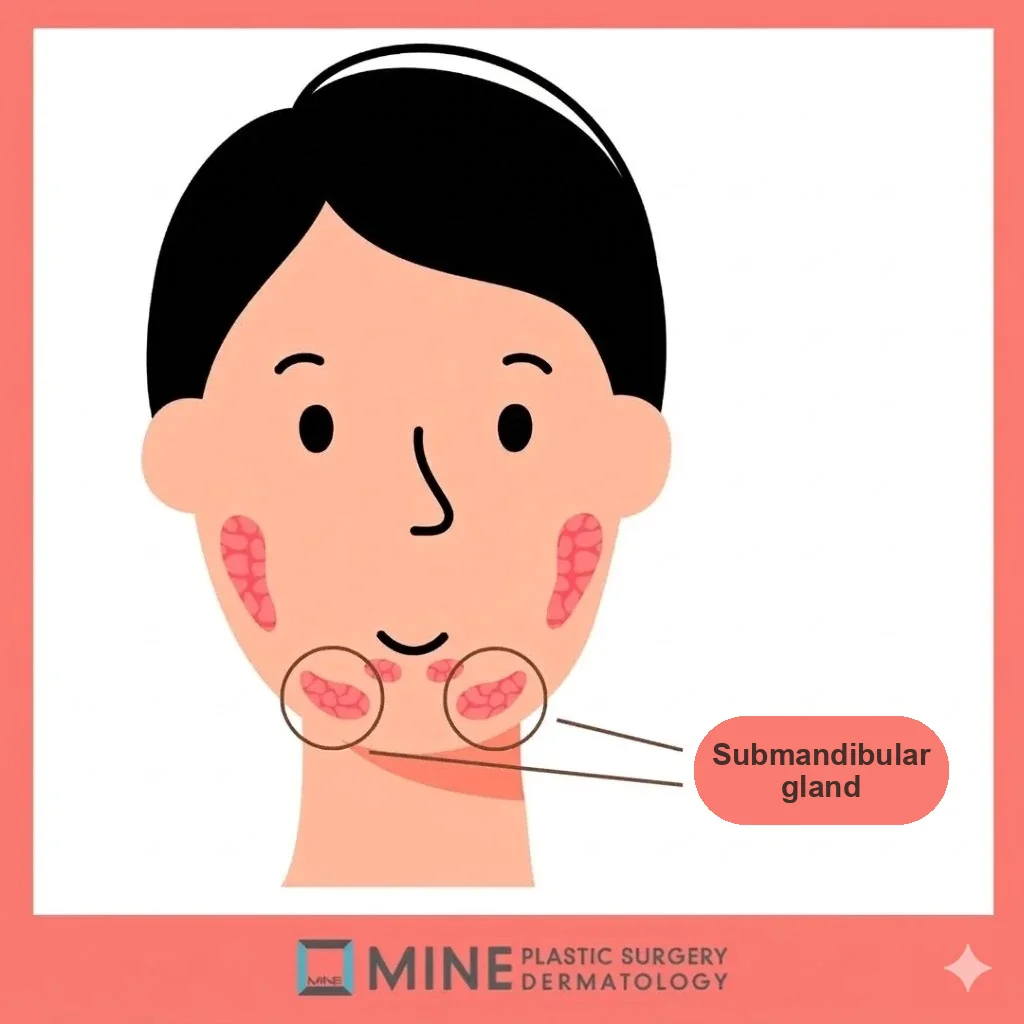
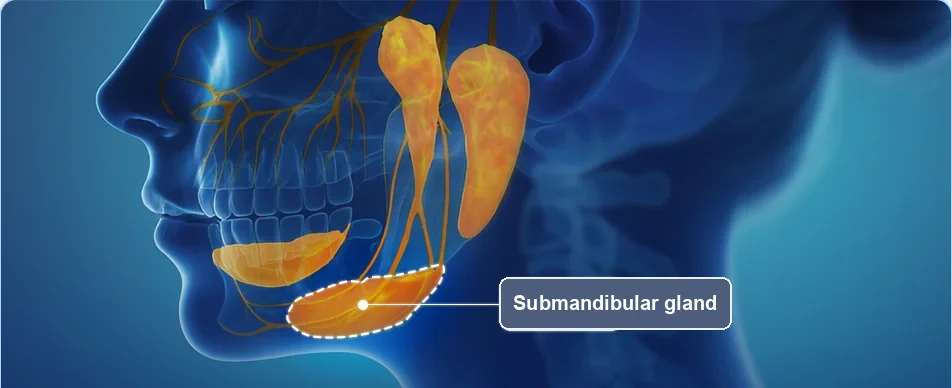
The submandibular glands are a pair of salivary glands that sit just under the jawbone, one on each side. When they are large or have dropped with age, they push the skin out and blur the line between jaw and neck. Many people mistake this bulge for fat or a double chin. Knowing where the gland sits is the first step to understanding salivary gland surgery side effects.
Partial reduction for appearance vs. full removal for disease
Aesthetic salivary gland reduction removes only the part of the gland that bulges below the jawline. That is a very different operation from the full gland removal performed for disease, such as salivary stones or tumors, where the whole gland has to come out.
This difference matters when you read about salivary gland surgery side effects online. Many of the frightening numbers come from full, disease-driven removal. A standard textbook on salivary gland surgery reports that in traditional total removal of the gland, injury to the nerve that moves the lower lip has been reported in 7.7–36% of patients and bleeding complications in 2–10%. Those figures describe a different procedure and should not be applied directly to aesthetic partial reduction.
A plastic surgery textbook makes the same distinction: complete removal risks nerve injury and can leave a visible dip under the jaw, while in the experience reported so far, subtotal (partial) removal has produced no cases of nerve injury, hematoma, seroma (a fluid pocket), salivary fistula (a leak of saliva through the skin) or gustatory sweating (sweating when eating).
The structures that sit next to the gland
Knowing the neighbors of the gland explains almost every possible complication:
- Marginal mandibular nerve — a small branch of the facial nerve that moves the lower lip. It runs along the jawline and can dip just below it, which is why it is the nerve surgeons protect most carefully.
- Lingual nerve — the nerve that gives the tongue its feeling. It lies deeper and runs alongside the gland’s saliva duct (Wharton’s duct).
- Hypoglossal nerve — the nerve that moves the tongue. It also lies deeper than the part removed in an aesthetic reduction.
- Blood vessels — the gland has its own blood supply deep in the neck, which is why careful bleeding control matters.
Who Is a Good Candidate — and Who Carries Higher Risk
Typical candidates
Salivary gland reduction is usually considered when:
- A bulging gland blurs the jawline even though you are not carrying much fat under the chin
- The gland became more visible after facial contouring surgery or weight loss
- The tissues that hold the gland up have loosened with age, so it sags below the jaw
- Salivary gland Botox had little effect, or the effect wore off quickly
Previous neck lift: why the nerve risk rises
Your personal risk of salivary gland surgery side effects depends partly on your history. The most important risk factor is previous neck surgery. Scar tissue from an earlier neck or face lift makes the layers harder to separate and the nerve harder to see. In the 112-patient series published by Mendelson (2015) in Plastic and Reconstructive Surgery, temporary lower-lip weakness occurred in 2.5% of first-time neck lifts but in 10% of revision cases — roughly four times higher.
If you have had any neck surgery before, tell your surgeon at the consultation. Please also list every blood thinner, painkiller and supplement you take. Some of them increase bleeding, and your surgeon may ask you to pause them before surgery to lower the chance of a hematoma.
How MINE’s Technique Is Designed to Prevent Side Effects
Most salivary gland surgery side effects have a clear mechanical cause. Prevention starts by designing the operation around those causes. You can read about the procedure itself on our page about salivary gland reduction at MINE.
A 2.5–2.8 cm incision in the first neck crease
At MINE, the incision is about 2.5–2.8 cm, placed in the first natural neck crease under the chin — the fold that appears when you look down. The line follows a crease that is already there, so the scar sits where it is least likely to be noticed. Through this opening, the surgeon lifts the skin and the thin neck muscle layer to reach the enlarged gland.
Direct vision of the gland and nearby nerves
Because the gland is approached from directly below, the surgeon can see it and the surrounding structures instead of working blindly. A 2025 review in the Aesthetic Surgery Journal concluded that careful planning, meticulous mobilization of the gland and proper exposure are essential for minimizing complications. The same review notes that when heat-based instruments are used, cooling the area with cold saline afterward helps protect the surrounding tissue.
Removing only the protruding part
Only the portion of the gland that bulges below the jawline is removed. The deeper part stays in place and keeps working. This is the main reason permanent dry mouth is so rare after aesthetic reduction, and it also keeps the surgery away from the deeper lingual and hypoglossal nerves.
Here is how the technique addresses the main causes of these complications:
| Possible side effect | Main cause | How the technique responds |
|---|---|---|
| Lower-lip weakness | Stretching or heat near the marginal mandibular nerve | Direct vision, gentle retraction, working away from the nerve’s path |
| Hematoma | Bleeding from vessels deep in the neck | Meticulous bleeding control before closing |
| Dry mouth | Removing too much gland tissue | Partial removal leaves working gland tissue |
| Visible scar | Incision position and closure | Short incision hidden in a natural crease |
Same incision when combined with double chin surgery
Many patients have both an enlarged gland and a double chin from fat or a loose platysma (the thin sheet of muscle in the front of the neck). At MINE, fat removal, platysma tightening and partial gland removal can be done through the same incision, so no extra cut is needed. The risks of both procedures then apply, so it is worth also reading about double chin surgery side effects.
6 Salivary Gland Surgery Side Effects: How Common and How They Resolve
The two most useful sources on salivary gland surgery side effects after aesthetic reduction are a 112-patient case series and a 2025 systematic review that pooled 11 studies. Here is the summary, followed by each side effect in plain English.
| Side effect | How often (studies) | Usually resolves | What’s done |
|---|---|---|---|
| Swelling & bruising | Expected in almost everyone | Mostly 1–2 weeks; slight swelling up to about 4 weeks | Cold compress for the first 48 hours, head elevated |
| Neck firmness (induration) | About 21% in studies that reported it (systematic review) | Softens over weeks | Observation |
| Temporary lower-lip weakness | About 2.5–4.5% (Mendelson 2015; review 3.97%) | Every case resolved by 3 months in the 112-patient series | Reassurance; Botox to the other side for symmetry if needed |
| Hematoma | About 1–2% (review 1.15%; 1.8% needed early reoperation in Mendelson 2015) | Treated promptly | Urgent drainage when large — it can press on the airway |
| Sialocele | About 1.3–4.5% | Weeks | Needle drainage and compression |
| Permanent dry mouth | None in 112 cases; pooled about 0.1% (1 case, resolved) | — | Hydration; see below |
Sources for the complication figures above: Mendelson (2015), 112 consecutive cases; 2025 systematic review in Aesthetic Surgery Journal (Morel et al.).
1. Swelling, bruising and neck firmness
Swelling and bruising are the most common salivary gland surgery side effects, and they are a normal reaction of tissue to surgery rather than a complication. Most of it settles within 1–2 weeks, and mild swelling can last up to about 4 weeks without getting in the way of daily life. Some patients also feel that the area under the jaw is firm or slightly lumpy. The 2025 systematic review found this firmness (induration) in about 21% of patients in the studies that recorded it, and it gradually softens over the following weeks.

2. Temporary lower-lip weakness (marginal mandibular nerve)
Of all the possible complications, this is the one patients worry about most. If the marginal mandibular nerve is stretched or bruised during surgery, one side of the lower lip may not pull down fully when you smile or show your lower teeth. At rest, the face usually looks normal.
In most cases this is a neurapraxia — the nerve is stunned by pressure, not cut — so it recovers on its own. In a series of 112 aesthetic submandibular gland reductions, Mendelson (2015) found temporary lower-lip weakness in 4.5% of patients, and every case had resolved by 3 months. The 2025 review pooled a transient nerve injury rate of 3.97%. While waiting, a small dose of Botox to the opposite side of the lip can balance the smile; this was used in three patients in that series.
The same review points out that temporary lip weakness after neck surgery does not always come from the gland step. Releasing the jaw ligament or tightening the platysma can also cause it, and this type also usually settles without treatment.
3. Hematoma (bleeding under the skin)
A hematoma is a collection of blood under the skin. It is uncommon, but it is the complication you most need to recognize. A 2025 systematic review in the Aesthetic Surgery Journal pooled a hematoma rate of 1.15% after submandibular gland reduction, and in the Mendelson series 1.8% of patients needed an early return to the operating room to manage bleeding.
Why does it matter so much? Bleeding deep in the neck has limited room to spread and can press on the airway. Mendelson described one potentially fatal case. That is why rapidly increasing, one-sided neck swelling is at the top of the warning-signs list below.
4. Sialocele (a soft pocket of saliva)
A sialocele is a soft, fluid-filled swelling that forms when saliva from the remaining gland tissue collects under the skin. It usually appears days to weeks after surgery as a squashy bulge under the jaw. Pooled studies put it at about 1.33%, and the Mendelson series at 4.5%.
It is benign. It is usually treated by drawing the fluid out with a needle and applying pressure, and it settles over a few weeks. A bland, “salivary-rest” diet in the early weeks helps, because sour and strongly flavored foods make the glands produce more saliva. Our guide to foods to avoid after salivary gland reduction lists practical choices.
5. Dry mouth
Dry mouth is one of the salivary gland surgery side effects people fear most, but a permanently dry mouth is very rare after a partial reduction. No patient in the 112-case series reported a permanent dry mouth, and pooled studies put dry mouth near 0.1% — a single case, which resolved. Part of the gland stays in place, and the other salivary glands, especially the parotid glands in front of the ears, supply a large share of saliva when you eat. For the full explanation, see our article on how saliva production adapts after gland removal.
6. Infection and scarring
Wound infection is one of the less common complications after aesthetic reduction. Signs include redness, warmth, pus or fever, and it is treated with antibiotics prescribed by your surgeon.
The scar is short and placed in the first crease under the chin, so it usually becomes hard to see as it matures. If the scar is your main concern, read more about where the scar sits and how it fades.
What about the tongue? The lingual nerve lies deeper than the part of the gland removed in an aesthetic reduction, so it is rarely exposed during this surgery.
Recovery Timeline: What’s Normal Week by Week
Knowing what normal recovery looks like makes it much easier to spot problems that need attention.
| Time after surgery | What’s normal | What you do |
|---|---|---|
| First 48 hours | Swelling builds and peaks; mild tightness | Cold compress 15–20 minutes at a time, head elevated, medication as prescribed |
| Weeks 1–2 | Most swelling and bruising settle | Soft, bland diet; avoid sour foods; no strenuous exercise |
| Weeks 3–12 | Firmness softens; any temporary lip weakness recovers | Follow-up checks; report a soft fluid pocket |

First 48 hours
Swelling usually peaks in the first two days. Apply a cold compress for 15–20 minutes at a time and keep your head raised above your heart, including when you sleep. If a drain was placed, it is typically removed within 1–3 days at a check-up.
Weeks 1–2
Most swelling and bruising fade during this period. Keep eating soft, mild food and avoid lemons, vinegar and other sour foods that make saliva flow. Wear any compression garment exactly as instructed, and avoid heavy exercise until your surgeon clears you.
Weeks 3–12
Remaining firmness softens gradually, and the jawline becomes easier to see as swelling clears. If you had temporary lower-lip weakness, it should be improving; in the 112-patient series, every case had resolved by 3 months.
Warning Signs: When to Call Your Surgeon
This is the part I most want international patients to remember once they fly home. Sort any symptoms you notice into one of these levels:

Call immediately: rapidly growing one-sided neck swelling, pressure, trouble breathing or swallowing
These can be signs of a hematoma. Contact your surgeon at once, and if you have difficulty breathing, go to the nearest emergency department without waiting.
Call the same day: redness, heat, pus or fever
These suggest infection. Send a photo to the clinic and follow the advice you receive the same day.
Mention at your next visit: a soft fluid pocket under the jaw
A soft, painless bulge that appears days to weeks after surgery is usually a sialocele. It is not an emergency, but it should be checked and drained if needed.
Schedule a follow-up: a lower lip that moves less on one side when you smile
This is usually temporary nerve weakness. Agree on a follow-up schedule with your surgeon; most cases recover within 3 months.
Normal and expected: 1–2 weeks of swelling and bruising, weeks of firmness
Symmetric swelling and bruising that slowly improve, and a firm feeling under the jaw that softens over weeks, are part of normal healing. Most of what patients notice falls into this group.
To lower the risk of salivary gland surgery side effects, avoid blood thinners and supplements as instructed, skip strenuous exercise early on, stick to the salivary-rest diet and wear any compression garment as directed.
Salivary Gland Surgery Side Effects: FAQ
How common are side effects after salivary gland surgery?
Swelling and bruising are expected in almost everyone. Specific complications are uncommon: in aesthetic reduction studies, temporary lip weakness occurred in about 2.5–4.5% of patients, hematoma in about 1–2% and sialocele in about 1.3–4.5%. Most salivary gland surgery side effects are temporary.
Will I have a dry mouth after salivary gland reduction?
Permanent dry mouth is very rare. No patient in a 112-case series reported it, and pooled studies put dry mouth near 0.1%, with that single case resolving. Part of the gland remains, and the other salivary glands keep working.
How long does nerve weakness last after submandibular gland surgery?
In the 112-patient series, every case of temporary lower-lip weakness had resolved by 3 months. The risk is higher if you have had a previous neck lift, so tell your surgeon about any earlier neck surgery.
When is swelling after salivary gland surgery not normal?
Swelling that grows quickly on one side, feels tense, or comes with trouble breathing or swallowing is not normal. It can mean a hematoma, so contact your surgeon immediately or seek emergency care.
Can salivary gland and double chin surgery be done together safely?
Yes. At MINE both can be done through the same 2.5–2.8 cm incision in the first neck crease, with no extra cut. The possible side effects of both procedures apply, which your surgeon reviews with you at consultation.
Talk to Dr. Lee Before You Decide
Your own risk depends on the size and position of your glands, whether you have had neck surgery before, and whether a double chin correction is planned at the same time. At consultation, I review these with you and explain which salivary gland surgery side effects matter most in your case and how we plan to prevent them.
If you live abroad, you can start with an online consultation or message us on WhatsApp with front and side-profile photos, or call +82-2-516-1175. We also explain what to watch for after you fly home and how to reach us during recovery.
Written and reviewed by Dr. Lee Sung-wook, Board-Certified Plastic Surgeon, MINE Plastic Surgery & Dermatology | 813 Nonhyeon-ro, Gangnam-gu, Seoul | +82-2-516-1175
Sources: Mendelson BC, Tutino R. Submandibular gland reduction in aesthetic surgery of the neck: review of 112 consecutive cases. Plast Reconstr Surg. 2015;136:463–471. Morel SBA et al. Aesthetic submandibular gland resection: a review of complication incidence and prevention. Aesthetic Surgery Journal. 2025. Salivary gland surgery and plastic surgery textbooks.
※ This content is for informational purposes only and does not replace professional medical advice, diagnosis, or treatment. Individual results may vary, and side effects may occur. Please consult with a board-certified plastic surgeon for personalized advice.