EN


Double chin liposuction pain is mostly felt after surgery, not during it: a bruised, tight ache that peaks on the day of the procedure, eases to mild discomfort within 2–3 days, and is usually minimal by about one week. For most people it is manageable with ordinary oral pain medication.
If you have been reading chin lipo reviews late at night, you are probably trying to answer three questions. How much will it hurt? How soon will I look presentable? And will I still be happy with it six months from now?
I’m Dr. Lee Sung-wook, a board-certified plastic surgeon in Seoul, and in this article I answer those three questions from what I see in my own practice, checked against plastic surgery textbooks. There are no invented testimonials here — just the typical course, explained plainly. If you first want to know what liposuction can and can’t fix under the chin, start there and come back.
What Chin Lipo Actually Treats — and Why the Cause Decides Satisfaction
Before talking about double chin liposuction pain or recovery, it helps to know what the operation is for. Chin liposuction removes fat that sits just under the skin beneath the jaw, using a thin tube called a cannula inserted through a tiny opening. It treats fat — and only fat. That simple fact explains most happy reviews and most disappointed ones.
Three causes of a double chin: fat, skin laxity, jaw structure
- Fat under the skin. Some people are genetically prone to storing fat under the chin. That is why slim people can still have a double chin that no diet seems to touch.
- Loose skin. With age, collagen (the protein that keeps skin firm) declines and the skin under the jaw starts to sag, which looks like a double chin even when there is little fat.
- Jaw structure. A lower jaw that sits further back, or a short chin, blurs the line between the face and the neck.
In my practice, most people I see have a mix of these causes rather than just one. That is the reason I never start with “how much fat should we remove?” The first step is always finding out what is actually causing the fullness.
Why “it’s just fat” is the most common misunderstanding
Many people assume the whole bulge under the jaw is fat. In reality, enlarged submandibular glands (the salivary glands that sit just under the jawbone) are a more common cause than most people expect. Surgical literature shows cases where these glands became more visible after fat was removed from around them, because the fat had been hiding them. When glands are part of the problem, salivary gland reduction may need to be considered alongside, or instead of, liposuction.
Dr. Lee’s key point: A double chin can come from fat, loose skin or bone — often a combination. Surgery without a clear diagnosis of the cause is the most common route to a disappointing result.
Who Tends to Be Happiest With the Result
Satisfaction after chin lipo depends less on the surgery day and more on whether the operation matched the problem.
The ideal candidate, according to plastic surgery textbooks
Plastic surgery textbooks describe the ideal patient for neck liposuction as someone relatively young, with good skin elasticity and fat that is localized under the chin and along the jaw. Once the fat is released from the muscle underneath, healthy skin shrinks back and settles onto the new contour — like a stretchy fabric relaxing back into shape.
The same textbooks note that when the chin itself is small or set back, adding chin surgery (genioplasty, which brings the chin bone forward) can make the result considerably stronger. In other words, if bone is part of the cause, liposuction alone will only take you part of the way.
How MINE diagnoses before recommending surgery
At MINE, a double chin consultation always covers three things together: how much fat there is and where it sits, how elastic the skin is, and how the jaw is shaped. For some people, liposuction alone is enough. Others get a better line when it is combined with salivary gland reduction or a mini neck lift.
Technique matters too. Good chin lipo is not about removing as much fat as possible. Over-suctioning can leave the skin uneven or create a hollow under the jaw. The goal is to remove an appropriate amount evenly, from a consistent layer, so the skin can drape smoothly. You can read more about double chin liposuction at MINE on our procedure page.
Does Double Chin Liposuction Pain Start During Surgery? What It Feels Like, Day by Day
Does chin lipo hurt? Most people feel very little during surgery because it is done under sedation with local anesthesia. Double chin liposuction pain shows up afterward as a bruised, tight ache, and for most patients it is controlled with oral pain medication rather than anything stronger.
During the procedure: sedation and local anesthesia
With sedation, you are relaxed and drowsy, and the area is numbed with local anesthetic. Most patients remember little of the operation itself. The discomfort, when it comes, starts in the days that follow, as the numbing wears off and the tissue starts to heal.
Pain by period
The table below shows the typical pattern of double chin liposuction pain I see in practice. The right-hand column summarizes how patients commonly describe it to me at follow-up visits.
| Period | Typical discomfort | How patients commonly describe it |
|---|---|---|
| Day of surgery | Moderate | A bruised, achy feeling under the jaw |
| Days 2–3 | Mild | Manageable with pain medication; normal activity at home is possible |
| About 1 week | Minimal | Tender only when pressed |
| 2 weeks and beyond | Generally none | Back to a normal routine |
Put simply, double chin liposuction pain typically peaks on the day of surgery, becomes mild by days 2–3 and is minimal by about one week. People who tolerate pain less well may feel each stage a little more, so treat the table as a typical range rather than a promise.
Why the compression garment bothers people more than the pain
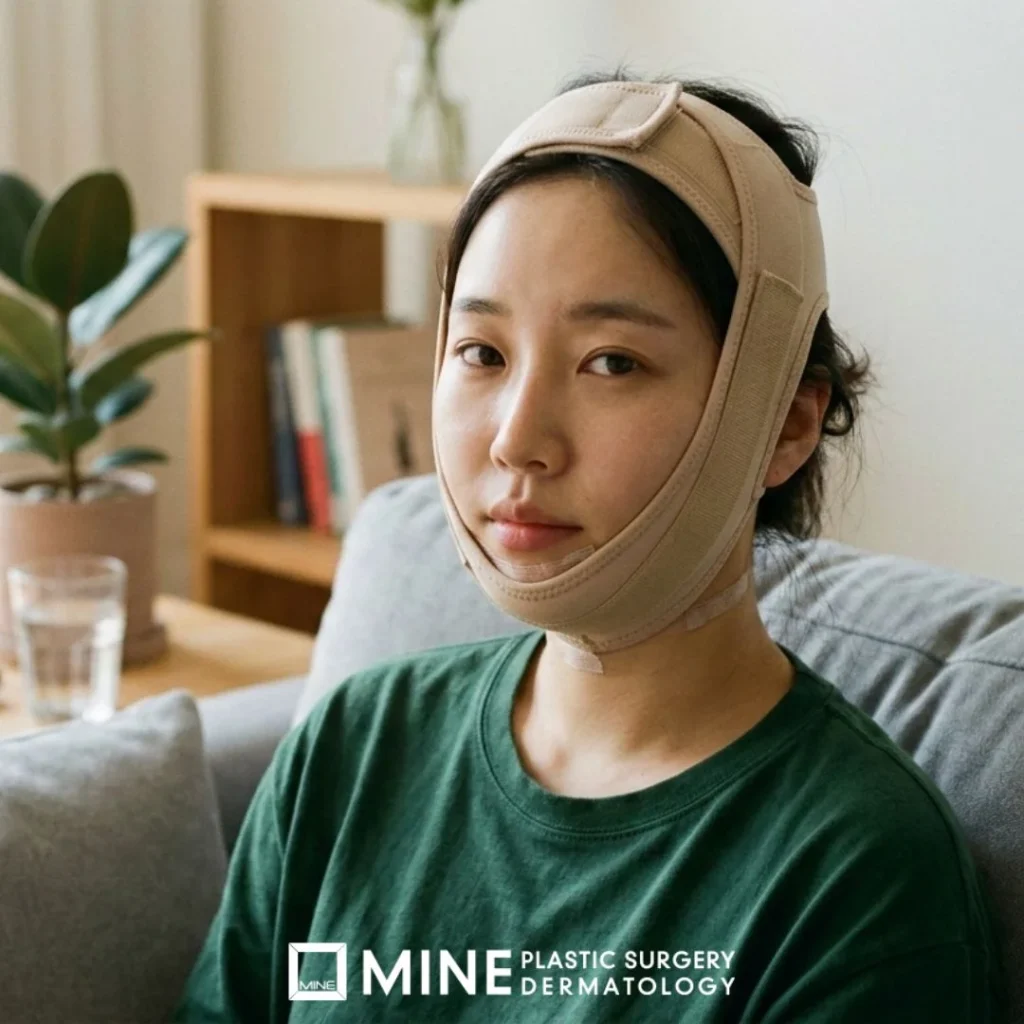
When patients tell me what they found hardest, it is usually not double chin liposuction pain at all — it is the compression garment. The chin strap feels tight and a little stuffy, especially at night. But it does real work: steady pressure limits swelling and bruising and helps the skin settle smoothly onto the new jawline. Wearing it as instructed, even when it is annoying, is one of the most useful things you can do for your result.
Back to Daily Life: A Realistic Timeline From Day 3 to Month 6
Plastic surgery textbooks note that neck liposuction swelling generally begins to decrease after 3–4 days, and that a compression garment is worn for at least 2 weeks, sometimes for up to 2–3 months depending on how healing goes. General liposuction texts describe a return to work as early as 3–4 days, or at about 2 weeks, depending on the procedure. Here is how that looks for chin lipo specifically.
Days 3–5: visible swelling and bruising
This is when swelling and bruising are most noticeable. If you can work from home, resting for this stretch is usually enough. Pain at this point is mild for most people, and short walks are encouraged.
Days 7–10 (chin liposuction after 1 week): bruising fades yellow
Around a week after chin liposuction, bruises turn yellowish and start to fade, and in my experience most bruising is gone within 7–14 days. Discomfort is usually minimal by now. A scarf, a high collar or a little concealer usually covers what is left, so many people return to in-person work and social plans in this window.
Weeks 3–4: most visible swelling settled
In my experience, most of the visible swelling has settled by 3–4 weeks, and the pain is generally a memory. This is often when friends and colleagues start to notice that your face looks slimmer, even if they can’t say exactly why.
Months 3–6: final jawline
Over the following months the skin keeps contracting and the jawline sharpens. The final jawline is judged at 3–6 months, not before. For the day-by-day aftercare routine, see our full recovery and aftercare guide.
How Satisfaction Changes Over Time
Chin lipo is one of those operations where people usually like the result more as time goes on — but the first two weeks can be unsettling if you don’t know what to expect.
Weeks 1–2: “Why does it look bigger?”
Right after surgery, swelling and a firm, slightly lumpy feeling can make the area under the jaw look less defined or even fuller than before. This worries people, but it is a normal part of healing. Tissue that has just been treated holds fluid, and it takes time to soften. Soreness usually fades within this window, well before the swelling does.
Months 1–3: the line emerges
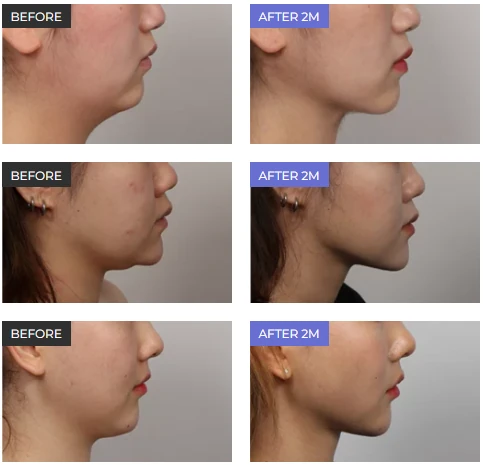
As the swelling drains away, the outline of the jaw gradually appears. At follow-up visits, many patients tell us they like the result more as the swelling settles. The changes they notice most are less volume under the chin and a cleaner side profile — the view that bothered them in photos.
Months 3–6: the fair time to evaluate
By now the skin has had time to contract onto the new contour, and this is when a fair judgment can be made. Realistic expectations help a great deal here. Chin lipo does not change the basic shape of your face; it removes the soft fullness under the jaw so your whole profile looks tidier.
Dr. Lee’s key point: Judge your chin liposuction result at 3–6 months. Early swelling is not the final result, so don’t panic in the first two weeks.
How to Read Double Chin Liposuction Pain and Results Reviews Realistically
Chin liposuction reviews online can be useful, but they mix very different people, causes and stages of healing. Pain, in particular, is described in very different ways. Reading reviews with a few filters in mind will tell you far more than star ratings ever could.
Jawline tidy-up, not a new face shape
Most positive reviews describe a cleaner jawline and a side profile that finally matches the front view. That is exactly what chin lipo does well. Reviews that expected a narrower, V-shaped face are often describing a different problem — width from the jaw muscles or bone — that fat removal cannot address.
Why some reviews are disappointed
A disappointing review often reflects a cause that liposuction can’t fix, rather than “bad surgery.” If the fullness came from salivary glands, loose skin or a set-back chin, removing fat will only help so much. Surgical literature describes patients whose enlarged submandibular glands became more noticeable after chin liposuction — the glands had been there all along.
Lifestyle matters too. A 2004 study by Rohrich and colleagues, published in Plastic and Reconstructive Surgery, found that liposuction patients who kept up a healthy diet and regular exercise were more likely to be satisfied with their result long term. Removed fat cells do not grow back, but significant weight gain can enlarge the ones that remain.
Five questions to ask of any review you read
- When was it written? A review at week 2 describes swelling; a review at month 6 describes the result.
- What was the cause? Fat, glands, loose skin or bone each respond differently.
- Was anything combined? Results after liposuction plus a neck lift or gland reduction aren’t comparable to liposuction alone.
- Did they wear the compression garment as instructed? Skipping it affects swelling and contour.
- Did their weight change? Gaining weight after surgery changes the outcome.
The same applies to double chin liposuction pain reports. Pain tolerance varies a lot between individuals, so one review saying “it barely hurt” and another saying “the first night was rough” can both be honest. Use the table above as the typical range.
Side Effects in Brief and Precautions Around Surgery
Side effects: the short version
Swelling, bruising, temporary numbness and, occasionally, contour irregularity are the main things to know. According to plastic surgery textbooks, numbness after liposuction is usually temporary and can take up to about 10 weeks to recover. Serious complications are uncommon; for the full list and what each one means, see our guide to chin liposuction side effects.
Before surgery checklist
- Stop smoking at least 2 weeks before. Smoking reduces blood flow, which slows healing and weakens the skin’s ability to tighten.
- Pause blood-thinning medicines and supplements about 1 week before. Aspirin, omega-3 and vitamin E can increase bleeding. Tell your surgeon about every medication you take.
- Plan your pain relief. Ask which pain medication to take so you have it at home before the first night.
- Set realistic expectations. Talk openly in consultation about what you want and what is achievable for your anatomy.
After surgery checklist
- Compression garment: wear it for at least 1–2 weeks, or as long as your surgeon advises.
- Sleep with your head raised: an extra pillow helps fluid drain and swelling settle.
- Avoid saunas, hot baths and strenuous exercise for 2–3 weeks: extra blood flow can make swelling and bruising worse.
- Keep your follow-ups: typically around 1 week, 1 month and 3 months after surgery.
In my view, aftercare — especially compression and regular follow-ups — meaningfully affects the final result. Plastic surgery organizations also stress that liposuction should be performed by a board-certified plastic surgeon with proper aftercare; the American Society of Plastic Surgeons overview of liposuction is a good general background read.
Is Chin Lipo Worth It? A Quick Self-Check
Is chin lipo worth it? For the right person, usually yes. The question is whether you are that person, and that comes down to your cause and your expectations.
Likely worth it if…
- You have localized fat under the chin that diet and exercise haven’t shifted.
- Your skin still has reasonable elasticity.
- You can accept a few days of soreness, about a week of visible bruising, and a wait of 3–6 months for the final line.
- Your weight is stable.
Consider something else first if…
- Loose skin or neck bands are the main issue: a mini neck lift or mini facelift addresses skin and muscle, which liposuction cannot tighten.
- Enlarged salivary glands are the cause: gland reduction targets the gland itself.
- Your chin is small or set back: the problem is bone, and chin surgery may be needed.
- Your face looks wide at the angle of the jaw: this is often the masseter (chewing) muscle, which responds to jaw Botox, not liposuction.
Lipo and masseter Botox treat different things — fat under the chin versus muscle width at the side of the jaw — so they are sometimes combined when both play a part.
Frequently Asked Questions About Double Chin Liposuction Pain
Does double chin liposuction hurt?
Very little during surgery, because it is done under sedation and local anesthesia. Double chin liposuction pain comes afterward as a bruised, tight ache that peaks on the day of surgery, is mild by days 2–3 and is minimal by about one week. Most people manage it with oral pain medication.
How long does chin lipo pain last?
Most double chin liposuction pain fades within about a week, although the area may stay tender when pressed for a little longer. Numbness is different: plastic surgery textbooks note it is usually temporary but can take up to about 10 weeks to recover.
When can I go back to work after chin liposuction?
Many people return to remote work after 3–5 days. In-person work and social plans are usually comfortable around 7–10 days, when any remaining bruising is easy to conceal. The final result is judged at 3–6 months.
Is chin lipo worth it compared with jaw Botox?
They target different problems. Jaw Botox relaxes the masseter muscle to slim width at the side of the jaw, while liposuction removes fat under the chin. A diagnosis of what is causing the fullness decides which one fits, and sometimes both are combined.
Are double chin liposuction results permanent?
Fat cells that are removed do not grow back, so the result is long-lasting. However, significant weight gain can enlarge the fat cells that remain, and skin sagging from aging is a separate process that may later need a lifting procedure.
How is the cost of double chin liposuction decided?
It depends on the area treated, whether other procedures are combined and the type of anesthesia. Because these vary from person to person, a quote is given after an in-person diagnosis.
Planning a Consultation at MINE
Patients who end up satisfied with chin lipo tend to have three things in common: an accurate diagnosis of the cause, a method matched to that cause, and consistent aftercare. Double chin liposuction pain is real but short-lived for most people; the bigger question is whether liposuction is the right tool for your jawline.
Read reviews as reference, but make your decision based on your own diagnosis. At MINE, we assess the fat, skin, salivary glands and jaw structure — including an ultrasound check where needed — before recommending any surgery. You can book an online consultation or call +82-2-516-1175 to arrange a visit.
※ This content is for informational purposes only and does not replace professional medical advice, diagnosis, or treatment. Individual results may vary, and side effects may occur. Please consult with a board-certified plastic surgeon for personalized advice.