EN


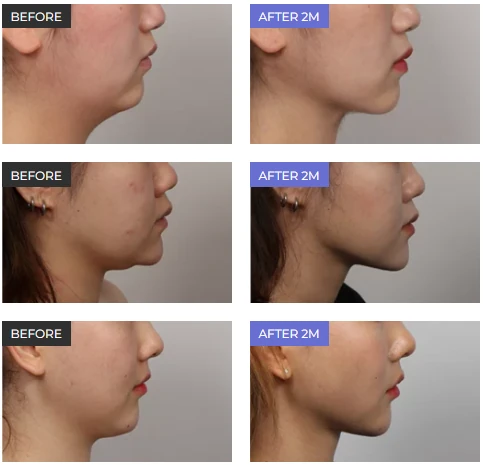
What is a double chin? A double chin is a fullness of the submental area — the space between the crease under your chin and the level of the hyoid bone — that blunts the angle between your jawline and neck. What fills that space can be fat, loose skin, bone position, a salivary gland or a lax platysma muscle.
“My weight is normal, so why does the skin under my chin fold?” Three or four patients ask me some version of that question every week. The fold itself is only the visible result. The real answer depends on what is sitting in that space.
This article answers the question “what is a double chin?” in precise terms: where it starts and ends, how to read your own chin-neck angle in a mirror, how the pattern differs in men, and which treatment direction fits each type. If you would rather read the five causes of a double chin explained in detail, that guide covers each one separately.
What Is a Double Chin? A Precise Anatomical Definition
In anatomical terms, a double chin is any condition in which the submental space (the area directly beneath the chin) bulges enough to soften the line between your jaw and neck. The second “chin” you see is simply the skin folding over whatever has filled that space.
Plastic surgery textbooks group the causes into four categories: submental fat, platysma laxity, skeletal shape and the position of the hyoid bone. In my own practice I add a fifth, an enlarged submandibular salivary gland, because it behaves so differently in treatment.
The Upper and Lower Borders of the Submental Area
Knowing the borders helps you see where your own problem begins. When a patient asks me “what is a double chin?”, I trace it on their profile like this:
- Upper border: the submental crease, the natural fold where the underside of the chin meets the neck.
- Lower border: the zone from the hyoid (a small U-shaped bone that sits below the root of the tongue) down to the thyroid cartilage (the Adam’s apple area).
Anything that adds volume inside these borders, or pulls them out of position, can create a double chin.
Three Fat Layers Under the Chin — and Why They Matter
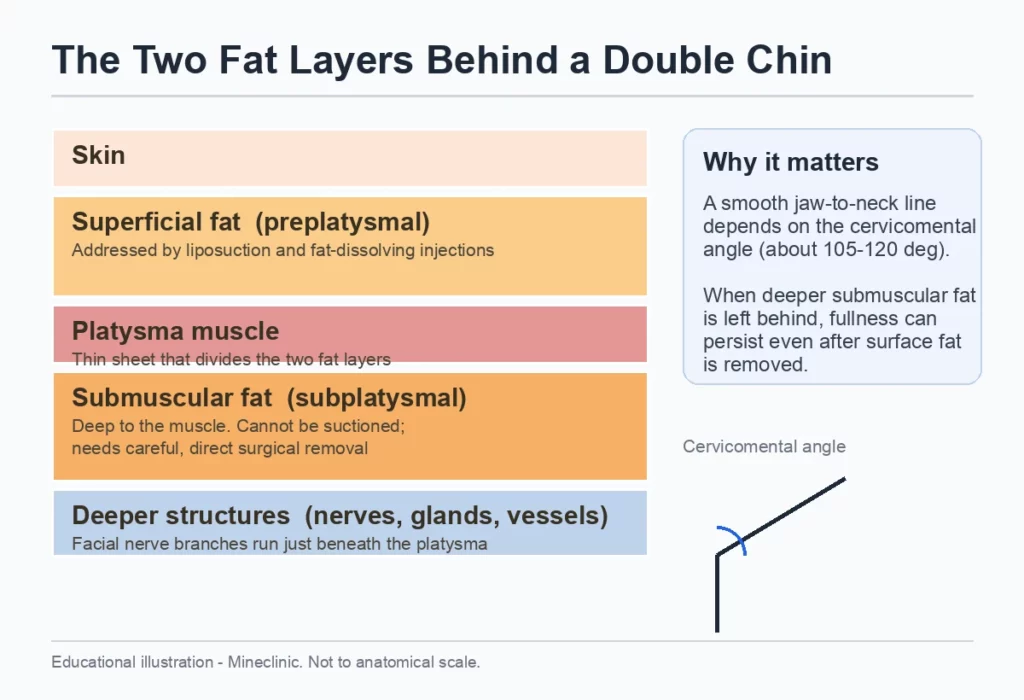
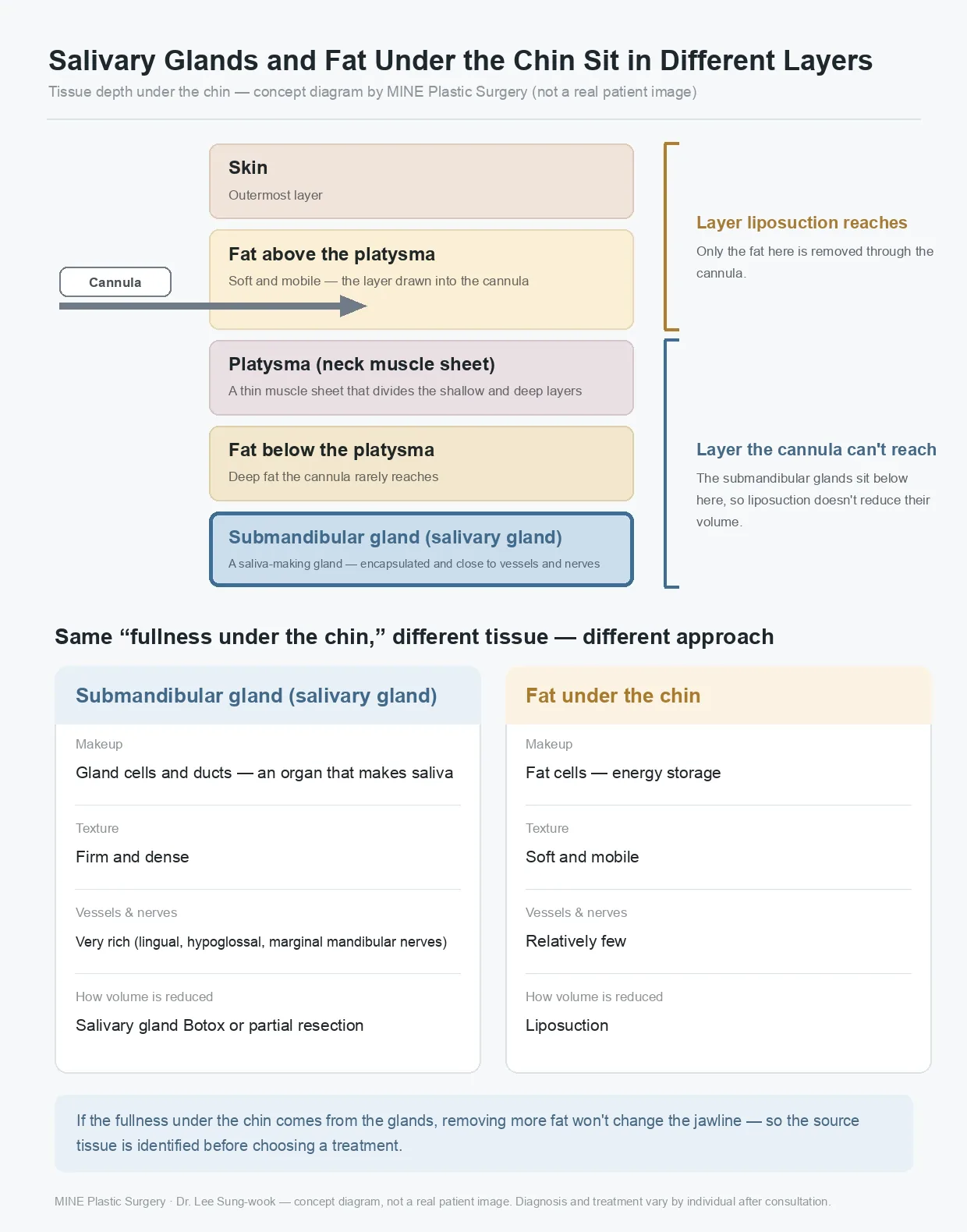
Surgical textbooks describe three layers of fat in the neck. The first sits between the skin and the platysma (the thin sheet of muscle that covers the front of the neck). The second lies beneath the platysma. The third, a very deep layer below the muscles and glands, is small and rarely matters clinically.
The first two layers are where double chins actually form, and they cannot be reached the same way. Most explanations skip this point, yet it is why two similar-looking chins can need different treatments.
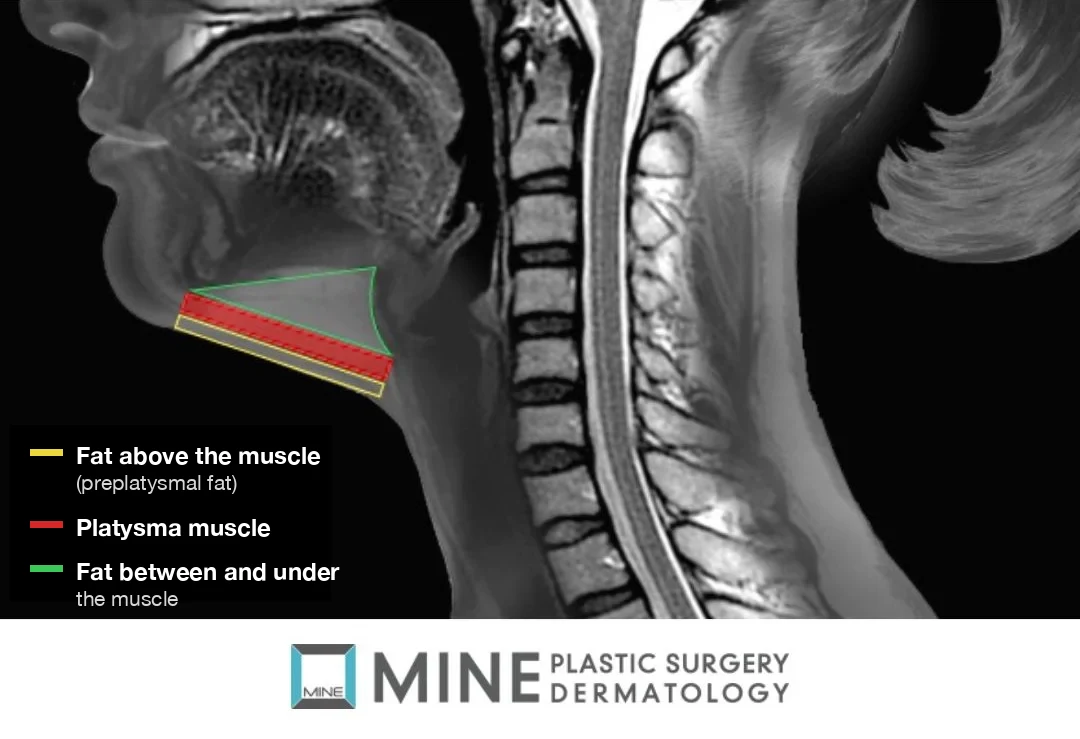
The platysma itself also varies. In cadaver studies cited in surgical textbooks, the left and right platysma muscles join only partly at the midline in about 75% of people, broadly in 15% and not at all in 10%. The weaker that join, the more likely two vertical bands are to appear in the neck with age.
How to Read Your Chin-Neck Angle in the Mirror
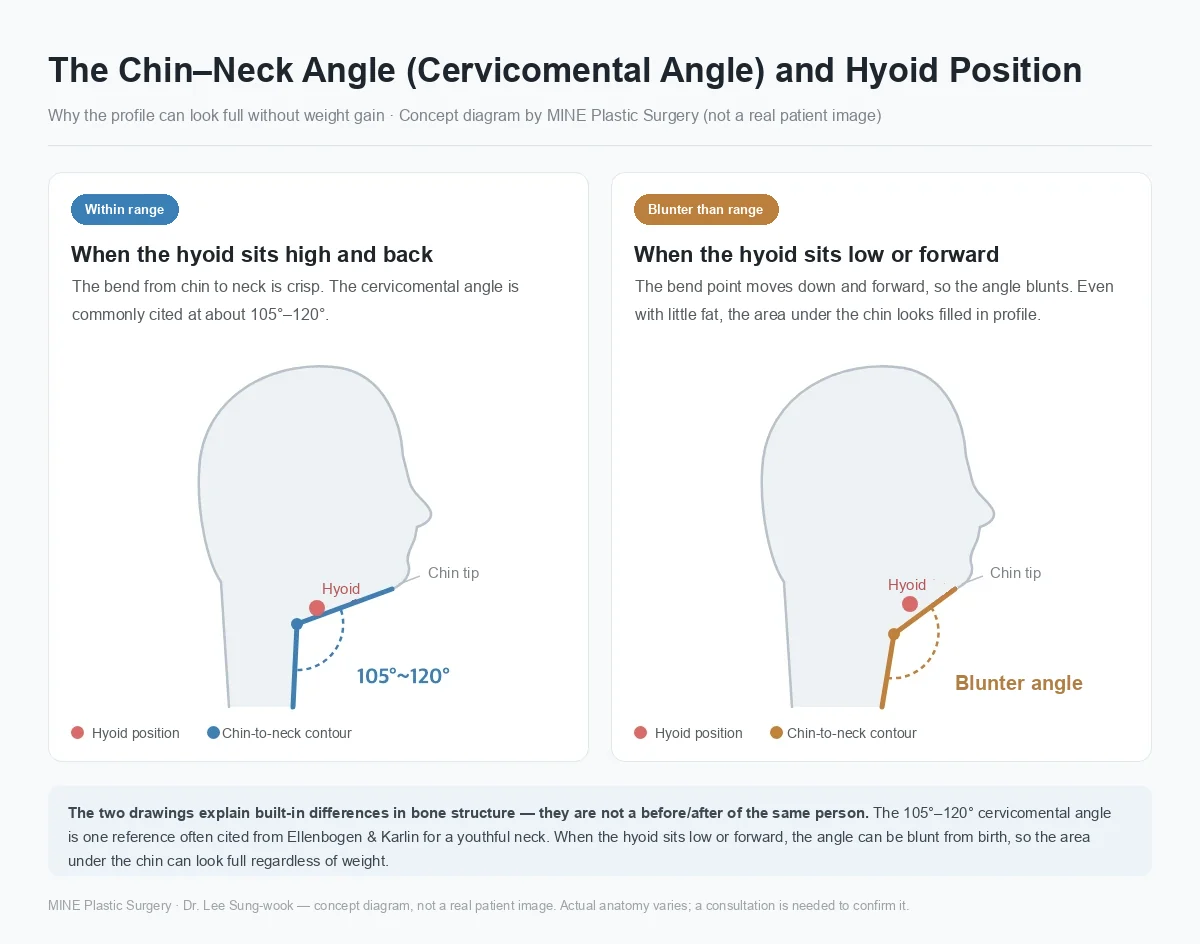
The chin-neck angle, or cervicomental angle, is the angle formed in profile between the line under your jaw and the front line of your neck. It is the quickest way to answer “what is a double chin?” for your own profile.
The 105–120° Benchmark
Plastic surgery textbooks put the ideal chin-neck angle at 105–120 degrees, the reference range used when assessing the aesthetic neck. If your angle in profile looks noticeably wider and softer than this, something is occupying the submental space.
Three Mirror Checks You Can Do Today
Stand side-on to a mirror, keep your head level and look for three landmarks:
- A clear jawline: is the lower edge of your jawbone visible as a distinct line?
- A hint of thyroid cartilage: can you just make out the Adam’s apple area?
- The front edge of the neck muscle: is the front border of the sternocleidomastoid (the long muscle running from behind the ear to the collarbone) visible?
If all three are blurred, the submental space is probably filled. These checks are a starting point, not a diagnosis. For the full routine, try a step-by-step double chin self-check.
If the area beside the midline bulges more when you look down, the anterior digastric muscle (a small muscle linking the chin to the hyoid) may be involved. A journal report describes 15 variations of this muscle, with non-typical anatomy found in about one in three people. Whether it truly enlarges is still debated, so I check it in person.
When Weight Loss Doesn’t Sharpen the Angle: The Hyoid Factor
Some people have a blunt chin-neck angle their whole life, regardless of weight. Textbooks link this to a low-lying or forward-positioned hyoid bone, sometimes together with fat beneath the platysma.
Marino and colleagues stressed how much the hyoid matters. When it sits in its normal, higher position, removing submental fat can markedly improve the angle. When it sits low, fat removal produces only a modest change. This is why, for some people, the honest answer to “what is a double chin?” is bone position rather than weight.
Double Chin Types Mapped to the Treatment Each One Needs
Answering “what is a double chin made of?” for your own neck is what decides treatment. A fat problem, a skin problem and a bone problem look similar in a photo, but each one responds to a different approach.
The Five-Type Map at a Glance
| Type | What you notice | Main driver | Treatment direction |
|---|---|---|---|
| Fat type | Soft, pinchable; worse with weight gain | Submental fat build-up | Liposuction or fat-dissolving injections |
| Skin-laxity type | Loose skin with creases under the chin | Aging, rapid weight loss | Lifting (thread lift or neck/face lift) |
| Skeletal type | Slim, yet the chin looks set back in profile | Small or retruded chin (mandible), low hyoid | Chin implant or chin/jaw contouring |
| Salivary-gland type | Firm fullness under the jawline | Enlarged submandibular gland | Salivary gland reduction (after imaging) |
| Mixed type | Two or more of the above | Combined | Customized combined plan |
Two rows deserve a note. With the skeletal type, liposuction alone rarely gives a satisfying result, because the problem is the frame rather than the filling; a chin implant or moving the chin bone forward is considered instead. With the salivary-gland type, an accurate distinction is difficult without ultrasound or CT, so it is worth learning how to tell a salivary gland from fat before you choose a treatment.
Why Most Double Chins Are the Mixed Type
In my clinic, a single clean cause is the exception. Most people have some fat, some laxity and some structural factor at the same time.
Dr. Lee’s Key Point: Most double chins are the mixed type. Correcting only one cause can leave the result feeling incomplete, so the overall plan matters more than any single procedure.
Male Double Chin: Why the Pattern Is Different in Men
A male double chin often involves several layers at once rather than fat alone, so for men the answer to “what is a double chin?” is usually more than one thing. Men tend to notice it along the shaving line, above a shirt collar or in side-profile photos.
The Four-Part Combination Common in Men
Literature on male facelift surgery repeatedly points to the same combination in men:
- A lax platysma with visible muscle bands
- Excess fat beneath the platysma
- Large submandibular glands
- Enlarged muscles under the chin
What This Means for Treatment Choice
Because the fullness sits in deeper layers, an approach that only tightens skin or only removes fat often works less well in men than expected. With a male double chin, the plan needs to look at fat above and below the muscle, the muscle itself and the glands together. That layered view is the theme of the next section.
From Diagnosis to Treatment: The Layer Decides the Method
The layer that holds the problem decides which method can reach it. A consultation turns the general question “what is a double chin?” into a specific answer about your neck.
What a Consultation Checks
- Your chin-neck angle and jawline in profile
- Pinch and touch, plus platysma bands when you tense the neck
- Chin projection and hyoid position
- Ultrasound or CT when a salivary gland is suspected
Non-Surgical Options Reach Only the Top Layer
Fat-dissolving injections, liposuction and thread lifts all work on the skin and the fat above the platysma. Textbooks state that fat beneath the platysma cannot be suctioned and must be reached directly through a small incision under the chin. Energy-based tightening such as Ultherapy (focused ultrasound) can firm mild skin laxity, but it does not remove deep fat or repair a separated muscle.
In my clinical experience, non-surgical treatment satisfies mainly when the change under the chin is still at an early stage. For details on each method, see non-surgical options compared.
Platysma Plication: Treating Fat and Muscle Together
Platysma plication uses an incision of about 2–2.5 cm along the submental crease. Through it, fat above and below the muscle is removed, and the loose edges of both platysma muscles are drawn to the midline and stitched together. Textbooks describe this approach as a way to prevent muscle bands from remaining or returning, a prominent gland showing and an uneven neck contour.
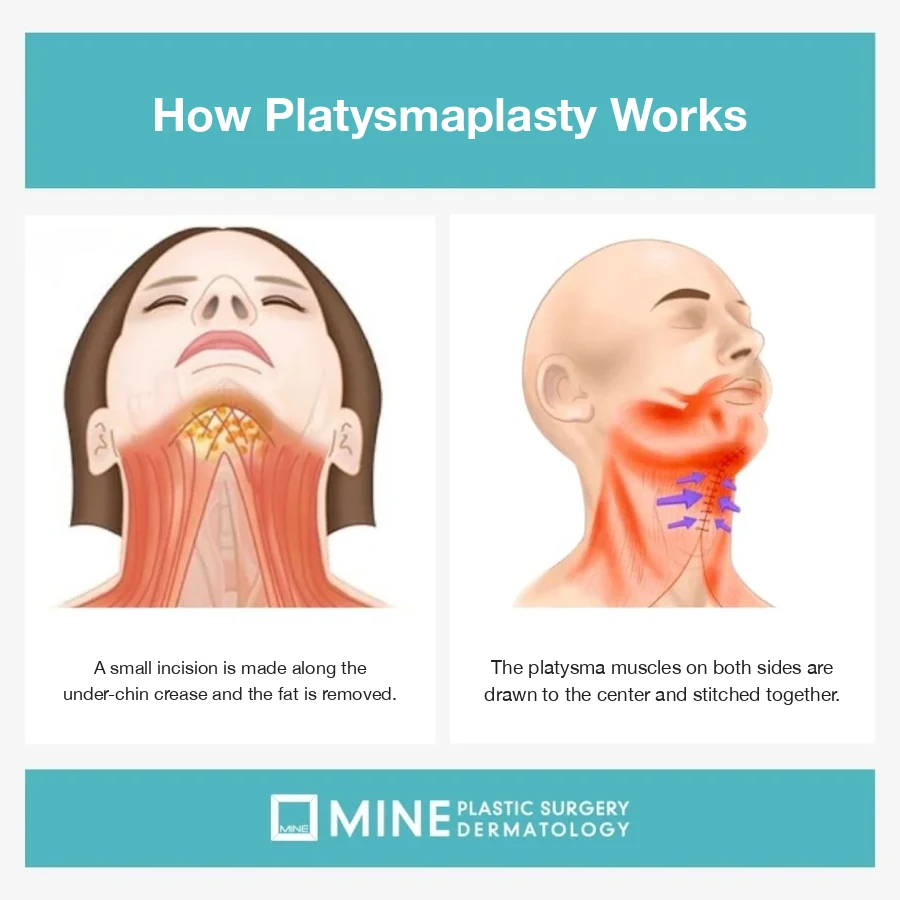
Removing more is not automatically better. The central fat compartment beneath the platysma, between the two digastric muscles, is left in place, because textbooks warn that disturbing it can cause a hollow deformity. Submandibular glands also deserve a check before surgery: once the neck is tightened, a gland that was hidden can become visible, and textbooks advise partial reduction when that is expected.
At MINE, this is done through a four-step protocol that separates each fat layer before the muscle is tightened. You can read about MINE’s platysma plication procedure for the full system. For general background on neck surgery, the neck lift overview from the American Society of Plastic Surgeons is a useful starting point.
When jowls are pronounced, textbooks note that neck surgery alone rarely satisfies, so a face or neck lift may be planned together.
Dr. Lee’s Key Point: Most double chins combine fat with a lax muscle. Removing fat alone leaves the deep fat and muscle laxity behind, so deciding which layers to treat together is the core of surgical planning.
Recovery Time by Treatment Type
Recovery time is the period before you look and feel like yourself again, and it depends on how deep the treatment goes: a few days for injections, several weeks when the neck is lifted.
Downtime at a Glance
| Treatment | Anesthesia | Procedure time | Typical downtime |
|---|---|---|---|
| Fat-dissolving injections | Topical numbing | About 15–20 min | 1–3 days |
| Thread lift | Local | About 30–60 min | 3–7 days |
| Liposuction alone | Sedation or local | About 30–60 min | 1–2 weeks |
| Platysma plication | Sedation | About 1–1.5 hours | 2–3 weeks |
| Combined with face/neck lift | General or sedation | About 3–5 hours | 3–4 weeks |
Platysma Plication: The First Month
- Day of surgery to day 2: swelling and bruising peak; you wear a compression band and usually go home the same day.
- Days 3–5: most people return to daily routines.
- Days 5–7: stitches are removed.
- Week 2: most bruising has faded.
- Month 1: most swelling has settled and the jawline starts to show.
- Months 1–3: the final contour becomes clear as the muscle repair stabilizes.
At MINE, we ask patients to wear the compression band for about a week. For comparison, one textbook neck-surgery protocol uses compression day and night for five days, then at night for two weeks, without drains.
Risks and Precautions to Know Before You Decide
Every double chin treatment carries some risk, and the risk grows with the depth of the layer being treated. Whatever the answer to “what is a double chin?” turns out to be for you, you should hear the downsides as clearly as the benefits.
Possible Side Effects by Method
- Fat-dissolving injections: swelling, bruising and temporary numbness are most common; an uneven surface or an allergic reaction is rare.
- Thread lift: tightness, bruising and swelling for one to two weeks; rarely, a thread may surface or an infection may develop.
- Platysma plication: swelling and bruising for two to four weeks, plus possible skin irregularity, hematoma (a collection of blood), infection or reduced sensation. Textbooks note that sensation usually returns gradually over a year, though some numbness can be permanent.
- Combined face or neck lift: scarring, hematoma, nerve injury and changes in sensation around the ears are possible.
Infection is uncommon: textbooks report a rate below 1% in facelift patient series, a figure for facelift patients rather than for platysma plication itself. Anatomical studies report that the marginal mandibular nerve, which moves the lower lip, runs 9.7 ± 1.2 mm above the mandibular cutaneous ligament, so a surgeon’s anatomical precision matters.
Before-Treatment Checklist
- Stop blood-thinning medicines and supplements such as aspirin, omega-3 and vitamin E at least two weeks before, after checking with your doctor.
- Stop smoking at least two weeks before; smoking slows healing.
- Fast for at least eight hours before sedation or general anesthesia.
- Wear a top that opens at the front on the day of surgery.
Frequently Asked Questions About Double Chins
What is a double chin made of?
A double chin can be made of fat above or below the platysma, loose skin, a set-back chin or low hyoid bone, an enlarged submandibular gland or a lax platysma muscle. In most people, two or more of these are present together.
What is a double chin called medically?
Doctors usually call it submental fullness, and when fat is the main cause, submental fat. The term covers any bulge in the space under the chin, whatever is causing it.
What is a normal chin-neck angle?
Plastic surgery textbooks describe an ideal cervicomental angle of 105 to 120 degrees. If your profile angle is clearly wider and softer than that, something is filling the submental space and is worth assessing.
Why do men get a double chin differently?
Male facelift literature notes that men often combine platysma bands, excess fat beneath the muscle, large submandibular glands and enlarged muscles under the chin. That is why skin-only or fat-only treatment tends to work less well for a male double chin.
Why doesn’t my double chin go away after losing weight?
The skeletal, salivary-gland and skin-laxity types do not depend on weight. Marino and colleagues also found that when the hyoid bone sits low, fat removal improves the chin-neck angle only modestly.
How do I know if it’s fat or a salivary gland?
Fat usually feels soft and pinchable, while an enlarged gland tends to feel firm under the jawline. A reliable distinction needs ultrasound or CT, so imaging comes before any gland treatment.
Is the platysma plication scar visible?
The incision is about 2–2.5 cm along the crease under the chin, so it is hard to see from the front unless you lift your head. Healing varies between people. A mildly raised scar sometimes appears around three months, and textbooks note that diluted triamcinolone injections usually resolve it.
Does platysma surgery affect your voice?
The platysma is the most superficial muscle of the neck, while the muscles used for speaking lie much deeper. An effect on your voice is therefore unlikely, although a temporary feeling of tightness in the neck is possible.
Find Out Which Type You Have — Consult Dr. Lee Sung-wook
The most useful answer to “what is a double chin?” is a personal one. Before asking which procedure to have, find out what is filling the space under your chin. Fat, skin, bone, gland and muscle each point in a different direction, and the right plan follows from an accurate diagnosis.
If you live abroad, you can start with an online consultation with MINE in Seoul. Send clear side-profile photos, and I can tell you what your double chin is likely made of before you travel. You can also reach us by phone at +82-2-516-1175.
Written and reviewed by Dr. Lee Sung-wook, Board-Certified Plastic Surgeon, MINE Plastic Surgery & Dermatology | 813 Nonhyeon-ro, Gangnam-gu, Seoul | +82-2-516-1175
Sources: aesthetic and plastic surgery textbooks; plastic surgery literature on the aging face and neck; MINE clinical experience.
※ This content is for informational purposes only and does not replace professional medical advice, diagnosis, or treatment. Individual results may vary, and side effects may occur. Please consult with a board-certified plastic surgeon for personalized advice.