EN


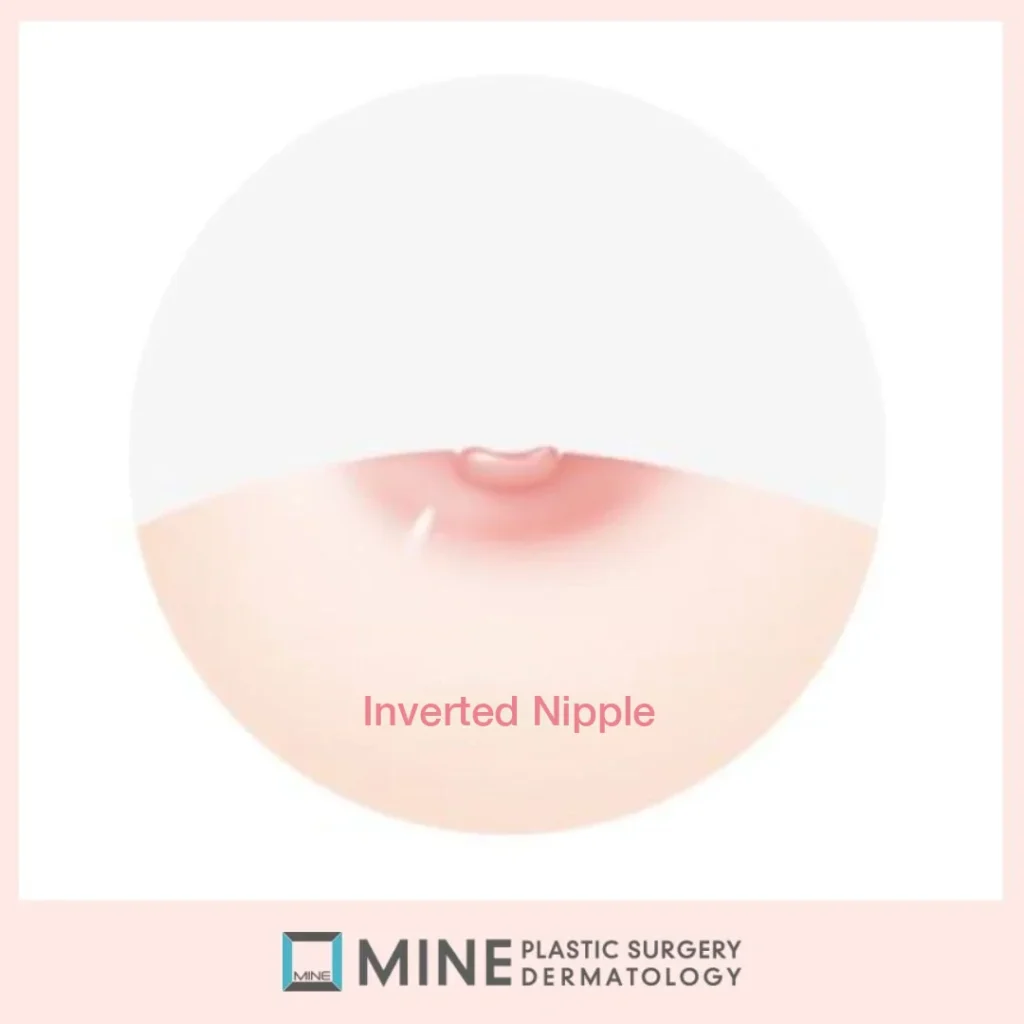
An inverted nipple is a nipple that sits flat or turns inward into the areola (the darker skin around it) instead of pointing outward. The main inverted nipple causes are shortened milk ducts and tight connective tissue pulling it in, usually from birth. Inflammation, scarring or breast surgery can also cause it later.
This article covers inverted nipple causes and what to check first, from new changes that need a breast exam to when non-surgical correction makes sense. Surgery, breastfeeding and recurrence each have their own guide, so here they get only a short summary and a link.
I’m Dr. Lee Sung-wook, a board-certified plastic surgeon at MINE Plastic Surgery & Dermatology in Seoul. This article draws on two breast surgery textbooks, Surgery of the Breast: Principles and Art and Plastic Surgery: Breast, along with my clinical experience.
- Inverted Nipple Causes You Can Be Born With
- Inverted Nipple Causes That Appear Later in Life
- One Nipple Suddenly Inverted? Get a Breast Check First
- Why You Can’t Determine Your Grade at Home
- Inverted Nipple Correction Without Surgery: When It Makes Sense
- If You Move On to Surgery: The Short Version
- 7 Questions to Ask at Your Consultation
- FAQ: Inverted Nipple Causes and First Steps
- Talk to a Board-Certified Plastic Surgeon
Inverted Nipple Causes You Can Be Born With
When inverted nipple causes are present from birth, they usually come down to what sits under the nipple. Milk ducts, the small channels that carry milk to the surface, are normally long enough to let the nipple sit outward.
Short Milk Ducts and Tight Connective Tissue
Breast surgery textbooks name two main inverted nipple causes: milk ducts that are too short, or connective tissue (the fibrous tissue that holds structures together) tight enough to pull the nipple inward. Picture a balloon on a short string: however much it wants to rise, the string holds it down.
Nipples vary a great deal from person to person, so if you aren’t sure where yours fits, here is what normal nipple size and shape look like.
How Common Is It, and Is It Usually Both Sides?
A study of 1,625 young Korean women (Park et al., 1999, Aesthetic Plastic Surgery) found that 3.26% had congenital inversion, meaning it was present from birth, and that 86.8% of those cases affected both sides. These were unmarried women aged 19 to 26 in one country, so read that as a snapshot of one group, not a worldwide rate.
In the same study, 7 of the 53 women with inversion had it on one side only. So one side alone isn’t alarming. What matters is whether the inversion is new, because that separates inverted nipple causes you’re born with from those that appear later.
Inverted Nipple Causes That Appear Later in Life
When a nipple that used to point outward turns in during adulthood, doctors call the cause acquired. The main inverted nipple causes in this group are inflammation, duct changes, scarring and past surgery. Breast conditions, including breast cancer, belong here too, which is why a recent change gets its own section next.
Inflammation and Duct Changes
Repeated inflammation, such as mastitis (inflammation of breast tissue), can make tissue contract and draw the nipple in.
Breast duct ectasia is another possibility. One or more milk ducts widen and thicken, and the National Cancer Institute says this may sometimes cause inverted nipples, along with nipple discharge or tender nipples.
Scars From Injury or Surgery
An injury or a surgical scar can distort the tissue around the nipple and change its shape. Scars are among the few inverted nipple causes you can often put a date on, so tell your doctor when the injury or surgery happened.
After Other Breast Surgery, Including in Men
In a review of 100 patients reported in a plastic surgery textbook, 18 had nipple inversion as a late complication after the Strombeck breast reduction, a technique described in 1960. That figure reflects neither the risk of modern breast reduction nor the recurrence rate after inverted nipple correction.
A textbook on complications of aesthetic breast surgery links nipple retraction (a nipple drawn inward) to removing too much tissue beneath the nipple.
Inverted nipple causes in men can include surgery too. Nipple inversion or tethering, where the nipple is held down, is listed among the complications of gynecomastia surgery (the operation for enlarged male breast tissue).
Dr. Lee’s Key Point: Inverted nipple causes differ depending on when the inversion began. Congenital inversion is often on both sides. A nipple that suddenly pulls in on one side in adulthood calls for a breast check before a correction consultation.
One Nipple Suddenly Inverted? Get a Breast Check First
A nipple that has recently pulled in on one side in adulthood should be examined before any cosmetic correction. That is standard medical advice, and I give it even when harmless inverted nipple causes seem obvious.
Breast cancer is one thing a doctor needs to check for. The National Cancer Institute lists a change in the nipple’s shape or the direction it points among the possible symptoms of breast cancer, while noting that most breast changes are not cancer. Benign explanations exist too, including some of the inverted nipple causes above, so a new change is not a diagnosis. The order of steps is what matters: breast check first, correction discussion second.
Signs That Need a Breast Exam First
Breast surgery textbooks list nipple retraction among the things a standard breast exam looks for, alongside lumps, skin changes and discharge. Book an exam if you notice any of these possible signs of breast cancer listed by the National Cancer Institute:
- A change in the nipple’s shape or the direction it points
- A nipple that has flattened
- Fluid from the nipple that is not breast milk
- A lump in the breast or underarm
- Scaly skin on the nipple or breast
- Dimpling of the breast skin
Why the Check Comes Before Any Correction Plan
A correction plan assumes the nipple is held in by long-standing tissue tightness. With a new change, nobody knows that yet, and some inverted nipple causes need medical attention in their own right. The exam answers that question first, and the doctor decides whether imaging is needed.
Tell the doctor when the change started, which side it affects, and whether you have had breast surgery or inflammation in the past.
Why You Can’t Determine Your Grade at Home
Reading about inverted nipple causes can explain why this happens, but no article can tell you which grade applies to you.
Two Grading Systems, Two Different Answers
Breast surgery textbooks sort inverted nipples into three grades by how the nipple usually sits at rest. Clinics also use a system from Han & Hong, 1999 (Plastic and Reconstructive Surgery), based on how easily the nipple can be pulled out by hand and whether it stays out.
| Grade | Usual state at rest (textbook) | Common response when drawn out (for reference) |
|---|---|---|
| Grade 1 (mild) | Usually out, sometimes in | Comes out fairly easily and tends to stay out for a while |
| Grade 2 (moderate) | Usually in, sometimes out | Comes out, but tends to slip back in soon after you let go |
| Grade 3 (severe) | Always in | Rarely comes out, and the tissue pulling it in is often firmer |
The diagram below is a reference sketch of how each grade commonly looks. An exam decides your actual grade.
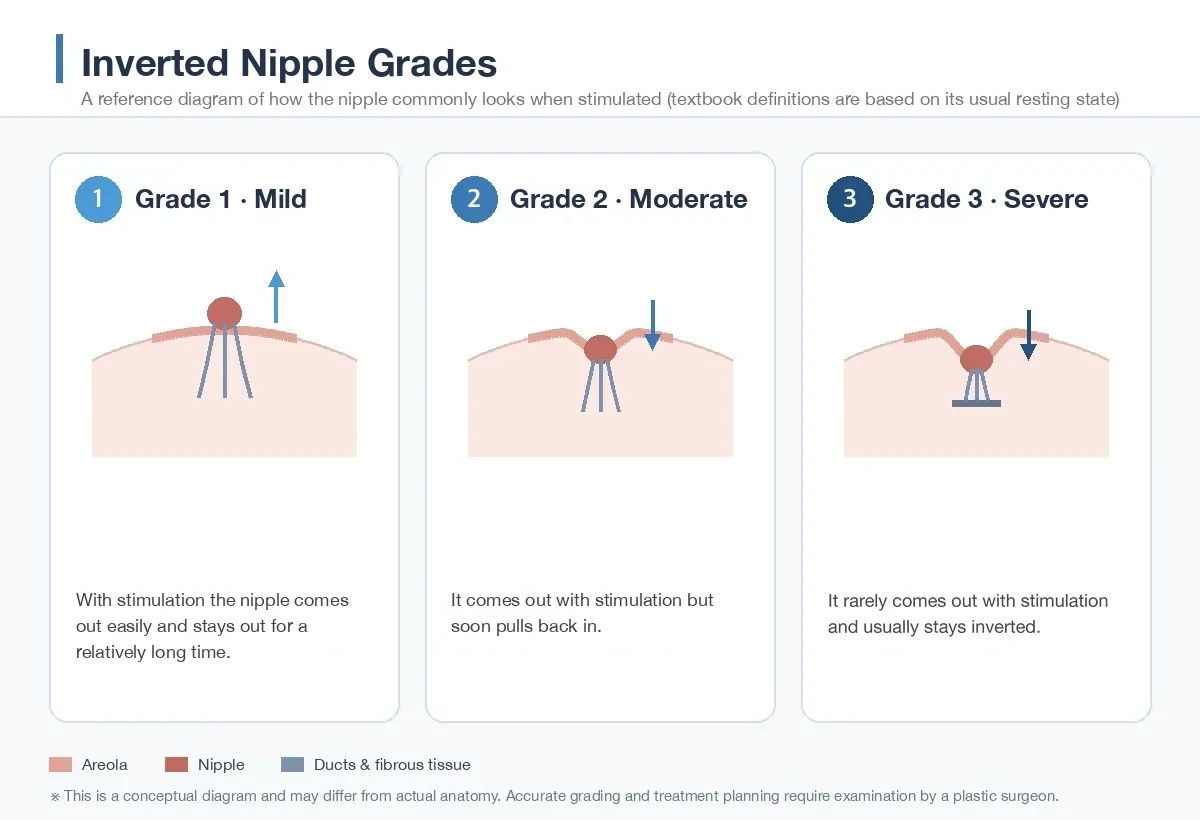
The same person can land on different grades depending on the system, and the shape can vary with temperature or touch. So the grade is confirmed at an exam. Grade alone doesn’t decide treatment, either.
Why It Sometimes Comes Back Out
An inverted nipple that comes back out is usually showing the lower-grade pattern. By the textbook definition, grades 1 and 2 both shift in and out, and temperature or touch can change how it looks.
That doesn’t make every change harmless. If the pattern itself is new, it still needs the breast check above.
What to Note Before Your Consultation
Three observations help at an exam, both for your grade and for sorting out inverted nipple causes:
- Is it out or in more of the time?
- Does gentle touch around the areola bring it out, and does it stay out?
- Is it one side or both, and is it long-standing or recent?
These notes are for describing what you see, not for diagnosing inverted nipple causes.
Dr. Lee’s Key Point: A grade only describes how the nipple sits. Whether to correct it, and how, depends on discomfort, hygiene and your breastfeeding plans.
Inverted Nipple Correction Without Surgery: When It Makes Sense
Inverted nipple correction without surgery means using a suction or traction device to draw the nipple outward. The textbooks I used for this article don’t cover these devices, so what follows comes from clinical practice.
Who May Consider a Suction or Traction Device
A device may be considered for milder cases, where the nipple already comes out fairly easily, and the goal is to ease day-to-day discomfort. If the change is new, the breast check still comes first.
Limits to Know Before You Start
- A device needs consistent use.
- The nipple can go back in after you stop.
- If skin irritation or pain develops, stop and seek advice.
- There isn’t enough evidence yet on how well it works or how long the effect lasts.
In my clinic, patients who talked through severity and expectations before deciding tended to be less disappointed later. Results vary widely.
‘It Went Back In’ Can Mean Three Different Things
People use the same words for three different situations:
- The nipple never came out enough after correction.
- It stayed out for a while after correction, then pulled back in.
- It came out temporarily with a device or during pregnancy or breastfeeding, then returned. This is not re-inversion after surgery.
The second situation has its own guide on why a corrected nipple can pull back in.
If You Move On to Surgery: The Short Version
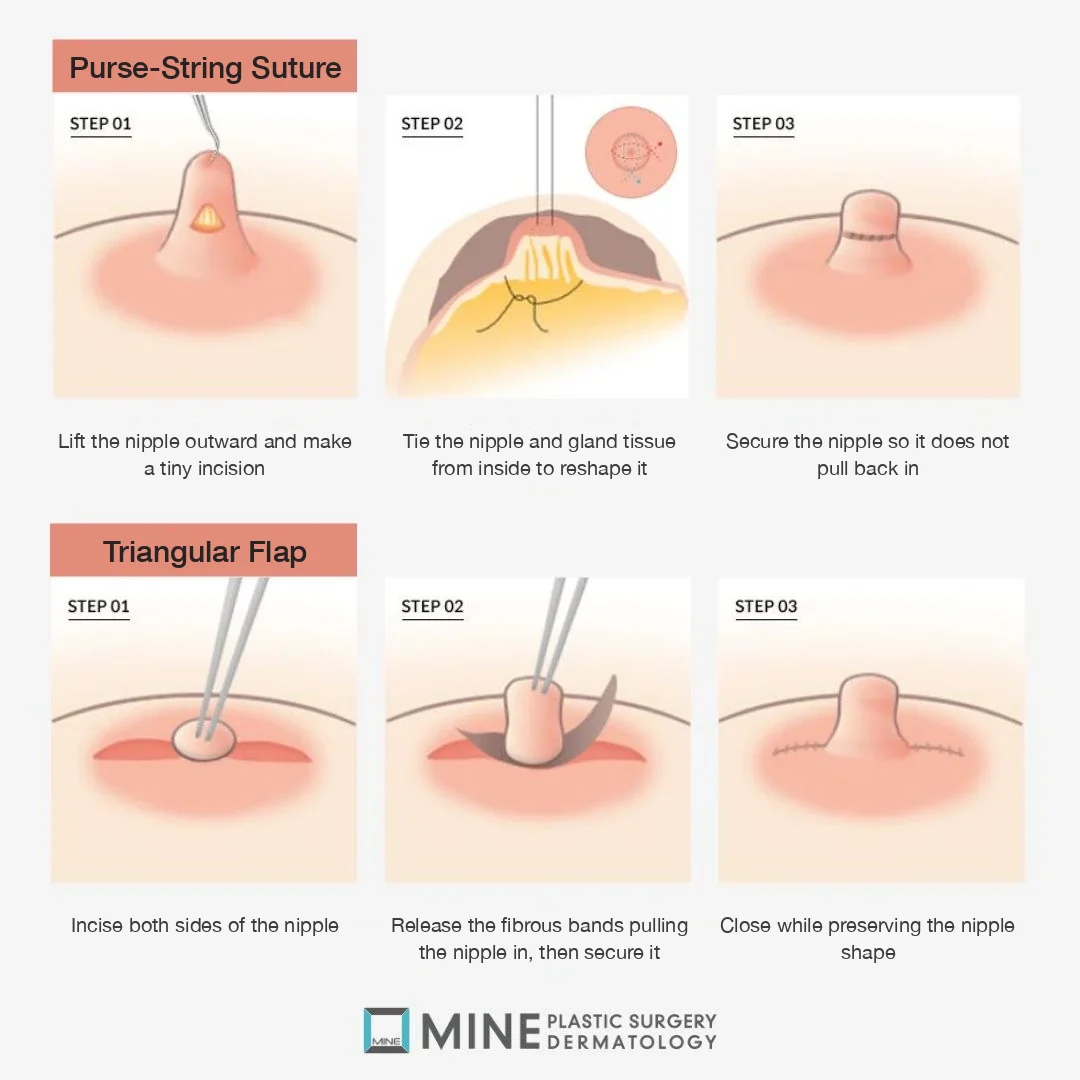
Surgery releases whatever is pulling the nipple in. Two separate choices are involved: whether the ducts are preserved or divided, and how the nipple is stitched afterward.
How Surgery Works, in Brief
One method described in a breast surgery textbook uses an incision of about 3 mm at the nipple base and divides the ducts. An inner purse-string stitch (a drawstring-style suture) then narrows the base. This is that author’s method, not a description of how we operate at MINE.
The illustration below shows the two methods I explain during a consultation, the purse-string suture and the triangular flap. Neither name tells you how the ducts are handled, so ask.
Breastfeeding, Risks and Recovery
Dividing the ducts effectively rules out breastfeeding on that side. The other approach aims to preserve the ducts, but it cannot guarantee that you’ll be able to breastfeed. A separate guide explains how each method affects breastfeeding.
Possible problems include swelling, bruising, reduced sensation, infection, scarring and re-inversion, and neither approach rules it out. Our surgery guide covers correction methods and recovery in detail.
7 Questions to Ask at Your Consultation
Once you know the likely inverted nipple causes, decide whether you plan to breastfeed, then compare methods. Bring that answer and this list with you.
- I may want to get pregnant and breastfeed in the future. Which method would you consider?
- How do you handle the ducts: keep them or divide them?
- Can I try non-surgical correction first, and if not, why not?
- Where is the incision, and where will the scar be?
- What kind of anesthesia is used, and can I go home the same day?
- What happens if the nipple pulls back in?
- Only one side is affected. Should I have a breast check first?
Dr. Lee’s Key Point: Breastfeeding plans and the chance of re-inversion have to be weighed together.
FAQ: Inverted Nipple Causes and First Steps
Why is one of my nipples suddenly inverted?
Inverted nipple causes that appear later include inflammation, duct changes, scarring and past surgery. Breast conditions, including breast cancer, can also change a nipple’s shape or the direction it points. You can’t tell these apart by looking. A new one-sided change in adulthood should be examined first, before any talk of correction.
Is an inverted nipple a sign of breast cancer?
It depends on when it started. Inversion you’ve had since birth is often on both sides. A new change on one side is different: the National Cancer Institute lists it among possible breast cancer symptoms, though most breast changes are not cancer. You can’t tell the difference by looking, so have that change examined before anything else.
Why does my inverted nipple come back out sometimes?
Many inverted nipples shift in and out, which fits the lower textbook grades. Temperature and touch can also change how the nipple looks from one moment to the next. If the pattern is recent, have it checked at a breast exam.
How do I know what grade my inverted nipple is?
You can note how it sits at rest and how it responds to gentle touch, but grading systems differ, so those notes won’t give you a final answer. A doctor confirms the grade at an exam, and the grade alone doesn’t decide treatment.
How well do suction devices work for inverted nipples?
Nobody can give you a reliable figure, because there isn’t enough evidence on how well they work or how long the effect lasts. Devices are considered for milder cases and need consistent use, and the nipple can go back in after you stop. It helps to talk through your likely inverted nipple causes with your doctor first.
Can an inverted nipple go back to normal on its own?
There isn’t enough evidence that it resolves by itself. Pregnancy and breastfeeding may change the shape temporarily, and that change may not last. If it causes no discomfort, watching it is one option. A recent change needs a check first.
Can men have inverted nipples?
Yes. Inverted nipples aren’t limited to women, and nipple inversion is also a recognized complication after gynecomastia surgery. Correction is discussed only after an examination, and a new one-sided change should be checked first, just as it would be for a woman.
Talk to a Board-Certified Plastic Surgeon
If you’re still unsure which inverted nipple causes apply to you, bring your notes and the 7 questions to a consultation. If the change is new and on one side, have the breast check first. You can read more about nipple correction at MINE, or contact us through our online consultation form or at +82-2-516-1175.
Written and reviewed by Dr. Lee Sung-wook, Board-Certified Plastic Surgeon, MINE Plastic Surgery & Dermatology | Last reviewed November 8, 2026
※ This content is for informational purposes only and does not replace professional medical advice, diagnosis, or treatment. Individual results may vary, and side effects may occur. Please consult with a board-certified plastic surgeon for personalized advice.