EN


“Won’t a mini facelift wear off quickly because it’s so small?” It is one of the questions I hear most often in consultation. So, how long does a mini facelift last? How long a mini facelift lasts is the length of time the lifted mid- and lower-face tissue stays above where it started before surgery — and it is decided less by the size of the incision than by how the SMAS layer (the supportive muscle-and-fascia layer under the skin) is released and fixed.
The honest answer is that results are measured in years, with wide variation from person to person, and no surgeon can responsibly promise you a fixed number. So rather than chase a single figure, this guide covers what actually decides longevity, how to tell when a lift is genuinely wearing off, and when a revision consultation makes sense.
If you would like to compare thread lifts, HIFU, deep plane and full facelifts side by side, I have covered facelift longevity by technique in a separate article. Here, the focus is the mini facelift alone.
How Long Does a Mini Facelift Last? Start With What “Lasting” Means
When patients ask “how long does a mini facelift last?”, most of them picture a date on the calendar when the face suddenly drops back to where it was. That is not how facial tissue behaves, and it helps to define the question before answering it.
Why the answer differs from person to person
Mini facelift longevity depends on several things at once: the surgical method, your age at the time of surgery, and the thickness and elasticity of your skin. Two operations can share the name “mini facelift” and still hold very differently, because one treated the deeper layer thoroughly and the other did not.
That is why, in my clinical experience, the most accurate answer is “years, with a lot of individual variation.” Promising a specific number of years would not be medically honest, because no reliable data lets anyone predict that for an individual face.
Surgery turns back the clock — it doesn’t stop aging
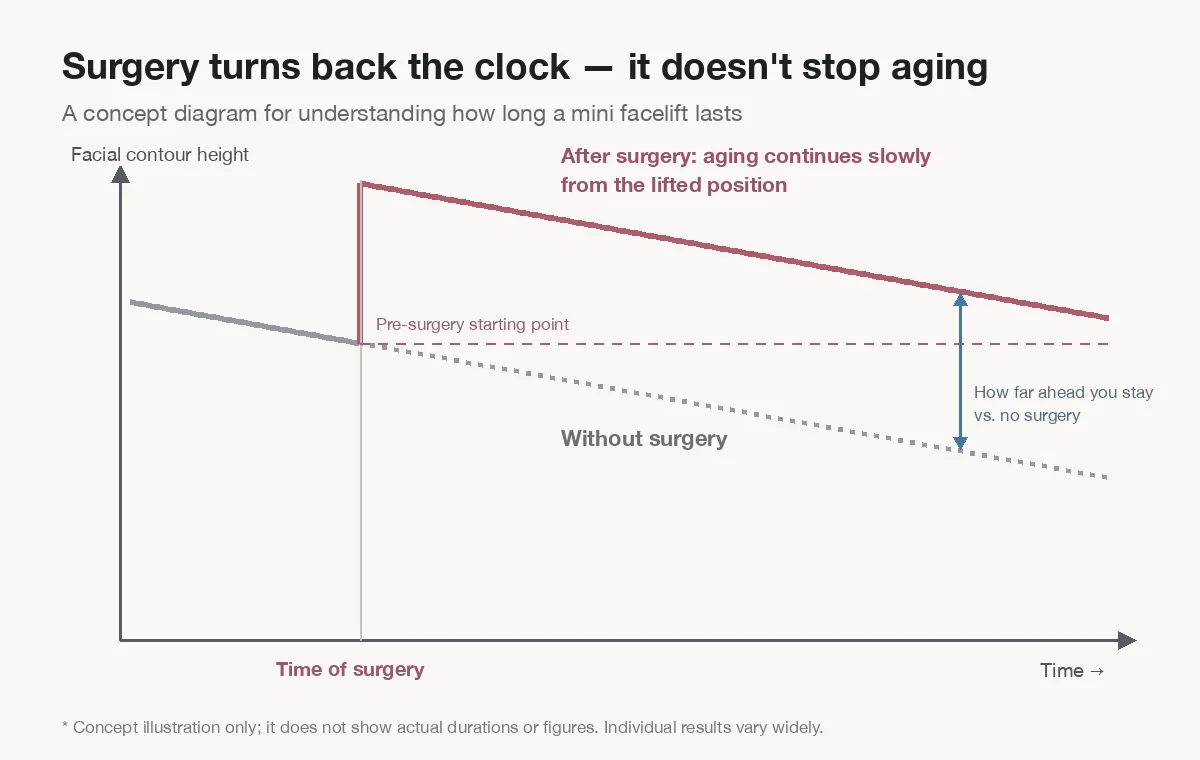
Plastic surgery textbooks make a simple but important point: a facelift does not stop aging. Patients who come back for a second lift usually return with the same concerns they had the first time — the fold beside the mouth and sagging along the jawline. Put simply, surgery winds the clock back, and the clock starts ticking again the next day.
So a better way to think about how long a mini facelift lasts is not “when will I be back to square one?” but “how far ahead am I compared with never having had surgery?” Even years later, many faces still sit above their pre-surgery starting point, because aging continues from the lifted position rather than from the old one.
Dr. Lee’s Key Point: Before asking how long it lasts, ask what was lifted, and how far.
3 Factors That Decide How Long a Mini Facelift Lasts
What sets the lifespan of a result is not the length of the scar but how the deeper layer was handled. Three factors matter most: how far the SMAS is lifted, whether the retaining ligaments are released, and where and in which direction the tissue is fixed.
A small incision doesn’t mean a small lift
The “mini” in mini facelift refers to the incision. We keep it to a short line around the ear — the minimum length we use, because cutting any shorter makes adequate dissection (the careful separation of tissue layers) difficult.
The key point is that what is small is the incision, not the lift. At MINE, the mini facelift incision runs from in front of the ear to behind it, while the mid- and lower-face SMAS lift range is close to that of a standard facelift; only the neck is excluded. You can read more about how the scope of a mini and full facelift differs if you are deciding between the two.
You may have read that mini facelifts last fewer years. That generalization usually assumes a small, skin-focused lift, or one that only folds and stitches the SMAS in place (plication). Textbooks describe plication and simple “sheet tightening” as more prone to loosening over time. What decides longevity is how the SMAS is released and fixed, not how long the incision is — though this does not mean a mini lift outlasts a full facelift, which treats a larger area, including the neck.
Our dissection focuses on the mid and lower face: the cheek, the area just outside the smile line, and the zone above the jawline. Sagging happens in these areas, so releasing them properly is what allows the lifted position to hold.
Why releasing the retaining ligaments matters
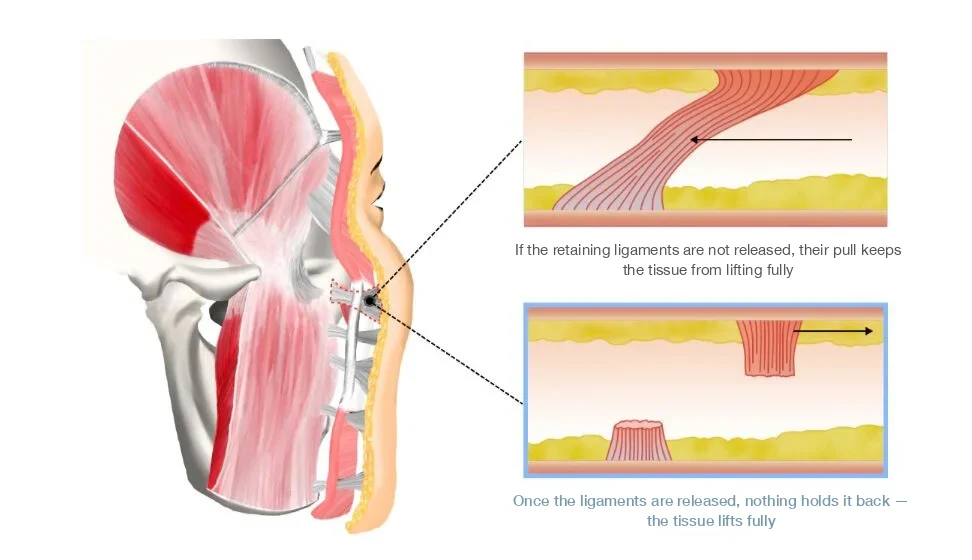
Your face contains retaining ligaments — small, strong bands that tether the skin and soft tissue to the underlying bone, a bit like the guy ropes on a tent. Medical textbooks explain that as these ligaments lose their supporting strength with age, facial fat slides downward, deepening the fold beside the mouth and forming jowls.
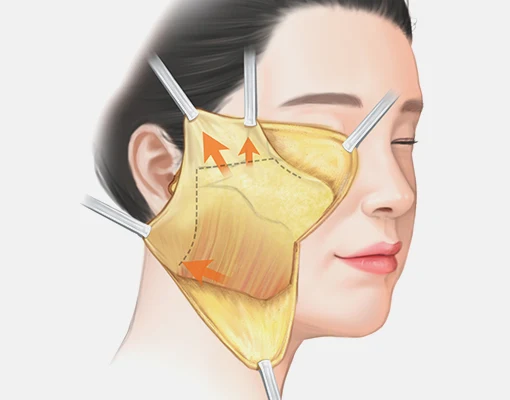
The same literature notes that where these ligaments sit, and how tightly they hold, dictates how far the SMAS has to be lifted to free it properly. In practice, that means extending the dissection toward the cheekbone area and releasing the tissue from the ligaments over the cheekbone and over the upper part of the main chewing muscle (the masseter). Once freed, the SMAS can glide, so tissue that has slipped down can be moved back up to where it belongs.
On the other hand, if the ligaments are not released and the SMAS is simply folded and stitched, the still-attached ligaments keep pulling downward and the effect can fade. This is why we never skip ligament release in a MINE mini facelift.
Fixing the SMAS, not the skin
After it is released, the SMAS is lifted upward and backward (posterior-superiorly) and fixed to the firm tissue in front of the ear. The deep fascia layer carries the weight of the lift, not the skin. You can see each stage of this in our step-by-step mini facelift method.
Because the skin is not used to hold anything up, it is only trimmed of its excess and closed gently, like laying a cloth back over a table. When too much tension is placed on the skin, the face can look pulled and scars tend to widen.
Textbook biomechanics explain why this matters. Tightening a stretched layer like a flat sheet tends to loosen again over time, and stitched lines in the SMAS can be strained or “cheese-wire” (the stitch slowly cutting through tissue) because the platysma — the thin muscle at the front of the neck, which is continuous with the SMAS — keeps pulling down on them. It is like a fold of fabric held only by thread: eventually it stretches out again. For readers who want the research side, Baker’s 2008 study on short-scar facelift and SMAS handling discusses different ways of treating the SMAS through shorter incisions.
Dr. Lee’s Key Point: What decides how long it lasts is not the scar length but how well the SMAS was released and where it was anchored.
Personal Factors That Change Mini Facelift Results
Even with the same technique, tissue holds differently from one person to the next, so mini facelift results vary as well. In consultation, I look at the thickness of your skin and fascia just as carefully as the degree of sagging.
Skin thickness, fat and SMAS thickness
Medical literature notes that when the fat under the skin is thin and weak, stitched fixation may not hold as well. Thin skin and a thin SMAS behave differently from heavier, fuller soft tissue, so for patients with thinner tissue, deciding which layer to anchor and in which direction becomes even more important.
The neck is the other factor. The platysma’s downward pull continues after surgery. If you already have some neck laxity, you may feel the lower face “coming down” a little sooner — but remember that the neck sits outside the scope of a mini facelift in the first place.
Weight change, smoking and sun exposure
Age and skin elasticity, large swings in weight, smoking and UV exposure all affect how a lift holds up over time. When you lose a lot of weight, facial volume drops and the skin can become loose again. Smoking and sun damage both weaken skin elasticity.
There is no evidence that lets anyone say these factors add or subtract a specific number of years. What I can tell you is that they clearly influence how well your result is protected, which is why I discuss them with every patient.
Dr. Lee’s Key Point: The same surgery holds differently on different tissue, so I start every consultation by assessing tissue thickness.
Signs Your Mini Facelift Is Wearing Off
True signs that a mini facelift is wearing off show up along the jawline, the outer cheek beside the smile line, the border between jaw and neck, and the balance between the two sides. Before looking for them, though, it is worth separating out the changes that are easy to mistake for re-sagging.
Two things often mistaken for re-sagging: swelling resolving and neck aging
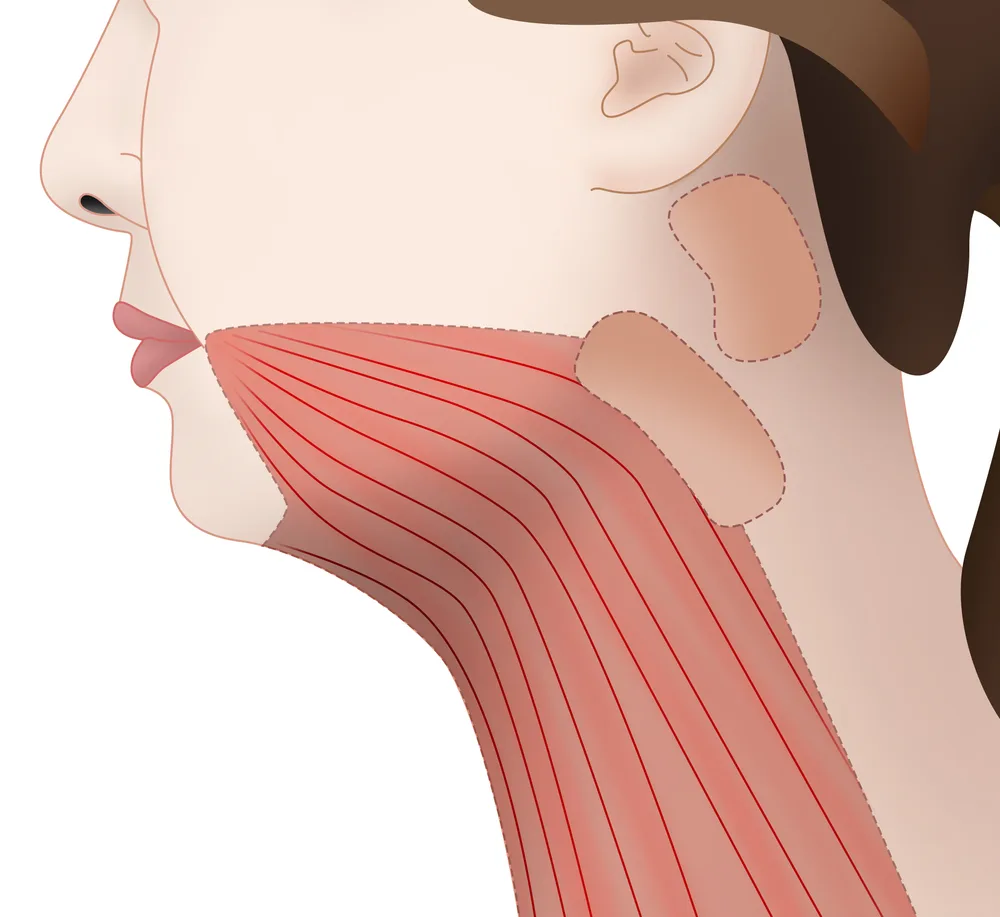
The first is swelling. Swelling after facelift surgery can take about 6 months to settle completely, so the final result is judged months later, not in the first weeks. A face that looks a little “flatter” during that time is usually swelling going down, not the lift failing.
The second is the neck. Neck sagging or new neck lines are not a sign that the mini facelift has come undone; they reflect aging in an area that was never part of the operation. In that case, the conversation turns to treating the neck on its own, for example with a mini neck lift.
When I listen to patients who arrive worried about “mini facelift regret,” many of them judged the result before the swelling had settled, or read changes in the neck as the face falling again. An in-person examination is the most reliable way to tell the difference.
4 signs that suggest true re-laxity
- Sign 1. Jowls reappear along the jawline. Textbooks describe under-corrected jowls as one of the most common findings in patients seeking a second lift, often linked to the cheek SMAS not being used fully the first time.
- Sign 2. The outer cheek beside the smile line drops again. Watching where that outer cheek sits is more telling than watching the smile line itself.
- Sign 3. The border between jaw and neck blurs again. This should be judged separately from sagging of the neck itself.
- Sign 4. A new left-right difference appears in comparable photos. Photos taken at the same angle and in the same lighting make this far easier to judge.
Seeing one of these changes does not automatically mean your mini facelift has “run out.” Treat them as a signal that it is time to be examined — not as a rule for deciding on surgery by yourself.
Dr. Lee’s Key Point: First work out whether it has truly loosened, or whether an area that was never treated is simply aging.
Mini Facelift Revision: When to Consult and What to Bring
A mini facelift revision is planned after the final result of the first surgery is clear, based on which layer the remaining problem sits in. What is left matters more than when.
Which layer and which area is the problem?
- The mid- and lower-face SMAS has loosened again — a re-lift is considered.
- Neck sagging or neck lines are the main concern — a mini neck lift or neck lift is discussed.
- Skin texture or fine lines are the main concern — non-surgical treatments can be added alongside.
Textbooks note that when a first operation was a limited, skin-only lift, the surface can look tight while deeper problems such as the smile-line fold and cheek sagging remain. The same literature explains that a careful SMAS dissection is usually still possible in a second lift, but earlier plication or thread lifts can leave the SMAS thinner or damaged. That is why knowing which layer was treated, and how far, is the starting point.
What to check before a revision consultation
- Your previous operative records (which method was used and how far the dissection went)
- The location and condition of your scars
- Whether enough time has passed to judge the final result of the first surgery
If only a few months have passed since your first surgery, it is too early to judge how long your mini facelift will last, and too early to decide on a revision. The textbook authors ask patients to allow 1 year of healing before considering any revision. That is their published practice rather than a fixed MINE rule, but the principle is the same: only once the tissue has fully settled can we see clearly what is left.
A revision involves more considerations than a first operation, so bringing your records makes the consultation far more specific. You can learn about our approach and consultation process on the MINE mini facelift page.
Dr. Lee’s Key Point: A revision is not “pulling again” — it is finding the layer that was under-treated the first time.
Mini Facelift Risks, Recovery and Habits That Help Results Last
A mini facelift is still an incision-based surgery, so it is important to understand the possible side effects before you decide. And how long a mini facelift lasts is also tied to how you look after yourself afterward.
Side effects to know before deciding
Possible side effects include swelling and bruising, hematoma (blood collecting under the skin), temporary numbness, and, rarely, facial-nerve weakness, scarring and asymmetry. Most improve with time, but you should contact your surgeon right away if anything feels wrong.
For reference, in a textbook series of 3,500 lateral SMASectomy facelifts — a different technique — hematoma occurred in 1.5% of women and 4.0% of men. In the same series, facial-nerve weakness was 0.1% and all cases resolved within 6 months; 2.0% had a small “minilift” after 1 year. These figures come from a technique that removes a strip of the SMAS and stitches the edges together; they are not MINE mini facelift figures.
That 2.0% figure is still a useful reminder: even after a well-performed first operation, a small touch-up may be needed for some patients. Textbooks also describe hematoma as the most common complication of facelift surgery in general, which is why blood-pressure control and early checkups matter after any lift.
Return to daily life takes about 5 days at MINE, and swelling and bruising mostly settle within 1–2 weeks. Recovery speed varies from person to person.
Aftercare habits that protect your results
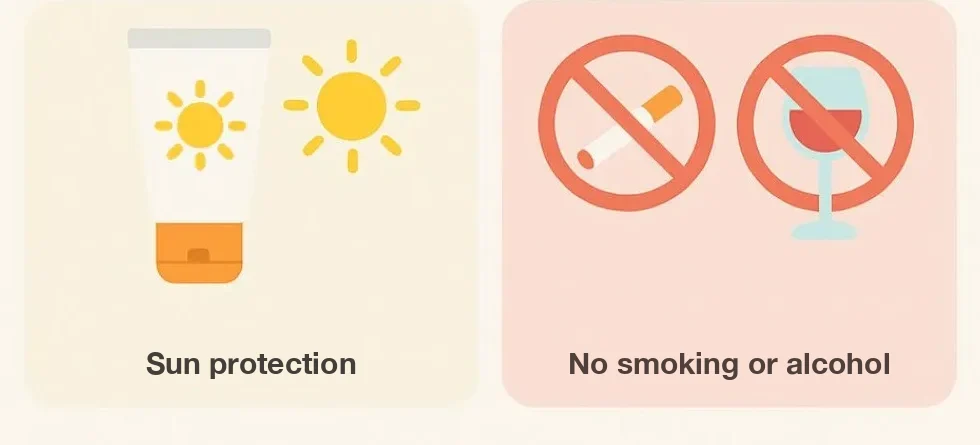
These are the habits I ask my patients to keep after surgery:
- Avoid large weight swings — big ups and downs in weight change facial volume and how much loose skin there is.
- Protect your skin from the sun — the most basic way to preserve skin elasticity.
- Smoking and alcohol — avoid smoking, and skip alcohol for the recovery period your surgeon advises. Smoking affects both healing and long-term skin elasticity.
- Take regular photos — photos under the same conditions let you see changes objectively.
- Care for your skin texture — fine lines and texture can be supported with non-surgical treatments when needed.
Dr. Lee’s Key Point: A lifted position lasts longest when good daily habits work alongside the surgery.
Frequently Asked Questions About Mini Facelift Longevity
How long does a mini facelift last?
A mini facelift lasts years, but individual variation is wide, so no specific number can be promised. Longevity depends on how far the SMAS was lifted, whether the retaining ligaments were released and where the tissue was fixed, together with your own tissue and lifestyle. Textbooks also describe releasing the SMAS from the ligaments as giving a longer-lasting result than stitching alone.
Does a mini facelift wear off faster than a full facelift because the incision is smaller?
What is small is the incision, not the lift. At MINE, the mini facelift lifts the mid- and lower-face SMAS over a range close to a standard facelift and leaves out only the neck. Which operation suits you depends on where you are sagging and how much.
How can I tell if my mini facelift is wearing off or just swelling going down?
The final result is judged several months after surgery, once swelling has settled. Swelling going down feels like an even deflation across the whole face, while true re-sagging is local — jowls or the outer cheek beside the smile line dropping again. Comparing photos taken under the same conditions helps.
Is a sagging neck a sign that my mini facelift has worn off?
No. The neck is outside the scope of a mini facelift, so neck aging carries on separately. If your neck is the concern, it is worth discussing a mini neck lift or neck lift on its own.
When can I consider a mini facelift revision?
The right time is after the final result of the first surgery is clear and the tissue has settled. A revision plan is made after reviewing your previous operative records, your scar location and which layer the remaining problem is in.
The Bottom Line on How Long a Mini Facelift Lasts
So, how long does a mini facelift last? Not a fixed number of years, but as long as the work done inside holds: how well the SMAS was released and lifted, where it was anchored, and how your tissue and daily habits support the result. If you notice signs of sagging, the first step is to separate true loosening within the treated area from natural aging outside it.
Diagnosis and surgical design depend on where your sagging is and how thick your tissue is, so the right plan differs from person to person. If you would like to know which approach suits your face, I recommend a 1:1 consultation with MINE Plastic Surgery — through our online consultation form, or by phone at +82-2-516-1175.
Written and medically reviewed by Dr. Lee Sung-wook, Board-certified Plastic Surgeon, MINE Plastic Surgery.
MINE Plastic Surgery | 813 Nonhyeon-ro, Gangnam-gu, Seoul, Korea | +82-2-516-1175
※ This content is for informational purposes only and does not replace professional medical advice, diagnosis, or treatment. Individual results may vary, and side effects may occur. Please consult with a board-certified plastic surgeon for personalized advice.