EN



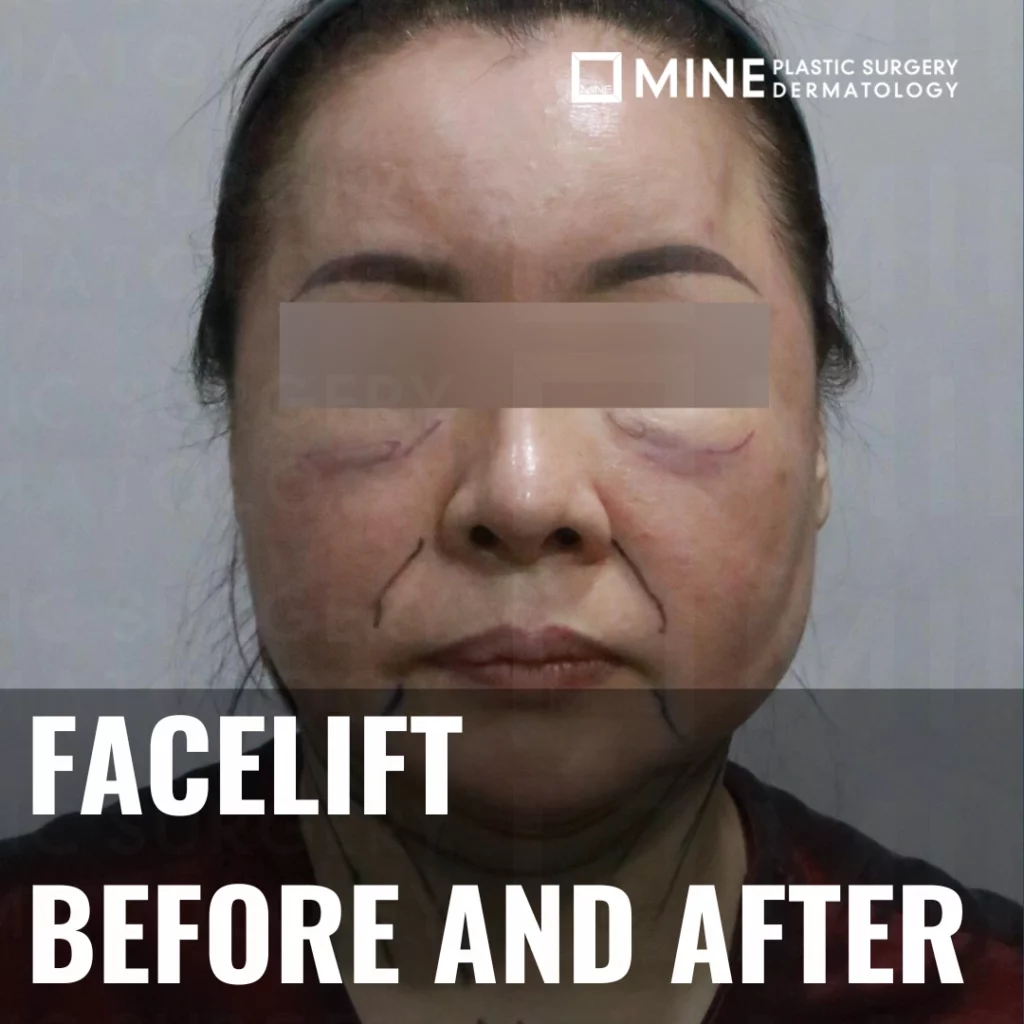
Mini facelift scars are the fine incision lines left inside the hairline in front of the ear, along the natural crease at the top of the ear and behind the ear. They are placed where hair and the ear itself hide them as they heal, so with good closure and aftercare most people find them hard to spot.
“The results sound great, but what about the scars?” I hear this in the consultation room almost every week. Patients in their 30s and 40s considering a mini facelift worry about scarring as much as about the lift itself, and that is completely understandable. It is your face, and even a small mark can feel like a big deal.
In my clinical experience, many people put off surgery for years out of a vague fear of scarring, only to come in later when the sagging has progressed further. I’m Dr. Lee Sung-wook, a board-certified plastic surgeon at MINE Plastic Surgery in Seoul. Below I’ll walk you through exactly where mini facelift scars sit, how visible they are likely to be a year from now, and what changes if your skin tends to form raised or keloid scars.
Dr. Lee’s key point: With the right incision placement, careful layered closure and consistent aftercare, mini facelift scars can become barely noticeable.
Where Are Mini Facelift Scars? Incision-by-Incision Visibility
A mini facelift incision is not one long cut. It is planned in short segments, and each segment is deliberately tucked into a spot where something natural covers it. That is the main reason mini facelift scars are much less obvious than most people expect.
The Three Incision Zones and What Hides Each One
| Incision zone | What hides it | Scar visibility |
|---|---|---|
| Inside the hairline in front of the ear | Covered naturally by hair | Very low |
| Natural skin crease at the top of the ear | Follows an existing skin fold | Low |
| Behind the ear | Hidden by the ear itself | Very low |
Of the three mini facelift incision zones, two (inside the hairline and behind the ear) are rated very low visibility because hair or the ear covers them. The third follows a crease that is already there, so this part of the scar tends to read as part of your normal skin texture rather than as a separate mark.
Why the Incision Goes Behind the Tragus
The tragus is the small flap of cartilage at the front of your ear opening. If an incision runs across the cheek skin directly in front of it, the healed line can leave a slight step in color or texture where cheek skin meets ear skin. Placing the incision just behind the tragus (a retrotragal incision) lets the line sit along the edge of the ear itself, which reduces that color mismatch and helps the area look natural from the side.
Dr. Lee’s key point: Where the incision is placed decides how visible mini facelift scars will be. A retrotragal incision is one of the simplest ways to avoid an “operated” look at the front of the ear.
Mini Facelift vs Full Facelift Scars: Why a Shorter Incision Isn’t the Whole Story
Length vs Closure Technique
One common misunderstanding is that a shorter incision automatically means less visible mini facelift scars. Length does matter, but it is not what decides visibility. How the incision is designed and, above all, how it is closed matters more. A long incision that heals flat and fine can be harder to see than a short one that heals stretched and thick.
The medical literature explains why. Cosmetic dermatology textbooks describe wound tension (the pulling force on the edges of a cut) as a known trigger for hypertrophic and keloid scars. Surgeons are taught to plan incisions that minimize those forces and to place deep sutures in the dermis (the thick lower layer of the skin) so the skin edges are not under strain. Less pulling on the skin edge means less of a signal for the body to overproduce scar tissue.
If you are still weighing up which procedure suits you, my article on choosing between a mini and a full facelift covers the decision in more detail.
What a Mini Facelift Still Lifts
A mini facelift uses a smaller incision than a full facelift, yet it still works at the SMAS level (the supportive muscle-and-fascia layer that holds up the skin of the lower face). Because the lift comes from that deeper layer rather than from pulling on the skin alone, the skin can be closed without excess tension. That is good for the result and good for your scars. For an overview of the procedure itself, see how a mini facelift works.
How Mini Facelift Incisions Are Designed and Closed
Incision Design: Hairline, Skin Creases, Behind the Tragus
At MINE, we plan each incision line before surgery with three principles in mind:
- Inside the hairline: the incision is placed just within the hair so hair covers it naturally.
- Along natural creases: in front of the ear, the line follows an existing skin fold so the scar blends in.
- Behind the tragus: this avoids the color difference that can appear when the incision runs in front of the ear cartilage.
Layered Closure: SMAS, Subcutaneous Tissue, Skin
Closing a mini facelift is not simply stitching the skin shut. We suture layer by layer, from the SMAS to the subcutaneous tissue (the fatty layer under the skin) and finally the skin surface. The deeper layers carry the load, so the outer skin edge sits together with very little tension. When skin tension drops, the chance of mini facelift scars widening or thickening drops considerably.
Tension control also protects the shape of the earlobe. When skin is pulled too tightly around the ear, the lobe can be dragged downward into a “pixie ear” deformity. Lifting from the SMAS and closing the skin without strain helps prevent this.
Dr. Lee’s key point: Suturing technique matters as much as the lift itself. Precise layered closure is the core of a clean, fine scar.
Who Gets More Visible Scars? Keloid-Prone Skin and Other Risk Factors
Two people can have the same operation by the same surgeon and still heal differently. Scar textbooks list several factors that shape how a scar turns out, including the location and depth of the wound, tension, infection, environment and genetic predisposition. For mini facelift scars, the factors I check most carefully are:
- Skin type: if you tend to form keloids, a scar may become raised.
- Age: younger skin regenerates collagen more actively.
- General health: nutrition and immune health both affect healing.
- Aftercare: sun protection and consistent use of scar products make a visible difference.
Hypertrophic Scar vs Keloid: The Plain-Language Difference
Both are raised, firm scars caused by the body making too much collagen (the protein that forms scar tissue) during healing. The difference is where they stop.
- Hypertrophic scar: stays within the original incision line. It often appears fairly soon after surgery and, according to scar-management textbooks, may soften and flatten on its own over months to years. It is more common than a keloid and usually responds better to treatment.
- Keloid: grows beyond the edges of the original wound, does not shrink on its own and can come back after it is removed. Earlobe keloids after ear piercing are a familiar example.
Can Keloid-Prone Patients Have a Mini Facelift?
In many cases, yes. A history of keloids does not automatically rule out a mini facelift, but it does call for more meticulous technique and more active aftercare. For these patients we plan preventive steroid injections or pressure therapy starting right after surgery, alongside silicone.
Why not rely on silicone alone? According to plastic surgery wound-healing literature, silicone gel significantly improves 80–100% of hypertrophic scars but only about 35% of keloids. Silicone is still worth using on mini facelift scars, but keloid-prone skin needs something more. You can browse the published studies on silicone gel sheeting if you’d like to read the research yourself.
What to Tell Your Surgeon at Consultation
The more I know before surgery, the better I can plan care for your mini facelift scars. Please mention:
- Any past keloids or raised scars, from ear piercings, previous surgery, injuries or acne
- How your previous surgical scars healed (flat and pale, or red and thick)
- Whether you smoke
- Any family history of keloids
Recovery: How Mini Facelift Scars Change from Week 1 to Year 1
Mini facelift scars change most in the first 6 months and keep maturing for up to 1 year or longer. Knowing what is normal at each stage makes the waiting much easier.
The Four Healing Stages at a Glance
- Hemostasis (right after surgery): blood clots seal the incision.
- Inflammation (1–2 weeks): immune cells gather to clean the wound and prevent infection.
- Proliferation (2 weeks to 3 months): new collagen is laid down and the scar can look pink and slightly firm.
- Maturation (3 months to 1 year or more): collagen reorganizes, and the scar gradually softens and fades.
Dr. Lee’s key point: Scars change most during the first 6 months, and how you care for them in that window largely shapes the final result.
Recovery Milestones
| Time after surgery | What to expect |
|---|---|
| 1 week | Sutures removed; light activity possible |
| 2 weeks | Most swelling and bruising gone; back to daily life |
| 1 month | Normal social activity |
| 3–6 months | Final result visible; scar still maturing |
Sutures come out at about 1 week, most swelling and bruising settle by 2 weeks, and normal social activity resumes by about 1 month. Some early redness along the incision, usually seen between 2 weeks and 2 months, is normal and fades gradually over 6 months to 1 year.
Aftercare in Brief
Once the wound is fully closed, usually about 2 weeks after suture removal, you can start silicone gel or silicone sheets and continue for 3 to 6 months. Gel is applied thinly twice a day. Sheets work best when worn 12 hours or more a day; start with about 4 hours and add 2 hours each day. Scar-management textbooks report that daily silicone gel sheeting for 3 months after surgery reduced redness and pigmentation in Asian patients. For the full routine, including massage, moisturizing and when laser care fits in, see our complete guide to minimizing facelift scars.
At MINE, we see mini facelift patients for checkups at 3 days, 7 days, 2 weeks, 1 month and 3 months, so any change in the scars is noticed early.
Precautions and Possible Complications
Do’s and Don’ts After Surgery
Do:
- Protect from the sun. Avoid direct sun for at least 3 months and use SPF 50+ on the incision. A wide-brimmed hat helps. UV light is one of the main reasons mini facelift scars darken and become more noticeable.
- Stay smoke-free. Smoking reduces blood flow and slows tissue repair. I recommend not smoking for at least 4 weeks before and after surgery.
- Eat enough protein. It supports collagen production and tissue repair.
- Keep your follow-up appointments so the scar can be checked at each stage.
Don’t:
- Scratch or rub the incision; this can thicken or widen the scar.
- Apply makeup to the incision for at least 2 weeks after suture removal.
- Do strenuous exercise until 4–6 weeks after surgery.
- Use a sauna or steam room for 4 weeks.
Rare Complications That Affect the Scar
The common, temporary effects are swelling (mostly better within 2 weeks), bruising (gone in 2–3 weeks) and temporary numbness (usually recovers within 3–6 months). Less common issues that need attention include:
- Hematoma: blood collecting under the skin from a small vessel; easy to manage when caught early.
- Infection: contact the clinic right away if you notice increasing redness, pus or fever.
- Hypertrophic scar: a thick, raised scar depending on your skin’s tendency.
- Pixie-ear deformity: an earlobe pulled downward from over-tightened skin, which is why tension control matters so much.
If a Scar Thickens: Treatment Options
If mini facelift scars turn out more noticeable than expected, or start to look raised, several treatments can help: vascular or pigment laser for redness and discoloration, steroid injections to flatten thick tissue, and, rarely, scar revision surgery after at least 6 months. Studies also suggest that starting laser within the first weeks after suture removal can reduce the amount of scar tissue that forms. MINE has an in-house dermatology team, so scar treatment can be handled in the same clinic.
Frequently Asked Questions About Mini Facelift Scars
Are mini facelift scars permanent?
Every incision leaves a scar, but mini facelift scars sit inside the hairline, in the ear crease and behind the ear, where hair and the ear itself hide them. With proper aftercare, by about 1 year most are hard to notice unless someone looks closely.
How visible is a mini facelift scar after 1 year?
Most of the change happens in the first 6 months, and early redness fades over 6 months to 1 year. At the 1-year mark, the scar is usually difficult to see at a glance. Keloid-prone skin is the main exception, which is why early follow-up matters.
Which works better for mini facelift scars: silicone gel or silicone sheets?
Both are silicone and work in a similar way. Sheets seal well on flat areas but are hard to keep in place on the curved skin around the ear. Gel is easy to apply anywhere, so after a mini facelift it is often the more practical choice.
When can I start scar care after a mini facelift?
Usually about 2 weeks after suture removal, and only once the wound has fully closed and your surgeon agrees. Starting within the first 3 months gives the best effect, and you should continue for 3 to 6 months.
What should I do if my scar becomes raised or thick?
A red, thick, raised scar suggests a hypertrophic or keloid tendency and should be treated early. Steroid injections can flatten the tissue, and laser can improve redness and thickness. Scheduled checkups help catch these changes before they become established.
Can I get a mini facelift if I have keloid-prone skin?
Often, yes, but tell your surgeon before surgery. It calls for more meticulous technique and active aftercare, such as preventive steroid injections or pressure therapy started right after surgery. Silicone alone is less reliable for keloids than for hypertrophic scars.
Planning a Mini Facelift with Minimal Scarring
Worrying about mini facelift scars is completely reasonable. Still, with precise incision placement, careful layered closure and consistent aftercare, they can become barely noticeable.
How mini facelift scars heal varies with skin type and constitution, so the most reliable plan is made in person, covering both the surgery and the scar care that follows. You can learn more about the MINE mini facelift in Seoul, or book an online consultation and tell us about any scar history before your visit.
※ This content is for informational purposes only and does not replace professional medical advice, diagnosis, or treatment. Individual results may vary, and side effects may occur. Please consult with a board-certified plastic surgeon for personalized advice.