EN
EN


Gynecomastia surgery scars are the incision marks left by liposuction, gland excision or skin reduction, and their location and length depend on which of these stages your chest actually needs. That is why two men with “the same” gynecomastia can end up with quite different scars.
Many men put off surgery for years because they are afraid of what their gynecomastia surgery scars will look like. In consultation, I hear the same question almost every time: “Will people notice when I’m shirtless at the gym or the pool?”
The honest answer is that any operation involving an incision leaves a scar, and no technique can erase it completely. What we can do is predict, before surgery, where your gynecomastia surgery scars will sit, how far they will extend and under what conditions it is likely to stay subtle.
This guide covers exactly that: incision location by surgical approach, the conditions that make a scar more noticeable, and the complications you should know about beyond the scar itself. If you would like a broader overview of male chest surgery first, you can browse all our breast surgery articles.
Why Gynecomastia Surgery Scars Differ From Man to Man: The 3 Surgical Stages
What gynecomastia is
Gynecomastia is an enlargement of the male breast, so that the chest looks fuller and rounder than expected. The MedlinePlus overview of breast enlargement in males lists several possible causes, including hormonal changes and certain medications. Because the causes vary, what fills the chest also varies from one man to the next, and that difference is exactly what shapes gynecomastia surgery scars.
The 3 building blocks: liposuction, gland excision and skin reduction
Plastic surgery textbooks divide gynecomastia surgery into 3 stages — liposuction, gland excision and skin reduction — and point out that not every patient needs all 3.
- Liposuction reduces chest fat using a cannula (a thin suction tube) inserted through tiny openings.
- Gland excision means cutting out the firm glandular tissue (breast gland tissue) that has collected under the areola, the darker circle of skin around the nipple.
- Skin reduction removes loose, excess skin when the chest has stretched or sagged.
Gynecomastia surgery scars follow the number of stages. If surgery stops at liposuction, you are left with a few tiny entry marks. Add gland excision and a short line appears along the edge of the areola. Go on to skin reduction, and the scar extends around the areola or beyond it.
Textbooks also explain why liposuction now comes first. When liposuction became the primary treatment and direct excision took a secondary role, the rate of contour problems and uneven results after surgery dropped markedly. In other words, the modern sequence was designed not only to reduce scars, but to reduce dents and asymmetry as well.
Fatty or Glandular? How Your Chest Type Predicts Scar Extent
If your whole chest feels soft and evenly enlarged, you are probably closer to the fatty type. If you can feel a firm, disc-like lump directly under the areola, the glandular type is more likely. And if your skin has become loose after major weight loss, a skin problem is added on top of either type.
This matters for gynecomastia surgery scars because, according to plastic surgery textbooks, liposuction is often not effective for very glandular tissue, small, well-defined breast buds, or bodybuilders, who tend to have a lot of gland and very little fat. In these groups, the firm tissue usually has to be cut out directly, which means an incision at the areola rather than tiny suction ports alone.
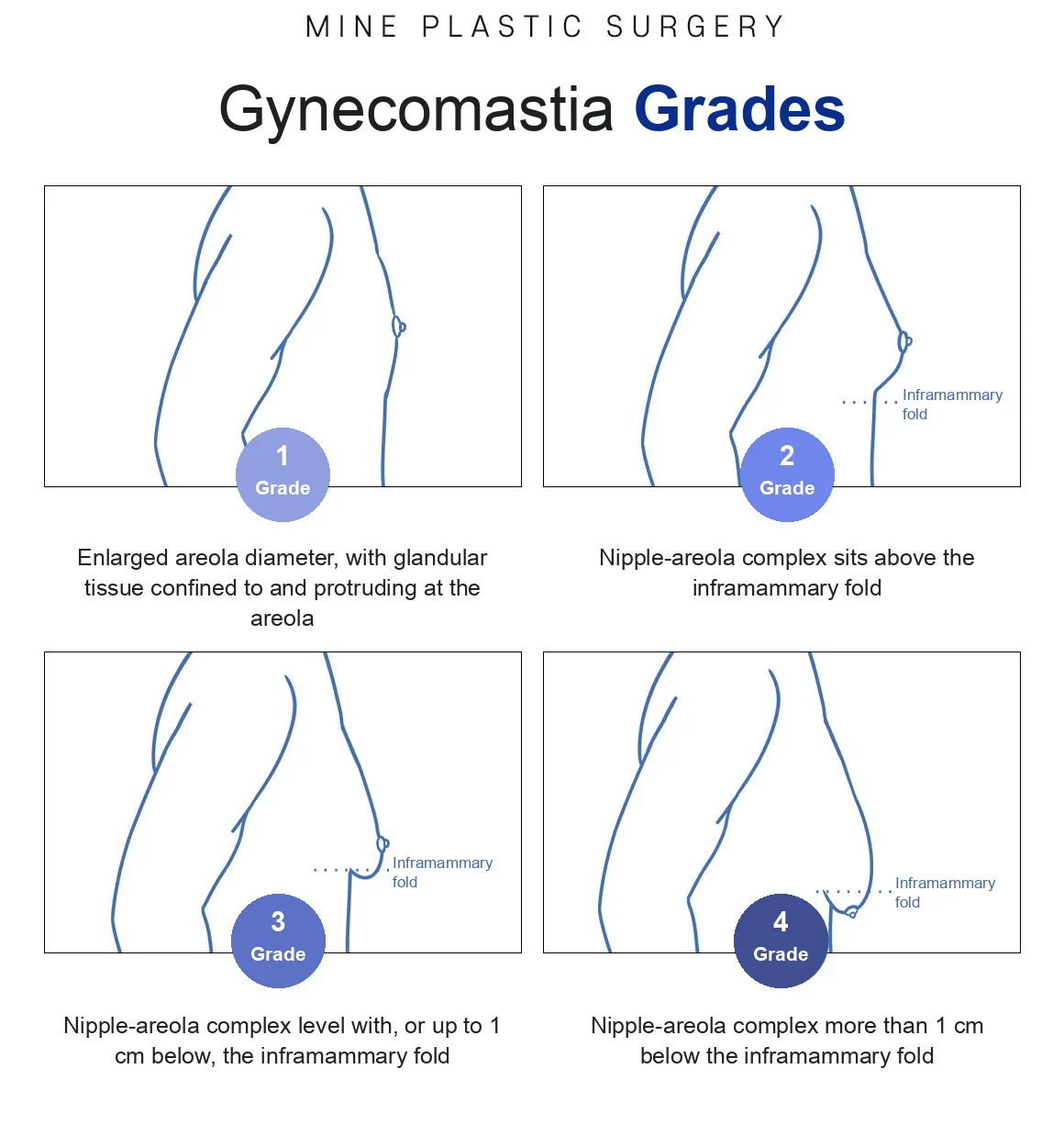
That said, you cannot reliably sort yourself into one group just by pressing on your chest. Fat and gland are usually mixed, and the final call is made at examination. Surgeons also grade how far the chest has dropped by where the nipple and areola sit relative to the inframammary fold (the crease under the chest), as shown in the diagram below — the lower they sit, the more likely skin reduction becomes.
Dr. Lee’s Key Point: The extent of your gynecomastia surgery scars is decided by what is inside your chest, not by how “big” the surgery sounds.
Gynecomastia Scar Location by Surgical Approach
Within the single label “gynecomastia surgery,” scar location differs by approach. With liposuction alone, gynecomastia surgery scars are limited to a few tiny cannula entry marks; adding gland excision places a half-circle line along the lower edge of the areola. Look at the three cases below and you will get a rough sense of where you fit.
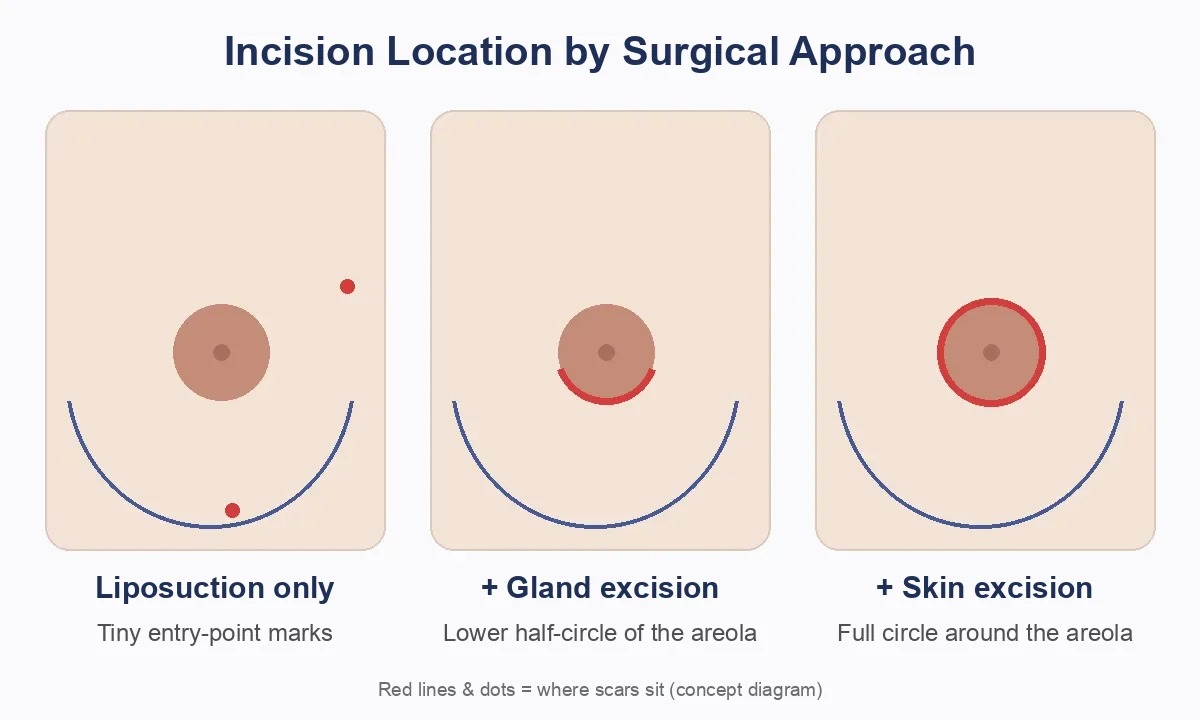
Liposuction only: tiny entry-point marks
Textbooks describe liposuction as a minimally invasive technique (one that puts little strain on the body) and as a first-line treatment for gynecomastia. Because it can smooth the chest all the way out to the edges, quite a few cases are finished with liposuction alone. In that situation, gynecomastia surgery scars are no more than the small marks where the cannula went in; their size and number depend on the cannula and the area treated.
Adding gland excision: a lower half-circle at the areola edge
If firm tissue is still left under the areola after liposuction, it has to be removed separately. This is done through an incision that follows the lower border of the areola in a half-circle — a periareolar incision, often described in textbooks as an infra-areolar approach. Going in at the areola and removing the tissue directly is still the core of gynecomastia surgery today.
The reason for this gynecomastia incision is simple: the line sits exactly where the darker areola meets the lighter skin of the chest, so it can be designed to blend into the color change. The scar stays within part of the areola’s circumference, mostly the lower half.
Adding skin reduction: a full circle around the areola, or longer
Liposuction also helps the skin shrink back on its own, so skin reduction is reserved for severe cases where a lot of skin remains even after liposuction. Textbooks note that male chest skin does not shrink as smoothly as female breast skin, which is why the decision is made case by case.
When skin does need to be removed, the first option is usually a donut-shaped removal of a ring of skin around the areola. In that case, gynecomastia surgery scars form a circle around the edge of the areola. Textbooks favor this concentric approach because it keeps the scar at the areola rather than adding new lines across the chest. They also note that the gathered circular closure can sometimes heal with faint, fine pleats radiating from the areola. If sagging is far more pronounced, some techniques accept a longer scar that runs toward the inframammary fold.
If the areola itself needs to be made smaller, the criteria are a little different; I cover them separately in our article on male nipple reduction.
| Approach | Incision location | Scar shape | Typical case |
|---|---|---|---|
| Liposuction | Where the cannula enters | Tiny entry-point marks | Chest enlarged mainly by fat |
| Liposuction + gland excision | Lower color border of the areola | Half-circle line along the areola edge | Firm tissue can be felt under the areola |
| Plus skin reduction | The entire areola border | Circular line around the areola | Clearly loose or excess skin |
| Techniques for severe sagging | Extending toward the inframammary fold | Longer linear scar | Very pronounced sagging |
Dr. Lee’s Key Point: Each stage you add moves gynecomastia surgery scars a little further out from the areola border.
How MINE Plans the Incision: One Areolar Opening, Double-Layer Closure
At MINE Plastic Surgery, the starting point of scar design is not making a second incision. That is why we sequence the operation so that liposuction and gland removal are done through a single opening.
Liposuction and gland removal through one small areolar-line incision
Our gynecomastia surgery begins with a small incision along the areola line. After tumescent anesthetic fluid (a numbing solution) is infused across the chest, fat is suctioned from everywhere except the area right around the areola. The fascia under the breast (the thin layer that covers the chest muscle) is then released, and the glandular tissue is removed. We keep to this order because thorough liposuction first makes the remaining tissue much easier to cut out.
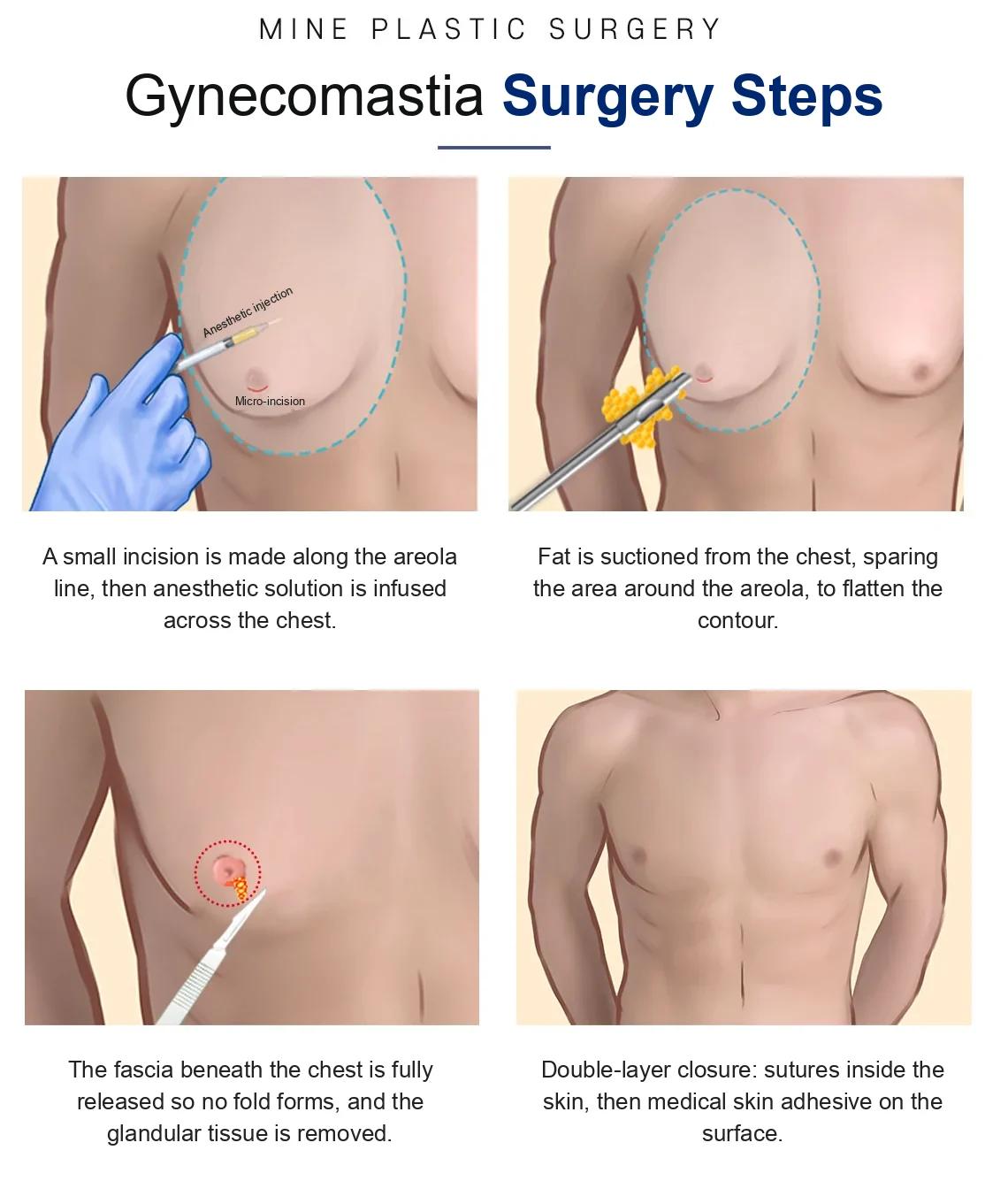
At MINE, gynecomastia surgery takes about 1 hour, patients go home the same day, and most return to daily life within 1 week. Anesthesia is local or general depending on your condition, and you will usually come back for 2–3 follow-up visits. We also work together with physicians experienced in treating breast conditions. You can read the full procedure details on our page about MINE gynecomastia surgery.
Inner sutures plus medical skin adhesive
The incision is closed in two layers: first with sutures inside the skin, then sealed on the surface with medical skin adhesive (a skin-safe surgical glue). The inner stitches carry the force that tends to pull the wound open, so less tension falls on the outer skin. The goal is not to make gynecomastia surgery scars disappear — that is not possible — but to design them so they settle into the areola border.
Dr. Lee’s Key Point: Doing liposuction and gland removal through one incision is the practical way to avoid extra incisions.
4 Factors That Make Gynecomastia Surgery Scars More Visible
Even with the same incision in the same place, some men’s gynecomastia surgery scars blend in well while others stay visible for longer. In my clinical experience, the difference usually comes down to four conditions. Of these, a sharp areola color border is the one that hides the incision line most.
A sharp vs blurred areola color border
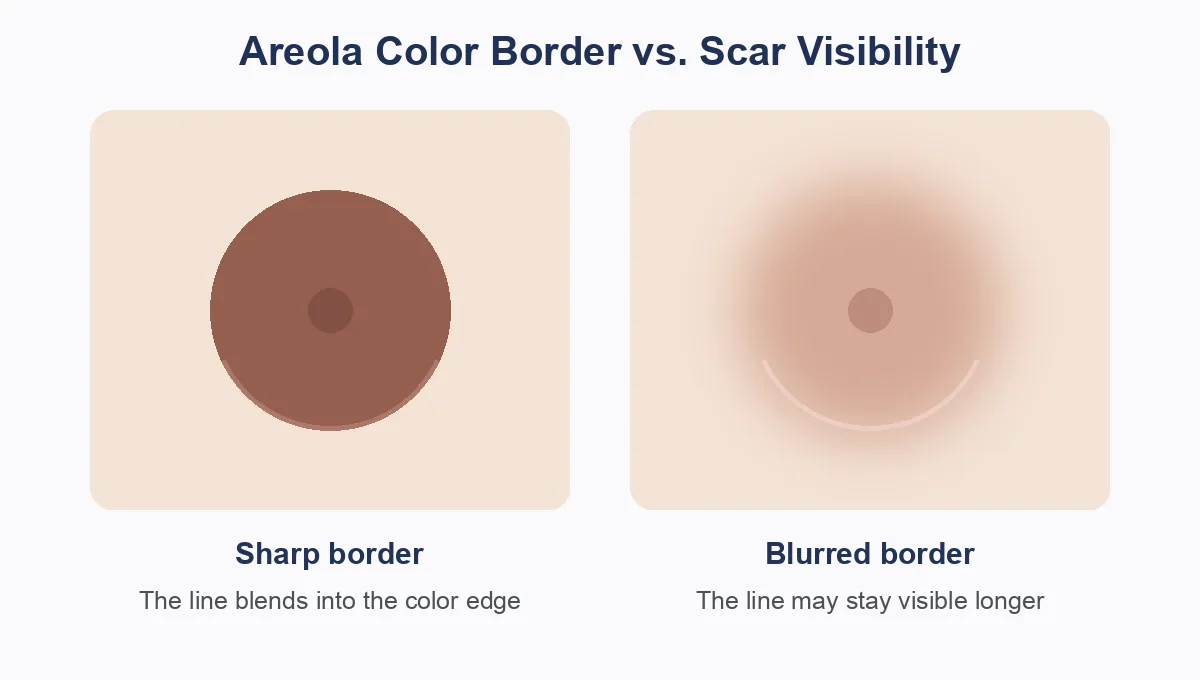
The clearer the boundary between the areola and the surrounding skin, the less noticeable a periareolar line becomes; when that boundary is faint, the line may stay visible for longer. The color change works like a curtain that hides the line. If your areola is pale or its edge looks blurred, I point this out during consultation so your expectations are realistic.
Skin elasticity and how much loose skin remains
If your skin elasticity is poor or borderline, it is generally better to deal with the loose skin at the first operation — an approach plastic surgery textbooks also prefer. Avoiding skin reduction just to keep gynecomastia surgery scars small can backfire: the leftover skin may fold or sag, and that shape can be more noticeable than the scar would have been.
How much tissue is removed (crater or dent risk)
If too much tissue is taken from under the areola, the area can sink into a saucer-shaped hollow. This is a contour problem rather than a scar, but when your shirt is off it draws the eye just as much. Textbooks point out that direct excision on its own carries a real risk of these contour deformities, which is why deciding how much tissue to leave directly under the areola matters so much.
Your scar tendency: hypertrophic scars and keloids
If an old injury or surgical scar of yours has ever turned red, thick and raised, please tell your surgeon at consultation. A hypertrophic scar thickens but stays within the original wound, while a keloid keeps growing beyond the wound’s borders. Both are strongly influenced by your constitution. If you are already living with a difficult scar elsewhere, our article on scar revision surgery explains what can and cannot be improved.
One more point for men who need skin reduction: a circular scar around the areola can, over time, pull the areola wider. This has been reported mainly after female breast reduction with a short periareolar scar, but it is worth knowing about if your plan includes a full circle.
Dr. Lee’s Key Point: Reducing gynecomastia surgery scars starts with the diagnosis that picks the right stage, not only with suturing technique.
Complications Beyond the Scar
When all your attention is on the scar, it is easy to overlook other complications. Every operation carries some risk, and it is better to know them before you decide.
Textbook complication list in plain English
The textbook list of gynecomastia surgery complications includes four forms of adverse scarring: widened scars, hypertrophic scars, keloids and pigmented (darkened) scars. Beyond the scar, the list includes the following:
- Bleeding and hematoma — blood collecting inside the surgical area; suspect it if swelling and pain are much worse on one side.
- Seroma — clear fluid, rather than blood, collecting under the skin; it can be drained if needed.
- Infection — contact your surgeon straight away if the wound turns red and feels hot.
- Nipple inversion or pulling — the nipple turning inward or the surrounding area looking drawn in.
- Altered sensation — the nipple or nearby skin may feel duller or more sensitive.
- Leftover skin or asymmetry — remaining skin folds, or the two sides looking different.
- Overcorrection or undercorrection — too much or too little tissue removed; revision surgery may be considered in some cases.
To give a sense of scale, a breast surgery textbook reports adverse scarring in 8.8–11% of open-excision gynecomastia cases. The same textbook data list infection at 1.5%, wound separation at 0.3–3% and loss of the nipple-areola complex at 3.7% after open excision. These are published figures for open excision in general, not results from our clinic, and they are a reminder of why the extent of excision is planned so carefully.
Scar-care timing is covered separately
The redness of gynecomastia surgery scars normally fades gradually over several months. When to start scar cream or laser, and when compression garments and exercise are safe, are all explained in our guide to gynecomastia surgery recovery precautions and scar-care timing.
Dr. Lee’s Key Point: Knowing the possible complications in advance takes away much of the “is this normal?” anxiety during recovery.
What Dr. Lee Checks Before Surgery, and Habits That Help the Scar Afterward
The question I am asked most in consultation is “Where will the scar be?” To answer it, there are a few things I need to check first.
Before surgery: 4 things checked at consultation
- Is there firm tissue you can feel under the areola? — This tells us whether gland excision is needed.
- How loose is the skin? — This decides whether to go as far as skin reduction or to rely on the skin shrinking after liposuction.
- Do you have a history of keloids or thick scars? — This is the basis for planning scar care in advance.
- Are you planning a big change in weight? — If significant weight loss is ahead, we discuss the timing of surgery together.
These four points effectively decide how far the incision goes. It is also why I do not quote a scar length in numbers before examining you: until I have assessed the tissue and skin inside your chest, there is no honest answer to give. Textbooks take the same cautious view — when excision is not clearly needed from the start, patients are still asked to consent to it in case liposuction leaves significant firm tissue behind.
After surgery: simple habits for a less noticeable scar
During recovery, avoid big arm movements that pull on the wound, and keep the scar out of direct sunlight. Smoking slows wound healing, so you should stop before and after surgery. Simply following these basics reduces the chance of gynecomastia surgery scars staying red for a long time.
Dr. Lee’s Key Point: Surgery sized to what you actually need, rather than the smallest-scar option, ends up easing scar worries the most.
Gynecomastia Surgery Scars: Frequently Asked Questions
Where are gynecomastia surgery scars located?
Most gynecomastia surgery scars sit along the lower color border of the areola. If only liposuction is done, you are left with tiny marks where the cannula went in. Only when loose skin also has to be removed does the scar extend around the whole areola or beyond.
Does liposuction alone leave smaller scars?
The incisions are smaller, but if firm glandular tissue remains, gland excision may still be needed. That is why, before surgery, patients are told that the plan may move on to excision if tissue is left after liposuction, and their consent is obtained in advance. Whether firm tissue remains matters more than scar size.
Why is the incision placed at the lower edge of the areola?
Placing the line where the color changes from areola to skin makes it less noticeable. The same opening also allows the glandular tissue under the areola to be removed. If your areola border is blurred, however, the line may stay visible for longer.
How long is the scar if loose skin also has to be removed?
There is no single answer, because the scar’s extent depends on how much excess skin there is. Usually it becomes a circular scar around the areola, and in cases of very pronounced sagging a scar running toward the fold under the chest may be needed. The exact extent is decided at examination.
Can gynecomastia scars become thick or turn into keloids?
Yes, gynecomastia surgery scars can thicken in some cases. The textbook complication list includes widened, hypertrophic, keloid and pigmented scars. The risk depends on your constitution and scar history, so be sure to mention it at consultation; for scar-care timing, see our article on what to expect during gynecomastia surgery recovery.
Planning Your Gynecomastia Consultation at MINE
To sum up: the location and extent of gynecomastia surgery scars are set by how many stages you need — liposuction, gland excision or skin reduction — while the areola color border, skin elasticity, the amount of tissue removed and your scar tendency decide how visible they are. No method can erase a scar entirely, but choosing only the stages you truly need limits where scars appear.
Because the extent of gynecomastia surgery scars depends on the tissue and skin inside your chest, I recommend confirming it at an in-person consultation at MINE Plastic Surgery. You can find more about the procedure on our gynecomastia surgery page.
Book a 1:1 consultation at MINE Plastic Surgery — call +82-2-516-1175.
Written and medically reviewed by Dr. Lee Sung-wook, Board-certified Plastic Surgeon
MINE Plastic Surgery | 813 Nonhyeon-ro, Gangnam-gu, Seoul, Korea | +82-2-516-1175
※ This content is for informational purposes only and does not replace professional medical advice, diagnosis, or treatment. Individual results may vary, and side effects may occur. Please consult with a board-certified plastic surgeon for personalized advice.