EN
EN


Choosing Motiva implants for a slim frame is a measurement-led process. The surgeon first checks how much tissue will cover the implant, then sets the pocket, implant width and profile, and only then matches a Motiva model to those numbers.
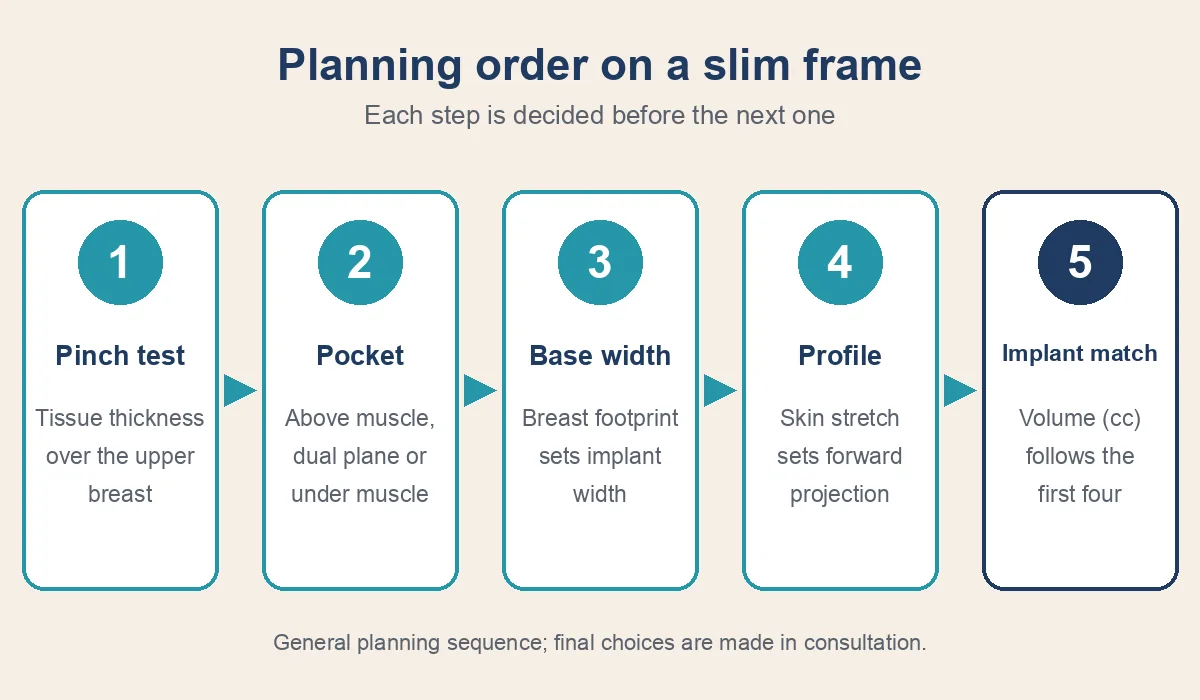
Many slim women arrive at a consultation with a brand name and a cc number already in mind, often picked up from forums or friends. That is understandable, but when you have little breast tissue, the brand is the last decision, not the first. The order that protects a natural result is simple: a pinch test decides the pocket, your breast base width decides the size, your skin stretch decides the profile, and the product line-up is matched at the end. The cc figure is an output of those choices, not a starting point.
This guide explains each step in plain language, shows how the measurements translate into decisions, and covers the risks that matter most when there is not much natural padding over an implant.
Table of Contents
- What Motiva Implants for a Slim Frame Really Involve
- Do You Have a Slim Frame? Signs You Have Little Breast Tissue
- The 3 Measurements That Decide Pocket, Size and Profile
- Matching the Motiva Line-Up to Your Measurements
- Risks and Recovery When Breast Tissue Is Thin
- Frequently Asked Questions About Motiva Implants on a Slim Frame
- Plan Your Motiva Implants Around Your Own Measurements
What Motiva Implants for a Slim Frame Really Involve
An implant does not sit in empty space. It sits under skin, a layer of fat and breast gland, and sometimes under the chest muscle as well. Everything you see and feel after surgery depends on how well those layers hide the implant edge. On a slim body, those layers are thin, and that changes how every other decision is made.
Why Thin Tissue Changes the Rules
Plastic surgery literature lists maximizing soft-tissue coverage (the natural padding of skin, fat and gland over the implant) as one of the most important guiding principles for success in breast augmentation. When that padding is generous, there is room for error. When it is thin, small choices show.
Textbooks on complications after aesthetic breast surgery make a point that surprises many patients: even the most cohesive, form-stable gel implant can be visible if it is oversized for thin skin. In other words, a well-made gel does not cancel out the basic physics of coverage and size. A premium product placed in the wrong pocket, or chosen too large for the chest, can still show its edge or a ripple.
That is why, with Motiva implants for a slim frame, the surgeon’s first questions are not “which model?” but “how much cover do we have?” and “how wide is your chest?”
The Measure-First, Brand-Last Order
In consultation, we follow the same four steps for every slim patient:
- Pinch test → pocket. The thickness of the upper breast tells us whether the implant needs extra cover from the muscle.
- Base width → size. The width of your breast footprint sets the width of the implant, and the volume follows from that.
- Skin stretch → profile. How far your skin can comfortably stretch forward decides how much projection (forward fullness) is safe.
- Match the Motiva line-up. Only now do we look for the round or ergonomic Motiva implant whose dimensions fit those three answers.
If you want a refresher on implant shapes, fillings and surfaces before going further, our complete guide to breast implant types covers the basics. This article focuses on how those options are narrowed down when tissue is limited.
Dr. Lee’s Key Point: With little breast tissue, the measurements choose the implant. The brand is chosen to fit the measurements, never the other way around.
Do You Have a Slim Frame? Signs You Have Little Breast Tissue
“Slim frame” is not a medical diagnosis, and it is not about weight alone. It describes a body where there is relatively little soft tissue on the chest to cover an implant. The same planning principles apply whether you call yourself petite, small-framed or simply thin, so information written about breast implants for thin women applies to you as well.
Physical Signs Surgeons Look For
During examination, these findings suggest that coverage will be the main planning issue:
- Low overall body fat, with ribs or the breastbone easy to see or feel
- A narrow chest wall and a narrow natural breast footprint
- An upper chest that looks flat or slightly hollow above the breast
- An upper-pole pinch (the tissue above the nipple, gathered between two fingers) of less than about 2 cm
- Very little breast gland, so there is not much natural tissue to drape over an implant edge
If several of these describe you, planning Motiva implants for a slim frame will usually prioritize extra coverage and careful sizing above everything else. Some slim patients also have loose skin or a low nipple position, for example after pregnancy or weight loss. Thin tissue combined with sagging can change the plan, sometimes adding a lift, so that should be assessed in person.
When Fat Transfer Is Not Enough
Fat transfer is a natural-feeling option, but it depends on having spare fat to harvest. Many slim patients simply do not have enough donor fat for a meaningful change in volume, and only part of the transferred fat survives long term. For a side-by-side look at what each method can and cannot do, see our article on implants vs fat transfer for breast volume. When implants are the better fit, the rest of this guide explains how they are tailored to a thin envelope.
Dr. Lee’s Key Point: A slim frame is defined by how much tissue covers the chest, not by the number on the scale. The pinch test tells us more than your weight does.
The 3 Measurements That Decide Pocket, Size and Profile
This is the heart of planning Motiva implants for a slim frame. Three simple measurements, taken with your hands, a ruler and a tape, drive the three biggest decisions. None of them requires guessing a cc number.
Step 1 — Pinch Test: Why Under 2 cm Usually Means a Dual Plane Pocket
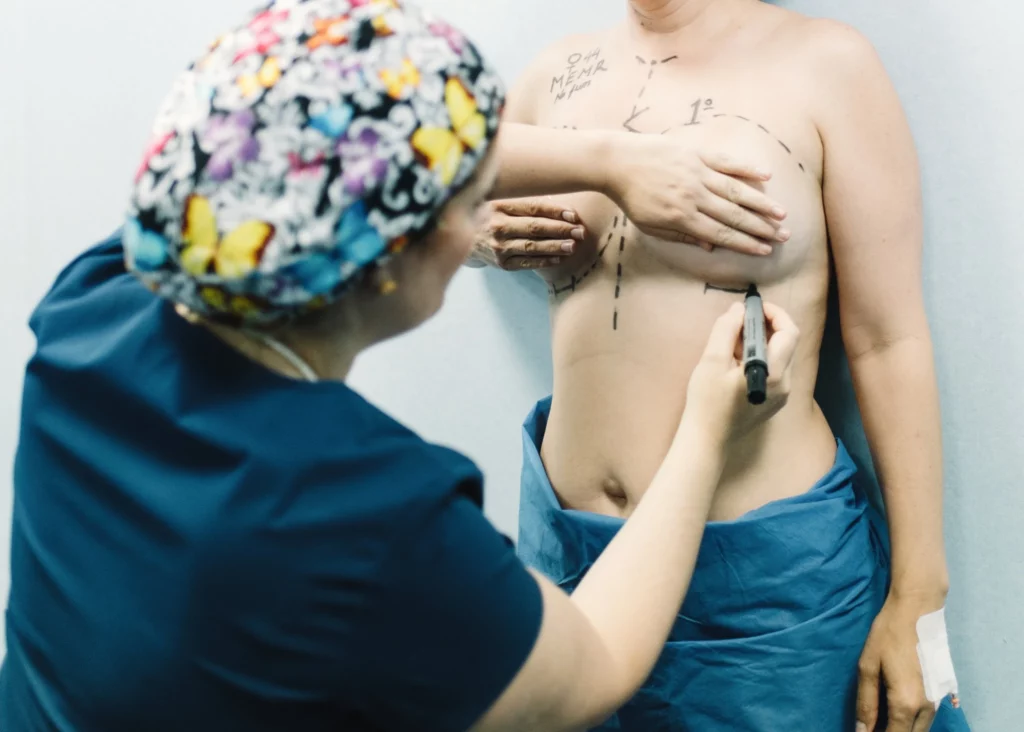
The surgeon gently gathers the upper part of your breast between thumb and index finger and measures the thickness of the tissue in between. It takes a few seconds and is painless.
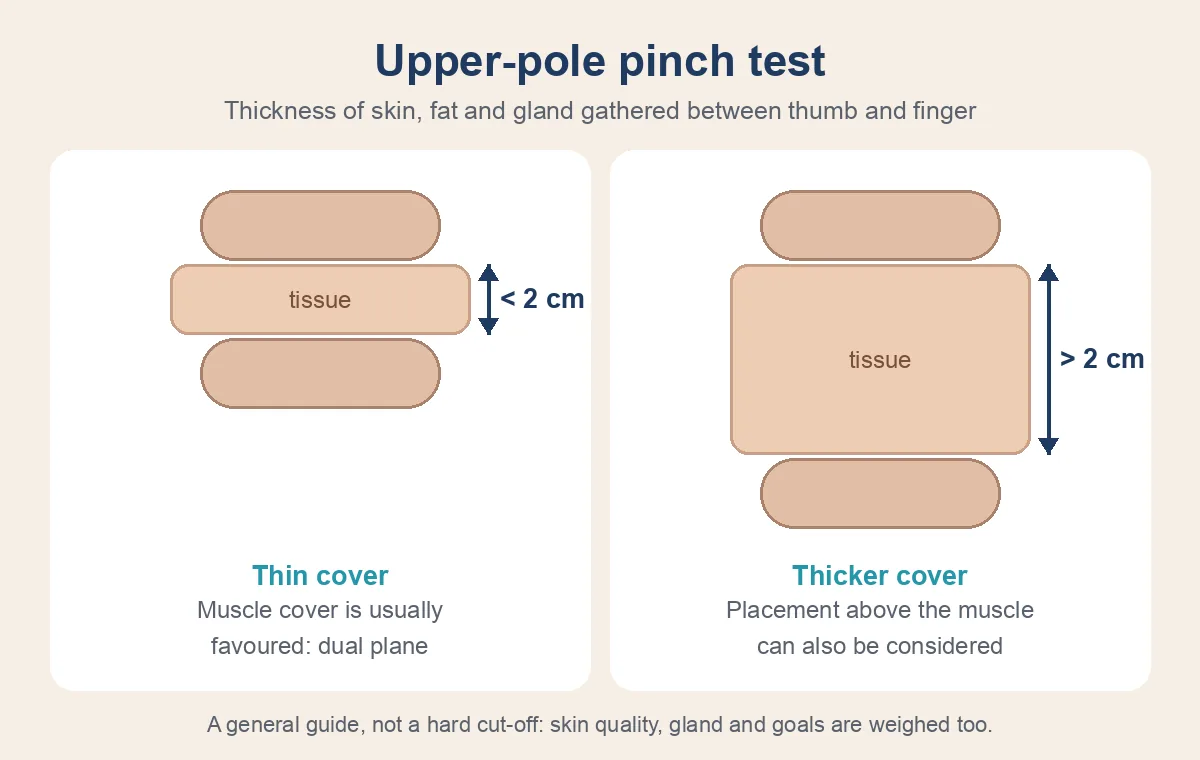
As a general rule in plastic surgery textbooks, an upper-pole pinch thinner than about 2 cm points toward placing the implant under the muscle to avoid visible wrinkling in the upper breast. When the pinch is thicker than about 2 cm, placement above the muscle (under the gland or under the thin fascia layer covering the muscle) can also be considered. This is a guide, not a hard cut-off: skin quality, gland distribution and your goals are weighed alongside it.
For most slim patients, this points to a dual plane breast augmentation. In a dual plane pocket, the muscle covers the upper part of the implant while the lower part sits beneath breast tissue. Think of it as a split blanket: the chest muscle adds a thick layer exactly where your own tissue is thinnest (the upper slope, where edges and ripples are most likely to show), while the lower half of the implant rests under the gland so the bottom of the breast can expand and take a soft, natural curve.
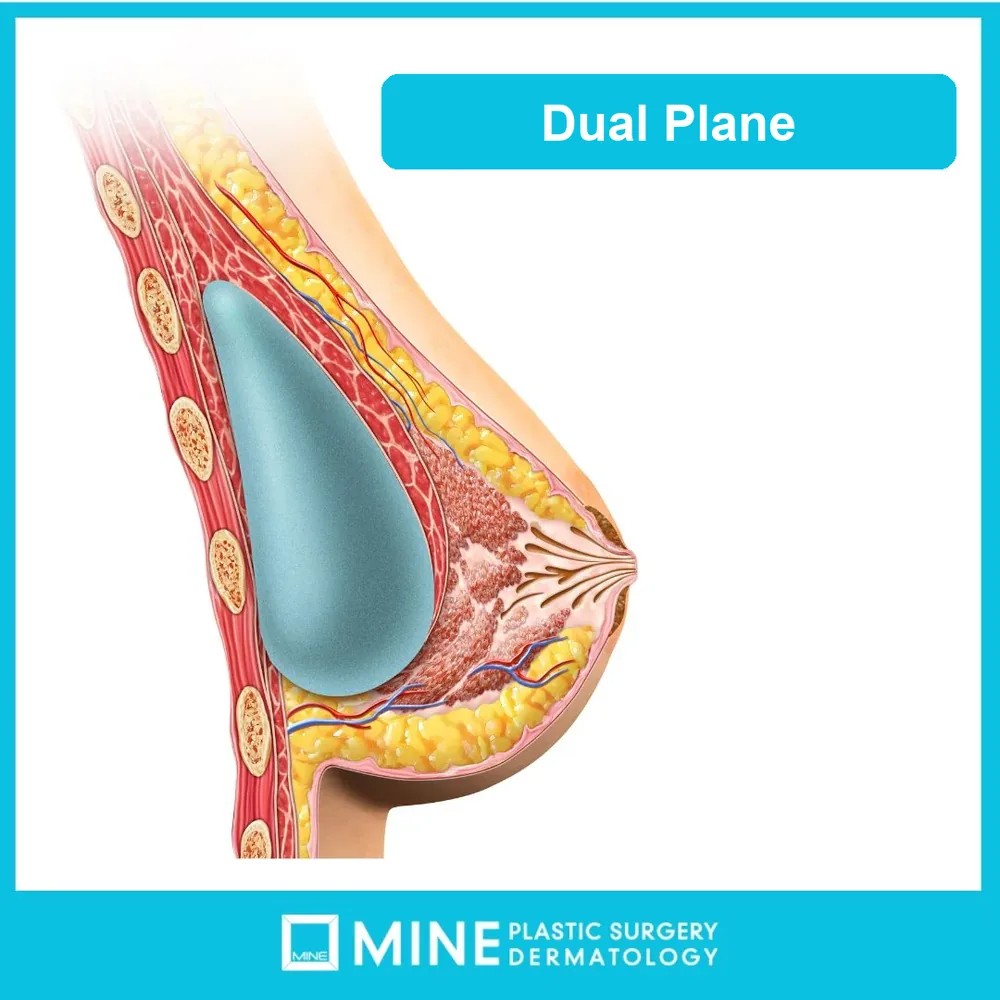
The amount of muscle released at the lower edge can be adjusted. Clinical literature notes that a tight, constricted lower breast often needs more of the muscle released (a higher dual plane level, such as level 2 or 3) so the lower half of the breast can open up fully. A purely under-the-muscle pocket gives the most cover, but textbooks note it causes more visible movement when the muscle contracts and restricts expansion of the lower breast. The dual plane is a middle path between those trade-offs.
We cover the general comparison of above-muscle, under-muscle and dual plane placement in our overview of implant placement options. Here, the key point is narrower: for a slim chest, the pocket is chosen first to buy coverage, and every later choice must respect it.
Step 2 — Base Width: How to Choose Breast Implant Size Without Starting From cc
Base width means how wide the breast footprint is on your chest, measured from the inner edge of the breast to the outer edge. Textbooks describe it as related to the width of the chest and proportional to overall body build, and they stress that this dimension should be respected. Doing so keeps two natural landmarks in place: the outer fold of the breast near the armpit line and the gap between the breasts.
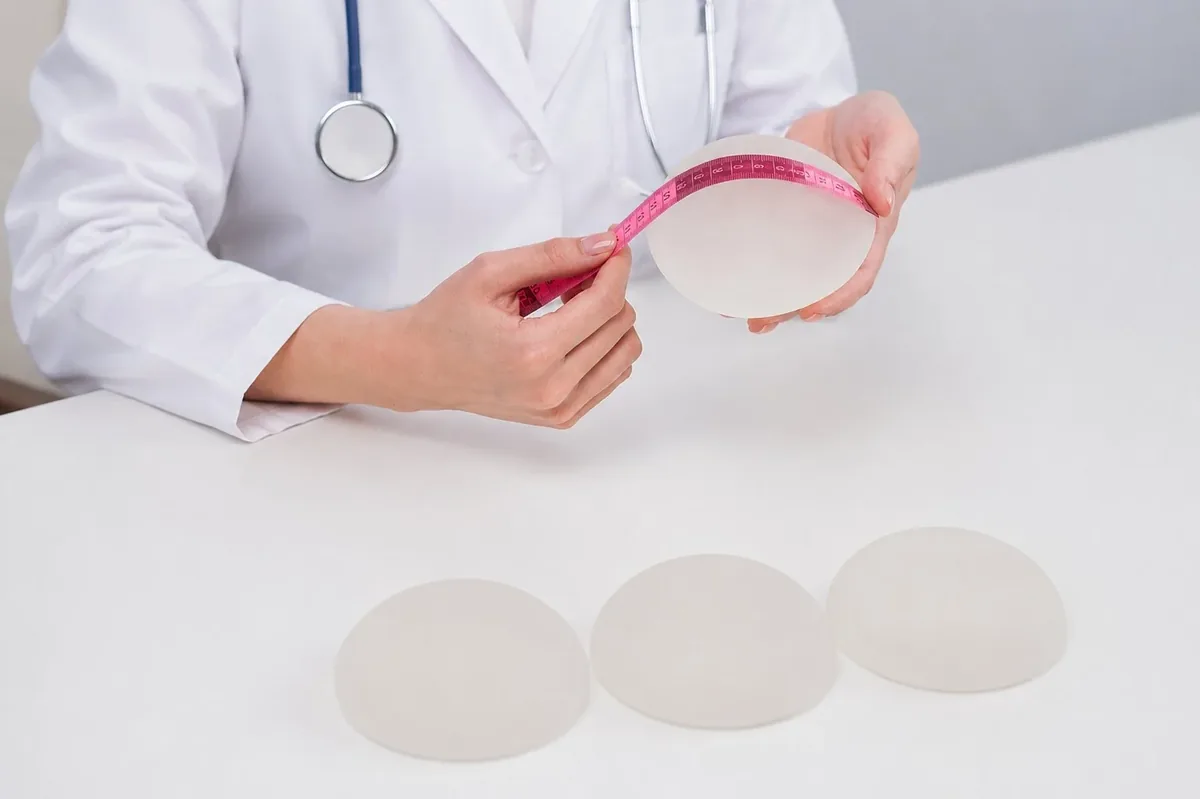
Implant size on a slim frame is chosen from the breast base width first; the cc volume is the result, not the starting point. If an implant is wider than your natural footprint, it tends to push into the armpit area or narrow the cleavage gap in an unnatural way, and on thin skin the edges are more likely to be felt. If you are wondering how to choose breast implant size, this is the honest answer: by width, then profile, with volume following. The American Society of Plastic Surgeons sizing overview offers useful patient-level background on the many variables that go into sizing.
This is also why we do not quote a “right” cc when planning implants for a slim chest. Two women of the same weight can have very different chest widths, and the same cc can look modest on one and overdone on the other.
Step 3 — Skin Stretch: Choosing a Breast Implant Profile That Fits the Envelope
The breast implant profile describes how far the implant projects forward from the chest wall. The surgeon assesses how much your skin stretches when gently pulled forward and measures the distance from the nipple to the breast fold while the skin is stretched. Tight skin with a short distance usually tolerates less projection; a looser, more stretchy envelope can accommodate more.
Textbooks note that round implants usually come in three or four projections for the same base width. That is very useful on a slim chest: the surgeon can keep the base width fixed to respect your anatomy and fine-tune fullness by moving up or down a profile, instead of making the implant wider.
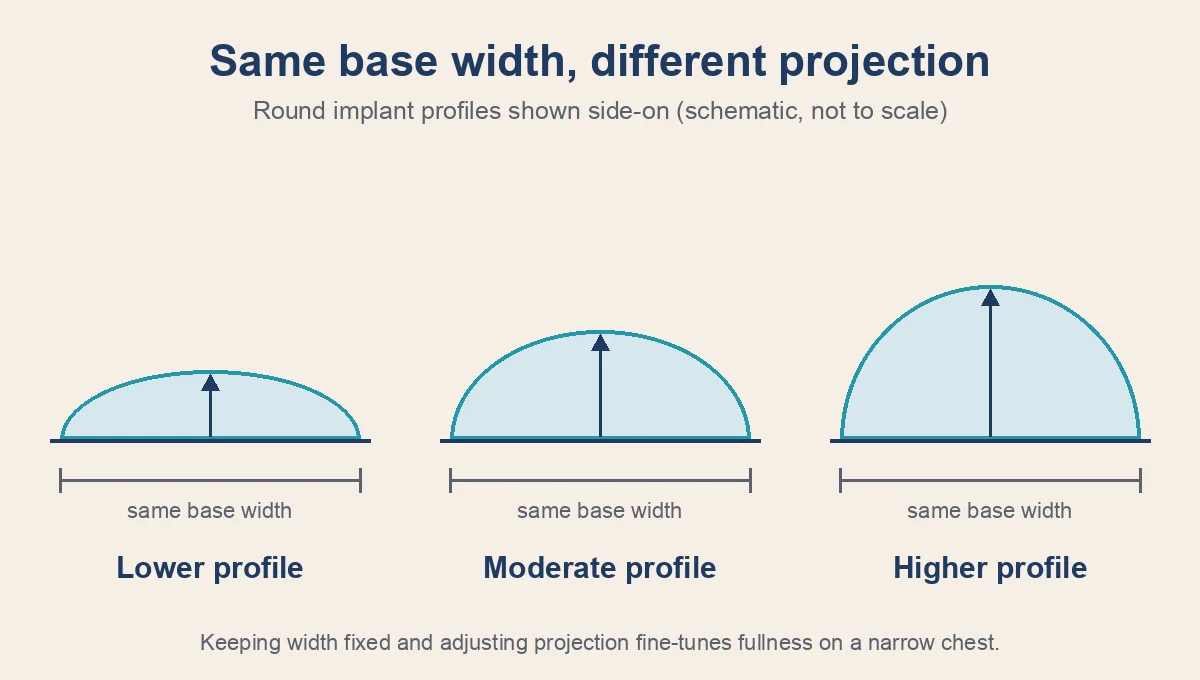
More projection is not automatically better. Breast reconstruction literature describes a principle worth knowing: in smaller breasts, a narrow implant with very high projection can pull the nipple outward or leave a slight hollow toward the cleavage. We use that as a general caution, not a rule with numbers, but it explains why the highest profile is not the default choice for a small, thin breast.
| Measurement | What it tells the surgeon | Decision it drives | Typical slim-frame finding |
|---|---|---|---|
| Upper-pole pinch test | How much natural cover sits over the top of the implant | Pocket: above the muscle, dual plane or under the muscle | Often under about 2 cm, pointing toward a dual plane pocket |
| Breast base width | How wide the implant can be without crowding the armpit or cleavage | Implant width, which then shapes the volume | Narrow footprint, so a narrower implant base |
| Skin stretch and nipple-to-fold distance | How much forward fullness the skin can hold comfortably | Profile (projection) | Often tight skin, so projection is chosen with care |
Dr. Lee’s Key Point: Pocket first, width second, profile third. When those three are right, the volume that results usually looks proportionate on a slim body.
Matching the Motiva Line-Up to Your Measurements
Once the pocket, base width and profile direction are set, the question becomes which Motiva implants offer dimensions that fit. Everything in this section about the products themselves is based on manufacturer information, and you can check the current range on Motiva’s official implant overview.
Round vs Motiva Ergonomix: What the Manufacturer Says
According to the manufacturer, Motiva offers round implants and an ergonomic line called Motiva Ergonomix. Motiva states that the Ergonomix design uses a softer, more flexible gel intended to move with the body, appearing rounder when lying down and more sloped when upright. The manufacturer also describes its SmoothSilk surface as a very smooth, low-roughness shell surface.
These are the manufacturer’s descriptions. Some company materials also describe a thinner capsule or lower rates of capsular contracture (hardening scar tissue around the implant); those statements come from manufacturer data, and you should weigh them as such. From a textbook point of view, the primary variables for visibility on a thin chest are still coverage and size. No gel or shell design replaces a well-chosen pocket and an implant that is not too wide or too large.
Motiva Profiles (Mini, Demi, Full, Corsé) in Plain Terms
In the manufacturer’s catalog, Motiva profiles are named Mini, Demi, Full and Corsé, running from the flattest to the most projecting. In plain terms, they are different amounts of forward fullness for a given width. The manufacturer’s size charts list many combinations of base width and profile, so when matching an implant to your measurements there are usually several candidates to compare, not just one.
The table below shows how measurement results are turned into discussion points. It is a framework for conversation, not a prescription.
| Your measurement result | Profile direction | What to discuss with your surgeon |
|---|---|---|
| Tight skin and a narrow base width | Lower to moderate projection | Whether a lower profile at your true base width gives enough fullness without stressing the skin |
| Narrow base width but stretchy skin | Moderate, sometimes higher projection | Whether stepping up one profile adds fullness without moving the nipple outward |
| Very thin upper pinch with little gland | Profile chosen conservatively; dual plane pocket | Round vs Motiva Ergonomix on upper-slope appearance, keeping in mind that coverage matters most |
| Loose skin or low nipple position | Depends on the lift assessment | Whether an implant alone is enough or a lift should be considered |
Why the Brand Comes Last
Motiva implants come in many sizes, but the brand cannot choose your pocket, your base width or your skin’s tolerance. That is why the final implant choice happens after measuring, often with sizers during planning, rather than from a catalog alone. Other manufacturers make well-regarded implants too; the implants guide compares the main types if you want a broader view. If you would like to know how we work with this brand specifically, see Motiva breast augmentation at MINE.
Dr. Lee’s Key Point: Read the manufacturer’s claims with interest, but let your own measurements make the decision. On a thin chest, the right width and pocket matter more than the label.
Risks and Recovery When Breast Tissue Is Thin
Every breast augmentation carries risk, and a slim build shifts which risks deserve the most attention. Knowing them helps you understand why surgeons who plan implants for thin patients tend to be conservative with size.
Rippling, Visible Edges and Palpability
Rippling means small waves or folds in the implant surface that can be seen or felt through the skin. Plastic surgery literature lists four factors that make wrinkling more likely: thin or inadequate tissue coverage, saline implants, textured implants and underfilled gel devices. The same sources note that adequate coverage takes priority when choosing the pocket, and that under-the-muscle or dual plane placement provides the most cover.
Even with good coverage, tissue can thin and stretch over the years, especially in the lower breast. That is one reason slim patients benefit from long-term follow-up rather than a one-time check.
Oversizing and Implant Displacement
An implant that is too wide or too heavy for a narrow chest can drift outward toward the armpit or downward over time. On a slim frame, there is less tissue to hold it in place and less padding to disguise the change. Our guide to breast implant malposition explains the causes and how it is corrected. The simplest prevention is respecting base width from the start.
What Recovery Looks Like After a Dual Plane Pocket
Because part of the implant sits under the muscle, the chest often feels tight in the first days, and the implants usually sit high at first. They gradually settle and soften over the following weeks to months as the muscle relaxes and the lower breast expands. Some people notice the breast shape changing slightly when they tense the chest muscle, known as animation deformity. This is usually mild with a dual plane pocket but is worth knowing in advance, especially if you lift weights.
Other risks apply to all breast augmentation and should be discussed openly:
- Capsular contracture (scar tissue around the implant tightening and hardening)
- Infection, bleeding or fluid collection
- Asymmetry between the two sides
- Changes in nipple or breast sensation
- The possibility of a future revision or implant exchange
Questions worth asking your surgeon before you decide on an implant:
- What was my pinch test result, and which pocket does it point to?
- What is my breast base width, and what implant width matches it?
- How much does my skin stretch, and which profiles fit that?
- If I want more fullness, will you go up a profile or make the implant wider, and why?
- How will you reduce the risk of rippling and visible edges in my case?
- What follow-up do you recommend in the years after surgery?
Dr. Lee’s Key Point: On a slim body, most problems we see in revision trace back to an implant that was too wide or too large for the cover available. Conservative sizing is not timid; it is protective.
Frequently Asked Questions About Motiva Implants on a Slim Frame
How do I know if my breast tissue is too thin for implants over the muscle?
A pinch test is the simplest guide. If the tissue gathered from your upper breast measures under about 2 cm, textbooks generally favor placing the implant under the muscle or in a dual plane pocket to reduce visible edges and wrinkling. It is a general rule rather than a strict cut-off, so your surgeon confirms it in person alongside skin quality and gland distribution.
What size Motiva implant is right for a slim frame?
There is no single right cc number. The size is chosen from your breast base width and how much your skin stretches, and the volume is the result of the base width and profile selected. Two women of the same weight can need very different implants, so a measured assessment matters far more than a figure from a forum.
Is a high profile implant better if I have little breast tissue?
Not automatically. Profile is set by how much your skin can stretch. On a narrow, tight envelope, too much projection can look less natural, push the nipple outward or create a hollow toward the cleavage. A higher profile can suit a stretchier envelope, but that decision should come from measurements discussed with your surgeon.
Will Motiva implants ripple if I am very thin?
Rippling depends mostly on tissue coverage and implant size. A dual plane pocket and an implant that is not too wide lower the risk considerably. The manufacturer describes its gel and surface as designed for a natural feel, but textbooks note that any gel implant can become visible when coverage is thin and the implant is oversized.
Why do surgeons recommend a dual plane pocket for thin patients?
Because it adds cover exactly where thin patients need it. The chest muscle lies over the upper part of the implant, where tissue is thinnest, while the lower part sits under breast tissue so it can expand naturally. The trade-off is some breast movement when the muscle contracts, which is usually mild.
Plan Your Motiva Implants Around Your Own Measurements
If you are considering Motiva implants for a slim frame, the most useful first step is a measured assessment rather than a cc number. At MINE Plastic Surgery & Dermatology in Gangnam, Seoul, Dr. Lee Sung-wook, a board-certified plastic surgeon, reviews your pinch test, base width and skin stretch, then explains which pocket, width and profile fit your body before discussing specific Motiva models.
International patients can start with an online consultation: send photos and any measurements you have for a preliminary review, and the final plan is confirmed after an in-person examination in Seoul. To book, call +82-2-516-1175 or use the consultation form on mineclinic.com.
Written and medically reviewed by Dr. Lee Sung-wook, Board-Certified Plastic Surgeon, MINE Plastic Surgery & Dermatology, Seoul. Last updated: October 13, 2026.
※ This content is for informational purposes only and does not replace professional medical advice, diagnosis, or treatment. Individual results may vary, and side effects may occur. Please consult with a board-certified plastic surgeon for personalized advice.