EN


Re2O side effects are the reactions that can follow an Elravie Re2O (also written RE20) skin booster injection, an hADM-based collagen treatment. Most are mild injection marks, swelling, bruising, and tenderness that fade over a few days; a few signs need a doctor right away.
Feeling nervous about side effects before a treatment is completely normal. In this guide I’ll separate the reactions that usually settle on their own from the 4 warning signs that should never be ignored, and explain what you can do before, during, and after treatment to lower your risk.
I’m Dr. Lee Sung-wook, a board-certified plastic surgeon at MINE Plastic Surgery & Dermatology in Seoul. The question I hear most often in my consultation room is, “Are there zero side effects?” My honest answer is always the same: no treatment carries zero risk, but most reactions can be prepared for in advance or managed early.
Table of Contents
Table of Contents
What Is Re2O and Why Do Side Effects Happen?
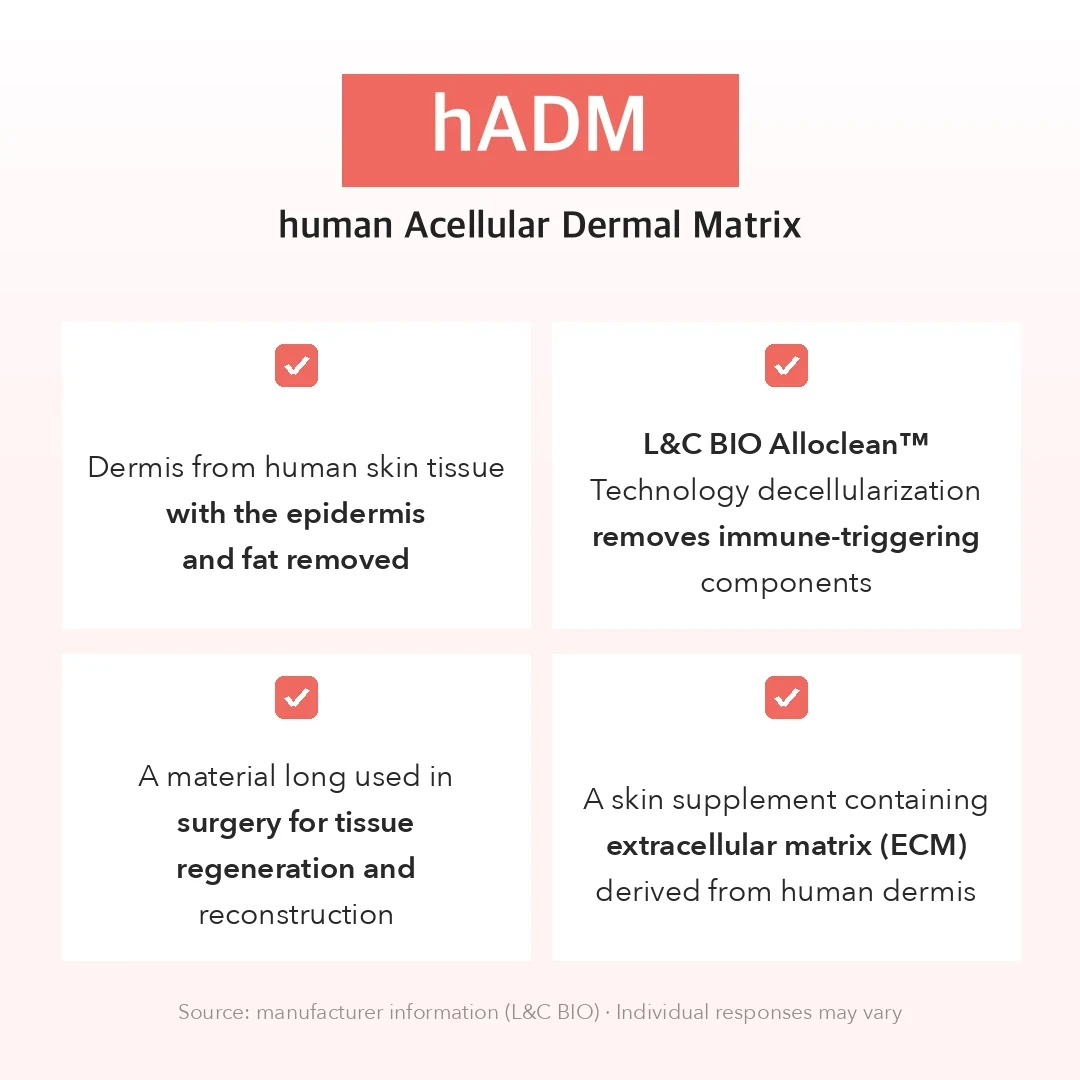
Elravie Re2O is a skin booster made from hADM, short for human acellular dermal matrix. In plain terms, it is donated human dermis (the deep, supportive layer of skin) from which the cells have been removed, leaving behind the extracellular matrix, or ECM: the mesh of collagen and other proteins that holds skin together. If you’d like the full picture of what happens in the skin after treatment, see my guide on how Re2O works.
For understanding Re2O side effects, one point matters most: the majority of reactions come from the injection itself, not from the material. Every needle puncture leaves a tiny wound, every small deposit of product stretches the tissue a little, and every pass near a small blood vessel can cause a bruise. That is why the common reactions look much the same across almost all injectable treatments.
hADM explained: what the manufacturer says
According to manufacturer information from L&C BIO, the tissue is sourced from AATB-accredited tissue banks and processed with the company’s patented Alloclean Technology. This process is designed to remove cells and other components that can trigger an immune reaction, keep residual DNA low, and avoid surfactants and chemical solvents. The material is then turned into a fine powder and sterilized.
The manufacturer reports a residual DNA level of 144.12 ng/mg for Re2O. In general, less leftover DNA means the body is less likely to treat the material as foreign. Still, no single lab figure can predict how your own skin will respond, which is why I always ask patients about their allergy history before treatment.
The first controlled human data on this type of booster are now available. In a 2026 randomized, split-face clinical trial of an injectable hADM booster, 20 adults received the hADM product on one side of the face and hyaluronic acid on the other, and no serious adverse events were reported over 20 weeks. That is reassuring, but it is a small study (and one author advised on the product’s development), so it does not mean side effects can’t happen.
Why surgical ADM studies don’t transfer directly to injections
Acellular dermal matrix is not new. Plastic surgery textbooks describe its long use in burn care, breast reconstruction, gum grafts, and soft-tissue repair. The medical literature also explains that when the body recognizes implanted tissue as “self,” it tends to grow blood vessels into it and integrate it, rather than wall it off.
However, those findings come from surgical sheets placed during an operation. A micronized powder injected into the dermis behaves differently, so surgical results can’t simply be carried over to Re2O. A human-derived material does not mean Re2O side effects are impossible; individual responses vary.
Who Is More Likely to Bruise or Swell?
Some people are more prone to bruising and swelling, the two most visible Re2O side effects, and much of this can be planned for before the appointment.
Blood thinners and supplements
Anything that thins the blood can make bruises larger and slower to fade. Cosmetic dermatology textbooks advise avoiding aspirin, NSAIDs (anti-inflammatory painkillers such as ibuprofen), vitamin E, and green tea for about 10 days before injections to reduce bruising. Omega-3, ginkgo extract, and prescription anticoagulants such as warfarin belong to the same group.
Here is the important part: never stop a prescribed medication on your own. Whether to pause it, and when, must be decided with the doctor who prescribed it. Please also tell us about everyday medicines for blood pressure, diabetes, or thyroid conditions.
Thin or sensitive skin, allergies and medical history
People with thin skin, those treated in areas with many small blood vessels, and those who simply bruise easily tend to see more marks. Before treatment, let your care team know about:
- Any allergy to fillers, skin boosters, or medications
- Any previous use of donor dermis (allograft) products
- Atopic dermatitis, hives, or an autoimmune condition
- Recent laser treatments, peels, or scrubs
Textbooks on aesthetic treatment in skin of color also note that, in darker skin types, a bruise can occasionally leave temporary darker marks (post-inflammatory hyperpigmentation). This is one more reason to take sun protection seriously after treatment.
Common Re2O Side Effects: Swelling, Bruising, and Injection Marks
The common Re2O side effects are the same short-lived reactions seen after most injections. According to cosmetic dermatology textbooks, redness, swelling, and bruising are the most common reactions in the days after any injectable treatment, and firm pressure right after injection helps limit them. The same literature lists temporary firmness and itching among typical post-injection reactions.
Injection marks and redness
Small red dots where the needle went in are expected. They usually fade over a few days, though this varies from person to person. A mild, even pinkness across the treated area is also common; it comes from a temporary increase in blood flow after the injections.
On the day of treatment, use short, repeated cold compresses, keep your hands off your face, and skip makeup over the injection points. After that, wash gently, use a mild soothing product your care team recommends (centella or cica products are popular choices), and wear sunscreen.
Swelling and bruising: how long they last
Swelling often feels like a general puffiness, especially around the eyes and cheeks, and is usually worse in the morning. Bruises tend to change color from red to purple to yellow as they fade.
How quickly Re2O swelling and bruising settle depends on the treated area, the amount injected, your skin thickness, and your constitution. That’s why I ask patients to watch the direction of change rather than count days. If things look a little better each day, that is normal healing. If swelling or bruising stops improving, gets bigger, or is clearly worse on one side, contact the clinic.
To help in the first days, wrap a cold pack in a towel and apply it for short sessions, sleep with your head raised, drink plenty of water, and go easy on salt. Ask your care team before trying warm compresses or massage. Once the injection points have closed, a green concealer can tone down red bruises and a yellow one can neutralize purple bruises.
Temporary firmness, itching, and flaking
Mild stinging or a tight, tender feeling when you press the area is common. Numbing cream before treatment and cold compresses are widely used to ease pain and bruising; textbooks describe the evidence for ice as anecdotal, so think of them as “may help.” Take painkillers only as your care team advises. If pain grows over time or throbs like a pulse, don’t wait it out; call.
Itching is also a common, usually temporary reaction. Cool the area, avoid scratching (which can lead to marks), and stay away from hot water and saunas. Itching becomes a concern when hives spread beyond the injection area, which can signal an allergy.
Some people also notice temporary flaking or dryness. Moisturize morning and night, avoid physical scrubs, and keep indoor air from getting too dry.
Normal Healing vs Re2O Side Effects That Need a Doctor
The simplest rule for judging Re2O side effects is this: normal reactions improve day by day and look roughly the same on both sides, while worrying ones get worse, affect one side much more, or become severe.
Quick comparison table: normal vs see a doctor
| Symptom | Usually normal if… | See a doctor if… |
|---|---|---|
| Pain | Mild and easing day by day | Getting worse, throbbing, or with heat |
| Swelling | Worse in the morning, smaller each day | Growing, or much worse on one side |
| Bruising | Fading from purple to yellow | Spreading, or swelling up hard |
| Redness | Mild and settling | Spreading, with heat, pus, or fever |
| Lump/firmness | Getting smaller | Growing, red, painful, or not improving |
| Itching/hives | Calms down if you don’t scratch | Hives spreading beyond the injection area |
| Skin color change | Never normal | White, blotchy, or net-like purple skin: call now |
Taking photos in the same light and from the same angle each day makes it much easier for your doctor to judge the change.
4 warning signs: infection, growing lumps, allergy, blood-flow problems
Four signs need a doctor: worsening pain with heat, a growing lump, hives or swelling beyond the injection area, and skin that turns white or net-like.
- Infection: redness that won’t settle, warmth, increasing pain and swelling, and in more serious cases yellow discharge or fever. Drinking alcohol, saunas, or touching your face with unwashed hands too soon after treatment can raise this risk.
- A growing lump (nodule): a firm bump that gets bigger, turns red, or hurts. See the next section.
- Allergy: hives spreading past the injection area, severe itching, swelling of the eyes or lips, dizziness, or a tight throat. Difficulty breathing is an emergency.
- Blood-flow problems: skin that turns pale white, a net-like red or purple pattern, or any change in your vision. Cosmetic dermatology textbooks treat this as a vascular warning sign that needs immediate medical care.
Textbooks also note that delayed nodules and infections are managed after a doctor’s examination, according to the cause, with treatments such as antimicrobials or injections into the lesion. These Re2O side effects are rare, but the earlier they are seen, the more options there are.
Re2O Nodules: Why Lumps Form and What to Do
Nodules are among the less common Re2O side effects. A nodule is a small, firm lump you can feel under the skin. It may be painless or slightly tender, and it isn’t always visible on the surface. Check four things: is it changing in size, is it red, warm, or painful, can you see it, and is it in only one spot?
What causes nodules
Textbooks link nodules after injectables to injections placed too superficially or too much product in one spot. With powder-based products, using too little liquid to dilute the product is another known factor. Your own immune response can also play a part. This is why careful technique (the right depth, the right dose for each area, and even spreading) matters so much.
For comparison with another collagen booster, see my article on Juvelook nodules.
Why Re2O is not dissolved with hyaluronidase
Unlike hyaluronic acid (HA) filler, Re2O can’t be dissolved with hyaluronidase, the enzyme injection used to reverse HA filler. So please don’t press, rub hard, or squeeze a lump yourself. Let a doctor examine it first.
How doctors manage delayed nodules
- Growing, red, painful, or with fever: contact the clinic right away.
- Small and painless but not improving: book a check-up.
After an examination, the doctor chooses treatment based on the cause, which may include medication or injections. In very rare cases, surgical removal is considered. Slight left-right differences are a separate issue: they are best assessed once swelling has fully settled, and can be adjusted with additional treatment if needed.
Re2O Side Effects vs Other Skin Boosters
“Skin booster” is a broad label. Products differ in what they are made of, so their side effect profiles differ too. Re2O is based on human-derived dermis. Other boosters use proteins from another species (for example, ingredients extracted from salmon) or synthetic polymers such as PLLA.

| Ingredient type | Example | Reactions more often discussed |
|---|---|---|
| Human-derived dermis (hADM) | Re2O | Generally considered highly biocompatible |
| Proteins from another species | Salmon-derived (PDRN-type) boosters | Immune-related reactions such as itching |
| Synthetic polymer | Juvelook (PLLA) | Foreign-body reactions and nodules |
These are general tendencies of each ingredient family, not predictions for any one person.
Re2O vs Juvelook (PLLA)
Cosmetic dermatology textbooks note that PLLA can cause more injection-site pain, bruising, and swelling than some other products, partly because of the larger needle used, and that bumps can appear if it is injected too superficially. For a full side-by-side comparison, read Re2O vs Juvelook.
Re2O vs PDRN-type boosters
Boosters made with proteins from another species are more often associated with immune-related reactions such as itching. If you are comparing other boosters too, our guide to Rejewel injection side effects may help. No product is simply “better” across the board; the right choice depends on your skin and your goals, which is why a consultation should come first.
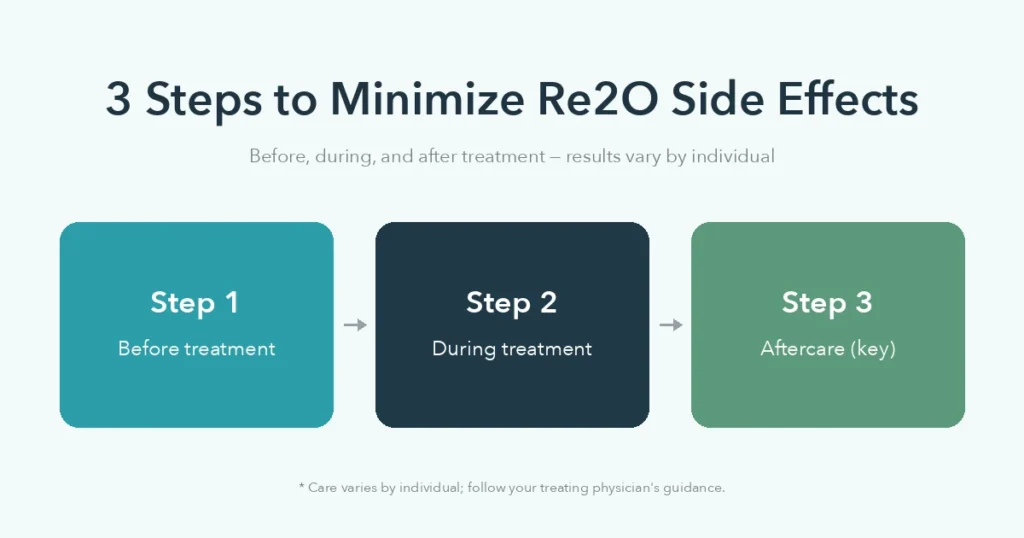
How to Minimize Re2O Side Effects: 3 Steps
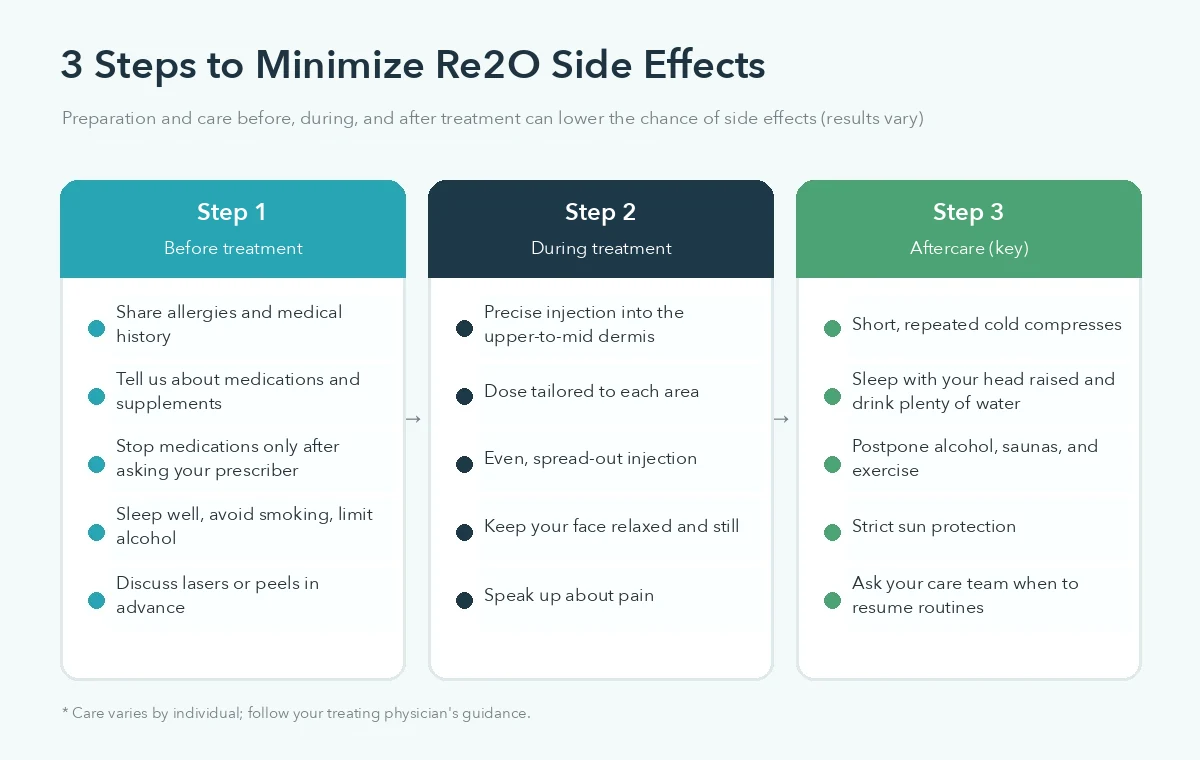
Many Re2O side effects can be prevented or caught early. Side-effect prevention works in 3 stages: before, during, and after treatment.
Step 1: Before treatment
- Share your allergy and medical history, including any past use of donor dermis products.
- Tell us about all medications and supplements; stop blood thinners only after asking your prescriber.
- Sleep well, drink enough water, avoid smoking, and limit alcohol.
- Discuss any planned lasers, peels, scrubs, heavy sun exposure, or strict dieting in advance.
Step 2: During treatment
- The doctor injects precisely into the upper-to-mid dermis, slowly and evenly.
- The dose is tailored to each area and skin condition; too much in one area raises the risk of nodules and swelling.
- Your part: keep your face relaxed and still, and speak up about pain rather than enduring it.
Step 3: Aftercare
- Use short, repeated cold compresses and sleep with your head raised.
- Drink plenty of water and use only a gentle moisturizer and sunscreen.
- Postpone alcohol, saunas, sweaty workouts, and facial massage until swelling settles. Alcohol increases blood flow and swelling, while heat and sweat raise the risk of inflammation.
- Avoid sleeping face down, swimming pools, gyms, and new lasers or peels while swelling or bruising remains.
- Return to your normal routine, and start any new skin-renewal products, only after checking with your care team.
If your skin is sensitive, bruises easily, or tends to get inflamed, we may suggest extra steps, such as more frequent cold compresses, delaying makeup longer, or a prescribed ointment.
What to Do If You Notice a Side Effect
Most serious Re2O side effects can be headed off by catching them early. If something feels wrong, please don’t wonder whether it’s “too small to mention.” Just get in touch.
Step-by-step: photo, note, contact the clinic
- Take photos twice a day (morning and evening) in the same light: front, both 45-degree angles, and both sides.
- Keep a short log: date and time, each symptom with a 1–10 score, whether it is better or worse, what you tried, and any medication taken.
- Contact the clinic and send the photos. For mild issues (slightly more swelling than expected, itching, lingering redness), keep up cold compresses and monitor; if there’s no improvement, call. For a lump, stubborn swelling, or hard-to-bear itching, contact us as soon as possible.
- Don’t self-treat until you’ve been advised: no squeezing, no needles, and no hot compresses on a suspected infection.
Many of our patients fly home soon after treatment. Before you leave Seoul, make sure you know how to reach us, and keep the name of the product and your treatment date handy for any local doctor.
When to go to emergency care
Difficulty breathing, a tight throat, chest tightness, rapid swelling of the face, fainting, or a change in consciousness can signal a severe allergic reaction (anaphylaxis). Call your local emergency number right away (119 in Korea) and go to the nearest emergency room; contact the clinic afterwards. Don’t drive yourself. Sudden pale or net-like skin or any vision change also needs same-day medical care.
Re2O Side Effects FAQ
How long does swelling last after Re2O?
Swelling usually goes down over a few days, but timing depends on the treated area, the amount injected, and your constitution. The key sign is that it gets a little smaller each day. If it stops improving or grows, contact the clinic.
How long do Re2O bruises take to fade?
Most bruises fade over several days, though some people take longer. Avoiding blood-thinning supplements beforehand (with your prescriber’s approval) and using cold compresses can help. A bruise that keeps spreading or swells up hard should be checked.
When can I drink alcohol, exercise, or use a sauna after Re2O?
Avoid alcohol for the first few days, and skip exercise on the day of treatment. Postpone hard workouts, saunas, and hot baths until swelling has settled, since heat and sweat increase blood flow. Light walks are usually fine; confirm the exact timing with your care team.
When can I wash my face and wear makeup after Re2O?
On the day of treatment, don’t apply skincare or makeup to the injection points, and avoid touching or rubbing them. Start with gentle cleansing, then resume makeup once the injection marks have closed. If any scabs remain, wait a little longer.
Are Re2O nodules permanent?
Not necessarily. Nodules can be managed according to their cause after a doctor examines them. Don’t rub or squeeze a lump yourself, because Re2O isn’t dissolved with hyaluronidase the way HA filler is.
Can Re2O cause an allergic reaction?
Allergy is one of the rarer Re2O side effects, but it can’t be completely ruled out. Hives spreading beyond the injection area or swelling of the eyes or lips need prompt medical care. Difficulty breathing is an emergency: call your local emergency number.
Why does Re2O feel firm or bumpy in the first days?
Temporary firmness right after injection is common while the product settles and the swelling goes down. It should soften and shrink over time. If a bump grows, becomes red, or hurts, see a doctor.
Considering Re2O in Seoul? Talk to Our Team First
Re2O side effects are mostly mild and temporary, and the most important habit is simple: don’t over-worry, but don’t ignore anything that is getting worse. Know what normal healing looks like, follow your aftercare, and reach out early if something changes.
Before booking, share your full medical history and medication list during consultation so we can plan the right dose and timing around your travel. You can learn more about Elravie Re2O treatment at MINE, or contact us through our online consultation form or by phone at +82-2-516-1175 (813 Nonhyeon-ro, Gangnam-gu, Seoul). Because every skin is different, I recommend an in-person consultation before you decide.
Written and medically reviewed by: Dr. Lee Sung-wook, Board-Certified Plastic Surgeon, Representative Director of MINE Plastic Surgery & Dermatology
※ This content is for informational purposes only and does not replace professional medical advice, diagnosis, or treatment. Individual results may vary, and side effects may occur. Please consult with a board-certified plastic surgeon for personalized advice.