EN
EN

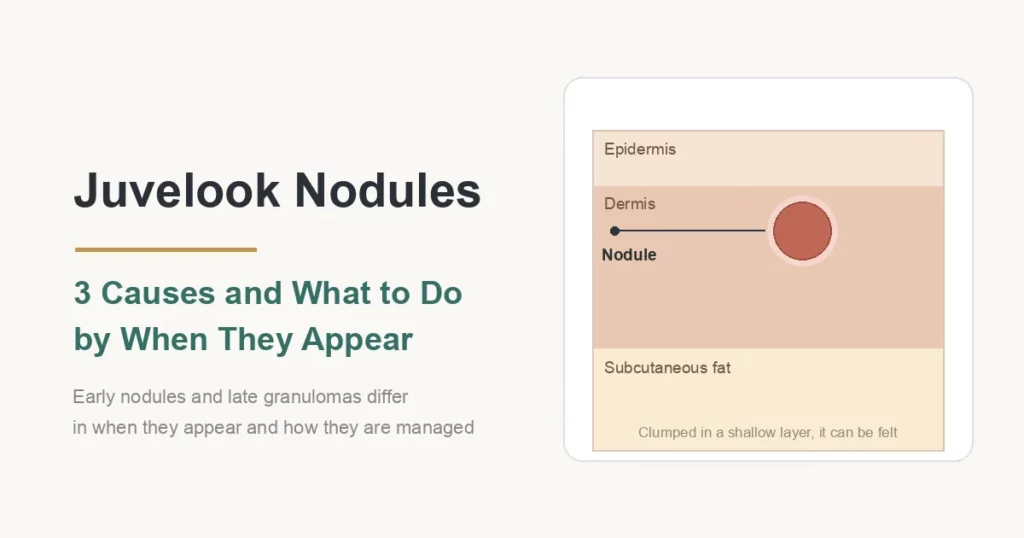
Juvelook nodules are small, firm lumps that can be felt under the skin at the injection site after a Juvelook treatment. They form as the body’s tissue response gathers around the injected PDLLA particles, and what they are called — and what the clinic does about them — depends on when you first felt them.
If you have just run a fingertip over your cheek and found something that was not there last month, the first question is rarely a medical one. It is whether this is permanent. In most cases the lump is closer to a reaction that a collagen-stimulating material can provoke than to something fixed in place for good, and there is a route for it either way.
This article follows one thread only: the lump. Swelling, bruising, redness and needle marks after treatment are separate stories with their own timelines, and mixing them together is what makes people panic at the wrong moment. Here we stay with what causes Juvelook nodules, how early ones differ from late ones, what can be done at each stage, and what genuinely lowers the risk.
Table of Contents
- What Are Juvelook Nodules? Early Nodule vs Late Granuloma
- 3 Causes of Juvelook Nodules — Depth, Dilution, Overcorrection
- Juvelook Nodules by Area — Under-Eye, Cheek, Forehead
- Reactions That Are Not Juvelook Nodules — and the Red Flags
- What to Do About Juvelook Nodules — the Pathway Splits by Timing
- Why Hyaluronidase Is Not the Answer for Juvelook Nodules
- 4 Ways to Prevent Juvelook Nodules — Before, During, After
- Juvelook Nodules: Frequently Asked Questions
- Talk to Us Before You Try Anything Yourself
What Are Juvelook Nodules? Early Nodule vs Late Granuloma
A nodule is the umbrella word for a firm lump felt beneath the skin. In the clinic the first fork is always the same question — did this appear soon after treatment, or long after? The answer changes the name, the mechanism and the management, so I ask it before I touch anything.
What Juvelook Is Made Of — PDLLA and Hyaluronic Acid
Juvelook is a hybrid injectable that combines high-molecular-weight PDLLA (polylactide, a lactic-acid-family polymer that breaks down slowly in the body) with hyaluronic acid, the sugar-like molecule that pulls in and holds water. It uses no cross-linking agent — the chemical “glue” that locks conventional filler molecules together so they last longer.
The two parts work in shifts. HA supplies the immediate, water-based volume you see on the day. PDLLA degrades over months and nudges fibroblasts — the collagen-making cells in your skin — into laying down new collagen. If you came here for the product rather than the complication, Juvelook and Juvelook Volume compared sets the two formulations side by side, and you can browse all our Juvelook articles for the rest.
One caveat before any number appears. In studies of injectable PLLA — the related lactic-acid biostimulator sold as Sculptra — particles are reported at 40 to 63 micrometers. PDLLA belongs to the same lactic-acid family and works on the same principle, but the two materials are not interchangeable, so every textbook figure in this article stays labeled as PLLA data rather than being restated as a Juvelook number.
Early Nodule vs Late Granuloma — Onset Decides the Name
In studies of PLLA, complications include nodules that typically arise several weeks after injection and granulomas that emerge months to years later, with reported incidence ranging from 6% to 52%. Textbook reports on PLLA also describe delayed inflammatory reactions appearing up to 5 years after injection.
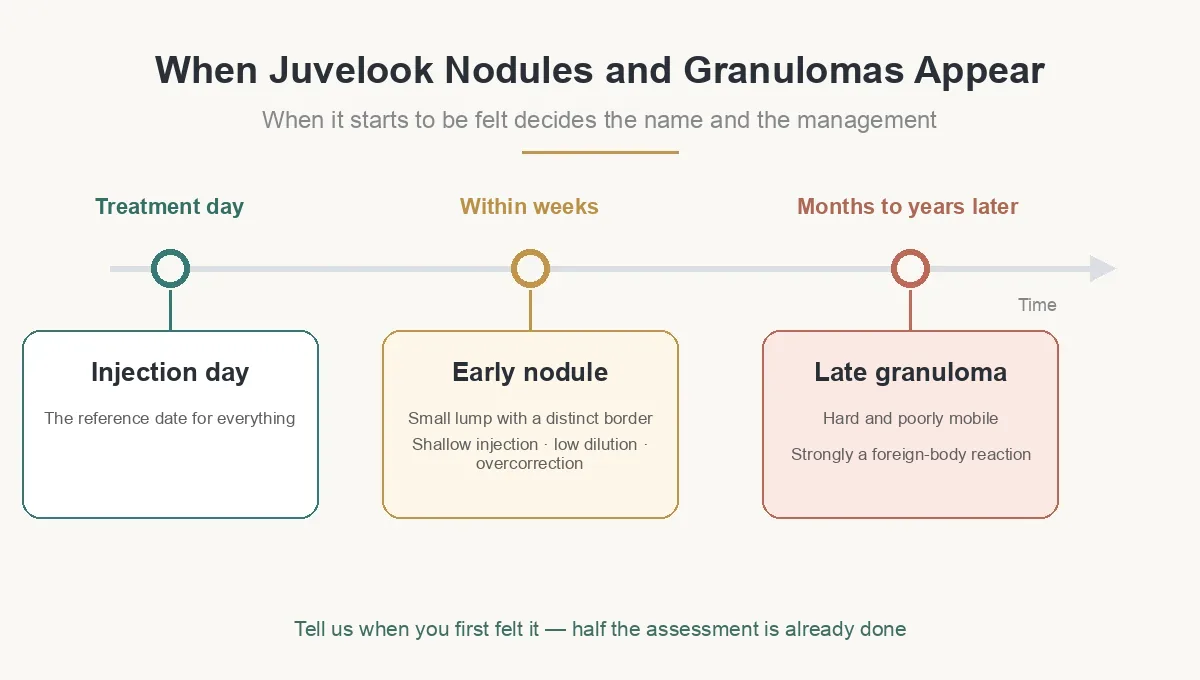
An early nodule tends to have a relatively distinct border and feels like material bunched in one place. Behind it there is usually a plane that was too superficial, too little dilution, or too much volume in one sitting. A late granuloma is harder and moves poorly, because the body has walled off residual particles rather than simply letting them sit.
| When it starts to be felt | How it feels | Nature | What the clinic considers | |
|---|---|---|---|---|
| Early nodule | Within weeks of treatment | Small lump with a relatively distinct border | Material still pooled in one place | Confirm onset, then consider further dilution or dispersion |
| Late granuloma | Months to years later | Hard and poorly mobile | Predominantly a foreign-body reaction | Intralesional steroid; excision considered if needed |
Day-One Volume Is Not a Nodule
The plumpness you see on the day of treatment is water from the reconstituted suspension, and it resorbs within days. The effect that lasts builds slowly over months, as particles degrade and new collagen forms. If a lump is still the same size in the same spot 2 to 3 weeks after treatment, it is treated as a nodule rather than as swelling.
General patient information about injectable fillers is also published by the American Academy of Dermatology, if you want a neutral overview to read alongside this one.
Dr. Lee Sung-wook’s Key Point: With Juvelook nodules, half the answer comes from one question — when did you first feel it?
3 Causes of Juvelook Nodules — Depth, Dilution, Overcorrection
There are three causes of Juvelook nodules that matter in day-to-day practice: depth, dilution and overcorrection. None of them is a verdict on the product. All three collapse into a single sentence — where it was placed, how dilute it was, and how far it was divided.
- Injection depth — placed shallower than the plane the goal requires, it catches under the fingertip
- Dilution and rehydration — too thick, or too briefly reconstituted, and particles pool
- Overcorrection — delivering the whole volume at once packs the same amount into a narrow space
Cause 1. Injection Depth — Too Shallow and It Catches Under Your Fingertip
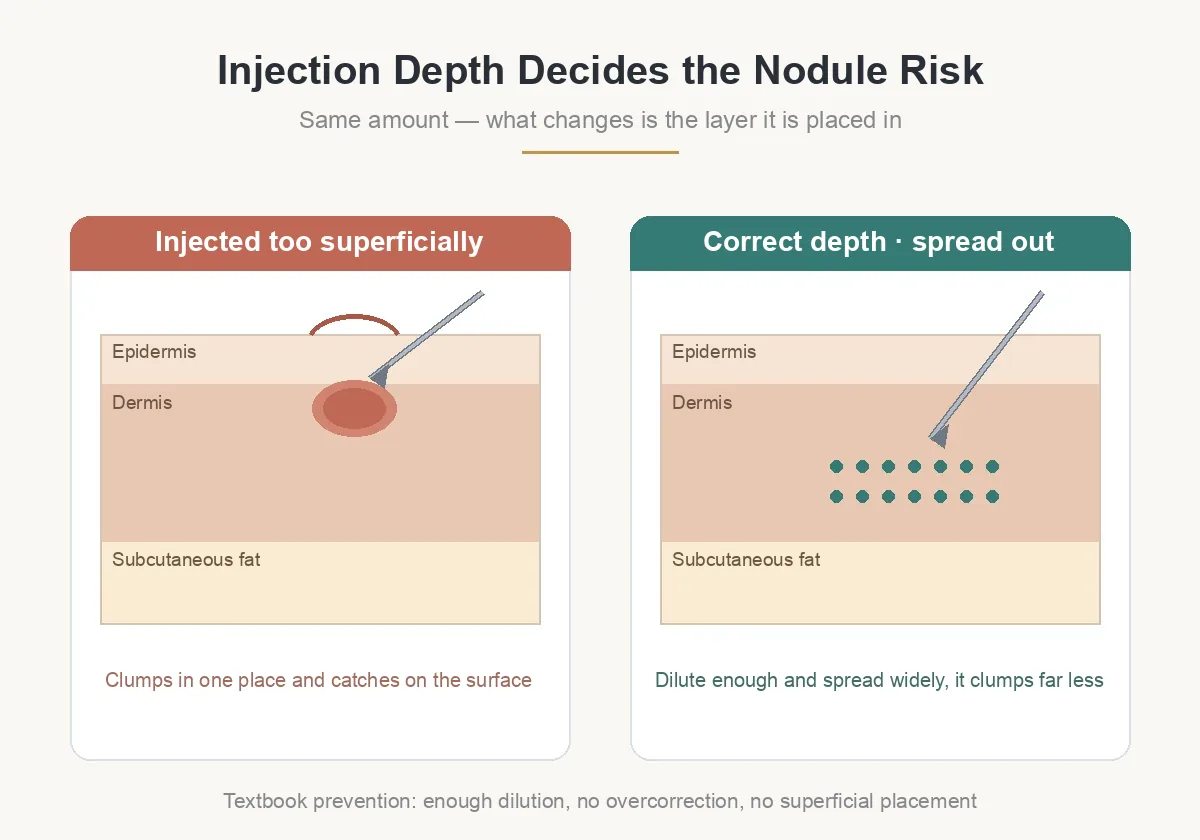
PLLA textbooks describe placing the material in the deep dermal, deep subcutaneous or supraperiosteal plane — the layer sitting directly over the bone — and note that placement that is too shallow produces visible nodules or blanching of the skin. The principle carries across the lactic-acid family, which is why depth is the first thing I check when a lump is described.
Shallow is not automatically wrong. Skin-quality work is placed deliberately shallow, in very small amounts spread across many points. The failure mode is a volume-sized dose sitting at a texture-sized depth: too much material, too close to the surface, in a place where a fingertip can find it.
Cause 2. Dilution and Rehydration — Too Thick and It Pools
Juvelook arrives as a powder that has to be reconstituted in liquid. How much liquid goes in (the dilution ratio) and how long it sits before use (the rehydration time) both change what happens in the tissue. In PLLA studies, moving to higher dilution volumes and longer reconstitution times decreased granuloma formation, so this single preparation step carries more weight than most patients expect.
I am deliberately not printing a ratio or a waiting time here. Those figures come from PLLA protocols, and Juvelook has its own instructions. Copying a number across two different materials is exactly the kind of shortcut that creates Juvelook nodules in the first place.
Cause 3. Overcorrection — The Temptation to Fill It All at Once
Because the day-one plumpness fades within days, there is a real temptation to top it off. The problem is timing. Material added now is still present months later, when the collagen response arrives and the space it occupies suddenly becomes crowded.
That is why our own protocol splits the work rather than front-loading it. At MINE, Juvelook is given in three sessions spaced 1 month apart, and each session takes about 10 to 20 minutes under topical anesthetic. Every session is adjusted based on what the previous one produced — the pacing is set out in our Juvelook treatment guide.
Dr. Lee Sung-wook’s Key Point: Juvelook nodules turn less on the product than on how dilute, how deep, and how divided the treatment was.
Juvelook Nodules by Area — Under-Eye, Cheek, Forehead
Same product, same volume, same hands — and still a different level of risk, because skin thickness is not uniform across the face. This section looks only at nodule risk, not at what each area is usually treated for.
Under-Eye and Periorbital — The Thinnest Skin on the Face
Periorbital skin is the thinnest on the face, so the same needle depth lands relatively more superficially. The area also moves with every expression and shows surface contour under raking light. The rule here is very small amounts spread across many points, never a single generous deposit.
Cheek and Nasolabial — Thicker, but Total Volume Creeps Up
Cheek and nasolabial skin has more subcutaneous padding, which gives more margin for error. The trap is the size of the canvas: a broad area invites “while we are here” volume creep. For nodule risk, cheeks are mostly about total volume and how far it is split across sessions.
Forehead and Temple — Close to Bone, So It Shows as Surface Irregularity
Forehead and temple sit thinly over bone. A plane that is only slightly too shallow reads as surface irregularity rather than as a discrete lump, and it catches the light when the hair is pushed back. Divide the amount rather than loading it.
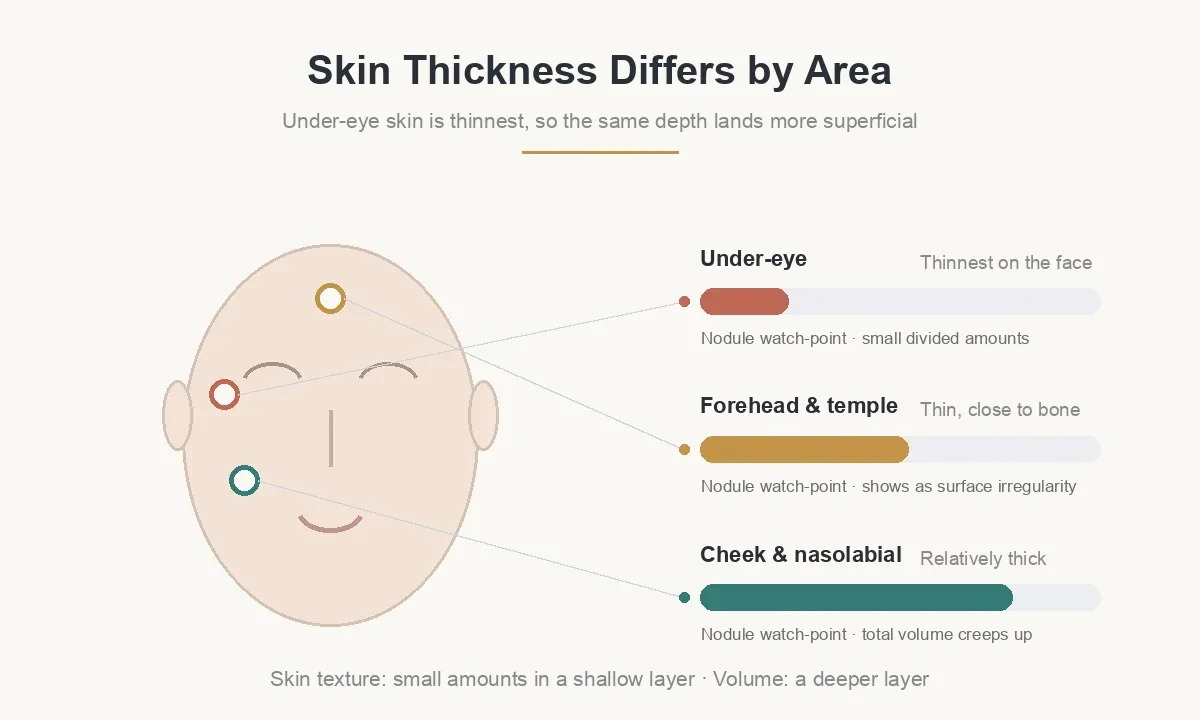
| Area | Skin and subcutaneous thickness | What to watch for nodule risk |
|---|---|---|
| Under-eye / periorbital | Thinnest on the face | The same depth lands more superficially; small divided amounts are the rule |
| Cheek / nasolabial | Relatively thick | A large area invites volume creep; splitting across sessions matters most |
| Forehead / temple | Thin, close to bone | A slightly shallow plane shows as surface irregularity |
Dr. Lee Sung-wook’s Key Point: Because thickness differs by area, the risk of Juvelook nodules is not the same everywhere, even with identical treatment.
Reactions That Are Not Juvelook Nodules — and the Red Flags
Swelling and Firmness Right After Treatment Are Not Nodules
Not everything you feel after treatment is a nodule. Swelling, bruising, redness and needle marks are separate reactions with their own timelines, and they sit outside this article deliberately. What separates them is time: something visibly smaller within days is not the same thing as something unchanged in the same spot at 2 to 3 weeks.
Signs That Need In-Person Care Right Away
The list below is not a diagnostic table. It exists so that you are not left deciding alone whether it is safe to watch and wait.
- Pain that worsens over time
- Skin color change — blanching white, or turning dark red
- Warmth together with red swelling
- A lump that visibly enlarges over a few days
- Any vision-related change
If any of these applies, in-person care comes first and the reading of the lump comes second. Working out which kind of nodule you are dealing with can wait; these signs cannot.
Dr. Lee Sung-wook’s Key Point: Swelling that settles in days and a lump still sitting there weeks later are two different stories.
What to Do About Juvelook Nodules — the Pathway Splits by Timing
Before any option is named: everything below is performed and judged by clinicians inside a clinic. None of it is something to attempt at home, and none of it is a menu to pick from before you have been examined in person.
- Confirm onset — when it started, where it sits, and at what size
- Within weeks — treated as pooled material; further dilution or dispersion considered
- After months — foreign-body reaction considered; intralesional steroid, excision if needed
- Follow-up — reviewed again at an interval rather than forced to close in one visit
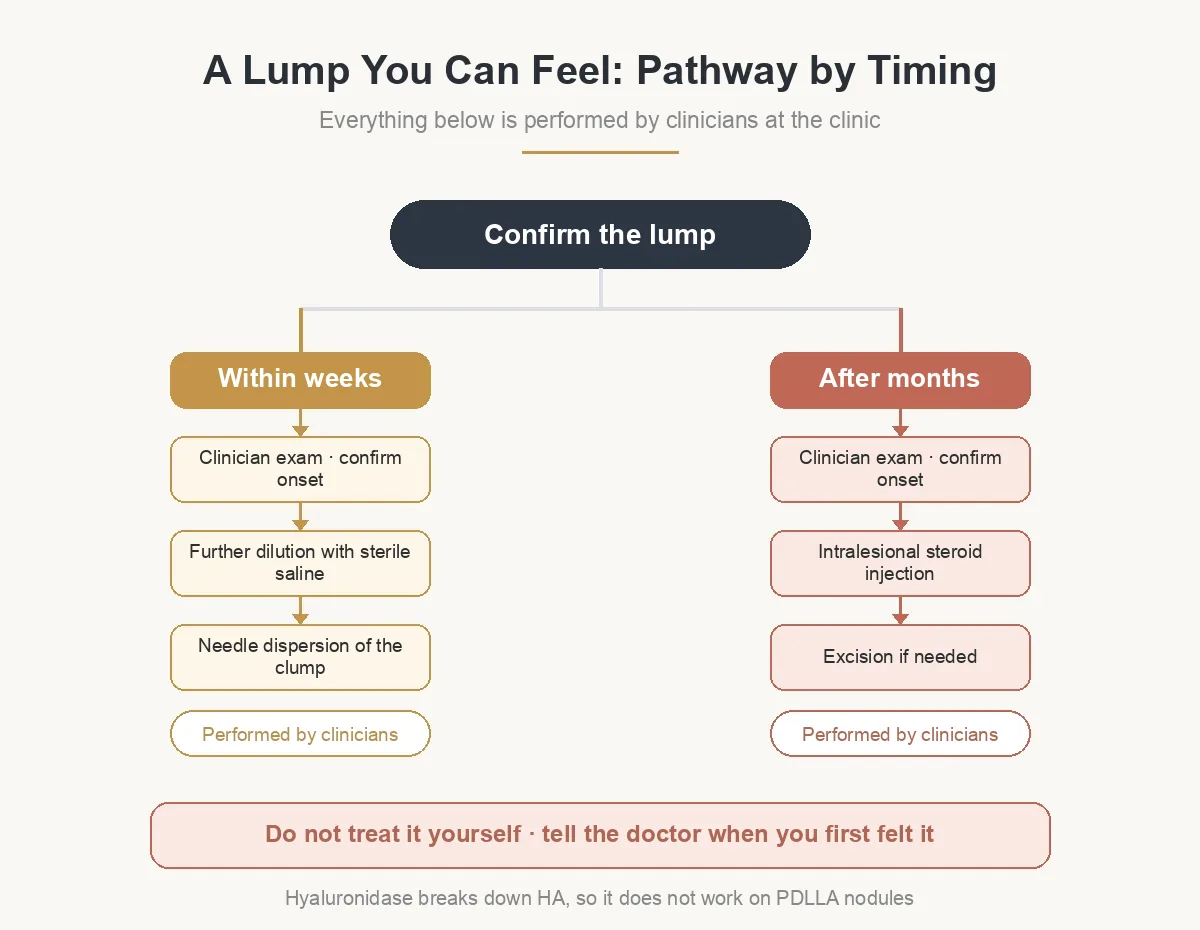
Within Weeks (Early Nodule) — Further Dilution and Dispersion
When a lump appears within weeks, it is treated as material still pooled in one place. In studies of PLLA, early nodules may be broken up with needle dispersion or diluted further with sterile saline. Whether that is done at all depends on the site and the size, and it is carried out under sterile technique by the treating clinician.
After Months (Late Nodule or Granuloma) — Intralesional Steroid, Excision If Needed
Once months have passed, the problem is no longer dispersing material — it is managing the tissue reaction that has built around it. Textbooks on PLLA describe intralesional steroid injections as effective in some cases, with excision reserved for late nodules and granulomas that do not settle.
I am not going to give you a number of weeks. The course of Juvelook nodules differs by person and by area, and the honest answer is that the endpoint is knowable only through review over time, not predicted at a first visit.
Follow-Up: What to Bring to the Appointment
Three things make the first visit far more useful. Dates: the treatment date and the date you first felt the lump. Change: a few photographs taken in the same light and at the same angle. Treatment record: which product, which areas, and how many sessions so far.
The point of follow-up is to look at the case again after an interval. Juvelook nodules are read by their trajectory, and a single snapshot rarely settles the question on its own.
Why Hyaluronidase Is Not the Answer for Juvelook Nodules
Anyone who has searched for filler complications has come across hyaluronidase, the “dissolving injection”. The premise that usually goes missing is what it actually does: it is an enzyme that breaks down hyaluronic acid, and only hyaluronic acid.
Juvelook confuses people precisely because it contains both PDLLA and HA. The enzyme can act on the HA portion. But the center of a lump you can still feel months later is PDLLA microparticles and the tissue reaction built around them, and neither of those dissolves.
The contrast is worth stating plainly: nodules from HA fillers can be dissolved with hyaluronidase, and Juvelook nodules cannot. That single difference is why the two are managed along different routes, and it sits behind the broader distinction explained in how skin boosters differ from fillers.
“There is no dissolving drug” is not the same statement as “nothing can be done”. It means the route is chosen by timing instead of by enzyme, which is exactly what the pathway above sets out.
Dr. Lee Sung-wook’s Key Point: Juvelook nodules are not solved with a dissolving injection — they are approached by the route that matches the timing.
4 Ways to Prevent Juvelook Nodules — Before, During, After
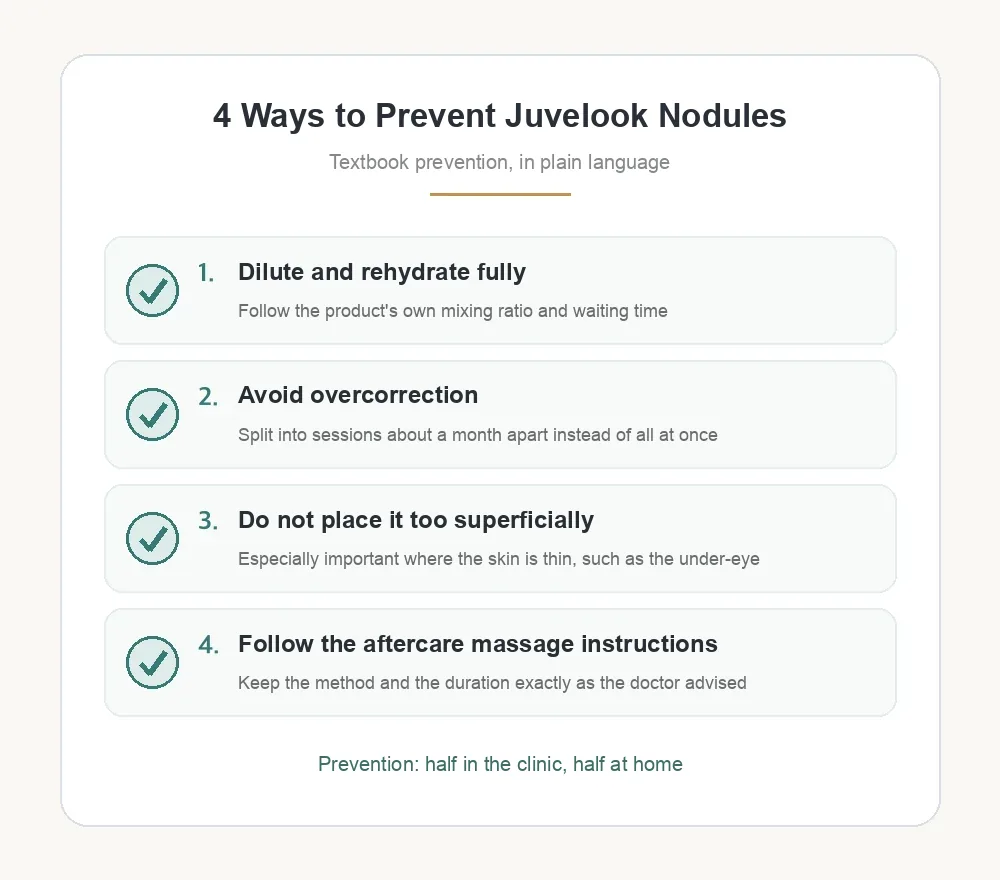
Prevention is mostly the three causes turned inside out, plus one aftercare item. General post-procedure advice about alcohol and saunas belongs to a different article; these four connect directly to Juvelook nodules.
- Dilute and rehydrate fully, following the product’s own instructions
- Avoid overcorrection — split into sessions and adjust based on the response
- Match depth to the goal — do not place a volume dose at a texture depth
- Follow the aftercare massage instructions exactly as given
Before — Align Goal, Area and Session Plan First
Settle the goal before anything else: skin quality, or restoring lost volume. That single decision changes both the plane and the total amount. Only then do the area and the session count get decided. At MINE the default is three sessions at 1-month intervals, with each one adjusted based on the response to the last.
Three questions are worth asking at consultation: how many sessions today’s volume will be divided into, which plane is being targeted, and how the aftercare massage should be done and for how long.
During — Full Dilution, No Overcorrection, No Shallow Plane
In PLLA research, injectable treatment averages three to four sessions in the first year, at 4- to 6-week intervals — a reminder that a material this long-lived is meant to be built up gradually rather than delivered in one go. The same logic governs dilution and depth: mix fully, place at the plane the goal requires, and stop before the mirror asks for a bit more.
After — Follow the Massage Instructions Exactly as Given
Keep both the method and the duration as instructed. Harder is not better, and skipping it altogether is not the safer option either. When you are unsure, ask the clinic that treated you rather than deciding from a video.
General patient-facing information about injectable treatments is also published by the American Society of Plastic Surgeons.
Juvelook Nodules: Frequently Asked Questions
When do Juvelook nodules usually appear after treatment?
Early nodules generally begin to be felt within weeks of treatment, while late granulomas are reported months to years later. The plumpness felt in the first few days is transient swelling from the water in the suspension, and it should be kept separate from a true nodule.
How long do Juvelook nodules take to settle?
It varies too much between individuals to promise a period. Early nodules and late granulomas differ in nature and therefore in course, and size and area change it further. Rather than setting your own waiting period at home, have it reviewed at the clinic.
What should I do at home if I feel a Juvelook nodule?
Do not press hard or rub it, and never touch it with a needle — infection and tissue damage are real risks. Note when you first felt it and whether the size is changing, then be seen at the clinic that treated you.
Why does hyaluronidase not dissolve Juvelook nodules?
Hyaluronidase is an enzyme that breaks down hyaluronic acid only. It can act on the HA portion of Juvelook, but not on PDLLA microparticles or on granuloma tissue that has already formed, which is why HA-filler lumps and biostimulator lumps diverge in management.
Why is the under-eye area higher risk for Juvelook nodules?
Because it is the thinnest skin on the face. The same injection depth lands relatively more superficially, and sitting close to the surface means even slight pooling can be felt or seen. Very small amounts spread across many points is the rule in that area.
What should I check before treatment to prevent Juvelook nodules?
Settle three things first: whether the goal is skin quality or restoring volume, which area is being treated, and how many sessions the volume will be split into. At MINE the default is three sessions a month apart, adjusted based on each response.
Talk to Us Before You Try Anything Yourself
To summarize: Juvelook nodules fall into two groups — early nodules and late granulomas — depending on when they were first felt; the causes come down to depth, dilution and overcorrection; and the management pathway branches along that same timeline. One more thing worth remembering — this is not a problem that gets solved by dissolving it away.
If something is palpable right now, please do not try to remove it yourself. Skin thickness, treatment goal and the area injected differ from person to person, so the judgment changes case by case and can only be confirmed in person.
You can read through how a Juvelook session runs at MINE first, then reach us through the consultation form on the site or at +82-2-516-1175 to arrange an examination.
Written and medically reviewed by Dr. Lee Sung-wook, Board-Certified Plastic Surgeon
MINE Plastic Surgery | 813 Nonhyeon-ro, Gangnam-gu, Seoul, Korea | +82-2-516-1175
※ This content is for informational purposes only and does not replace professional medical advice, diagnosis, or treatment. Individual results may vary, and side effects may occur. Please consult with a board-certified plastic surgeon for personalized advice.