EN
EN

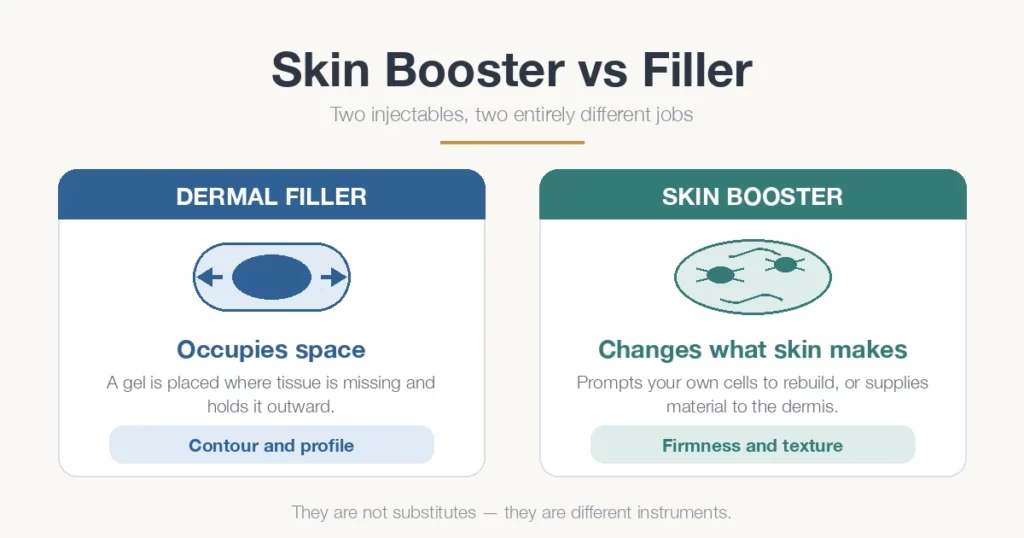
The skin booster vs filler question has one answer at its core: a filler is an injectable gel that occupies space under the skin to restore volume and contour, while a skin booster is an injectable that improves the quality of the skin itself — by prompting your own cells to rebuild, or by supplying the material they work with.
Most people arrive here from the product name rather than from the problem. You hear about a booster from a friend, see a filler in a video, then work backwards to whether it suits you. In a consultation the order runs the other way.
That reversal is why the skin booster vs filler comparison is worth doing at the category level, before any brand name comes up. Two injectables can share an ingredient and still be built for entirely different jobs.
Skin Booster vs Filler: What Actually Separates the Two
A filler occupies space; a booster changes what your skin produces
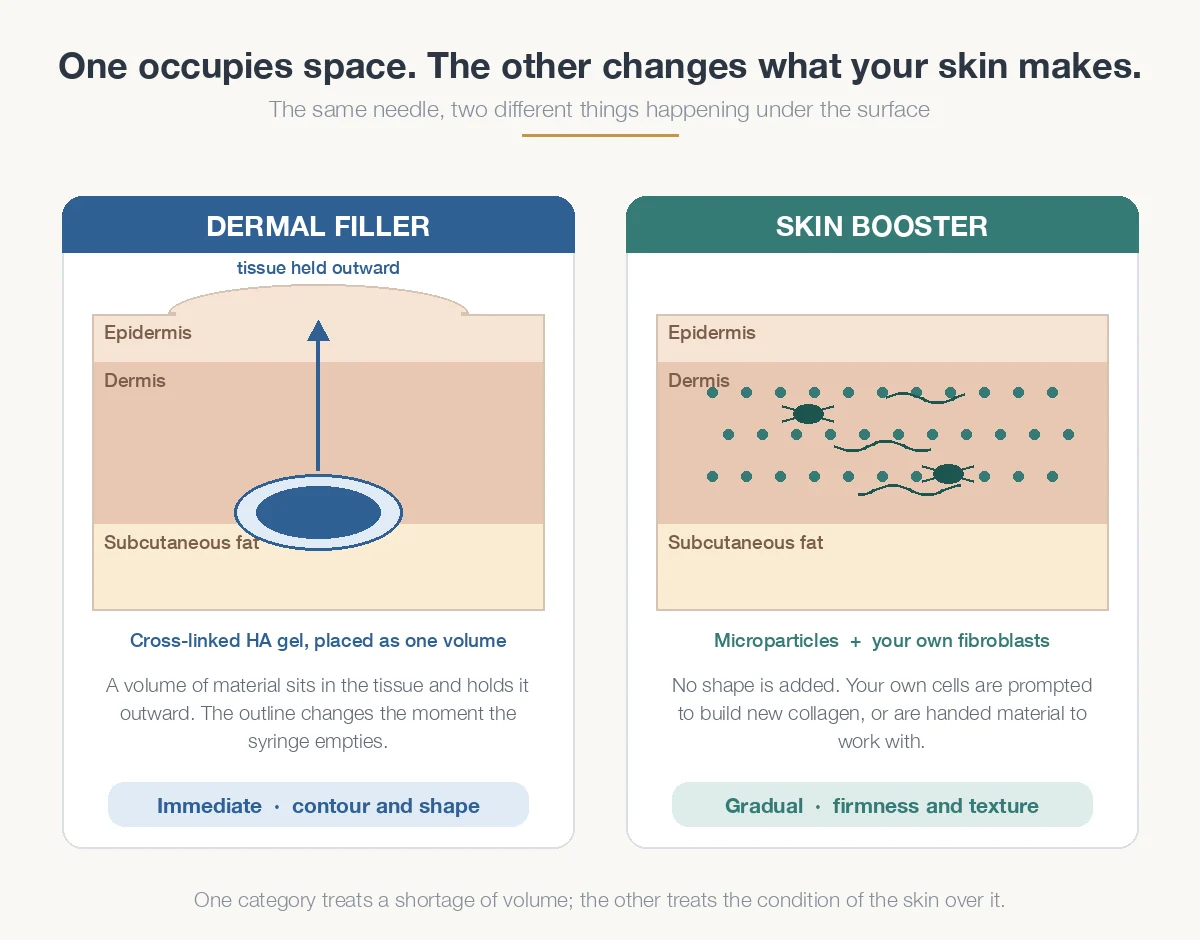
Start with what physically happens. A dermal filler is a gel — most often hyaluronic acid (HA, a sugar-like substance your body already makes to hold water) — placed in one spot, where it stays as a volume of material. It takes up room, and your outline changes the moment the syringe empties.
A skin booster does something else. Instead of occupying space, it changes what the dermis (the living layer under the surface, where collagen sits) is doing. Some act as a biostimulator — a material that prompts your own fibroblasts (the cells that manufacture collagen) to build new tissue. Others hand the skin raw material to work with.
| What it does under the skin | What changes | When you notice it | What it does NOT do | |
|---|---|---|---|---|
| Dermal filler | Occupies space as a gel and holds tissue outward | Contour, projection, the depth of a hollow or fold | Right away, with swelling settling afterward | Does not thicken thin skin, smooth crepiness or refine texture and pores |
| Skin booster | Prompts your cells to rebuild, or supplies material and water to the dermis | Firmness, hydration, smoothness, fine surface lines | Gradually, as the skin responds | Does not rebuild a flattened cheek, a fold or a jaw outline |
Read across that table and the framing of skin booster vs filler stops looking like a contest. One category addresses a shortage of volume; the other addresses the condition of the skin covering it. They are not substitutes, but different instruments.
Why “which one lasts longer” is the wrong first question
Almost every consultation opens with duration. It is a fair question in the wrong position. A filler works the moment it is placed; a collagen-stimulating booster works over the weeks after it is placed, because the change has to be manufactured by your own cells. Those are two different clocks, and a long-lasting filler in a face that never needed volume is simply a long-lasting mistake.
In a skin booster vs filler comparison, duration becomes useful only once the category is settled, which is why every figure in this guide sits in one section further down rather than scattered through the text.
Two people can hand me the same photograph of themselves and leave with different treatments — one is pointing at the shadow under a cheekbone, the other at the skin lying over it.
How Dermal Fillers Work: Volume, Shape, and Contour
What a hyaluronic acid gel actually does under the skin
Hyaluronic acid occurs naturally throughout human tissue, which is why the body tolerates it and eventually breaks it down. To work as a filler, it is cross-linked — the chains tied to each other so the gel holds a shape instead of dispersing. Once placed, it holds tissue outward and draws water to itself, which sustains that volume.
Cosmetic dermatology literature describes hyaluronic acid as a biodegradable, biocompatible dermal filler for moderate to severe folds, and reports that HA products last about twice as long as the collagen-based fillers that preceded them. For a plain-language overview of the category, the American Society of Plastic Surgeons’ overview of dermal fillers is a reasonable place to start.
One footnote still circulates and is worth clearing up: earlier generations of HA were animal-derived, and allergy testing was sometimes part of the process. Today’s products are made by biofermentation, which is why that step is no longer part of routine filler practice.
The concerns fillers are built for — and the ones they are not
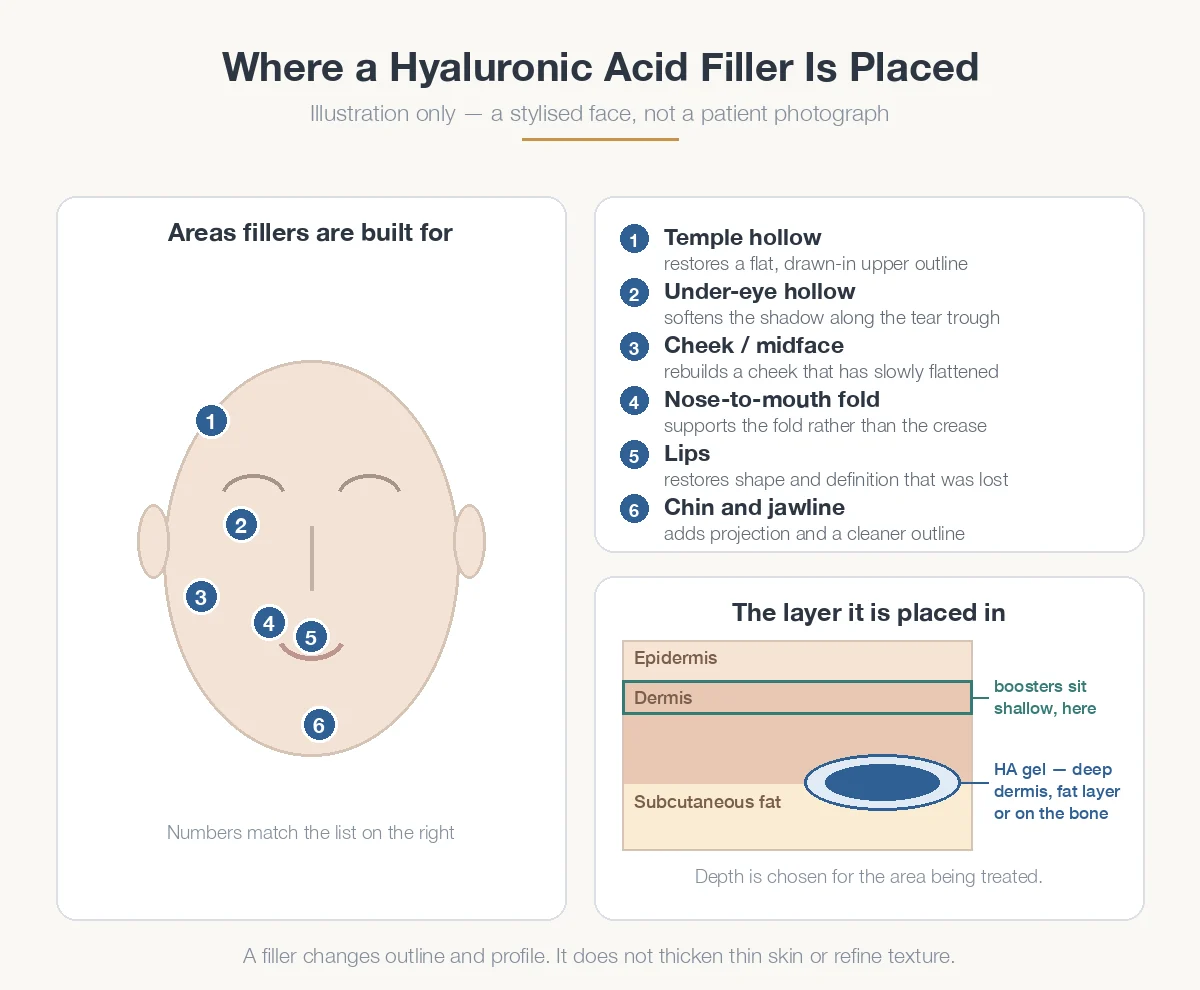
Fillers earn their place where tissue is missing or has shifted: a flattened cheek, the fold running from nose to mouth, the hollow that shadows the under-eye, a chin or jaw outline without projection, a lip that has lost its shape. Because they work by replacing what is gone, they change outline and profile rather than skin texture. Our dermal filler treatment page sets out how those areas are approached.
What a filler cannot do is equally definite. It will not thicken thin skin, refine pores, smooth a rough surface, or do much for the fine crepey lines that come from the skin itself. That limit is exactly where the other half of the skin booster vs filler split begins.
A cheek that has slowly flattened responds to filler predictably enough. Fill the same cheek to a perfect contour on skin that is thin, dry and finely lined, and you get a patient who agrees the shape is right and still dislikes the photograph.
How Skin Boosters Work: Three Different Jobs Under One Name
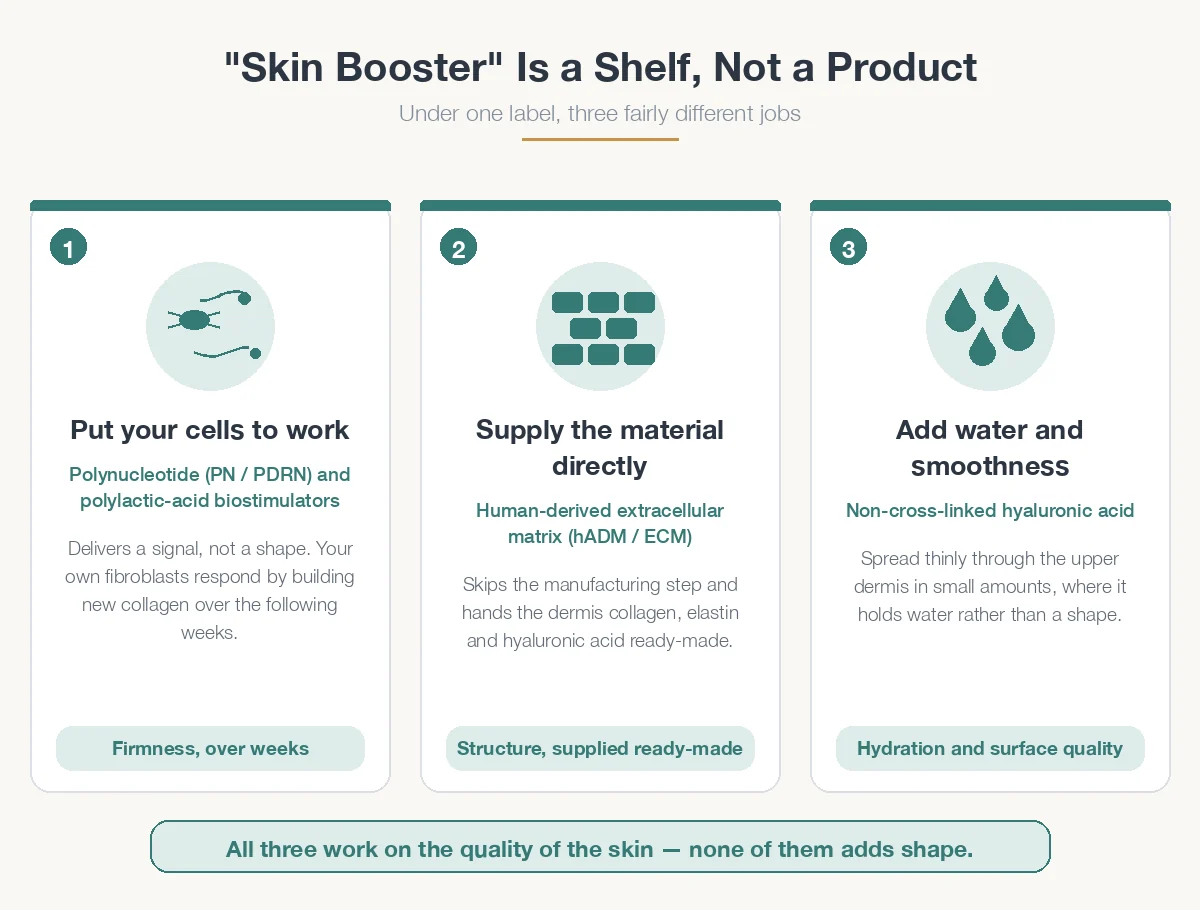
“Skin booster” is a shelf, not a product. Under one label, injectables do three fairly different jobs, and the one you are offered depends on which job your skin actually needs done.
- Boosters that put your own cells to work — polynucleotide (PN/PDRN) and polylactic-acid biostimulators, which prompt the skin to rebuild its own collagen.
- Boosters that supply the building material directly — human-derived extracellular matrix (hADM/ECM), which delivers collagen, elastin and hyaluronic acid ready-made.
- Boosters that add water and smoothness to the upper dermis — non-cross-linked hyaluronic acid, placed shallow in small amounts for hydration and surface quality.
All three work on the quality of the skin rather than its shape, which is what keeps them on the booster side of the skin booster vs filler question, whatever their ingredient lists look like.
Boosters that put your own cells to work (polynucleotide, PDLLA)
Polynucleotide boosters deliver purified DNA fragments into the dermis, where they act less like a substance you can see and more like a signal to repair. A 2023 study on polydeoxyribonucleotide reported measurable improvement in skin-barrier function and cell regeneration, which is why this family is discussed in terms of skin quality rather than volume.
Polylactic-acid biostimulators work on a longer arc. Microparticles are injected, the body breaks them down, and that slow breakdown provokes a repair response in which fibroblasts lay down new collagen — de novo collagen synthesis, in textbook language. Two related polymers appear here: PLLA (poly-L-lactic acid) and PDLLA (poly-D,L-lactic acid). They are the same family but not the same material, and figures published for one should not be quoted for the other.
Boosters that supply the building material directly (hADM / ECM)
The second branch does the opposite. Instead of asking your cells to manufacture, it delivers the components of the extracellular matrix — the mesh of collagen, elastin and hyaluronic acid that gives the dermis its structure — ready-made. If a polynucleotide booster gives instructions, this one delivers bricks.
Boosters that add water and smoothness to the upper dermis (non-crosslinked HA)
The third branch causes most of the confusion, because it is hyaluronic acid — the same molecule used in fillers. The difference is that it is not cross-linked into a firm gel and is not placed to hold a shape. It is spread thinly through the upper dermis, where it holds water and improves smoothness rather than contour.
A collagen-stimulating booster does not add material you can see on day one — it adds instructions, and the visible part is whatever your fibroblasts build over the following weeks. Which raises the next question: why does the face sometimes look fuller the moment the appointment ends?
Why Some Injectables Blur the Line Between the Two
This is where the skin booster vs filler line genuinely blurs, for two separate reasons. The first is formulation: some products carry a biostimulator and a hyaluronic acid in the same syringe. The second is physical: for the first few hours a biostimulator can look exactly like a filler.
Hybrid formulations that carry a stimulator and a hyaluronic acid together
Hybrid products combine a polylactic-acid biostimulator with non-cross-linked hyaluronic acid. The HA gives immediate hydration and a little softness while the PDLLA works slowly in the background. Juvelook is the formulation patients ask about most often here; if that is your real question, how the two Juvelook formulations differ is covered separately. At the category level, a hybrid is still classified by what it is built to do.
The plumpness you see on day one is not the result you keep
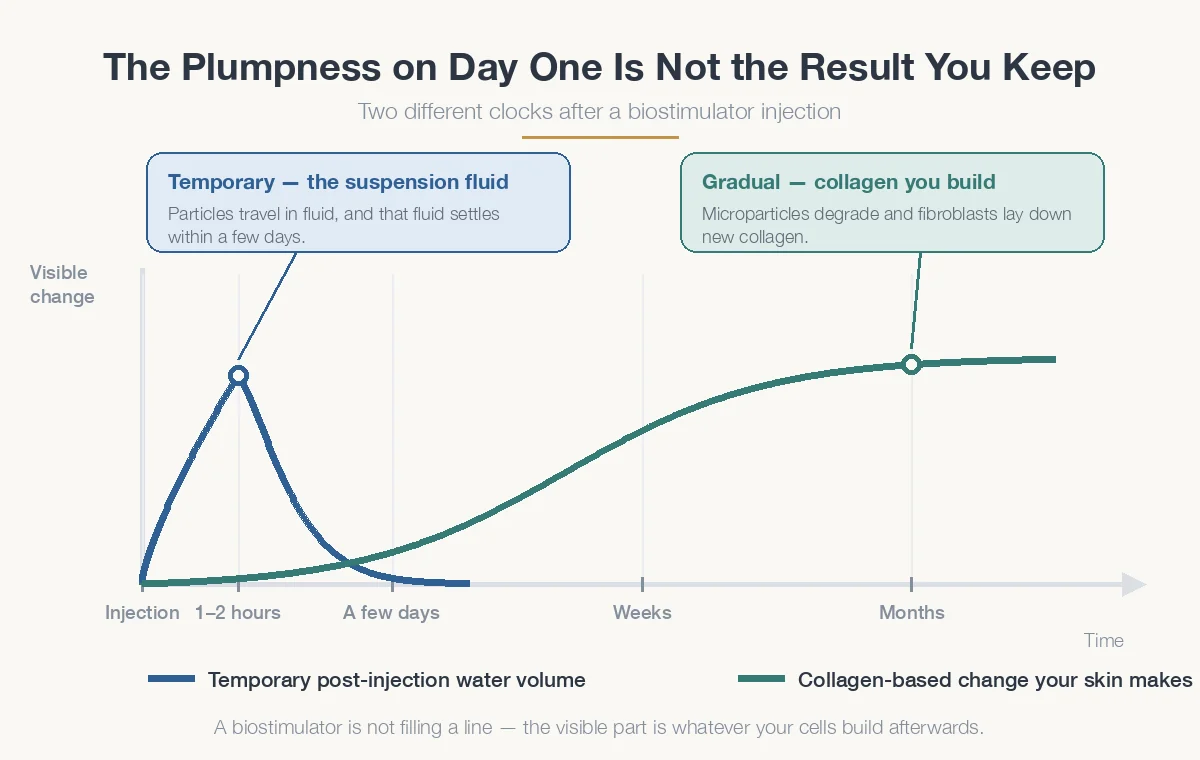
The second reason is plain physics. Biostimulator particles are suspended in fluid so they can pass through a needle. The plumpness you see in the mirror one to two hours after a biostimulator injection comes from the fluid the particles are suspended in, and it settles within a few days.
Cosmetic dermatology textbooks are explicit about this. Injectable PLLA is described as a pure biostimulator: it does not directly fill lines or depressions the way an HA filler does. The immediate volumizing effect comes from the injected suspension and fades within days, while the effect people come for appears over the months that follow, as the microparticles degrade and the skin builds collagen of its own.
So “it contains hyaluronic acid, therefore it is a filler” does not hold. Classification follows function rather than the ingredient list: a material that holds a shape is behaving as a filler, and a material that changes what your skin produces is behaving as a booster.
Which One Fits Your Concern: A Decision Path by Complaint
Start from the complaint, not from the product name
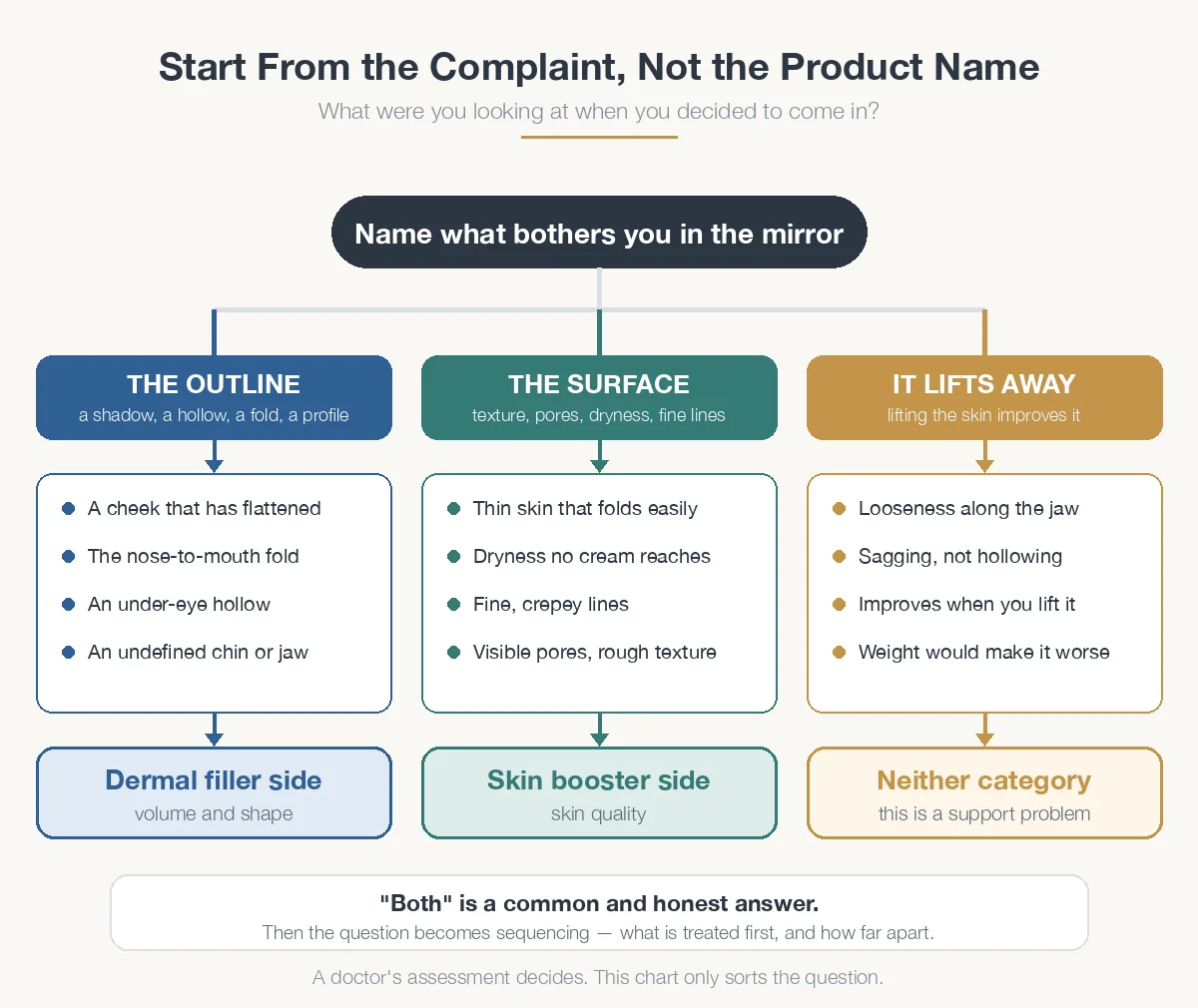
The first thing I ask is not which treatment interests you. It is what you were looking at when you decided to come in. The answer usually sorts the skin booster vs filler decision before any product has been named.
- Name what bothers you in the mirror. Is it the outline — a shadow, a hollow, a fold, a profile? Or the surface: texture, pores, dryness under your makeup, fine crepey lines?
- Lift the area gently with your fingers. If lifting improves what you were looking at, the issue is support rather than volume or texture.
- Look at a photograph taken in ordinary overhead light. Volume problems appear as shadows that move as the light moves; skin-quality problems stay visible whatever the light does.
Mapping that onto categories is straightforward. Flattened cheeks, the shadow of a nose-to-mouth fold and an undefined jaw outline sit on the filler side. Thin skin that folds easily, dryness no cream reaches, fine lines, visible pores and rough texture sit on the booster side.
When the honest answer is both
Volume loss and declining skin quality tend to arrive together, so “both” is a common and honest answer. That turns the skin booster vs filler question into a sequencing one: what is treated first, how far apart, and whether both belong in a single appointment. If the booster side is settled and the remaining question is which booster, you can compare the individual booster ingredients side by side.
When the answer is neither
If that finger-lift test was the one that changed what you saw, neither injectable category is the right tool — the problem is support, not volume or texture. Injecting either one into sagging tends to add weight where you wanted lift — the situation covered in when the issue is sagging rather than volume.
If you still cannot separate outline from surface after looking twice, that is information in itself: both are probably mildly involved, and the sensible move is to treat whichever one bothers you in photographs first.
Timelines and Duration: When Each One Shows Up, and How Long It Holds
Every figure in this guide lives in this section, because duration is where categories get confused with brands. What follows are ranges reported for classes of material, not the promised lifespan of any product. It is the part of the skin booster vs filler comparison that resists a one-line answer.
Fillers: visible right away, measured in months
Because a filler is already in place the moment it is injected, its timeline starts at zero; a biostimulator’s timeline starts when your fibroblasts respond. What you see right after a filler is shape plus swelling, and the settled shape is what a reported duration refers to.
Boosters: gradual, and usually measured across a course rather than a single visit
Boosters are normally planned as a series. For a biostimulator, duration is not the shelf life of the material but how long the collagen response holds, which is why the figures below are reported for a course of treatments rather than one syringe.
| Category of material | When you see it | Textbook duration range |
|---|---|---|
| Injectable collagen | Right away | 2 to 4 months |
| Injectable hyaluronic acid filler | Right away | 3 to 12 months |
| Injectable PLLA (poly-L-lactic acid), given as a series | Gradually, over the months after treatment | 2 years or more |
These ranges describe classes of material as reported in dermatology textbooks. They are not guaranteed durations for any branded product. PDLLA is a related but different polymer from PLLA, and the range above is not a claim about PDLLA products.
Dermatology textbooks put injectable collagen at 2 to 4 months and injectable hyaluronic acid at 3 to 12 months. The same textbooks describe injectable poly-L-lactic acid as holding for 2 years or more when it is given as a series rather than as one treatment. That gap is not a ranking: one material is sitting in the tissue, while the other has been replaced by tissue you grew yourself.
Which is also why I cannot give you a single number on request. Reported ranges describe materials across populations, and where any treatment lands inside its range depends on placement depth, how much the area moves, and the metabolism of the person it was placed in.
Risks, Side Effects, and Aftercare on Both Sides
What can go wrong with fillers
Bruising, swelling and tenderness are ordinary and short-lived. Asymmetry and palpable lumps are usually a placement issue rather than a material one. The serious complication, rare but real, is vascular — gel entering or compressing a blood vessel — which is why anatomy and technique matter more than product choice. Risk is not uniform across the face, and what to expect after lip filler in particular is worth reading if that is your area.
What can go wrong with skin boosters
Boosters trade a smaller peak risk for a longer commitment. Expect injection marks, pinpoint bruising and short-lived swelling; with biostimulators, nodules — small firm lumps under the skin — are the complication to know about. The other honest downside is not medical: several spaced-out sessions are a real demand on your calendar.
Polylactic-acid biostimulators are sterile synthetic polymers, which is why they do not require the skin allergy testing that animal-derived collagen fillers once did. There is no animal protein for the immune system to react against.
Aftercare that applies to either one
- Leave the injection points alone on the day — no makeup over them, and no scrubbing when you wash.
- Skip saunas, hot yoga, heavy exercise and alcohol for the first days, since heat and raised blood flow worsen swelling and bruising.
- Sleep with your head slightly raised if the area swells easily, and use cold rather than heat on a bruise.
- Call the clinic — do not wait it out — if pain increases instead of fading, if the skin turns white, dusky or mottled, or if your vision changes.
On both sides of the skin booster vs filler divide, the complaint I hear most often at follow-up is not a side effect. It is a patient who tolerated the treatment well and is disappointed anyway, because what they received answered a different question from the one they walked in with.
Frequently Asked Questions
Is a skin booster a filler?
No. A filler occupies space to build shape and volume, while a booster changes the quality of the skin, either by prompting your cells to rebuild or by supplying material for them. Some products contain both, which is where the confusion starts, but the skin booster vs filler distinction follows function rather than ingredients.
How do I know whether I need a skin booster or a filler?
Name what you were looking at in the mirror. If it is an outline — a hollow, a shadow, a fold, a profile — you are on the filler side. If it is the surface — texture, pores, dryness under makeup, fine lines — you are on the booster side.
Can you have a skin booster and a filler at the same time?
Combining them is common, because volume loss and declining skin quality usually appear together. The practical questions are sequence and spacing: whether both go into the same area on the same day, and how far apart sessions sit. That belongs to an in-person examination rather than to a general rule.
How long does it take for a skin booster to show results compared with a filler?
They run on different kinds of clock. A filler is visible immediately, with the final shape appearing once swelling settles. A booster shows nothing on day one, because your own cells have to respond first, and improvement accumulates across a planned course rather than arriving at one appointment.
What happens when a skin booster wears off — does my skin get worse than before?
It does not rebound below where it started. The injected material is biodegradable and is absorbed, and the collagen built in the meantime is then lost at the ordinary pace of aging. What you notice is a gradual return toward your own baseline, not a drop beneath it.
Talk It Through Before You Choose
The skin booster vs filler decision is rarely made from a photograph. It depends on how your skin behaves when it is touched, how thick it is, where the volume actually went, and what you want changed — none of which travels well through a screen.
If you would like that assessment, MINE Plastic Surgery & Dermatology is at 813 Nonhyeon-ro, Gangnam-gu, Seoul, and consultations can be arranged on +82-2-516-1175. Bring the photograph that made you start looking into this — in the room it is more useful than a product name.
Written and reviewed by Dr. Lee Sung-wook, Board-Certified Plastic Surgeon
MINE Plastic Surgery & Dermatology | 813 Nonhyeon-ro, Gangnam-gu, Seoul, Korea | +82-2-516-1175
Published 4 September 2026 · Last reviewed 4 September 2026
※ This content is for informational purposes only and does not replace professional medical advice, diagnosis, or treatment. Individual results may vary, and side effects may occur. Please consult with a board-certified plastic surgeon for personalized advice.