EN
EN

Table of contents
What Are Juvelook and Rejuran?
Juvelook vs Rejuran is the choice between two popular Korean skin boosters: Juvelook builds new collagen to firm and lift the skin, while Rejuran repairs and hydrates skin cells to restore a healthy, calm glow. Both are injected to improve the skin from the inside, but they do very different jobs.
Skin boosters have become a go-to for “skin quality” rather than dramatic change, so it is no surprise that the Juvelook vs Rejuran question comes up in almost every consultation. People want smoother texture, more bounce, and a brighter tone without looking overfilled.
Juvelook uses PDLLA (poly-D,L-lactic acid) plus hyaluronic acid, and its main aim is to stimulate your own collagen. Rejuran uses polynucleotides (PN) plus hyaluronic acid, and its main aim is skin-cell repair and hydration. If you are new to injectables, our complete guide to skin boosters in Korea is a helpful starting point.
This article breaks down the Juvelook vs Rejuran comparison in plain language: what is inside each one, how they work, what they treat, how the sessions feel, how fast you see results, and how long those results last. The goal is to help you talk to your clinician with confidence.
Juvelook vs Rejuran: Key Ingredient Comparison
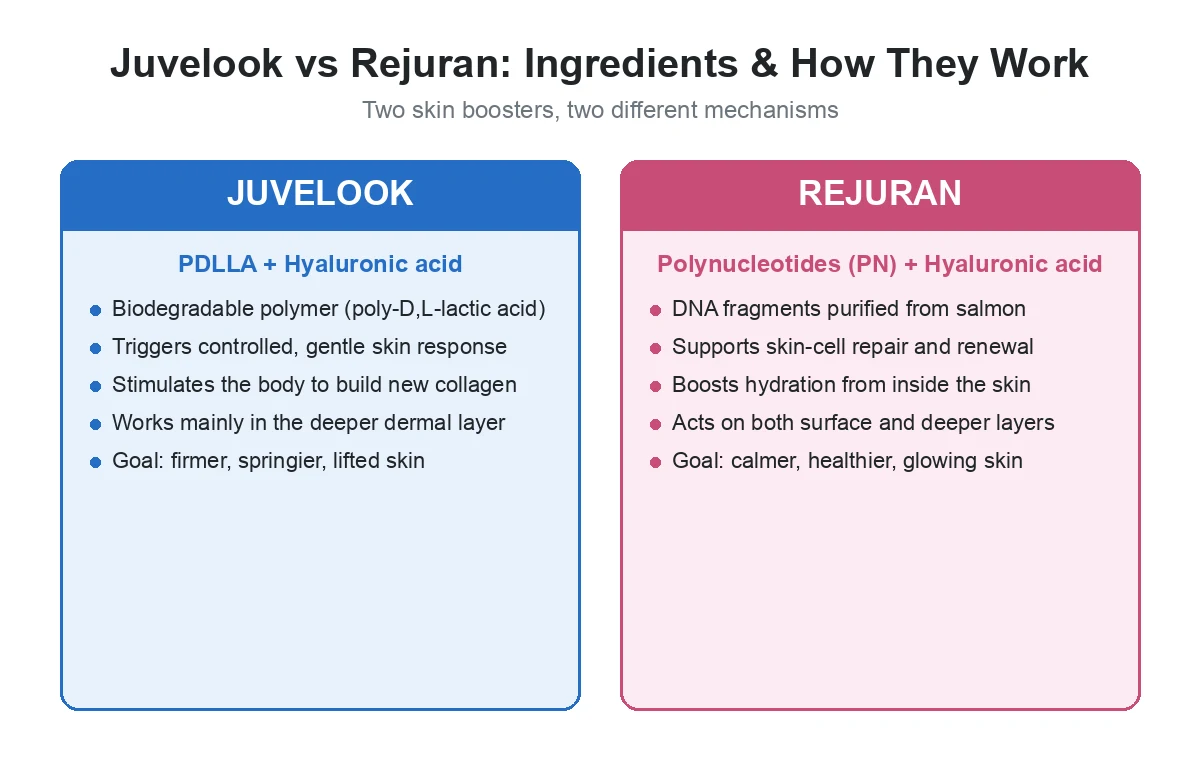
The biggest difference in the Juvelook vs Rejuran debate starts with the active ingredient. That single choice shapes everything else, from the kind of result you get to how the treatment feels.
What is inside Juvelook
Juvelook’s key ingredients are PDLLA and hyaluronic acid.
- PDLLA: a biodegradable polymer. Once injected, it prompts a gentle, controlled repair response that tells your body to make fresh collagen. This is the same family as poly-L-lactic acid, which is well known in dermatology for stimulating the cells (fibroblasts) that produce collagen.
- Hyaluronic acid: gives an instant boost of hydration and a touch of volume while the PDLLA slowly does its longer-term work.
What is inside Rejuran
Rejuran’s key ingredients are polynucleotides (PN) and a smaller amount of hyaluronic acid.
- Polynucleotides (PN): short DNA fragments purified from salmon. They support skin-cell repair and renewal, and research on this family of ingredients (such as polydeoxyribonucleotide, PDRN) describes their ability to help regenerate skin cells and strengthen the skin barrier.
- Hyaluronic acid: present at a lower level than in Juvelook, mostly to support hydration.
Here is the short version of the Juvelook vs Rejuran ingredient story, side by side.
| Ingredient point | Juvelook | Rejuran |
|---|---|---|
| Main active | PDLLA + hyaluronic acid | Polynucleotides (PN) + hyaluronic acid |
| How it works | Stimulates new collagen via gentle, controlled repair | Supports direct cell repair and renewal |
| Hyaluronic acid level | Higher | Lower |
| Main layer it targets | Mostly the deeper dermal layer | Both surface and deeper layers |
Effects and Where Each Works Best
Because the ingredients differ, the results differ too. This is where the Juvelook vs Rejuran choice usually becomes clearer for most people.
What Juvelook does best
By encouraging new collagen, Juvelook tends to deliver:
- Firmer, springier skin: helpful for mild sagging and softening lines.
- Gentle volume and contour: a smoother, more refreshed facial shape.
- Better texture over time: finer-looking pores and a more even surface.
- Long, steady improvement: collagen keeps remodelling for months.
It is often a good fit for people in their mid-30s and older who are starting to notice early loss of firmness. To go deeper, see our complete guide to Juvelook collagen boosting.
What Rejuran does best
By supporting cell repair, Rejuran tends to deliver:
- Repair and recovery: healthier-looking, more resilient skin.
- Deep hydration: a plumper, dewier feel from within.
- Calming support: often chosen for sensitive, reactive skin and redness.
- Brighter, more even tone: a fresher overall glow.
It is a popular choice when the main concern is dryness, dullness, or sensitivity rather than sagging. For the full picture, read our complete guide to Rejuran treatment.
Best areas for each
Both can be used on the face, neck, and hands, but each has its sweet spots.
| Area | Leans Juvelook | Leans Rejuran |
|---|---|---|
| Cheeks and contour | Stronger fit | Supporting |
| Around the mouth | Stronger fit | Supporting |
| Under-eye fine lines | Good fit | Good fit |
| Neck | Good fit | Stronger fit |
| Back of hands | Supporting | Stronger fit |
| Overall tone and glow | Supporting | Stronger fit |
Treatment Process, Pain, and Downtime
The session itself is similar for both, but a few details differ. Knowing them helps you plan around work and social events.
A typical Juvelook session
- Cleanse and numb: the area is cleaned and a numbing cream is applied for about 30 minutes.
- Inject: a fine needle places the PDLLA and hyaluronic acid blend into the deeper skin layer.
- Massage: gentle massage spreads the product evenly.
- Cool down: a cold compress calms any swelling.
Juvelook is usually done as 2-3 sessions, 2-3 weeks apart, with a top-up about every 6-12 months.
A typical Rejuran session
- Cleanse and numb: same gentle prep as Juvelook.
- Inject: the PN solution is placed into shallower layers, often with many small micro-injections.
- Soothe: a cooling mask or pack settles the skin afterwards.
Rejuran is usually done as 3-4 sessions, 1-2 weeks apart, with maintenance every 3-6 months.
Pain and downtime at a glance
| Item | Juvelook | Rejuran |
|---|---|---|
| Discomfort | Mild to moderate (deeper placement) | Low to mild (shallower placement) |
| Swelling | 1-3 days | 0-1 day |
| Redness | 1-2 days | A few hours |
| Bruising chance | Moderate | Low |
| Back to normal | After 1-2 days | Often same day |
In short, Rejuran usually has slightly less downtime, while Juvelook asks for a little more recovery in exchange for its firming effect. A good clinic will use numbing and careful technique to keep either treatment comfortable.
How Fast They Work and How Long They Last
Timing is one of the most practical parts of the Juvelook vs Rejuran decision. One rewards patience; the other rewards quickly.
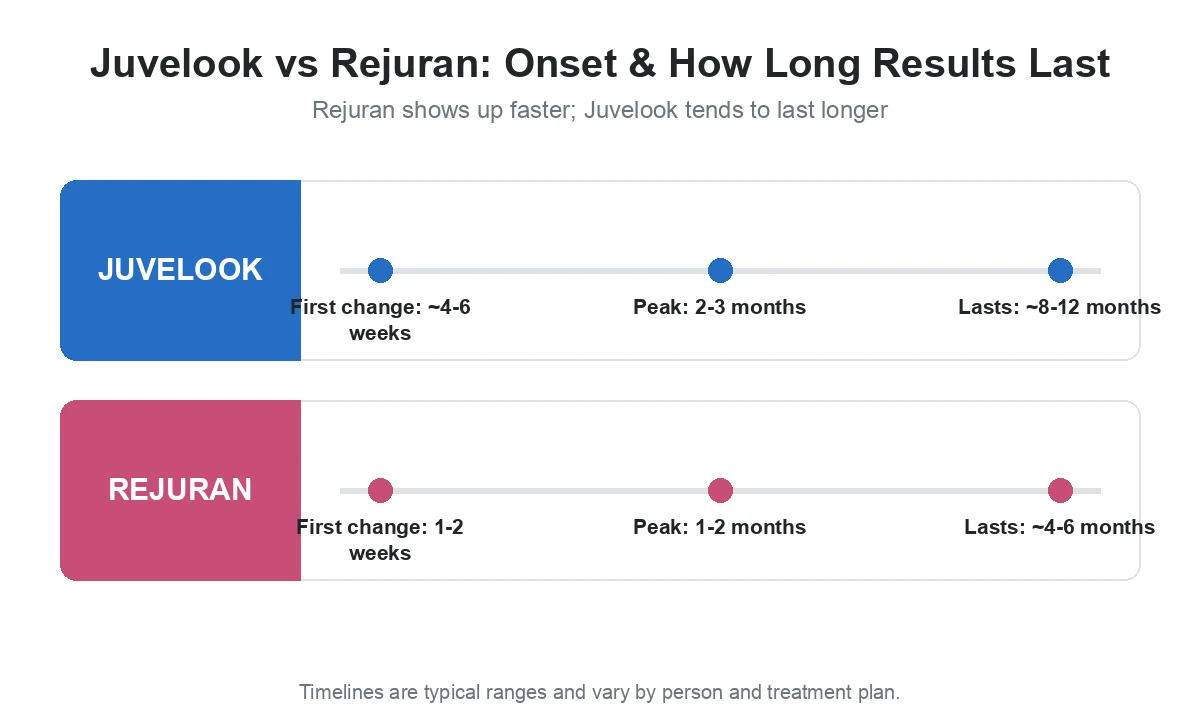
Juvelook timeline
- Right away: a little hydration and volume from the hyaluronic acid.
- 4-6 weeks: the real change begins as new collagen forms.
- 2-3 months: results reach their peak.
- Duration: after a full course, effects often last about 8-12 months.
Juvelook is slower to show, because building collagen takes time, but the payoff tends to last longer. You can learn more in our guide on how long Juvelook results last.
Rejuran timeline
- 1-2 weeks: skin feels more hydrated and looks brighter.
- 2-4 weeks: repair and smoothing become visible.
- 1-2 months: results peak after the recommended course.
- Duration: effects often last about 4-6 months.
Rejuran works faster because it supports the cells directly, but it usually needs more frequent top-ups to keep that fresh look going.
Which Skin Types Suit Juvelook vs Rejuran?
Matching the treatment to your skin is the heart of the Juvelook vs Rejuran question. The chart below is a simple guide by concern.
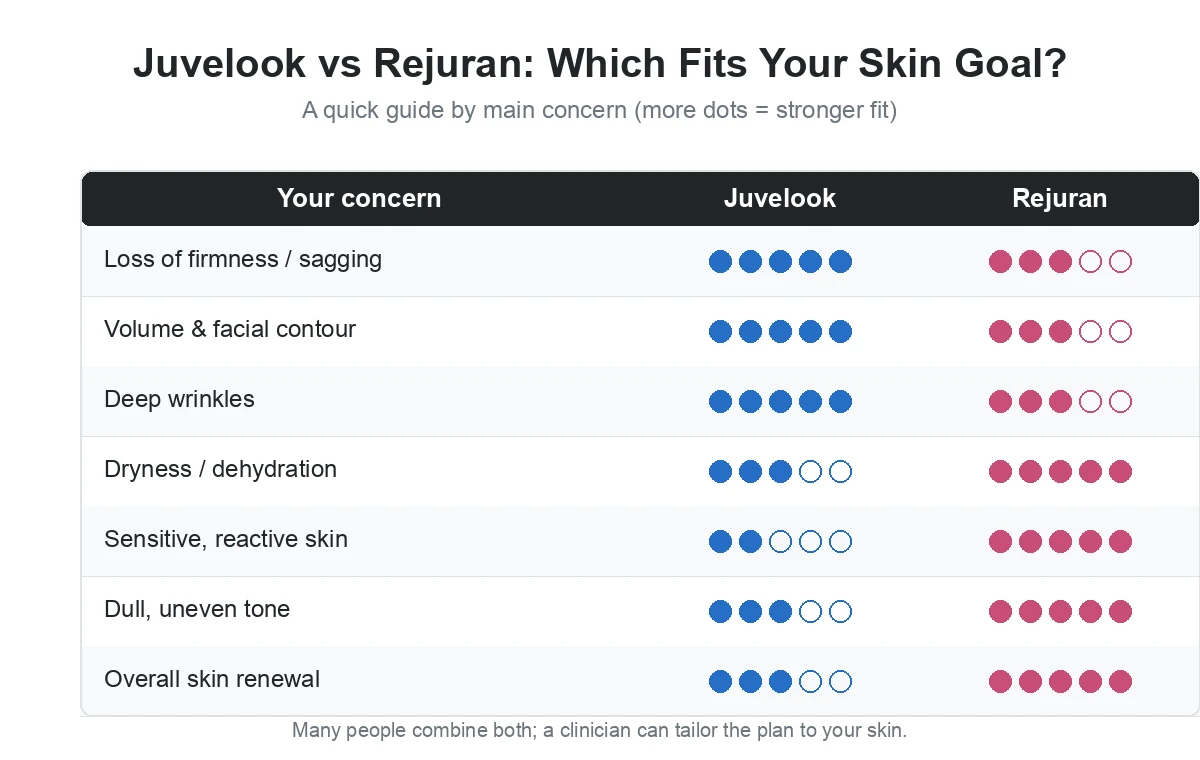
Juvelook may suit you if
- You are roughly 35-55 with early to moderate signs of aging.
- Your main concerns are loss of firmness and volume.
- You want smoother contours and softer, deeper lines.
- You prefer natural, gradual results over a quick fix.
Rejuran may suit you if
- You are in your late 20s to 40s with early skin fatigue.
- Your skin is dry, dull, sensitive, or easily irritated.
- You want brighter tone and a healthier glow.
- Stress, sun, or pollution have left your skin looking tired.
If you see yourself in both lists, that is common, and it is exactly why many people consider using the two together.
Can You Combine Juvelook and Rejuran?
Yes, and combining them is increasingly popular because their strengths complement each other. Rejuran repairs and hydrates the canvas; Juvelook then firms and supports it.
A common approach looks like this:
- Assess first: a clinician reviews your skin and sets a plan.
- Start with Rejuran: 1-2 sessions to build hydration and repair.
- Add Juvelook: about 2 weeks later, 1-2 sessions for firmness.
- Maintain: alternate the two every 3-6 months.
Combining tends to help most when several issues overlap, such as dryness plus loss of firmness, or uneven tone alongside fine lines. As always, the right mix depends on your skin and goals.
Frequently Asked Questions
Which is more effective, Juvelook or Rejuran?
Neither is “better” overall; they simply do different jobs. Choose Juvelook for firmness and volume, and Rejuran for repair, hydration, and glow. The more useful question is which one matches your goal.
How many sessions will I need?
Juvelook is typically 2-3 sessions every 2-3 weeks, while Rejuran is typically 3-4 sessions every 1-2 weeks. Your clinician adjusts this to your skin and recovery, then sets a maintenance rhythm.
Can I get both on the same day?
Same-day treatment is generally not advised. A sequence works better: usually Rejuran first, then Juvelook about 1-2 weeks later. This spacing supports results and lowers the chance of irritation.
How should I care for my skin afterwards?
For both, keep it simple for the first 24 hours: gentle, soothing products and strong sun protection. Ingredients like ceramides and panthenol support the barrier, while daily SPF 50+ helps protect your results.
Which is safer for sensitive skin?
Rejuran is generally the gentler option for sensitive skin, since its polynucleotides help calm and repair. Juvelook relies on a mild repair response to build collagen, which can feel a bit more reactive. A consultation is the safest way to decide.
Conclusion: Choosing What Is Right for You
When it comes to Juvelook vs Rejuran, both are excellent skin boosters with different strengths. Juvelook focuses on firmness and volume through new collagen, with slower but longer-lasting results. Rejuran focuses on repair, hydration, and glow, with faster results that need more frequent upkeep.
The best choice in the Juvelook vs Rejuran comparison is simply the one that fits your skin, your concerns, and your routine, and for many people that is a thoughtful combination of both. A personal consultation is the surest way to land on the right plan.
At Mineclinic, our specialists tailor each plan after a one-on-one skin analysis. To explore which option suits you, you are welcome to book a consultation for personalized guidance.
This article is for general education and does not replace professional medical advice. Individual results vary. Please consult a qualified specialist for a diagnosis and a treatment plan suited to your skin.
※ This content is for informational purposes only and does not replace professional medical advice, diagnosis, or treatment. Individual results may vary, and side effects may occur. Please consult with a board-certified plastic surgeon for personalized advice.