EN


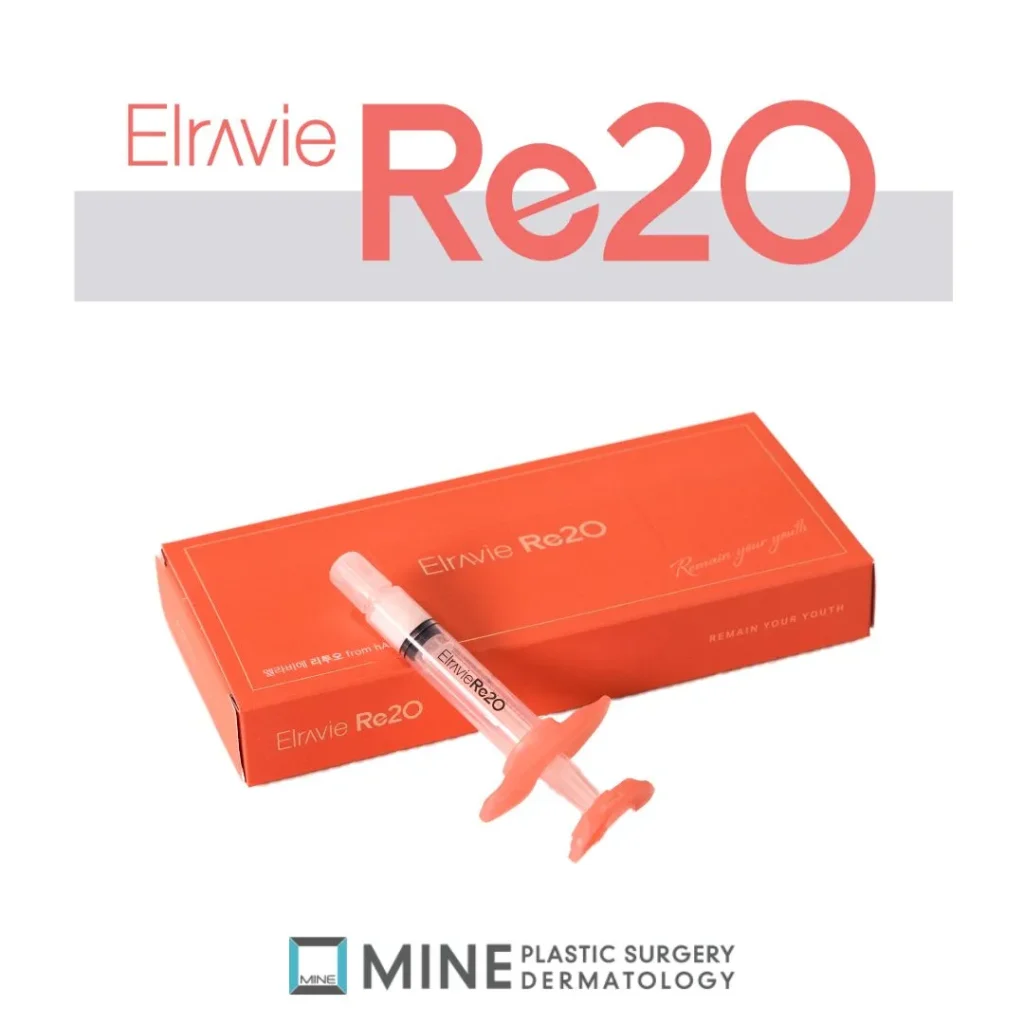
Re2O ingredients are a human-derived acellular dermal matrix (hADM): donated human skin that has been stripped of cells, fat and antigens, leaving only the extracellular matrix — collagen, elastin, hyaluronic acid, fibronectin, laminin and proteoglycans — milled into an injectable powder.
In my consultations, one question comes up more than any other: “What exactly is in Re2O?” It is a fair question. Many people assume Re2O is simply the newest trend among skin boosters, but what sets it apart is the material itself. Most skin boosters work by prompting your skin to make more collagen. Re2O takes a different route: it supplies the structural components your skin is built from.
The full product name is Elravie Re2O, developed by L&C Bio, a Korean company that specializes in human tissue regeneration. The hADM technology behind it was used in burn care and reconstructive surgery for more than a decade before it was adapted for aesthetic treatment. I’m Dr. Lee Sung-wook, a board-certified plastic surgeon at MINE Plastic Surgery & Dermatology in Seoul, and in this guide I’ll walk you through Re2O ingredients one by one: where they come from, how they are purified and how they compare with PN, PDRN and animal collagen.
Table of Contents
Table of Contents
Re2O Ingredients at a Glance: The 6 Building Blocks of Human ECM
To understand Re2O ingredients, it helps to start with the extracellular matrix, or ECM. If your skin were a house, the ECM would be its frame. You can redecorate the rooms as often as you like, but if the frame is weak, the house still sags. Skin works the same way.
What Is the Extracellular Matrix (ECM)?
The extracellular matrix is a three-dimensional network that sits outside your cells, holding them in place and linking them together. It is not just packing material. Medical textbooks on skin grafting describe the ECM as an active player: the way its proteins are arranged sends signals that influence how nearby cells attach, move, multiply and mature. In other words, the space between your cells is where much of the skin’s sensing, repair and renewal actually happens.
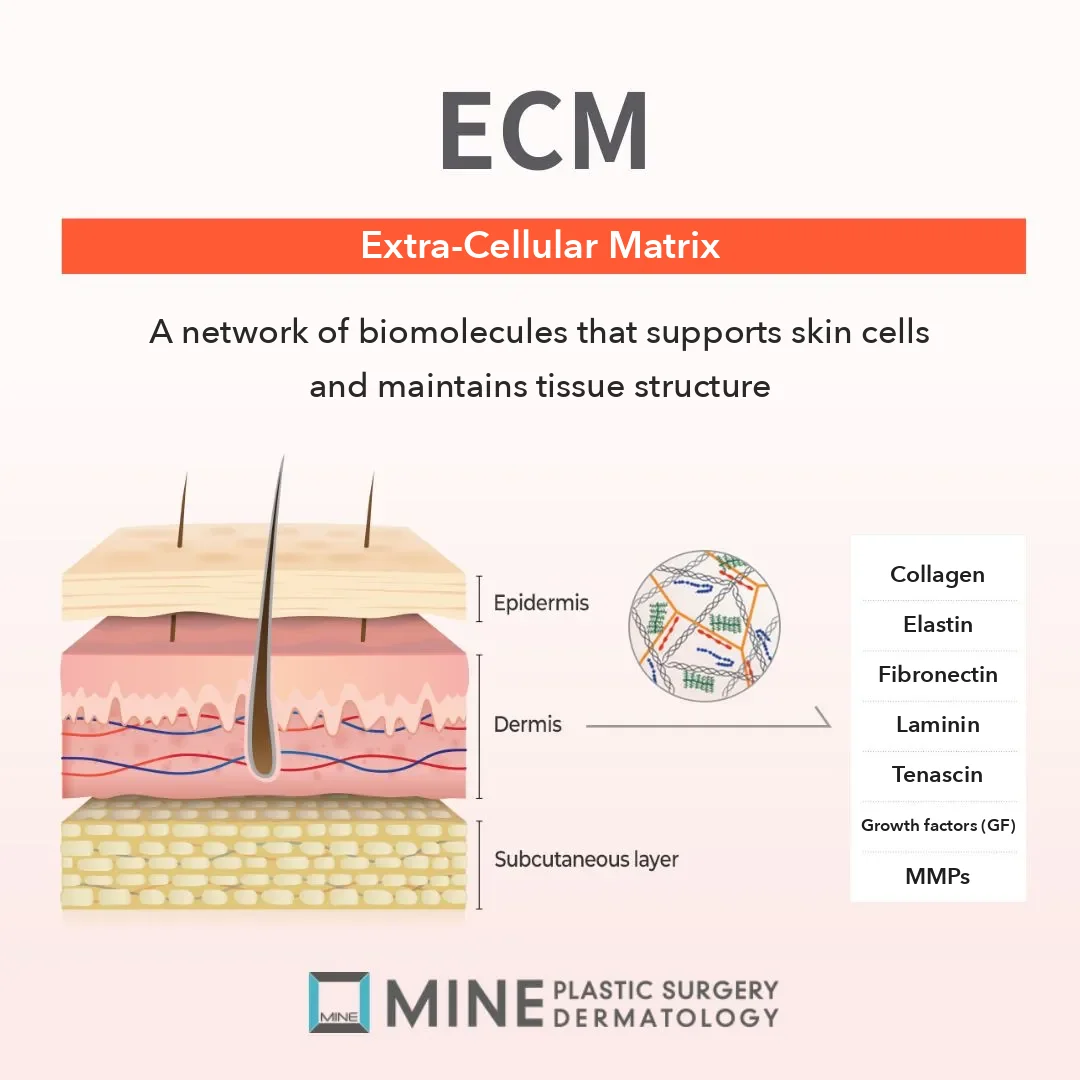
Collagen, Elastin, Hyaluronic Acid, Fibronectin, Laminin and Proteoglycans
The skin’s extracellular matrix is built from six main components, and all six are present in Re2O ingredients:
| Component | What it does in the skin |
|---|---|
| Collagen | The main structural protein; gives skin firmness and strength |
| Elastin | Elastic fibers that let skin stretch and spring back |
| Hyaluronic acid | Holds water and keeps the dermis plump and hydrated |
| Fibronectin | A “glue” protein (glycoprotein) that helps cells attach and move |
| Laminin | A key protein of the basement membrane, the thin sheet that anchors the skin’s top layer |
| Proteoglycans | Cushioning molecules that help tissue resist pressure |
With age, this network thins out and loses its order. In your twenties the ECM is dense and tightly woven, which is why young skin feels springy. From around your mid-thirties, both the amount and the quality of the ECM decline. Cosmetic dermatology textbooks list the loss and alteration of dermal ECM proteins as one of the core changes of skin aging, alongside a thinner epidermis and slower cell renewal.
Why Collagen Alone Is Not Enough
Patients often ask, “Can’t I just top up my collagen?” Collagen matters, but it is only one of the six parts. Healthy skin needs elastin, hyaluronic acid and the supporting glycoproteins working together. Elastin is a good example of why. Of the 6 components above, cosmetic dermatology textbooks single out elastin as the hardest to replace, because it does not pass through the skin when applied on the surface and is difficult to rebuild directly. That is one reason a booster that delivers the whole matrix, rather than a single protein, interests me as a surgeon.
Dr. Lee’s Key Point: The ECM is not a single ingredient; it is the structure that shapes and supports your skin. Re2O ingredients stand apart because they replenish that structure as a whole.
Where Do Re2O Ingredients Come From? The 4-Step hADM Purification
The raw material of Re2O is hADM, short for human acellular dermal matrix. “Acellular” means “without cells.” It starts as human dermis (the deeper layer of skin) and ends as a clean protein framework with the cells removed.
Is Re2O Made From Cadaver Skin? A Straight Answer
When I explain this part, many patients pause and ask, “So it comes from a cadaver?” It can feel like an uncomfortable question, but I welcome it. Knowing where the material injected into your skin comes from is your right.
Here is the honest answer. The source material is donated human skin tissue. Just as with organ donation, an accredited tissue bank screens each donor for infections and medical history before the tissue is recovered, and this donation system includes tissue donated after death. Plastic surgery textbooks describe the same origin for other acellular dermal matrices used in hospitals, such as AlloDerm, which is made from banked donor skin. The tissue is never used as it is. It goes through the purification process below, and what reaches your skin is a protein scaffold with no living cells in it.
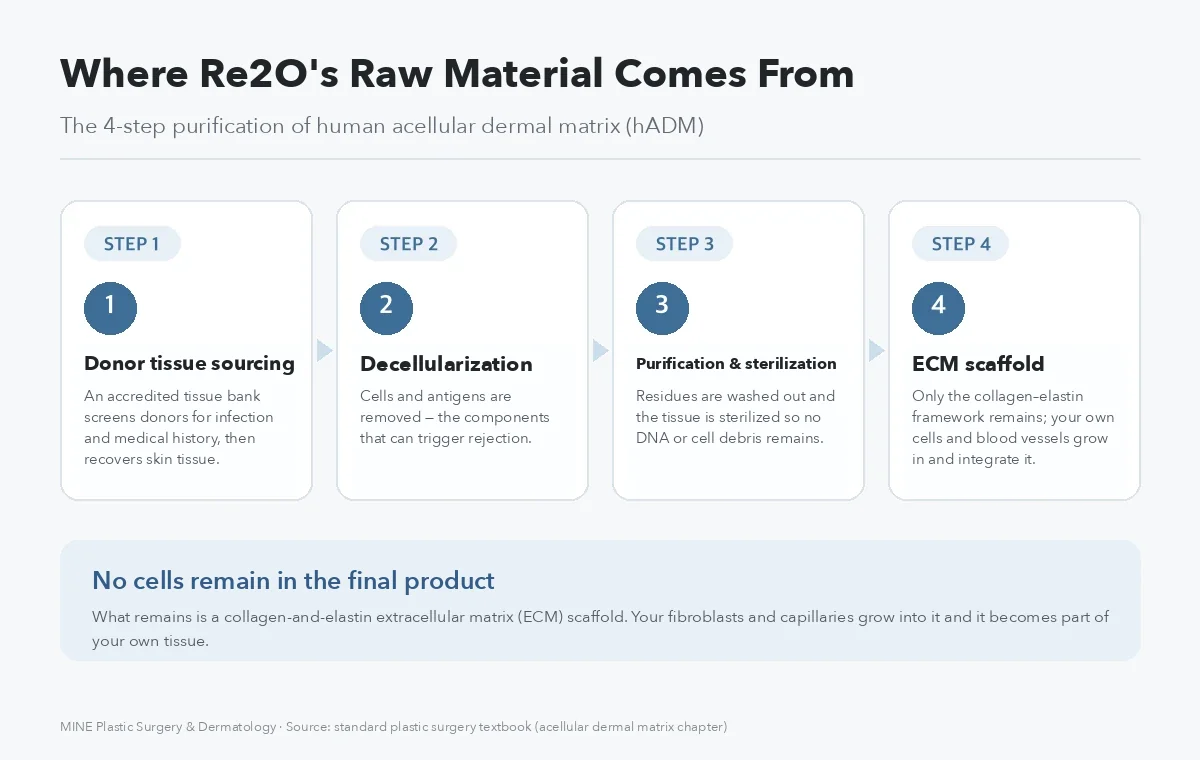
Decellularization, Fat Removal, Structure Preservation, Micronization
hADM is made in 4 steps. L&C Bio describes its patented process, which it calls AlloClean Technology, as follows:
- Cell removal (decellularization): every cellular component that could trigger an immune reaction is removed.
- Fat removal: fatty tissue, which could promote inflammation, is cleared out.
- Structure preservation: the tissue’s natural three-dimensional framework is kept intact.
- Micronization: the matrix is broken down into very fine particles so it can pass through a needle.
The infographic above shows the same process from a slightly different angle: donor sourcing, decellularization, purification and sterilization, and finally the ECM scaffold. Both describe one journey — from screened donor tissue to a cell-free matrix.
What Remains in the Final Product
The whole point of making an acellular dermal matrix is to remove the cells and antigens (the “ID tags” your immune system reacts to) that could cause rejection or infection. Once they are gone, what remains is the collagen–elastin framework, along with hyaluronic acid, fibronectin and laminin: the core materials skin is built from.
Because the basement membrane and the 3D structure of the matrix are preserved, your own fibroblasts (the cells that make collagen) and tiny blood vessels can grow into it over time, so it gradually becomes part of your own tissue. This is not a new idea. It is a principle built up over years in reconstructive surgery, where acellular dermal matrix is used far more extensively, in burn care and breast reconstruction. If the phrase “human tissue” made you hesitant, it may help to remember that what is injected is a cell-free protein structure.
Dr. Lee’s Key Point: Asking where Re2O ingredients come from is the right question. The answer is screened donor tissue, purified until only the protein framework is left.
How Re2O’s Ingredients Behave in the Skin: Fibrillation and Biocompatibility
Preserved Triple-Helix Collagen and Fibrillation
Natural collagen is shaped like a rope of three twisted strands, known as a triple helix. According to the manufacturer, the processing of Re2O ingredients preserves this triple-helix structure, whereas in some synthetic or animal-derived collagens the structure can be altered during processing. This is a manufacturer claim, and I present it as such.
Intact collagen molecules can go through fibrillation: the process in which collagen molecules link with one another to form denser, more stable fibers, much like single threads being woven into a strong cord. This is part of why changes after Re2O tend to develop over the following weeks rather than appearing all at once.
Skin-Like pH and Comfort During Injection
Re2O is prepared at a pH close to that of your own skin. In my experience, many patients say the stinging during injection feels milder than they expected, but how comfortable it feels varies from person to person. Because the material comes from components that already exist in human skin, it is generally well tolerated by the surrounding tissue.
From Scaffold to New Collagen (In Brief)
Once placed in the dermis, the matrix first fills space and restores structure. It then gives your skin cells a better environment to work in; ECM proteins carry binding sites that cells latch onto, and the matrix can hold growth factors (signaling proteins that support repair). Next, your fibroblasts become active and begin producing new collagen and elastin. Remodeling continues for roughly 3–6 months after treatment.
Textbooks on scar formation explain that in normal wound healing, enzymes called MMPs break down old matrix before new matrix is laid down, which is why skin remodeling is a gradual process rather than an overnight one. For a step-by-step explanation of the mechanism, see my guide on how Re2O works in the skin.
Re2O vs PN, PDRN and Animal Collagen: An Ingredient Comparison
“How is it different from other skin boosters?” is the next question I hear. The clearest way to answer is to compare starting materials and how each one works.
| Booster type | Source material | How it works | When change is felt | Things to consider |
|---|---|---|---|---|
| Re2O | Human dermis (hADM, cell-free ECM) | Supplies structural components directly | Some early fullness, then gradual remodeling over months | Human-derived donor tissue; prepared as a powder |
| PN (e.g., Rejuran) | Salmon DNA fragments | Prompts cells to repair and make collagen | Weeks to months | Fish-derived; injection can feel more stinging |
| PDRN | Salmon DNA (polydeoxyribonucleotide) | Calms inflammation, supports blood vessels and collagen synthesis | Weeks to months | Fish-derived; works through cell signaling |
| Animal collagen | Porcine or bovine collagen | Supplies collagen from another species | Relatively early | Species differences may trigger immune reactions in some people |
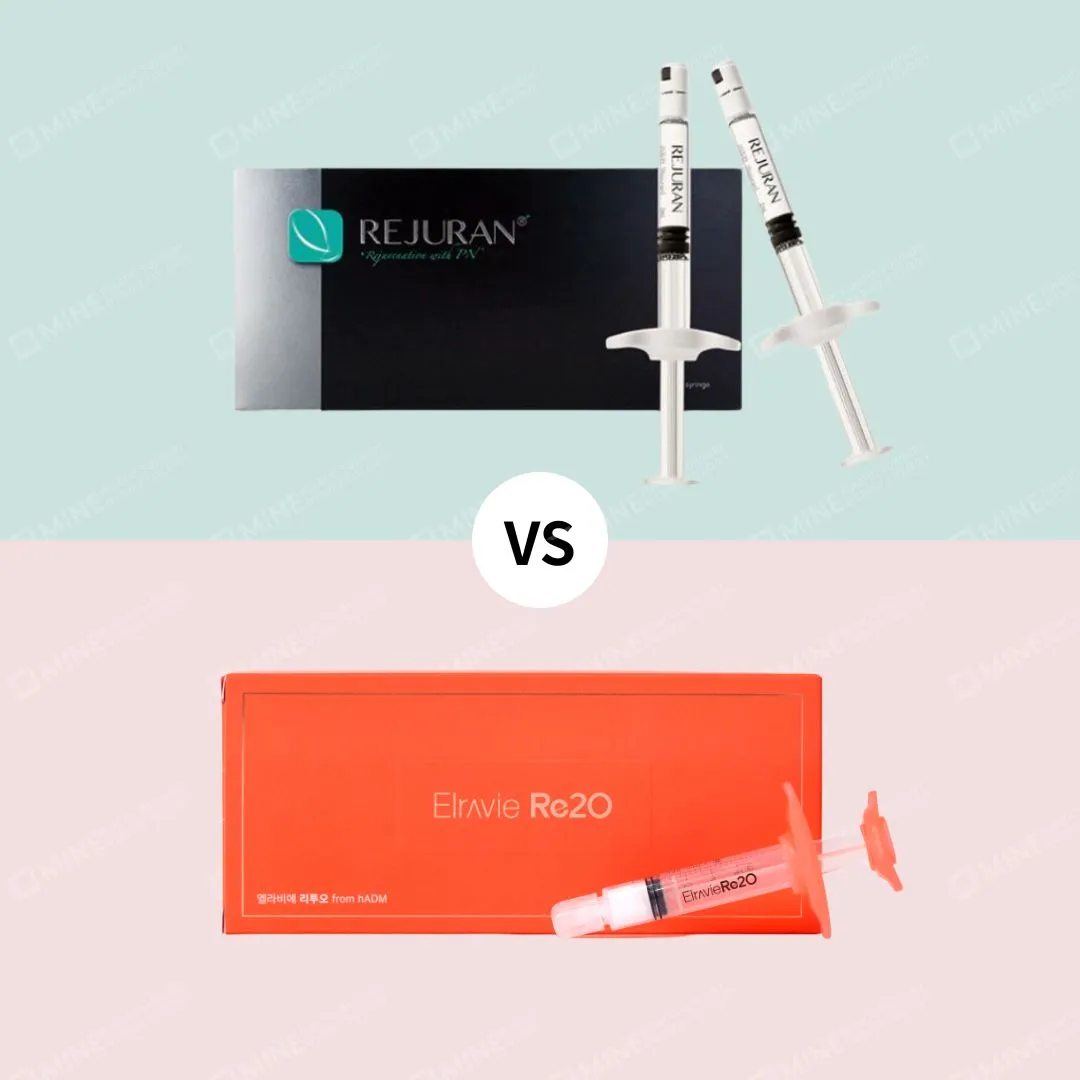
Rejuran (PN, Salmon DNA) vs Re2O
Rejuran Healer uses PN (polynucleotide), short fragments of DNA extracted from salmon. It works indirectly: it helps damaged cells recover and encourages them to produce collagen. Re2O ingredients, by contrast, are the structural materials themselves. A simple way to picture it: Rejuran asks your cells to do the work, while Re2O delivers the building materials. With PN you wait for your cells to build new collagen; with Re2O some of the material is already in place. If you are curious about the fish-derived side of this comparison, I’ve written about salmon-derived PN in Rejuran and what it means for people with allergies.
Porcine or Bovine Collagen Boosters vs Human-Derived ECM
Skin boosters made with porcine (pig-derived) collagen have become popular. In my own clinical experience, however, I have seen some patients develop small nodules, firm lumps or reactive redness, which can be immune responses to protein from another species. Human-derived Re2O ingredients come from human dermis and go through a process designed to remove cells and antigens, so the chance of an immune rejection reaction is considered low.
To keep the picture fair: breast surgery textbooks list both human and porcine dermal matrices among the materials used in reconstruction, so animal-derived matrices are legitimate medical materials too. The difference lies in the source, not in whether one is “real” medicine.
PDRN vs Re2O
PDRN (polydeoxyribonucleotide) is also extracted from salmon DNA. It is valued for reducing inflammation, supporting new blood vessel formation and encouraging collagen synthesis, but it works through cell signaling, so it takes weeks to months to show its effect. Re2O places the skin’s own type of matrix directly in the dermis, which then continues to remodel over time.
Which Ingredient Profile Suits Whom?
Based on ingredients alone, Re2O is often a good fit for people with:
- Thin, dry skin that lacks density
- Loss of firmness and elasticity
- A wish to avoid salmon-derived or pig-derived materials
- A preference for a booster that supplies structure, not only stimulation
That said, ingredients are only one factor. Your skin thickness, goals, pain sensitivity and treatment history all matter, and the final choice should be made in consultation.
Dr. Lee’s Key Point: Other boosters ask your skin to produce more of its own components. Re2O ingredients are those components, which makes it easier to explain what is being replenished and why.
A Long Medical Track Record: Acellular Dermal Matrix Beyond Aesthetics
Burns, Breast Reconstruction and Soft-Tissue Repair
Long before hADM reached aesthetic clinics, acellular dermal matrix had a place in reconstructive medicine, including:
- Burn care and skin grafting
- Breast reconstruction
- Soft-tissue reconstruction
- Dental implant and gum (periodontal) tissue regeneration
- Abdominal wall reconstruction
Plastic surgery textbooks on burns and breast surgery describe acellular dermal matrix as an established reconstructive material, a use that now spans more than a decade. In burn care, textbooks describe dermal substitutes as protecting the wound from drying out and reducing pain and the loss of water and protein, and they note that donor-skin ADM can improve both function and appearance in deep burns. In breast reconstruction, the literature lists both human and porcine dermal matrices, and most published studies used an acellular dermal matrix as the primary dermal substitute.
Quality Control: Tissue Bank Standards
Human tissue products depend on how donors are screened and how tissue is processed. In the United States, the American Association of Tissue Banks (AATB) sets widely referenced standards for this work. L&C Bio states that its human tissue processing quality system is accredited by the AATB and that its patented AlloClean Technology is used in Re2O. The company also reports that its flagship dermal matrix, MegaDerm, has been the subject of around 80 SCI-indexed papers. These are the manufacturer’s claims, and I share them as background rather than as independent findings.
Dr. Lee’s Key Point: The hADM behind Re2O ingredients is a material reconstructive surgeons have worked with for years. Still, no treatment carries zero risk, so your skin condition and medical history should always be reviewed first.
Why Re2O Comes as a Powder: Customizing the Mix for Your Skin
One practical feature of Re2O is that it comes as a powder and is hydrated into a liquid just before treatment. This lets the doctor choose the type and ratio of diluting solution to suit your skin, instead of using one fixed formula for everyone.
Hydration Ratios by Skin Type
- Thin, dry skin: a higher dilution so the material spreads smoothly and evenly.
- Skin with marked loss of firmness: a richer concentration to provide stronger support.
- Sensitive skin: a higher proportion of saline to keep irritation to a minimum.
Injection depth and placement in the dermis matter just as much as the mix, so experience with the technique is an important part of the outcome.
Before Your Appointment
- Avoid heavy drinking the day before, and check with your doctor about aspirin or other blood-thinning medication.
- Come with light makeup or none at all.
- Share any allergies and your previous treatments during the consultation.
Recovery and Safety in Brief
Like any injection, Re2O can cause temporary reactions. The common ones are:
- Mild redness, usually settling within a few hours to 1 day
- Slight swelling for 1–3 days
- Small bruises at injection points, usually fading within a week
- Rarely, a firm spot or small lump at the injection site
For aftercare, avoid saunas and intense exercise for 2–3 days, limit alcohol and smoking for a week, and use sunscreen daily. To tell normal healing apart from signs that need a check-up, read normal healing vs warning signs after Re2O. Clinical reports describe improvements in volume and texture after one session and in dermal density and firmness after a course of three, though the degree varies by person; for a detailed timeline, see what changes at 2 weeks and 3 months.
Frequently Asked Questions About Re2O Ingredients
What is Re2O made of?
Re2O is made of human acellular dermal matrix (hADM): donated human dermis with the cells, fat and antigens removed, leaving the extracellular matrix. Re2O ingredients therefore include collagen, elastin, hyaluronic acid, fibronectin, laminin and proteoglycans. It is supplied as a powder and hydrated just before treatment.
Is Re2O made from cadaver skin?
Re2O’s raw material is donated human skin tissue obtained through the tissue donation system, which includes tissue donated after death. Accredited tissue banks screen donors for infection and medical history. The tissue is then decellularized, so what is injected is a cell-free protein scaffold that gradually integrates with your own tissue.
Is Re2O human-derived or animal-derived?
Re2O is human-derived. Its starting material is human dermis, which is different from salmon DNA used in PN and PDRN boosters and from the pig or cow collagen used in animal-derived collagen boosters.
How are Re2O ingredients different from Rejuran’s PN?
Rejuran’s PN comes from salmon DNA and prompts your cells to repair themselves and produce collagen. Re2O ingredients directly supply the structural components of the skin’s matrix. Which one suits you depends on your goals, skin type and pain sensitivity, which is best decided in consultation.
Are Re2O ingredients safe?
The hADM in Re2O comes from a material used in burn care and reconstructive surgery for more than a decade, and the decellularization process removes the components that typically cause rejection. Swelling and bruising are still common, and small lumps can occur rarely. For details, see normal healing vs warning signs after Re2O.
Why does Re2O come as a powder?
Re2O comes as a powder so it can be hydrated right before treatment. This allows the doctor to adjust the type and ratio of diluting solution to your skin, for example a thinner mix for thin, dry skin or more saline for sensitive skin.
Considering Re2O in Seoul? Talk to Dr. Lee Sung-wook
Understanding Re2O ingredients is the first step. The next is a skin assessment to decide whether a structure-supplying booster suits you and, if so, which hydration ratio and injection plan fit your skin. At MINE, I review your skin thickness, concerns and treatment history before recommending anything. You can learn more about Elravie Re2O treatment at MINE, or contact us through our online consultation form or by phone at +82-2-516-1175 (813 Nonhyeon-ro, Gangnam-gu, Seoul). Let us know your main concern and travel dates, and we’ll suggest a realistic plan.
Written and medically reviewed by: Dr. Lee Sung-wook, Board-Certified Plastic Surgeon, Representative Director of MINE Plastic Surgery & Dermatology
※ This content is for informational purposes only and does not replace professional medical advice, diagnosis, or treatment. Individual results may vary, and side effects may occur. Please consult with a board-certified plastic surgeon for personalized advice.