EN


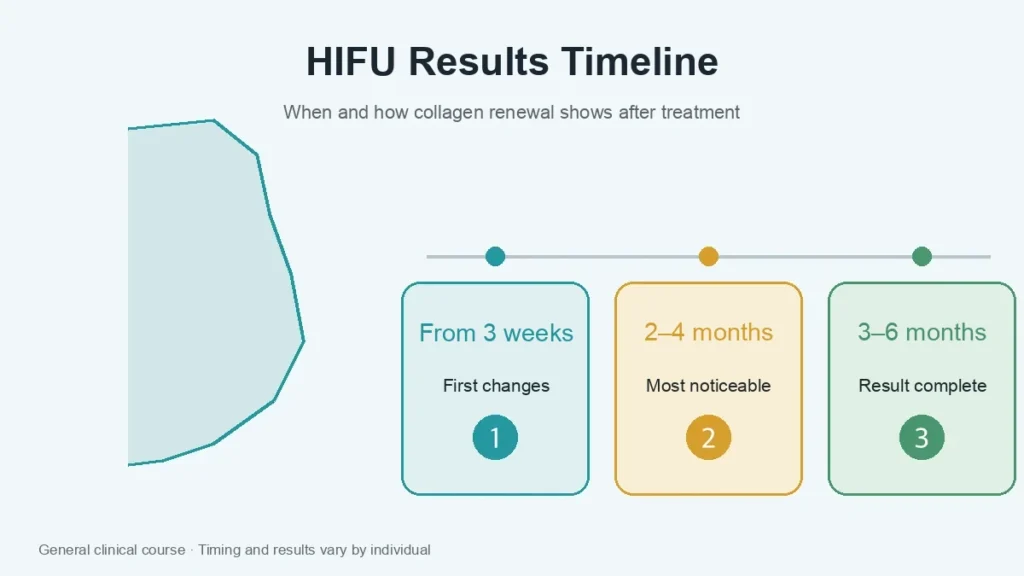
The HIFU results timeline is the period after high-intensity focused ultrasound (HIFU) treatment when new collagen forms and firmer skin becomes visible. Changes usually start around 3 weeks, are most noticeable at 2–4 months and are complete by about 3–6 months.
“I had HIFU two weeks ago. Why does my face look exactly the same?” I hear some version of this question in clinic more often than any other. The short answer is that at two weeks, and often at six, seeing nothing is normal. HIFU sets off a repair process, and your body needs months to finish it.
This guide walks through the HIFU results timeline in general terms rather than for one brand, and at each stage it answers a practical question: should you keep waiting, or get checked? I’m Dr. Lee Sung-wook, a board-certified plastic surgeon at MINE Plastic Surgery & Dermatology in Seoul.
- HIFU Results Timeline at a Glance: 3 Weeks, 2–4 Months, 3–6 Months
- Why HIFU Doesn’t Work Overnight
- Days 0–14: What’s Normal Before Any Lift Appears
- Week 3 to Month 3: When HIFU Starts Working
- Months 3–6: When the HIFU Result Is Complete
- Not Seeing Results Yet? How to Tell Slow From Not Working
- When to Consider Another HIFU Session
- Warning Signs That Don’t Fit the Timeline
- HIFU Results Timeline: Frequently Asked Questions
- Planning HIFU at MINE in Seoul
HIFU Results Timeline at a Glance: 3 Weeks, 2–4 Months, 3–6 Months
HIFU results usually begin around 3 weeks, are most noticeable at 2–4 months and are complete by about 3–6 months, though timing varies by individual. HIFU is the technology, and devices such as Shurink and Doublo are examples of it. The table sets out the general HIFU results timeline, pairing what happens under the skin with what you can see and what to do if nothing has changed yet.
| When | Under the skin | In the mirror | If you see no change yet |
|---|---|---|---|
| Days 0–14 | Heat-damaged collagen is cleared and repair begins | Possible mild redness, swelling or bruising, with little or no lift | Normal. Keep waiting. |
| About week 3 | Collagen-making cells are active and soft new collagen starts to form | The earliest hint of firmness, for some people | Normal. Many people see nothing yet. |
| Months 2–4 | New collagen keeps filling in | The most noticeable change in jawline and cheek firmness | Before month 3, usually too early to judge. Keep waiting. |
| Months 3–6 | Collagen firms up and the fibers reorganize | The result settles and is complete | At 6 months, if matching photos show no change, review it with your doctor. |
The HIFU results timeline above describes the general clinical course, and individual variation is wide. These are not deadlines.
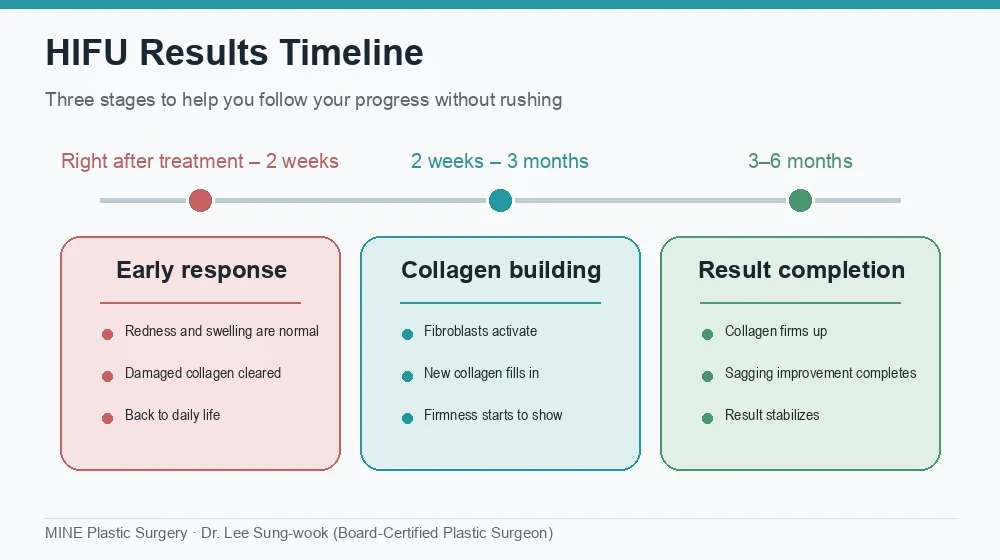
You may notice the numbers overlap, because two clocks are running at once. Inside the skin there are three phases: early response (0–2 weeks), collagen building (2 weeks to 3 months) and completion (3–6 months). What you see in the mirror lags behind that biology. “Most noticeable” at 2–4 months is when people first clearly see a difference, while “complete” at 3–6 months is when the improvement levels off and settles.
Dr. Lee’s Key Point: Remember three numbers: about 3 weeks for the first hint, 2–4 months for the clearest change and 3–6 months for the finished result.
Why HIFU Doesn’t Work Overnight
The Heat Points Are the Trigger, Not the Result
Medical textbooks describe HIFU as focusing ultrasound at three different depths to create tiny invisible wounds that prompt new collagen. Picture a magnifying glass concentrating sunlight onto a single spot. Here the energy gathers at set depths in the skin and in the SMAS (the fibrous layer that supports the face from within).
Those same textbook accounts link the new collagen to lifted skin and softer creases on the neck, jowls, cheeks and forehead. Each focal point is a small, deliberate injury, and the injury itself changes nothing you would want to see. The improvement comes from what your body builds while repairing it.
Collagen is slow to build, which is why a HIFU results timeline is measured in months. If you want the full science, this guide explains how Ultherapy HIFU builds collagen.
That Tight Feeling on Day One Isn’t the Lift
Some people notice slight tightness right after treatment. That sensation can come from heat and swelling, and it fades. So if your face felt tight on day one and seemed to “go back” a week later, you haven’t lost anything. The lasting change simply hasn’t started to show.
Days 0–14: What’s Normal Before Any Lift Appears
What You May See
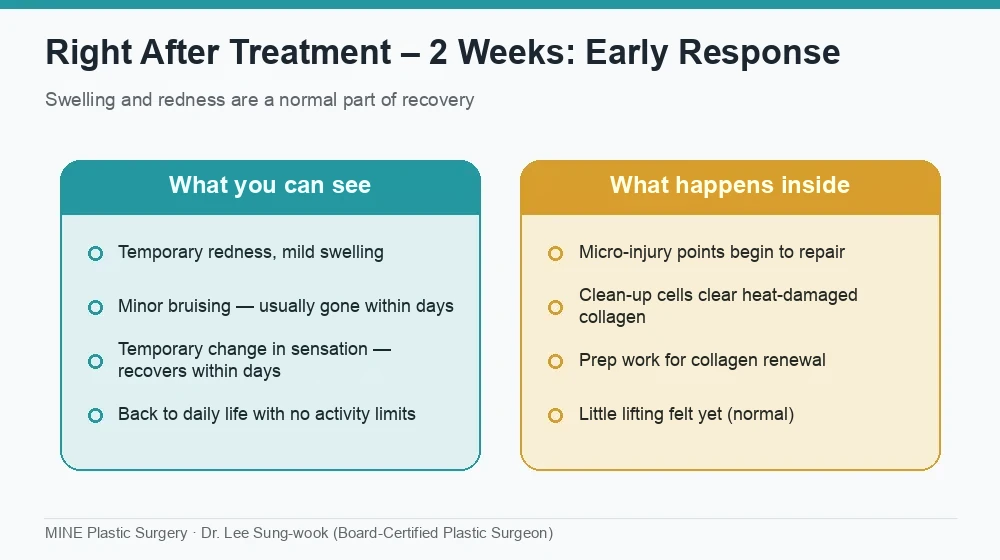
Mild redness, swelling and bruising after HIFU usually settle within a few days, and you can keep up your normal activities in the meantime. Some people also have a brief change in sensation in the treated area, and that tends to resolve within days as well.
What’s Happening Under the Skin
During these two weeks, your body starts repairing the tiny heat points while clean-up cells clear away the collagen the heat damaged.
Because new collagen production hasn’t really ramped up, you shouldn’t expect much lift yet. Feeling no tightening at day 10 is exactly what this stage of the HIFU results timeline looks like.
Dr. Lee’s Key Point: The first two weeks are preparation. A face that looks unchanged at this stage doesn’t mean the treatment failed.
Week 3 to Month 3: When HIFU Starts Working
The Earliest Changes Around Week 3
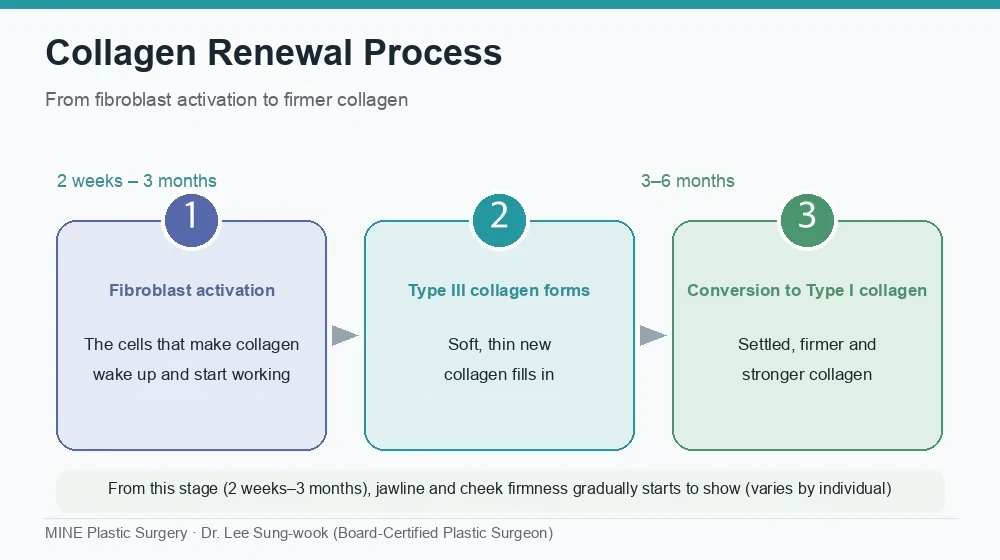
When does HIFU start working? In general clinical experience, the earliest changes can appear around 3 weeks, and for many people it takes longer. From roughly two weeks to three months, fibroblasts (the cells that make collagen) become active and lay down Type III collagen, a soft, thin early form that matures later.
When I explain this stage to patients, I describe the skin being refilled from the inside. Along with new collagen, tiny blood vessels, elastin (the protein that lets skin spring back) and hyaluronic acid (a molecule that holds moisture) also increase. Firmness along the jawline and cheeks tends to build gradually in this window.
Why Progress Feels Uneven
You see your own face every day, and that makes slow change almost invisible. The difference from one week to the next is too small to register, until a photo from two months ago makes it obvious.
If you see no change at 6 weeks, you are usually still within the normal range. Many people haven’t yet reached the part of the HIFU results timeline where change is easy to see. How quickly and how clearly it shows depends on your skin condition and how much sagging you started with.
Months 3–6: When the HIFU Result Is Complete
The Clearest Change Comes at Months 2–4; the Final Result at Months 3–6
Months 2–4 are when most people first clearly see a difference, because enough new collagen has built up to show. Over months 3–6, the usual clinical explanation is that soft Type III collagen gives way to sturdier Type I collagen and the fibers reorganize into a denser network. Visible gains slow down as the HIFU results timeline draws to a close.
Published studies of one HIFU device, the Ulthera system, also measured improvement months after treatment. In a 2014 study of the Ulthera system on the face and neck, physicians rated 77.7% of 45 patients as improved at 180 days (Fabi and Goldman, Dermatologic Surgery 2014). At 90 days the figure was 81.3%, but only 16 patients were assessed at that point, so it is a small sample. These numbers apply to that device and protocol, not to every HIFU treatment.
To judge your own change, you need photos taken under matching conditions, and it helps to know how to compare before-and-after photos fairly.
How Long the Result Lasts
Duration varies widely from person to person, depending on skin condition, degree of sagging and lifestyle. Aging also continues after treatment, so I never tell a patient that a result will last forever. I don’t put a single number on HIFU in general either, because devices and energy levels differ too much for one figure to be honest.
Not Seeing Results Yet? How to Tell Slow From Not Working
Check the Calendar First
Before you decide anything, count the weeks since treatment and find where you are on the HIFU results timeline.
- Before 6 weeks: Wait. No visible change is what most people should expect.
- 6 weeks to 3 months: It’s usually still too early to judge, so keep waiting.
- 3 to 6 months: Change should be appearing by now. Compare matching photos instead of relying on the mirror.
- At 6 months, with no change in matching photos: Book a review with the doctor who treated you.
Keep in mind that the change itself can be modest, small enough that you might miss it on your own face. And the warning signs listed further down always override this calendar.
Reasons a Result Can Stay Subtle
Not everyone gets a clear change, and you deserve a straight answer about that. In a 2014 clinical trial of the Ulthera system, blinded reviewers saw improvement in 58.1% of 93 patients at 90 days (Oni et al., Aesthetic Surgery Journal 2014). In the same lower-face study, 65.6% of patients felt an improvement themselves.
That trial found no change in 12.2% of patients with a BMI of 30 or below, compared with 54.5% of those above 30. BMI is a standard measure of weight relative to height.
These figures come from one Ulthera study, measured at 90 days, which is earlier than the 3–6 month finish on the HIFU results timeline. They show that response varies between people, but they can’t predict your result or be applied to other HIFU devices.
When skin sagging is advanced, ultrasound alone may not be enough, and an in-person assessment can tell you whether that applies to you.
If You Flew to Korea for Treatment
For international patients, the most important part of the HIFU results timeline happens after the flight home. Before you leave, have your starting photos taken and ask at your consultation how follow-up will work, whom to contact if something seems wrong and when it makes sense to send an update.
When to Consider Another HIFU Session
Why 3–6 Months Is a Review Point, Not a Schedule
There is no fixed number of sessions. Until your first result has settled, you can’t tell what another treatment would add. That makes months 3–6 on the HIFU results timeline a time to review what you got, rather than a reminder to rebook.
At that review, I look at your skin, your degree of sagging and what still bothers you. Sometimes the right plan is no further treatment for now.
Why Intervals Differ
The gap between sessions depends on the class of device, the total energy delivered and the state of your skin. Ultherapy, a high-energy single-session protocol, is commonly repeated every 12–18 months, and its results are commonly reported to last about one to two years.
With lighter, lower-energy HIFU protocols, a further session can sometimes be discussed sooner, once the previous result has settled. If you’re comparing devices, this overview explains how Ulthera compares with other lifting options.
Dr. Lee’s Key Point: Judge first, then plan. Months 3–6 show what the first session achieved, and that answer decides whether a second one makes sense.
Warning Signs That Don’t Fit the Timeline
The HIFU results timeline assumes normal healing. Burns are a rare risk of HIFU, and some symptoms shouldn’t be waited out. Contact your clinic promptly if you notice any of the following.
- Swelling or redness that hasn’t settled after several days, or that is getting worse
- Pain or blisters in the treated area
- Redness lasting more than 3 months
- Darkened patches of skin (pigmentation)
- Raised, thickened scars (hypertrophic scarring)
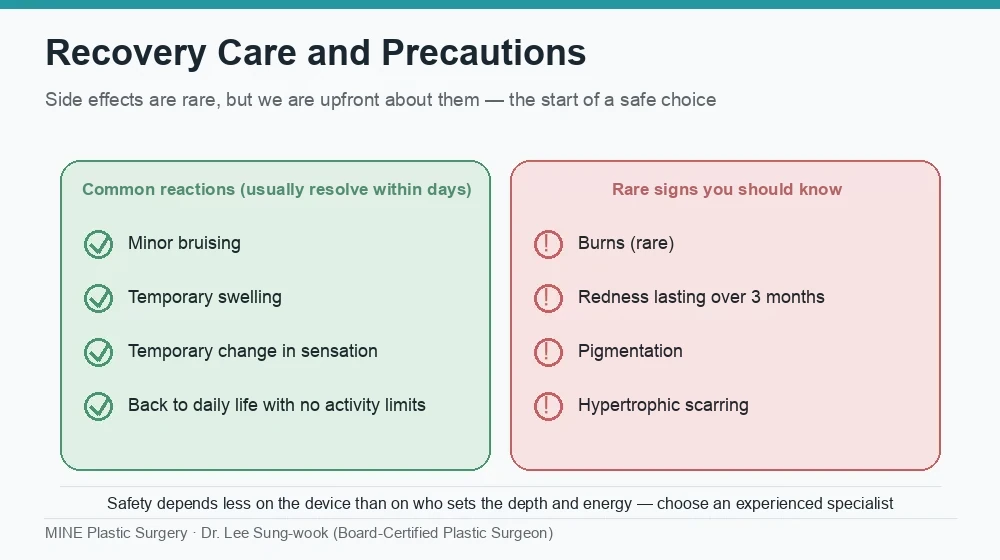
Long-lasting redness, pigmentation and scarring are linked to how deep the injury went and whether too much energy was used. That is why safety depends less on the machine than on who sets the depth and energy.
HIFU Results Timeline: Frequently Asked Questions
How long does HIFU take to work?
HIFU usually takes around 3 weeks to show the first changes, and many people need longer. The change is most noticeable at 2–4 months and complete by about 3–6 months. This is the general clinical course, and individual timing varies widely.
How long do HIFU results last?
HIFU results aren’t permanent, and how long they last varies widely because aging continues after treatment. There is no reliable single figure for HIFU in general. For Ultherapy specifically, results are commonly reported to last about one to two years, a range that shouldn’t be assumed for other devices.
How many HIFU sessions do I need?
There is no fixed number of HIFU sessions. Your first result needs about 3–6 months to settle, and that is the time to assess it and decide on your next step. Intervals vary by device and energy, and Ultherapy, for example, is commonly repeated every 12–18 months.
When do swelling and bruising go away after HIFU?
Mild bruising, swelling and brief changes in sensation usually go away within a few days after HIFU, and most people return to normal activities right away. If swelling or redness doesn’t settle as expected, or you develop pain or blisters, contact your clinic instead of waiting.
Why can’t I see my HIFU results yet?
Early in the HIFU results timeline, collagen is still being built, so the change is small and easy to miss in the mirror. Give it until 6 months, then compare photos taken under the same conditions. If swelling or redness isn’t settling after several days, or anything else seems wrong, contact your clinic.
Planning HIFU at MINE in Seoul
Your own HIFU results timeline depends partly on where you start. A good plan begins with an in-person look at your skin and your degree of sagging, which together decide what device and energy level make sense. You can read more about Doublo HIFU lifting and Ulthera treatment at MINE, or call +82-2-516-1175 to arrange a consultation.
Written and reviewed by Dr. Lee Sung-wook, Board-Certified Plastic Surgeon, MINE Plastic Surgery | 813 Nonhyeon-ro, Gangnam-gu, Seoul | Last reviewed November 10, 2026
※ This content is for informational purposes only and does not replace professional medical advice, diagnosis, or treatment. Individual results may vary, and side effects may occur. Please consult with a board-certified plastic surgeon for personalized advice.