EN
EN

Table of contents
Skin aging is a natural process everyone experiences, but advances in modern medical technology have introduced various effective lifting procedures that can significantly improve aging signs. Non-surgical lifting treatments like Ulthera vs Thermage, HIFU, and thread lifts offer remarkable lifting effects without surgery, attracting considerable attention from patients seeking facial rejuvenation. However, what are the differences between these seemingly similar procedures? How do Ulthera vs Thermage differ, and when is one more effective than the other?
This comprehensive guide provides an objective comparison analysis covering the mechanisms, effectiveness, duration, and suitable skin types for various lifting procedures, helping you find the most appropriate treatment for your individual needs.
Comparison of non-surgical lifting procedures: Ulthera vs Thermage, HIFU, and thread lift mechanisms shown across different target skin depths.
Types and Basic Mechanisms of Lifting Procedures
Modern medical technology advances have introduced various skin lifting procedures, each with unique mechanisms and characteristics that can be selected based on individual skin conditions and desired effects.
Ulthera (HIFU Technology) Mechanism and Features
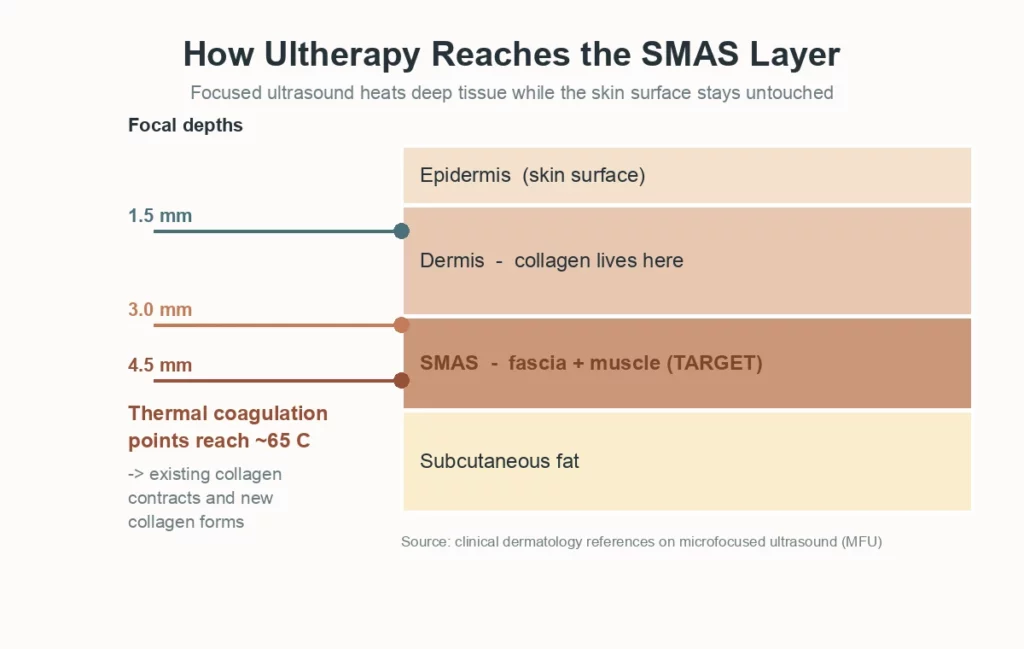
Ulthera utilizes High-Intensity Focused Ultrasound (HIFU) technology for non-surgical lifting procedures. This technology delivers ultrasound energy to deep skin layers (SMAS layer) to stimulate collagen production.
Key Features:
- Target Depth: Reaches the SMAS layer at a depth of 4.5mm below the skin surface
- Mechanism: Ultrasound energy generates 65-70°C heat at focused points, promoting collagen production
- FDA Approval: FDA-approved procedure since 2009 with verified safety
- Distinction: Deepest-acting non-surgical lifting procedure
Thermage (RF Technology) Mechanism and Features
Thermage uses radiofrequency (RF) energy for lifting procedures. RF energy converts to heat through tissue resistance, inducing collagen regeneration.
Key Features:
- Target Depth: From epidermis to dermis (approximately 3mm depth)
- Mechanism: RF energy generates heat in skin tissues causing immediate collagen contraction and long-term collagen regeneration
- Characteristics: Delivers heat energy evenly across broad areas
- Distinction: Immediate elasticity effects combined with long-term improvement
HIFU Technology Mechanism and Features
HIFU uses the same technology as Ulthera but may vary in details depending on brand and device. Ulthera represents the original brand using HIFU technology.
Key Features:
- Mechanism: Identical to Ulthera using ultrasound energy
- Variety: Different energy outputs and cartridge types depending on brand and device
- Distinction: Ulthera is the original HIFU brand with patented technology and verified safety
Thread Lift Mechanism and Features
Thread lifts involve inserting special medical threads under the skin to physically lift tissue.
Key Features:
- Procedure Type: Minimally invasive procedure
- Mechanism: The inserted threads act as physical support structures while stimulating collagen production
- Immediacy: Lifting effects visible immediately after procedure
- Distinction: Relatively immediate and pronounced lifting effects
Ulthera vs Thermage: Technology, Effects, and Comparison
Ulthera and Thermage are both popular non-surgical lifting procedures, but they have important differences in energy types and mechanisms. (Ulthera vs Thermage vs Titanium lifting guide)
Target Skin Layer Differences
Ulthera:
- Acts on SMAS layer (fascial layer) reaching 4.5mm depth
- Customizable treatment at various depths (1.5mm, 3.0mm, 4.5mm)
- Acts directly on the underlying support structures
Thermage:
- Primarily acts on dermis layer (approximately 3mm depth)
- Delivers heat energy evenly from the skin surface to deep layers
- Uniform effects across broad areas
Effect and Duration Comparison
Ulthera:
- Effect Onset: Gradual effect development over 2-3 months post-procedure
- Duration: Average 1-2 years
- Primary Effects: Definitive lifting effects, facial line improvement, volume increase
- Characteristics: Fundamental improvement through deep layer action
Thermage:
- Effect Onset: Some immediate effects plus gradual improvement over 2-3 months
- Duration: Average 6 months to 1 year
- Primary Effects: Skin elasticity improvement, pore reduction, skin texture enhancement
- Characteristics: Overall skin improvement effects
Pain and Recovery Period Comparison
Ulthera:
- Pain Level: Moderate to high (individual variation)
- Treatment Duration: Approximately 30-60 minutes
- Recovery Period: Immediate return to daily activities, minor swelling or pain may persist 1-3 days
- Side Effects: Possible temporary erythema, edema, sensory changes
Thermage:
- Pain Level: Moderate (generally lower than Ulthera)
- Treatment Duration: Approximately 30-90 minutes
- Recovery Period: Immediate return to daily activities, mild erythema may persist several hours
- Side Effects: Temporary erythema, mild burn risk
Suitable Skin Types and Age Groups
Suitable for Ulthera:
- Ages 40+ with moderate skin sagging
- Those seeking definitive lifting effects
- Primary focus on facial line and jawline improvement
- Previous experience with Botox or filler treatments
Suitable for Thermage:
- Early 30s to early 40s with initial aging signs
- Overall skin elasticity improvement goals
- Those also wanting skin texture improvement and pore reduction
- Pain-sensitive individuals
Ulthera vs Thermage Comparison Table
| Category | Ulthera | Thermage |
|---|---|---|
| Technology | HIFU (High-Intensity Focused Ultrasound) | RF (Radiofrequency) |
| Target Depth | 1.5mm, 3.0mm, 4.5mm (to SMAS layer) | ~3mm (dermis layer) |
| Effect Onset | Gradual over 2-3 months | Some immediate + gradual |
| Duration | 1-2 years | 6 months-1 year |
| Pain Level | Moderate-High | Moderate |
| Recommended Age | 40+ | 30+ |
| Primary Effects | Lifting, jawline improvement | Elasticity, texture, pore improvement |
Ulthera vs HIFU: Same Technology, Different Brand Differences
Ulthera and HIFU both use HIFU technology, but ‘Ulthera’ is a brand name from Ulthera Inc., while ‘HIFU’ is the technology name. Ulthera is generally recognized as the representative HIFU brand.
Technical Similarities and Differences
Similarities:
- Both based on High-Intensity Focused Ultrasound (HIFU) technology
- Based on the principle of delivering heat energy to deep skin layers
- Provides a non-surgical lifting effect
Differences:
- Energy Delivery Method: Ulthera features patented DeepSEE technology enabling real-time tissue monitoring
- Safety: Ulthera holds FDA approval as original technology with extensive clinical data
- Cartridge Types: Ulthera uses standardized cartridges, other HIFU devices have various specifications
- Precision: Ulthera enables accurate targeting through ultrasound imaging
Effect and Duration Comparison
Ulthera:
- Effect Onset: Complete effect development over 2-3 months post-procedure
- Duration: Average 1-2 years
- Effect Uniformity: Uniform effects through precise energy delivery
- Treatment Interval: Generally recommended every 1-2 years
General HIFU Devices:
- Effect Onset: Varies by brand but generally 1-3 months
- Duration: 6 months-1.5 years (varies by device and individual differences)
- Effect Uniformity: Varies depending on device performance
- Treatment Interval: May require more frequent retreatment
Safety and Certification Comparison
Ulthera:
- FDA approval obtained in 2009
- Usage authorization in over 60 countries worldwide
- Over 10 years of clinical data and research results
- Real-time tissue monitoring possible through patented DeepSEE technology
General HIFU Devices:
- Various certification status by brand
- Some have FDA approval, some only CE certification
- Relatively less clinical data and long-term studies
- May have differences in safety features by device
When to Choose Which Option?
Choose Ulthera when:
- Prioritizing verified safety and effectiveness
- Seeking long-term effects
- Desiring precise treatment
- Jawline and neck lifting are primary concerns
Consider Other HIFU Devices when:
- Cost-effectiveness is important
- Customized treatment for specific areas needed
- Various depth options required
- Seeking partial supplementation after Ulthera treatment
Ulthera vs Thread Lifts: Non-Invasive vs Minimally Invasive Procedures
Ulthera and thread lifts provide lifting effects but have fundamental differences in approach and treatment methods.
Fundamental Procedure Differences
Ulthera:
- Completely non-surgical, non-invasive procedure
- Ultrasound energy delivery from skin surface
- Only topical anesthetic cream if needed
- No needles or incisions
Thread Lifts:
- Minimally invasive procedure
- Special medical threads inserted under skin
- Local anesthesia required
- Micro-incisions and needle insertion necessary
Immediate Effects vs Gradual Effects
Ulthera:
- A slight lifting effect immediately after the procedure
- Gradual effect development over 2-3 months
- Natural improvement with collagen regeneration
- Effects maximize over time
Thread Lifts:
- Immediate lifting effect visible right after procedure
- Additional collagen production from thread stimulation over time
- More pronounced and dramatic lifting effects
- Some effect reduction possible over time
Area-Specific Effect Differences
Ulthera:
- Effective for overall facial lifting
- Applicable to various areas: jawline, neck, eye area, forehead
- Suitable for broad-area overall improvement
- Particularly effective for SMAS layer lifting
Thread Lifts:
- Effective for concentrated lifting of specific areas
- Particularly effective for severe sagging in mid-face, cheeks, jawline
- Directional lifting possible (upward, lateral, etc.)
- Various effects depending on thread type (lifting, volume, etc.)
Duration and Maintenance Comparison
Ulthera:
- Average duration: 1-2 years
- Retreatment interval: 1-2 years
- Maintenance: No special care required
- Effect reduction follows natural aging process
Thread Lifts:
- Average duration: 1-3 years (varies by thread type)
- Retreatment interval: Retreatment possible when threads are absorbed
- Maintenance: May require initial facial movement restrictions
- Thread position may shift over time
Ulthera vs Thread Lifts Comparison Table
| Category | Ulthera | Thread Lifts |
|---|---|---|
| Procedure Type | Non-invasive (non-surgical) | Minimally invasive |
| Technology | HIFU (ultrasound) | Medical thread insertion |
| Anesthesia | Topical cream (optional) | Local anesthesia required |
| Effect Onset | Gradual (2-3 months) | Immediate + gradual |
| Lifting Degree | Natural lifting | More pronounced lifting |
| Recovery Period | Immediate daily return | 1-3 days swelling/bruising possible |
| Duration | 1-2 years | 1-3 years |
| Risk Level | Very low | Low-moderate (thread exposure, etc.) |
Age-Specific Recommended Lifting Procedures
Different age groups have varying skin conditions and aging degrees, making different lifting procedures most suitable for each age range.
Lifting Procedure Guide for 20s-30s
The 20s-30s focus on preventive lifting and improvement of initial skin elasticity decline.
Recommended Procedures:
- Thermage: Effective for initial elasticity decline and pore management
- Ulthera (low intensity): Preventive lifting for SMAS layer strengthening
- LED therapy and radiofrequency lifting: Skin health and mild elasticity improvement
Recommendation Reasons:
- Focus on prevention and maintenance rather than severe sagging
- Primary goal of skin elasticity and collagen production stimulation
- Natural improvement utilizing 20s-30s recovery capacity
Optimal Lifting Procedures for 40s
The 40s mark the beginning of significant aging signs, requiring effective lifting procedures.
Recommended Procedures:
- Ulthera: Most effective for moderate skin sagging
- Combined Thermage and Ulthera: Simultaneous action on various skin layers
- Thread lifts (mild cases): When concentrated lifting needed for specific areas
Recommendation Reasons:
- Deep layer lifting including SMAS layer needed
- Compensates for decreased collagen and elastin
- Facial line and jawline definition improvement
Lifting Solutions for 50s and Above
Ages 50+ have significant skin sagging and volume loss requiring stronger lifting solutions.
Recommended Procedures:
- Ulthera (high intensity): Deep SMAS layer lifting
- Thread lifts: When pronounced lifting effects needed
- Combined Ulthera + Thread lifts: Synergistic effects
- Combined with fillers: Volume loss compensation
Recommendation Reasons:
- Improvement of severe gravity-induced sagging
- Facial contour redefinition needed
- Strengthens both the skin and its support structures
- More effective comprehensive approach
Optimal Lifting Procedures by Skin Type
Skin type significantly influences lifting procedure effects and side effects. Selecting procedures suitable for your skin type is crucial.
Lifting Options for Dry/Sensitive Skin
Dry and sensitive skin are vulnerable to irritation and may have slower recovery, requiring careful consideration.
Recommended Procedures:
- Ulthera (controlled intensity): Minimized skin surface irritation
- Thermage (low intensity): Dermis improvement without epidermal damage
- Combined low-irritation LED therapy: Soothing and recovery promotion
Treatment Considerations:
- Sufficient hydration before treatment
- Allow longer recovery periods
- Thorough post-treatment soothing care
- Gradual approach (multiple sessions rather than one strong treatment)
Suitable Lifting Procedures for Oily/Combination Skin
Oily and combination skin typically recover faster but require consideration with pore management.
Recommended Procedures:
- Ulthera: Does not affect sebaceous gland activity
- Thermage: Pore reduction effects combined with lifting
- Combined procedures: Ulthera followed by pore management treatments
Treatment Considerations:
- Thorough skin cleansing before treatment
- Combined sebum control management
- Use a differentiated approach for the T-zone and U-zone
- Avoid excessive oil control post-treatment
Treatment Selection Guide by Sagging Degree
The degree of skin sagging is an important criterion for treatment selection.
Mild Sagging:
- Thermage: Effective for initial elasticity decline
- Ulthera (low intensity): Preventive SMAS strengthening
Moderate Sagging:
- Ulthera: Most effective non-surgical option
- Combined Ulthera + Thermage: Multi-layered approach
Severe Sagging:
- Ulthera (high intensity): Basic lifting
- Combined thread lifts: More definitive lifting effects
- Combined fillers: Volume loss compensation
- Consider surgical options when appropriate
Recommended lifting procedures comparison chart for dry, oily, and sensitive skin types.
How to Choose Between Ulthera vs Other Lifting Procedures
Selecting the most suitable option among various lifting procedures requires careful consideration. Use the following guide for an informed choice.
Understanding Your Skin Condition
Accurately assessing your skin condition is the first step in proper treatment selection.
Items to Check:
- Sagging Degree: Improvement level when lifting face at 45-degree angle in mirror
- Primary Concern Areas: Facial line, eye area, forehead, neck, etc.
- Skin Type: Dry, oily, sensitive, combination
- Existing Skin Issues: Acne, pigmentation, rosacea, etc.
- Aging Degree: Wrinkle depth and patterns
Self-Check Tips:
- Examine both expressionless and smiling face states
- Observe skin condition in natural light
- Record past treatment experiences and effects
Consultation Points with Professionals
Discuss the following essential points during consultations with specialists.
Questions to Ask During Consultation:
- “What lifting procedure is most suitable for my skin condition and age?”
- “Between Ulthera vs Thermage, which would be more effective for me?”
- “How long do treatment effects last?”
- “When can I return to daily activities after treatment?”
- “What are potential side effects and management methods?”
- “Are there complementary procedures to maximize effects?”
Verifying Professional Expertise:
- Experience and case numbers with relevant procedures
- Before and after photos of similar cases
- Professional certifications and credentials
- Authentic device verification (especially for Ulthera)
Personalized Lifting Strategies
Lifting procedures should be customized to individual conditions and goals.
Custom Strategy Examples:
- Elasticity Recovery Focus: Thermage → Ulthera after 6 months → Maintenance
- Facial Line Improvement Focus: Ulthera → Thread lift partial reinforcement if needed
- Overall Anti-Aging: Combined Ulthera + appropriate fillers + Botox
- Preventive Approach: Regular low-intensity Thermage or Ulthera
Additional Factors to Consider:
- Cost-effectiveness ratio
- Personal pain tolerance
- Available recovery time
- Maintenance commitment
Professional medical associations emphasize the importance of individualized procedures, recommending selection of appropriate treatments through thorough consultation with specialists.
What are the Best Post-Treatment Care Methods for Maximizing Results?
Proper post-treatment care is essential for maximizing and maintaining lifting procedure effects.
Immediate Post-Treatment Care Points
The first 48-72 hours post-treatment are crucial for recovery and side effect prevention.
After Ulthera Treatment:
- Apply ice packs to reduce swelling on treatment day (avoid direct contact, wrap in towel)
- Avoid hot showers, saunas, alcohol for 48 hours
- Mild pressure sensation or pain is normal; consult doctor for severe pain
- Avoid vigorous exercise for at least one week
After Thermage Treatment:
- Avoid makeup on treatment area for 24 hours
- Apply sunscreen diligently
- Focus on moisturizing on treatment day
- Use soothing skincare if erythema present
After Thread Lift Treatment:
- Wear compression band as directed by doctor
- Avoid excessive facial expressions for 1-2 weeks
- Maintain cleanliness of insertion sites
- Complete prescribed antibiotic course
Skincare for Long-Term Effect Maintenance
Daily skincare habits are important for maintaining treatment effects long-term.
Essential Skincare Elements:
- Sun Protection: Daily SPF 50+ sunscreen use, reapply every 2-3 hours
- Antioxidants: Products containing vitamin C, E, polyphenols for collagen protection
- Retinol/Retinoids: Collagen production promotion as directed by doctor
- Peptides: Products containing collagen-supporting ingredients
- Adequate Moisturizing: Hyaluronic acid, ceramide products for skin barrier strengthening
Lifestyle Management:
- Adequate water intake (1.5-2L daily)
- No smoking (smoking accelerates collagen destruction)
- Healthy diet (antioxidant foods, collagen-rich foods)
- Sufficient sleep (skin regeneration golden time)
- Stress management (cortisol promotes collagen destruction)
When is Additional Treatment Needed?
Lifting effects are not permanent, requiring consideration of additional treatments at appropriate times.
Signs for Retreatment:
- Noticeable decrease in lifting effects
- Visible return of sagging
- Ulthera: Usually after 1-2 years
- Thermage: Usually after 6 months-1 year
- Thread lifts: After 1-3 years (varies by thread type)
Pre-Retreatment Considerations:
- Previous treatment satisfaction level
- Reassessment of changed skin condition
- Possibility of combining with other procedures
- Preventive maintenance vs complete retreatment
Professional Tips:
- More effective to retreat when effects are 70-80% maintained rather than completely gone
- Consider option of more frequent treatments with lower intensity
- Individual intervals vary greatly, requiring specialist consultation
Frequently Asked Questions (FAQ)
Which has less pain, Ulthera vs Thermage?
Generally, Thermage has less pain than Ulthera. Ulthera may cause sharp pain felt near the bone because it acts deep within the SMAS layer. Thermage delivers heat more evenly across broader areas, resulting in relatively less pain. However, pain perception varies greatly among individuals, and pain can be managed with topical anesthetic cream or pain control medication.
What is the biggest difference between Ulthera vs HIFU?
Ulthera is a specific brand name using HIFU technology, while HIFU refers to the technology itself. Ulthera is the original FDA-approved device with patented DeepSEE technology enabling real-time tissue monitoring during treatment. Other HIFU devices vary in energy output, cartridge types, and precision by brand, with varying quality and safety standards.
How long do effects last with one treatment?
Duration varies by treatment type:
- Ulthera: Average 1-2 years
- Thermage: Average 6 months-1 year
- Thread lifts: 1-3 years (varies by thread type used)
Effect duration can vary based on individual age, skin condition, lifestyle habits, and post-treatment care. Better collagen production ability and proper care can maintain effects longer.
When can I return to daily activities after lifting procedures?
Most non-surgical lifting procedures have minimal downtime:
- Ulthera: Immediate daily activity return possible, minor swelling/pain may persist 1-3 days
- Thermage: Immediate daily activity return possible, erythema may persist several hours
- Thread lifts: 1-3 days of swelling/bruising possible, avoid excessive expressions and exercise for 1-2 weeks
Most cases allow immediate return to work or daily routines, but it’s safer to allow at least one week buffer for important schedules.
Can multiple lifting procedures be combined?
Yes, many cases benefit from synergistic effects when combining multiple lifting procedures. However, appropriate intervals between procedures and following specialist guidelines are necessary.
Effective Combination Options:
- Ulthera + Thermage: Simultaneous improvement of deep layers (SMAS) and middle layers (dermis)
- Ulthera + Thread lifts: Additional reinforcement of specific areas after basic lifting
- Lifting procedures + Botox/Fillers: Combined elasticity and volume improvement
Combined procedures should be decided through specialist consultation based on individual skin condition and goals.
Lifting procedures are effective methods for improving skin aging, but each treatment has advantages and disadvantages. Understanding the characteristics of Ulthera vs Thermage, HIFU, and thread lifts and selecting procedures suitable for your skin condition and goals is important.
The most suitable procedure can vary based on individual skin condition, age, and desired effects, making it ideal to find personalized solutions through professional consultation. At mineclinic, we precisely analyze each patient’s skin condition and provide the most suitable lifting procedure recommendations.
Combining effective lifting procedures with daily skin care and healthy lifestyle habits will help maintain youthful, elastic skin for longer periods. For more detailed consultation, find optimal lifting solutions through personalized consultation at mineclinic.
Contact mineclinic today for expert consultation on the best lifting procedure for your individual needs!