EN
EN


If you have researched non-surgical lifting in Korea, you have almost certainly run into the same question everyone asks first: Ulthera vs Thermage — which one is right for me? It is the most common comparison in skin tightening, and yet most articles online never explain the one thing that actually decides the answer: the type of energy each device uses and how deep it reaches.
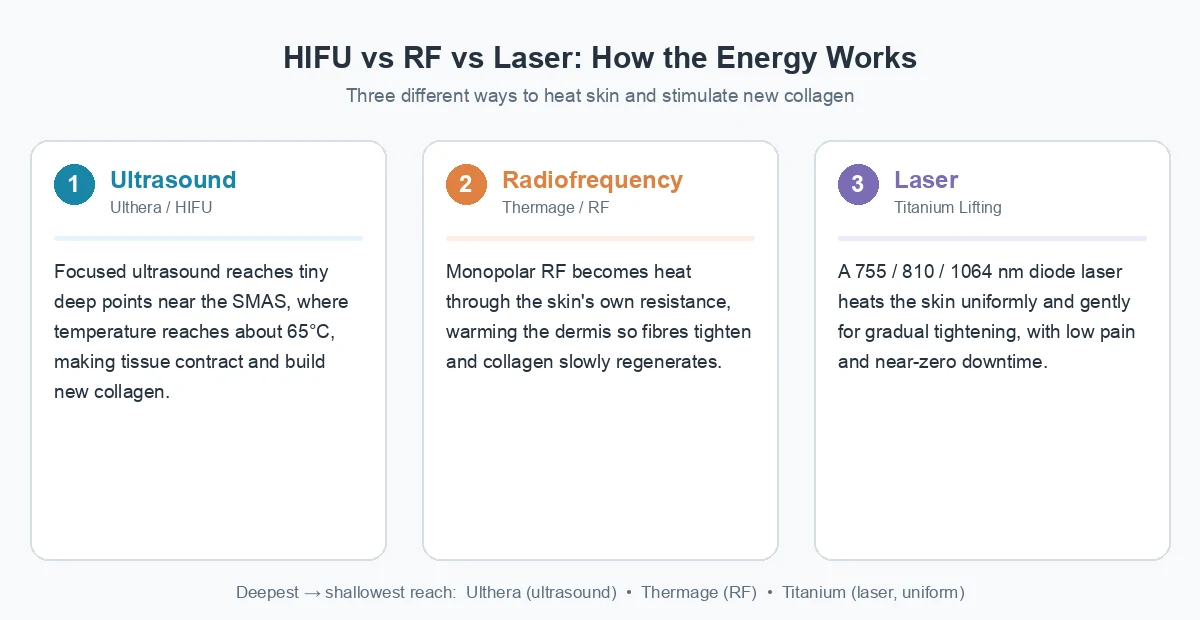
The short version of Ulthera vs Thermage is this: Ulthera uses micro-focused ultrasound (HIFU) to heat the deep SMAS support layer, while Thermage uses monopolar radiofrequency (RF) to tighten the dermis closer to the skin surface. Titanium Lifting adds a third option — a multi-wavelength (755/810/1064nm) laser that heats the skin evenly with low pain and near-zero downtime.
I am Dr. Lee Sung-wook, a board-certified plastic surgeon in Seoul. In our clinical experience, patients make far better decisions once they stop thinking in brand names and start thinking in energy and depth. This guide compares all three honestly — including where an energy device simply cannot replace surgery.
Table of Contents
Ulthera vs Thermage vs Titanium Lifting: The Quick Answer
Here is the whole comparison in one breath. The core difference is energy type and depth — not the brand name:
- Ulthera = micro-focused ultrasound (HIFU) that heats the deep SMAS layer. Best for deeper jawline and neck sagging.
- Thermage = monopolar radiofrequency (RF) that warms the dermis. Best for early laxity, skin texture and pores.
- Titanium Lifting = a multi-wavelength diode laser (not RF) that heats the skin uniformly. A gentler middle-ground with low pain and near-zero downtime.
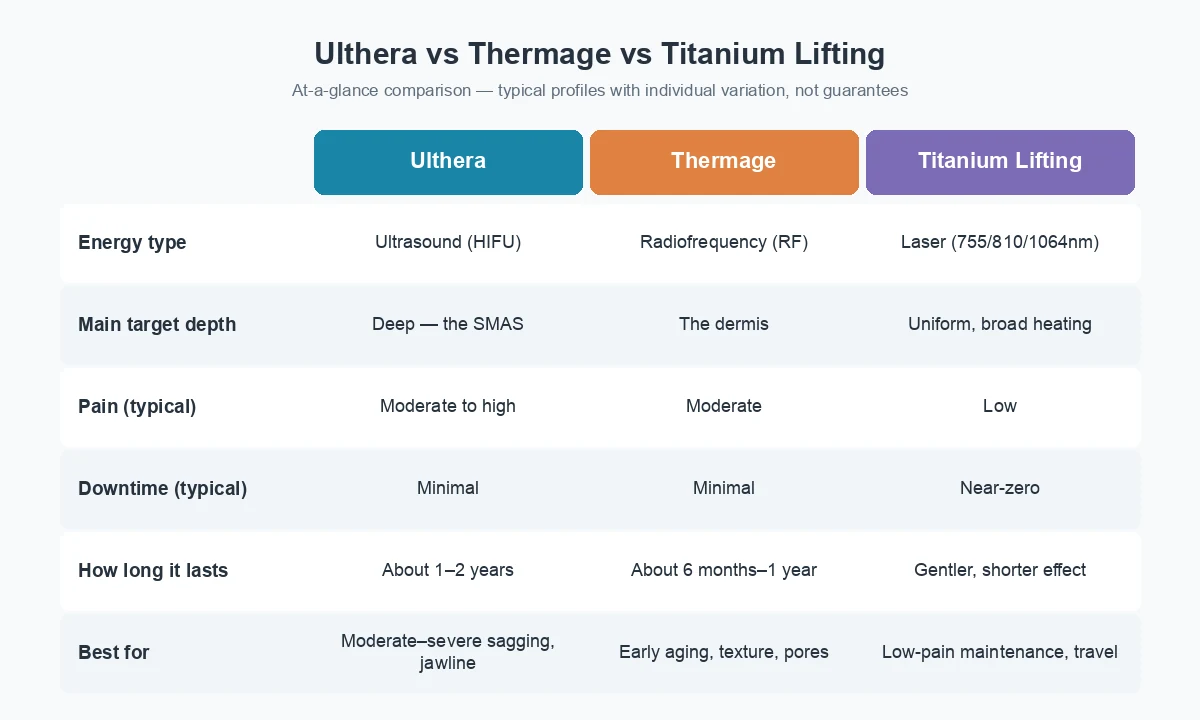
So when people frame it as Thermage vs Ultherapy, the honest answer is that neither is universally “better” — they simply work at different depths with different energy. In other words, the whole Ulthera vs Thermage debate is really a question about ultrasound versus radiofrequency. Here is an at-a-glance table you can screenshot.
| Ulthera | Thermage | Titanium Lifting | |
|---|---|---|---|
| Energy type | Ultrasound (HIFU) | Radiofrequency (RF) | Laser (755/810/1064nm) |
| Main target depth | Deep — SMAS | Dermis | Uniform, broad heating |
| Pain (typical) | Moderate to high | Moderate | Low |
| Downtime (typical) | Minimal | Minimal | Near-zero |
| How long it lasts | ~1–2 years | ~6 months–1 year | Varies; gentler effect |
| Best for | Moderate–severe sagging, jawline | Early aging, texture, pores | Low-pain maintenance, travel |
How Each One Works: Ultrasound vs Radiofrequency vs Laser
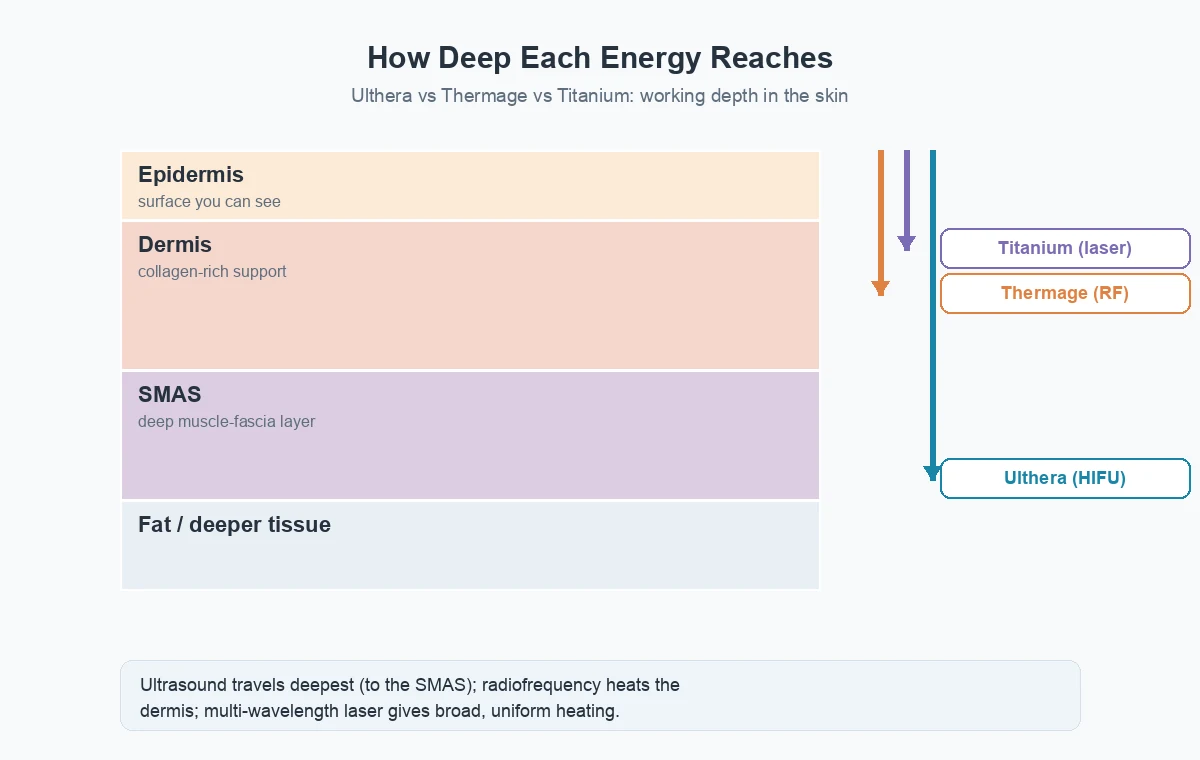
To really understand the Ulthera vs Thermage question, it helps to picture the layers of your skin. On top is the epidermis (the surface you can see). Beneath it is the dermis (the thicker, collagen-rich layer). Deeper still sits the SMAS — the layer of muscle and fascia that a surgical facelift physically lifts. Each device targets a different one of these layers.
Ulthera (HIFU): micro-focused ultrasound to the SMAS
On the ultrasound side of this comparison, Ulthera delivers micro-focused ultrasound to tiny focal points deep in the dermis and the SMAS, where the temperature reaches roughly 65°C. That focused heat creates microscopic thermal-coagulation points — think of them as pinpoint “contraction dots.” The tissue tightens right away, and over the following months your body lays down fresh collagen (a process called neocollagenesis) to rebuild support.
Medical texts describe HIFU as the deepest-reaching non-surgical modality, precisely because ultrasound energy travels farther through tissue than laser or RF. That is why Ulthera is the go-to for deeper jawline and neck laxity. If you want the mechanism in more detail, we cover it in the science of Ultherapy and HIFU.
Thermage (RF): monopolar radiofrequency in the dermis
On the radiofrequency side, Thermage works differently. Its monopolar radiofrequency turns into heat through your skin’s own natural resistance, mainly within the papillary and mid-to-upper dermis — in other words, closer to the surface than Ulthera reaches. As that layer warms, the fibrous strands and retaining ligaments shrink and tighten for an immediate firming effect, followed by gradual collagen regeneration.
Because RF spreads its warmth broadly and evenly, it does more than tighten: clinical literature notes it also improves skin texture, pore appearance and overall elasticity. That broad, even heating is exactly why Thermage tends to suit early aging rather than deep structural sagging.
Titanium Lifting: multi-wavelength laser (not RF)
Titanium Lifting is the one most often misunderstood, so let me be precise: it is a laser platform, not radiofrequency. It combines three wavelengths — 755nm, 810nm and 1064nm — to heat the skin uniformly and gradually. The result is gentle bulk heating that stimulates collagen for tightening, lifting and a brighter tone, with low pain and near-zero downtime. This is exactly why Titanium widens the classic two-device choice into a three-way one.
Think of the clean three-way picture this way: Ulthera is ultrasound (deepest), Thermage is RF (mid-dermis), and Titanium is laser (uniform and gentle). You can read the full device details on Titanium Lifting at MINE, and the deep HIFU explanation on Ulthera at MINE. According to peer-reviewed dermatology literature, matching energy to depth — rather than chasing a brand — is what produces sensible, realistic results.
Depth, Pain, Downtime & Results: A Side-by-Side Comparison
Now let’s put these two devices side by side, adding Titanium as the third reference point. Everything below is a typical range that varies from person to person — never a promise.
Which reaches deepest — and why depth matters
When you compare Ulthera vs Thermage, depth is the whole story. HIFU acoustic energy penetrates deeper into tissue than either laser or radiofrequency, forming new collagen across the upper, middle and lower dermis. Radiofrequency, by contrast, concentrates its new collagen in the shallower papillary and upper-to-mid dermis. Laser-based Titanium sits in between, producing broad, uniform heating.
In plain terms: the deeper and heavier the sagging, the more a depth-reaching tool like Ulthera makes sense. For surface-level dullness, fine texture and early looseness, a shallower, even heat like Thermage often fits better.
Pain and downtime compared
Pain is often the deciding factor between these two devices. Because Ulthera concentrates energy deep at the SMAS, it tends to feel the most intense of the three, though numbing and adjustable settings keep it tolerable. Thermage is usually moderate. Titanium laser lifting is generally the most comfortable. Downtime for all three is minimal — you may see temporary redness or mild swelling, but most people return to normal activity quickly, which matters if you are timing a trip to Korea.
How long results last
Longevity is another key part of the Ulthera vs Thermage comparison. Here is a quick summary: Ulthera results typically build gradually over about 2 to 3 months and last roughly 1 to 2 years, while Thermage results last about 6 months to 1 year, with individual variation. Titanium offers a gentler effect suited to comfortable maintenance. None of these is permanent — collagen changes with time — so occasional maintenance sessions help sustain the result.
As a rough planning guide, many patients revisit a deep HIFU treatment once every year or two, while a gentler laser like Titanium can be repeated more often as light upkeep. Your own timeline depends on your age, skin quality and how quickly your collagen turns over — which is why we set a personalized schedule rather than promising a fixed calendar that applies to everyone.
Which Skin-Tightening Treatment Is Right for You?
Rather than crowning a single “winner,” it is more useful to match your main concern to the right energy. That is really what the Thermage vs Ultherapy debate comes down to in practice.
By concern: early laxity vs moderate-to-severe sagging
When you reframe the choice as a match between your concern and the right energy, the decision becomes much simpler:
- Early aging, texture, pores, mild looseness → broad, even RF-style heating (Thermage territory).
- Deeper jawline and neck laxity → depth-reaching HIFU (Ulthera territory).
- Want the lowest pain and minimal downtime → uniform laser heating (Titanium Lifting).
One nuance worth understanding in any HIFU vs RF skin tightening decision is that skin quality and structural support are two different problems. Radiofrequency and laser heating mainly polish the surface layer — tone, texture and mild firmness — whereas focused ultrasound targets the deeper scaffolding that holds the lower face and neck. Many people actually have a mix of both concerns at once, which is why the honest recommendation is often a tailored combination rather than a single device doing everything.

For international patients planning a Korea trip
If you are traveling for treatment, two practical factors matter as much as the mechanism: downtime and the number of sessions you can realistically fit into your visit. A low-downtime option can be easier to schedule around flights and sightseeing. We break down the practical side in our guide to Ultherapy in Korea: cost, recovery and results.
Most importantly, suitability is not something a table can decide for you. A hands-on assessment by a board-certified surgeon — looking at your skin quality, the pattern of your sagging and your goals — is what determines the right plan. Reputable authorities such as ISAPS emphasize individualized, evidence-based care over one-size-fits-all promises.
Worth noting: both HIFU/ultrasound and RF devices are widely used and have FDA-cleared systems for skin tightening. MINE offers Ulthera and Titanium Lifting; we do not perform Thermage, so we discuss it here purely as an objective benchmark. If you are weighing your own case, we invite you to compare it against Ulthera vs thread lifts and other procedures as well.
Can You Combine Ulthera and Titanium Lifting?
Yes — and this is where the two-device framing opens up, because Ulthera and Titanium can actually be paired. Combining them can be a smart strategy precisely because they work at different depths. A deep HIFU lift with Ulthera addresses the structural SMAS layer, while a gentle, uniform laser like Titanium works on broader skin quality and comfort. Used thoughtfully in one plan, they can complement each other rather than overlap.
That said, combining treatments is not automatically “more is better,” and there are no additive guarantees. What actually works for you is decided in consultation. For the full picture, see our dedicated guide on combining Titanium and Ulthera.
Honest Limits: Energy Devices vs a Surgical Lift
Here is the candid part that thin comparison pages tend to skip. Energy-based devices — HIFU, RF and laser alike — are genuinely valuable, whether on their own or alongside other treatments. But they do not achieve the same impact on facial aging as a surgical face or neck lift. If your sagging is significant, no energy device will fully replace surgery, and it would be dishonest to imply otherwise.
This is the caveat that the usual Ulthera vs Thermage articles rarely state plainly. The medical literature is clear on this point, and so am I with my own patients: these devices shine for early-to-moderate laxity and for maintenance, not as a substitute for a facelift when structural drooping is advanced. Setting realistic expectations up front is part of good care.
So how do you know which camp you fall into? A simple at-home check can hint at the answer: if you gently lift the sagging tissue along your jawline with a fingertip and it makes a dramatic difference, that kind of structural descent usually points toward surgery for the fullest correction. If your main complaints are fine looseness, dullness or early jowling, non surgical skin tightening is often a reasonable and lower-risk place to start. The only way to be sure, of course, is an in-person exam — a photo or a mirror can only take you so far.
As with any procedure, side effects are possible. Temporary redness, swelling, tenderness and occasional bruising can occur, and rarer nerve-related effects have been reported. A proper consultation screens for who is and is not a good candidate — which is exactly why a personalized assessment matters more than any online comparison, including this one.
Frequently Asked Questions
Which is better, Ulthera or Thermage?
In the Ulthera vs Thermage decision, neither is universally better — they use different energy at different depths. Ulthera (HIFU/ultrasound) reaches the deep SMAS and suits moderate-to-severe sagging and jawline lift, while Thermage (RF) works in the dermis and suits early laxity, texture and pores. The right choice depends on your skin and goals, which a board-certified surgeon can assess.
How is Titanium Lifting different from Ulthera and Thermage?
Titanium Lifting uses a multi-wavelength (755/810/1064nm) diode laser for uniform, gradual heating with low pain and near-zero downtime — a gentle middle-ground. By contrast, Ulthera uses focused ultrasound aimed at the deep SMAS, and Thermage uses monopolar radiofrequency in the dermis. It is a laser, not RF. Because it is so comfortable, Titanium is a popular choice for first-timers and for patients who prefer steady, low-key maintenance over one intense session.
How long do Ulthera and Thermage results last?
Their timelines differ, typically with individual variation: Ulthera results build over about 2 to 3 months and last roughly 1 to 2 years, while Thermage shows some immediate effect and lasts about 6 months to 1 year. Neither is permanent, and periodic maintenance sessions can help extend the results.
Is Ulthera or Thermage more painful?
In the pain comparison, Ulthera tends to feel more intense because its energy reaches the deep SMAS, whereas Thermage is usually moderate. Titanium laser lifting is generally the most comfortable of the three. Numbing cream and adjustable settings are used to keep any discomfort within a tolerable range.
Can non-surgical skin tightening replace a facelift?
No. Energy devices such as HIFU, RF and laser tighten skin and stimulate collagen, but they do not match a surgical face or neck lift for significant sagging. They are best for early-to-moderate laxity or as a maintenance option. In practice, the two approaches are not rivals so much as tools for different stages: many patients use energy devices in their 30s and 40s to slow visible aging, then consider surgery later if deeper sagging develops. A board-certified surgeon can advise what genuinely fits your case.
Book a Personalized Consultation
Ultimately, the right way to settle the Ulthera vs Thermage question for your face is a proper assessment, not a checklist. No online comparison, however careful, can examine your skin in person. At MINE, our board-certified team can evaluate your skin and recommend whether Ulthera, Titanium Lifting, or a combination best suits your goals. We welcome international patients and are happy to arrange a free, no-pressure consultation — simply reach out to schedule yours.
Written and medically reviewed by Dr. Lee Sung-wook, board-certified Plastic Surgeon (Korea), MINE Plastic Surgery & Dermatology.
※ This content is for informational purposes only and does not replace professional medical advice, diagnosis, or treatment. Individual results may vary, and side effects may occur. Please consult with a board-certified plastic surgeon for personalized advice.