EN
EN


If you have been researching skin lifting and keep landing on the same question — “should I just have it done while I’m in Seoul?” — you are not alone. Every week, international patients ask me whether traveling for this treatment is worth it, what it really costs here, and whether they can still enjoy their trip afterward. This guide answers those questions honestly, from a board-certified surgeon’s chair.
Ultherapy in Korea is a non-invasive skin-tightening treatment that uses microfocused ultrasound (MFU) to lift the lower face, jawline and neck — performed at Korean clinics that combine high operator volume with authentic Ulthera devices. In my clinical experience, the reason patients fly here is not the technology itself (the device is the same worldwide) but how it is used: who holds the handpiece, how carefully your candidacy is assessed, and how the treatment fits into a single, well-planned trip.
Rather than re-explaining the deep science you have probably already read elsewhere, this article focuses on the part that is genuinely Korea-specific: cost factors here, a recovery timeline built for travelers, realistic results, and how to choose a clinic. For the full mechanism, I will point you to our dedicated deep-dives along the way.
What Is Ultherapy in Korea? (And Why Patients Travel for It)
The 40-second answer: how Ultherapy works
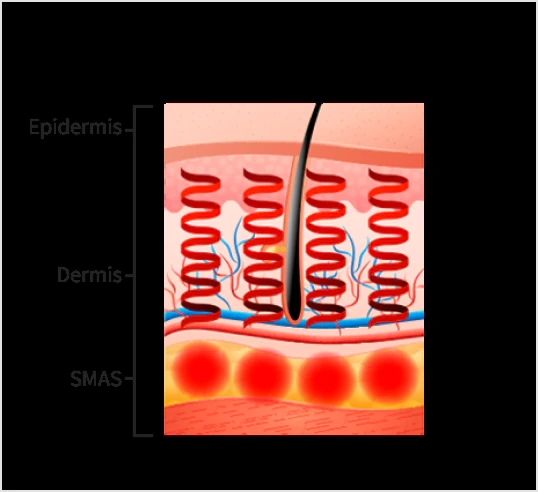
Here is the simplest honest explanation. Ultherapy delivers focused ultrasound energy past the surface of your skin to a deeper support layer called the SMAS (the sheet of muscle and fascia that holds your face up, the same layer surgeons tighten in a facelift). At tiny focal points there, the tissue briefly reaches about 65°C, creating microscopic heat spots. Your skin surface is left untouched — the energy is aimed deep, not on top.
Those heat spots do two things over time. First, existing collagen contracts a little right away, giving a subtle early tightening. Then, over the following months, your body treats each spot like a small repair site and builds fresh collagen — which is why the lift appears gradually rather than overnight. If you want the full biology, our guide on how Ultherapy stimulates collagen covers it in depth, so I will keep it brief here.
Dr. Lee’s Key Point: Ultherapy works deep where surgeons work — but without a single incision.
Why Korea has become a hub for Ultherapy
Korea did not invent microfocused ultrasound, but our clinics perform it at a very high volume. That density of cases matters: an operator who treats this layer day after day develops a feel for where energy helps and where it is wasted. Korea also has a mature dermatology-and-travel ecosystem, so it is realistic to combine a consultation, the session, and even complementary treatments inside one short visit.
One honest caveat before we go further. Ultherapy tightens and lifts mildly. Medical literature is clear that microfocused ultrasound was designed as a non-surgical option and does not match the result of a surgical face or neck lift when sagging is advanced. I would rather you hear that from me now than feel disappointed later.
Dr. Lee’s Key Point: Choose Korea for operator experience, not for a “stronger” machine — the device is the same everywhere.

How Much Does Ultherapy Cost in Korea? (Price Factors, Not Guarantees)
This is the question I am asked most, and also the one I cannot answer with a single number. The cost of Ultherapy in Korea is not a fixed price tag — it is a sum of choices made for your face. What I can do is explain exactly what drives that figure, so you can read any quote intelligently.
What actually drives the price (lines/shots, area, device)
Three variables move the price more than anything else. The first is the number of lines or shots delivered — more energy lines over a wider area means a higher cost. The second is the treatment area: a focused lower-face-and-jawline session is different from a full-face-plus-neck plan. The third is whether Ultherapy is combined with other treatments in the same visit.
There is also a technical lever worth knowing about. The operator can target three different depths using different probes — about 1.5 mm, 3.0 mm and 4.5 mm beneath the surface — choosing the deepest (4.5 mm) to reach the SMAS and shallower ones for the dermis. The depths and number of lines chosen for your plan affect both the result and the price, which is why two patients rarely pay the same.
Dr. Lee’s Key Point: Ask what you are paying for — lines, area, depths — not just the total.
Korea vs. home country: why patients compare
Many international patients tell me they first considered Korea after comparing it with quotes back home. That comparison is reasonable, but I encourage you to compare on value rather than on a headline price: operator experience, device authenticity, and an honest assessment of whether you are even a good candidate. The most useful number is the one a specialist gives you after seeing your skin in person, so I would rather invite you to a consultation than quote a figure that may not apply to you.
Red flags: “too cheap” and counterfeit HIFU devices
A price that looks dramatically low is itself information. Genuine Ulthera (made by Merz) includes a real-time ultrasound view — the operator can actually see the target layer on a screen before releasing energy, which is a meaningful safety and precision feature. Grey-market or counterfeit HIFU devices that skip this visualization are a real risk in any country, so confirming the device is authentic should be on your checklist before the cost ever is.
Dr. Lee’s Key Point: An unusually cheap “HIFU lift” may not be Ultherapy at all — verify the device first.

Ultherapy in Korea Recovery: A Timeline for Travelers
For people planning a trip, this is the most welcome news in the article: Ultherapy has essentially no downtime. There is no surgical wound to heal, so the recovery question is really a trip-planning question. Here is what to expect day by day.
Day-by-day: what to expect after treatment
Right after the session (Day 0), most travelers walk out and return to sightseeing the same day. Some mild redness, slight swelling and tenderness are normal, and these transient effects typically settle within 1–3 days. A few people notice temporary changes in skin sensation, such as mild numbness or tingling, that can last a few days. Rarely, minor bruising can occur. None of these usually stop you from enjoying your visit.
Dr. Lee’s Key Point: No incision means no surgical downtime — but plan for one quiet evening, just in case.
How long should you stay in Korea?
Because there is no surgical recovery, the treatment fits comfortably into a short trip. Practically, I suggest allowing a buffer day for your consultation and assessment, then the treatment session itself. You can typically resume your itinerary the same day as the session. Many patients fold it into a longer holiday without rearranging a single plan.
Aftercare while traveling
Good aftercare on the road is mostly common sense: gentle skincare, sun protection, and hydration. I deliberately keep this section short because the details deserve their own space — our complete before-and-after care guide walks through exactly what to do before and after, which is handy to read before you fly.
Dr. Lee’s Key Point: Pack sunscreen — sun protection matters more than anything fancy after treatment.

Realistic Ultherapy Results: What to Expect (and What Not to)
Setting expectations is, to me, the most important part of any consultation. Ultherapy gives real but measured results, and understanding the timeline prevents the most common disappointment: expecting an instant facelift.
The gradual collagen timeline (2–6 months)
Think of it in two phases. Phase one is immediate: the heat gently contracts existing collagen, so some patients notice a slight tightening soon after. Phase two is the real work — your body builds new collagen at each treated spot, and this remodeling unfolds slowly. In general, results build gradually over the first 2–3 months and typically peak around 3–6 months after treatment. Individual results vary, and that gradual curve is normal, not a sign that “it didn’t work.”
Any specific efficacy figures you see quoted are most accurately understood as manufacturer- or clinical-study-cited, with the honest caveat that individual results vary. For readers who want to read the actual studies, we summarize the clinical evidence behind Ultherapy results separately so I do not have to overload this page.
Dr. Lee’s Key Point: If someone promises an overnight lift, be skeptical — real collagen takes months.
Who is a good candidate — and who isn’t
Ultherapy is most suitable for early-to-moderate laxity of the lower face, jawline, neck and brow — the stage where skin has started to soften but has not heavily descended. If that describes you, you are likely a good candidate. If your concern is significant, heavy sagging, your expectations and the treatment will not match, and I will tell you so directly.
When Ultherapy is NOT enough
For advanced sagging, a surgical lift gives a result that microfocused ultrasound simply cannot match — and pretending otherwise would do you a disservice. In those cases I walk patients through when a surgical facelift is the better choice so they can self-select honestly. Sometimes the most caring recommendation is to not do Ultherapy.
Dr. Lee’s Key Point: The right treatment depends on your degree of laxity — not on what is trending.

Choosing a Clinic for Ultherapy in Korea
Since the device is the same everywhere, the clinic decision is really a decision about people and process. Two variables decide your outcome more than any brochure: operator experience and patient selection. A skilled operator who places energy precisely — and who is willing to turn you away if you are not suited — is worth far more than any marketing claim.
Operator experience and case volume
High case volume is one of Korea’s genuine advantages, but only when it sits behind a board-certified specialist who assesses you individually. Volume builds the operator’s judgment about where to treat and where not to; specialist training keeps that judgment safe. Ask who will actually perform your treatment, not just whose name is on the door.
Authentic device + combination protocols
Confirm the device is genuine Ulthera with its real-time ultrasound view. When appropriate — and only when appropriate — Korean clinics can combine Ultherapy with radiofrequency tightening or thread lifting in a single consultation, which is convenient for a one-trip plan. You can read more about the procedure and book a consultation through Ultherapy at MINE Clinic in Seoul.
What to ask in your consultation
Bring this short checklist to any clinic you consider:
- Is the device a genuine Ulthera unit with real-time ultrasound visualization?
- How many lines or shots are planned for my treatment, and over which areas?
- Who, specifically, will perform the procedure?
- What is a realistic result for my degree of laxity?
For internationally recognized standards on non-invasive aesthetic care, the ISAPS is a useful reference point when you evaluate any clinic.
Dr. Lee’s Key Point: A clinic willing to say “you may not need this” is usually one worth trusting.
Frequently Asked Questions About Ultherapy in Korea
How much does Ultherapy cost in Korea?
There is no fixed price. The cost depends on the number of shots or lines delivered, the treatment area (lower face, full face, or neck), and whether it is combined with other treatments. Because every face is different, the most reliable figure comes from a consultation rather than an online quote.
How long should I stay in Korea for Ultherapy?
Because Ultherapy has essentially no downtime, it fits within a short trip. Allow at least one day for consultation and assessment, plus the treatment session itself. You can typically resume sightseeing the same day as the procedure, so it rarely disrupts a travel itinerary.
Is Ultherapy recovery really downtime-free?
Largely, yes — there is no surgical recovery because the skin surface is not broken. Transient redness, mild swelling and tenderness usually settle within 1–3 days, and occasional temporary changes in skin sensation can last a few days. Rare minor bruising can occur but is uncommon.
When do Ultherapy results show, and how long do they last?
Results build gradually as new collagen forms — usually over 2–3 months, peaking around 3–6 months after treatment. Individual results vary. A single course does not stop natural aging, so a specialist may discuss periodic maintenance to help sustain the effect over time.
Can Ultherapy replace a facelift?
No. Ultherapy tightens and lifts mildly and is most suitable for early-to-moderate laxity. For advanced sagging, a surgical facelift produces a result that Ultherapy cannot match. A board-certified specialist can advise which option genuinely suits your degree of laxity.
Planning Ultherapy in Korea? Let’s Talk First
If you are weighing a trip, the most useful next step is not a price quote — it is an honest assessment of whether Ultherapy is right for you. We are happy to review your goals, confirm your candidacy, and explain exactly what a session would involve, with no pressure. You can learn more and request a free consultation through Ultherapy at MINE Clinic in Seoul, or contact the clinic directly via KakaoTalk, WhatsApp, or phone at +82-2-516-1175.
※ This content is for informational purposes only and does not replace professional medical advice, diagnosis, or treatment. Individual results may vary, and side effects may occur. Please consult with a board-certified plastic surgeon for personalized advice.
Written and reviewed by Dr. Lee Sung-wook, Lead Director (Board-Certified Plastic Surgeon), MINE Plastic Surgery & Dermatology.