EN


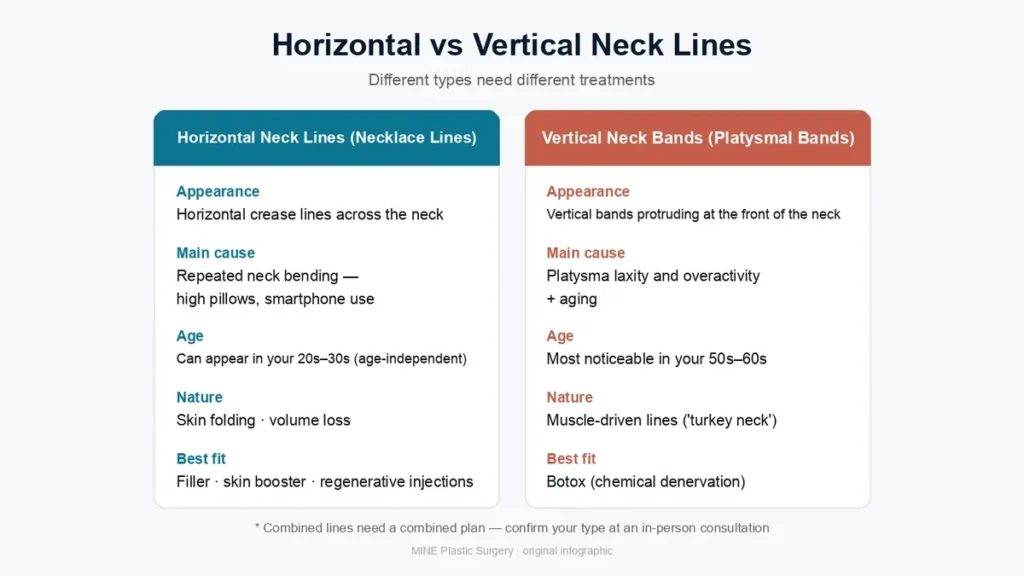
Neck Botox vs filler is a choice between two injections that treat different neck lines: Botox relaxes the platysma muscle that creates vertical neck bands, while filler restores volume in horizontal necklace lines caused by skin folding. The right choice depends less on the product and more on which kind of line you have.
In consultations, I often hear, “Can Botox get rid of my neck lines too?” What many patients don’t realize is that a good share of the people asking for neck Botox actually have lines that Botox barely touches. Neck lines fall into two broad types, horizontal and vertical, and because they form for different reasons, they respond to different treatments.
Drawing on my clinical experience as a board-certified plastic surgeon, I’ll walk you through the neck Botox vs filler question in four steps:
- How to tell horizontal lines from vertical bands
- Why Botox works on muscle-driven bands, and why filler suits folded skin
- The right order if you combine the two
- Side effects, how long results last, and where injections reach their limit
- Neck Botox vs Filler: Two Line Types, Two Different Causes
- Who Is a Good Candidate for Botox for Neck Bands — and Who Isn’t
- Combining Neck Botox and Filler: Why Order Matters
- Neck Botox vs Filler: Duration, Downtime and Repeat Schedule
- Side Effects to Know: From Bruising to Swallowing Difficulty
- When Injections Aren’t Enough: Moving to Lifting or Platysmaplasty
- Frequently Asked Questions About Neck Botox vs Filler
- Not Sure Which Type You Have? Get Your Neck Assessed
Neck Botox vs Filler: Two Line Types, Two Different Causes
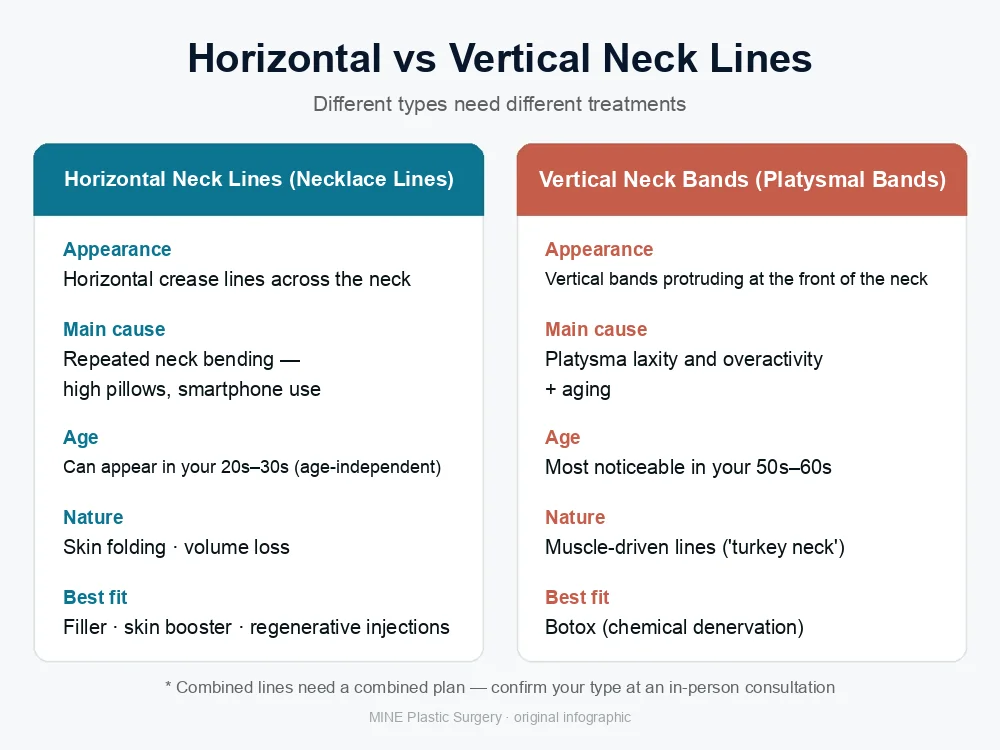
The first step in any neck consultation is simple: is the line that bothers you running across your neck, or down it? The two form in completely different ways, so treating them with the same injection often leads to disappointment. That is why the neck Botox vs filler decision starts with line type, not with the product.
Horizontal neck lines (necklace lines): skin folds, not age alone
Horizontal lines are the creases that circle the neck, often called necklace lines. Most people blame age, but horizontal neck lines can form from repeated neck bending alone, such as sleeping on a high pillow or looking down at a phone for hours. They can appear in your 20s and 30s.
By nature, these are skin-and-volume lines. Every time the skin folds in the same place, the dermis (the deeper, supportive layer of the skin) loses a little elasticity and volume, and the fold slowly sets into a groove. If you want to read more about why they form and how to slow them down at home, see our guide to the causes and home care for neck wrinkles.
Vertical neck bands (platysmal bands): the muscle behind “turkey neck”
Vertical lines are cords that stand out down the front of the neck, and they usually become prominent in your 50s and 60s. They come from the platysma, a thin sheet of muscle that covers the front of the neck like a broad strap. With age, the front edges of this muscle can separate and loosen, while parts of it contract more strongly than before. Combined with skin that has lost some firmness, the muscle edges show through as bands.
This is the look people often call “turkey neck.” Cosmetic dermatology textbooks note that platysmal bands and vertical neck lines tend to track chronological age fairly closely, especially in people with a lot of past sun exposure.
A 10-second mirror check: which type do you have?
Before deciding on neck Botox vs filler, try this quick check in front of a mirror in good light:
- Clench your teeth and pull the corners of your mouth down, as if grimacing. If cords pop up down the front of your neck and soften again when you relax, those are muscle-driven bands.
- Relax and tilt your head slightly down. Lines that circle the neck at rest and deepen when you look down are fold-driven.
Many people see a bit of both, which is why neck Botox vs filler is often a combined plan. Treat this check as a way to get oriented in the neck Botox vs filler decision, not as a diagnosis. Skin thickness, laxity and muscle activity all affect the plan, and those need to be assessed in person.
Dr. Lee’s Key Point: Horizontal lines come from skin folding; vertical bands come from muscle. Different cause, different tool.
Who Is a Good Candidate for Botox for Neck Bands — and Who Isn’t
Once you know your line type, the neck Botox vs filler question becomes much clearer, because each injection fits one type of line far better than the other.
How chemical denervation softens platysmal bands
Botulinum toxin (Botox) temporarily blocks the signal that tells a muscle to contract. Doctors call this “chemical denervation,” but in plain terms, it lets a tense, overactive muscle relax for a while. Because vertical bands are created by the platysma contracting and bunching up, relaxing that muscle softens the bands. That muscle-relaxing mechanism is what sets Botox apart from filler.
This is not a new idea. Using botulinum toxin for vertical neck bands was first reported in the plastic surgery literature in 1999, and it has since become a standard approach. Aesthetic dermatology texts describe platysmal bands as the main target for toxin in the neck. You can read general patient information in the ASPS patient information on botulinum toxin.

Where neck Botox works well vs where it barely helps
Here is where the comparison gets interesting. Botox for neck bands works because those bands are muscle-driven. Horizontal lines, on the other hand, are caused by folded skin and lost volume, not by muscle contraction. Relaxing the muscle doesn’t refill a groove that has already formed in the skin.
That doesn’t mean Botox does nothing for horizontal lines. Plastic surgery textbooks describe necklace lines as improving only minimally when toxin is placed just above and below them. Some patients see slight softening, but results vary, and Botox alone is rarely enough for a deep crease.
Textbooks also describe who tends to respond well. According to plastic surgery textbooks, good candidates for Botox for neck bands are relatively young, roughly 35 to 45 years old, with good skin elasticity and little excess fat or loose skin.
Signs filler is the better match: horizontal folds and thin skin
Because horizontal neck lines come from folding and volume loss, treatments that add volume or improve the dermis fit the mechanism better. This is where filler comes out ahead in the neck Botox vs filler comparison. Filler for horizontal neck lines, such as hyaluronic acid (HA, a gel similar to a substance your skin already makes) or calcium hydroxylapatite (CaHA, a mineral-based gel that also stimulates collagen), fills the groove from beneath so the surface lies smoother. For an overview of how these products work, see the ASPS overview of dermal fillers.
If you would rather improve the skin itself than add volume, skin boosters or regenerative injections (injections that help the dermis rebuild a healthier collagen environment) are another option. At MINE, our Neck Wrinkle Eraser program combines elasticity lasers, regenerative injections and hydrating skin-booster injections to treat horizontal and vertical lines together without surgery.
Dr. Lee’s Key Point: Botox is made for muscle-driven lines, not for folded skin.
Combining Neck Botox and Filler: Why Order Matters
“Can I have Botox and filler at the same time?” is one of the questions I’m asked most. The short answer is yes, but the order matters. In practice, neck Botox vs filler is often not an either-or choice at all; many patients need both, in a planned sequence.
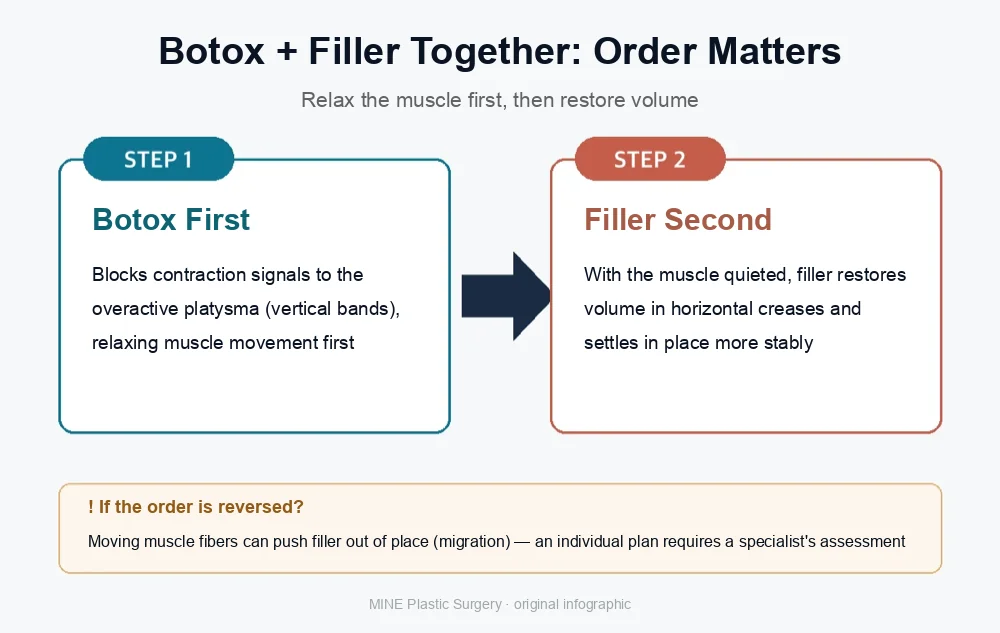
Step 1: relax the platysma with toxin first
When toxin and filler are given on separate visits, the aesthetic medicine literature recommends injecting the toxin first. The reason: if filler goes in while the muscle underneath is still very active, moving muscle fibers can push it out of place. Textbooks describe this principle for the chin, where an overactive muscle can displace filler, and the same logic is widely applied elsewhere. There is no neck-specific trial behind it, but it is a sound general rule.
For the bands themselves, the technique is precise. Plastic surgery textbooks describe asking the patient to tense the neck so the band stands out, holding it gently between the thumb and index finger, and injecting along it from just below the jawline downward. A typical session targets about 2 to 4 main platysmal bands rather than the whole neck.
Step 2: fill horizontal grooves once the muscle is quiet
Once the muscle has calmed down, filler is placed into the horizontal creases. With less movement underneath, the filler settles more evenly and stays where it is meant to be. This sequence is the practical answer when neck Botox vs filler turns out to be “both.” Because neck skin is thin, I place it in small amounts at a carefully chosen depth.
Planning combined (horizontal + vertical) lines
Many patients have both types at once. In that case, I use toxin for the vertical bands and filler or regenerative injections for the horizontal grooves, keeping the Botox-first order. Because line depth, skin thickness and muscle activity differ, the combined plan is designed individually at an in-person consultation.
Dr. Lee’s Key Point: If your neck Botox vs filler plan includes both: Botox first, filler second.
Neck Botox vs Filler: Duration, Downtime and Repeat Schedule
When comparing neck Botox vs filler over time, remember that neither injection is permanent. Neck Botox usually lasts about 3 to 4 months, while neck filler lasts about 6 to 12 months depending on the product, and both vary from person to person. The table below sums up the neck Botox vs filler comparison at a glance.
| Neck Botox | Neck filler | |
|---|---|---|
| Matching line type | Vertical platysmal bands | Horizontal necklace lines |
| How it works | Temporarily relaxes the overactive platysma muscle | Fills the folded groove from beneath |
| Typical duration | About 3–4 months | About 6–12 months, depending on product |
| Common side effects | Bruising, swelling, asymmetry; rarely swallowing or voice changes | Bruising, swelling, visible filler or small lumps in thin skin |
| Repeat cycle | As the effect fades, based on your condition | As the effect fades, based on your condition |
How long neck Botox lasts (about 3–4 months)
As the nerve signal to the muscle gradually recovers, the bands slowly return. Most patients plan a repeat session when they notice the bands reappearing, rather than on a fixed calendar. That shorter cycle is one practical difference in neck Botox vs filler planning.
How long neck filler lasts (about 6–12 months)
Filler breaks down slowly in the body, so the groove gradually becomes visible again. Like Botox, filler is topped up according to how your lines look over time. If you weigh neck Botox vs filler on maintenance alone, filler generally needs fewer visits a year, but your line type should still drive the choice.
What the first days after injection look like
Downtime is one area where neck Botox vs filler makes little difference: most people return to their usual routine the same day. Mild bruising or swelling at the injection points is common and usually settles on its own. With filler, the treated area may feel slightly firm at first. If you notice anything unusual, such as increasing pain or a change in swallowing, contact your clinic.
Side Effects to Know: From Bruising to Swallowing Difficulty
Non-surgical injections still carry risks, and any honest neck Botox vs filler comparison has to include them. Some apply to both injections, and some are specific to one.
Common: bruising, swelling, asymmetry
The most common issues are bruising and swelling at the injection sites and slight differences between the left and right sides. These are usually temporary.

Filler-specific: visibility and nodules in thin neck skin
Neck skin is thinner than facial skin, so filler is more likely to show through or form small lumps (nodules) if it is placed too superficially or in too large a volume. Filler can also shift away from where it was placed. This is filler’s main drawback in the neck: depth and volume control matter a great deal in the neck, which is why I take a conservative approach here.
Toxin-specific: why dose and depth matter near swallowing muscles
The platysma sits close to deeper neck muscles that help you swallow and speak. If the dose is too high or the toxin is placed inaccurately, it can spread to those muscles. Cosmetic dermatology textbooks note that high toxin doses in the neck can raise complication risk above the benefit. Rarely, this can show up as difficulty swallowing (dysphagia) or a change in the voice. This risk applies only to Botox, since filler does not act on muscle signals.
That is the main reason to choose a doctor who knows neck anatomy in detail. A board-certified plastic surgeon works with the layers of the neck every day and can keep doses conservative and placement precise.
Dr. Lee’s Key Point: Neck injections sit close to swallowing muscles — anatomical skill is the core of safety.
When Injections Aren’t Enough: Moving to Lifting or Platysmaplasty
To be honest, injections can’t fix every neck. Knowing where they stop working matters as much as the neck Botox vs filler choice itself.
What neither Botox nor filler can correct
Neck Botox vs filler is a choice between two tools, and both have limits. Botox only relaxes muscle for a while; it does not tighten skin that has already stretched. Filler adds volume, but it cannot correct heavy, thick muscle bands or loose, sagging skin. Severe vertical bands or significant excess skin, the full “turkey neck” picture, fall outside what injections are designed to treat.
There is one more point from the literature worth knowing. Relaxing the platysma can make the jawline look a little sharper and the angle between the chin and neck slightly more defined, because the muscle no longer pulls the lower face down as much. In older patients with clear skin laxity, however, textbooks describe toxin mainly as an option when surgery is not possible, not as a substitute for it.
A stepwise path: injections → energy lifting → surgery
As a rough guide, neck Botox vs filler covers only the first of three stages:
- Early or mild lines respond to injections such as Botox and filler.
- Moderate loss of firmness may need energy-based lifting, such as Ultherapy (focused ultrasound) or radiofrequency treatments.
- Clear excess skin usually calls for surgery.
For a side-by-side look at every option, see our article comparing all neck wrinkle treatments.
Signs it is time to consider platysmaplasty
It may be time to look at surgical options if:
- your bands are thick and visible even at rest
- your skin hangs loosely under the jaw
- Botox gives you less and less improvement
At that point, neck Botox vs filler is no longer the right question. A platysmaplasty tightens the muscle directly, and we explain the details in our guide to platysmaplasty in Korea.
Dr. Lee’s Key Point: Sometimes injections simply aren’t enough. Being honest about where they stop working is where a good decision starts.
Frequently Asked Questions About Neck Botox vs Filler
How long does neck Botox last?
Neck Botox usually lasts about 3 to 4 months, with individual variation. The effect doesn’t stop suddenly; it fades gradually as the muscle regains its signal, so repeat treatments are planned according to how your bands look.
Does Botox work on horizontal neck lines?
Only minimally. Horizontal lines come from skin folding and lost volume rather than muscle contraction, so Botox alone has clear limits. Filler or regenerative injections fit the mechanism better, and whether to add a little toxin is decided case by case at consultation.
Which comes first, Botox or filler, if I get both?
Botox comes first. Relaxing the platysma before filler is placed helps prevent active muscle from pushing the filler out of position, so it settles more evenly and stays where it was placed.
Can neck Botox affect swallowing or my voice?
Rarely, yes. If the dose is too high or the toxin spreads to deeper neck muscles, it can cause difficulty swallowing or a change in the voice. Conservative dosing and precise placement by a doctor trained in neck anatomy keep this risk low.
What if injections don’t improve my neck lines?
Severe bands or loose skin are beyond what injections can treat. Energy-based lifting or platysmaplasty may be considered instead. Which stage you are at is a decision for an in-person assessment.
Not Sure Which Type You Have? Get Your Neck Assessed
The answer to neck Botox vs filler depends on whether your lines are horizontal, vertical or a mix of both. Above all, only an in-person examination can tell whether non-surgical treatment is enough or whether you need a different approach.
If you are still weighing neck Botox vs filler, I recommend a one-on-one consultation at MINE Plastic Surgery & Dermatology in Seoul for an accurate assessment. You can learn more about our neck wrinkle injection program, request a consultation through our online consultation form, or call us at +82-2-516-1175.
Written and reviewed by Dr. Lee Sung-wook, Board-Certified Plastic Surgeon, MINE Plastic Surgery & Dermatology | 813 Nonhyeon-ro, Gangnam-gu, Seoul | +82-2-516-1175
Sources: Plastic surgery textbooks (botulinum toxin injection techniques for the neck); cosmetic and aesthetic dermatology textbooks (platysmal bands, combined toxin and filler treatment, and complications of neck injections).
※ This content is for informational purposes only and does not replace professional medical advice, diagnosis, or treatment. Individual results may vary, and side effects may occur. Please consult with a board-certified plastic surgeon for personalized advice.