EN


Ultherapy after filler means having Ultherapy (MFU-V, microfocused ultrasound with visualization — a type of HIFU) on a face that already has dermal filler. It is usually possible, but the common advice is to wait at least 2 weeks after your filler injection before the ultrasound session.
Hello, I’m Dr. Lee Sung-wook, a board-certified plastic surgeon at MINE Plastic Surgery & Dermatology in Seoul. A question I hear constantly in consultation is: “I had filler not long ago. Won’t Ultherapy melt it?”
The short answer:
- Ultherapy after filler is usually fine.
- If the filler came first, wait at least 2 weeks.
- If you want both on the same day, Ultherapy goes first and the injections follow.
- Areas that already hold filler are skipped, or the energy and depth are adjusted.
The research on this topic is still small, so I’ll walk you through what is known, what isn’t, and how we plan the order and timing of both treatments in practice. If you are new to the treatment itself, our complete Ultherapy guide covers the basics.
Why Do People Worry About Ultherapy After Filler?
The worry is simple: “Ultherapy uses heat, and there’s filler inside my face. What happens when that heat reaches it?” To understand the risk, we first need to look at where Ultherapy delivers its heat.
Ultherapy heats tiny points at set depths, not the whole skin surface
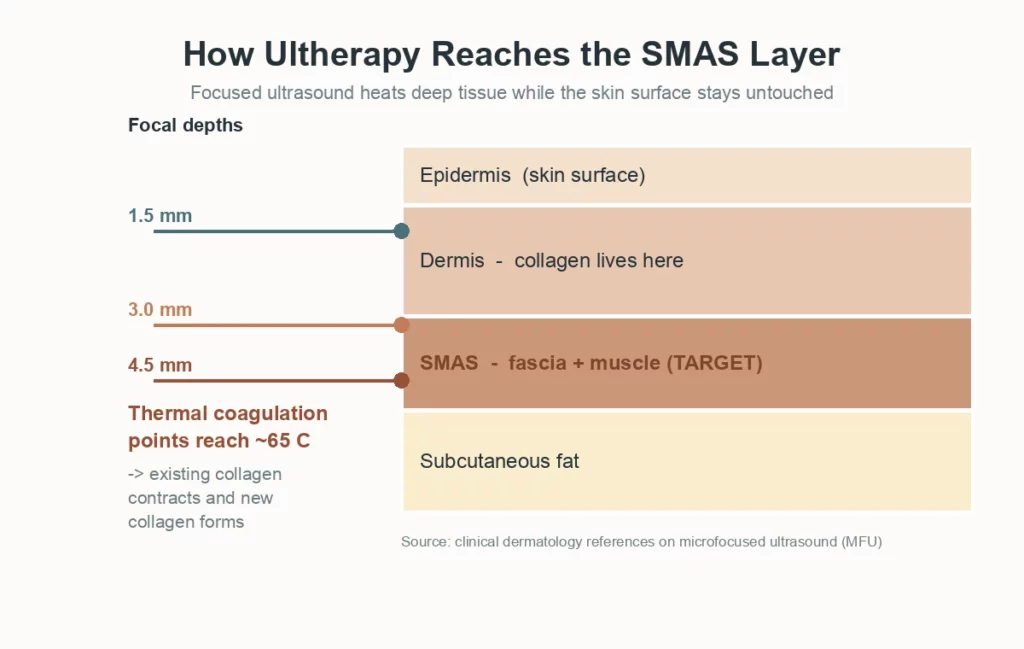
Ultherapy focuses ultrasound energy onto small points beneath the skin, like a magnifying glass gathering sunlight. Medical textbooks describe focused ultrasound as raising tissue at the focal point above roughly 60°C, where proteins coagulate. In practice, Ultherapy creates tiny coagulation points of about 65°C in the dermis and the SMAS (the supportive layer under the skin that holds up fat and muscle). The device was first cleared by the US FDA for lifting the eyebrow (FDA 510(k) clearance for the Ulthera System).
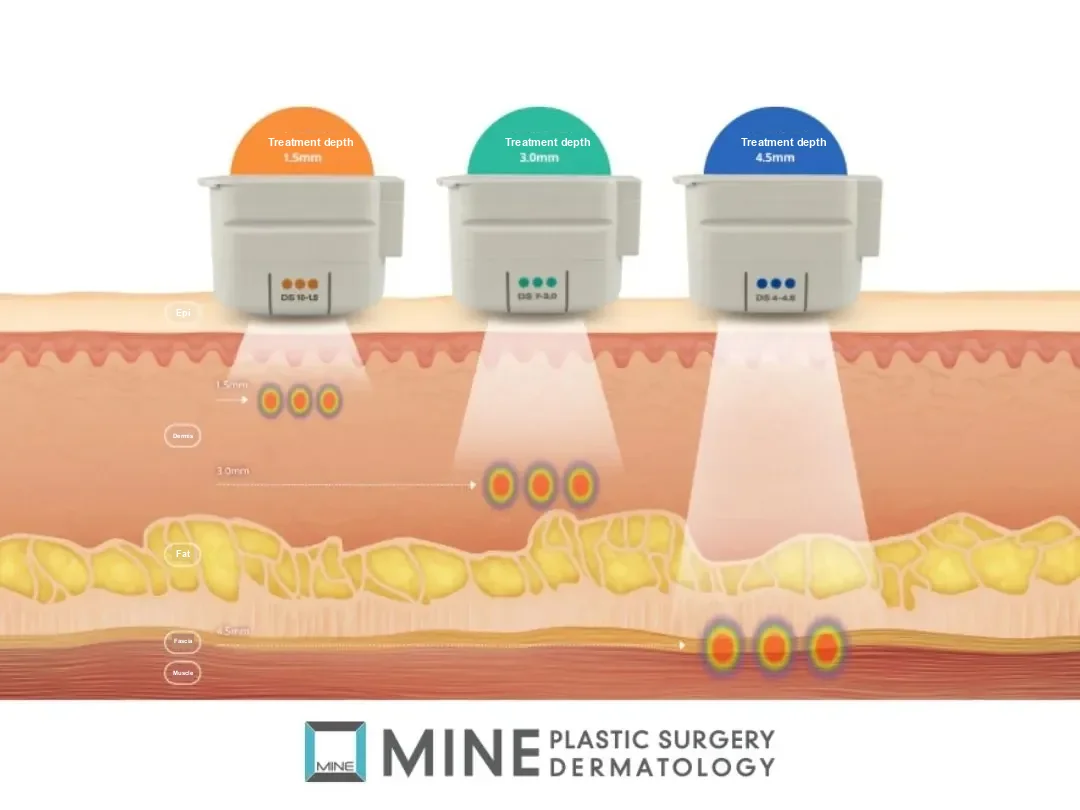
The transducer (the treatment tip) decides how deep the heat lands — commonly 1.5 mm, 3.0 mm or 4.5 mm. I’ve explained how Ultherapy’s 65°C heat points work on the SMAS in a separate article.
Which layer is your filler in?
Filler sits at different depths: shallow near the dermis for fine lines, in the fat layer for volume, and deep above the bone for structure such as the nose or chin.
So the real concern with Ultherapy after filler is this: the layer holding your filler and the depth of the heat points can overlap. The good news is that if your clinician knows where the filler is, the treatment can be planned to keep that overlap to a minimum.
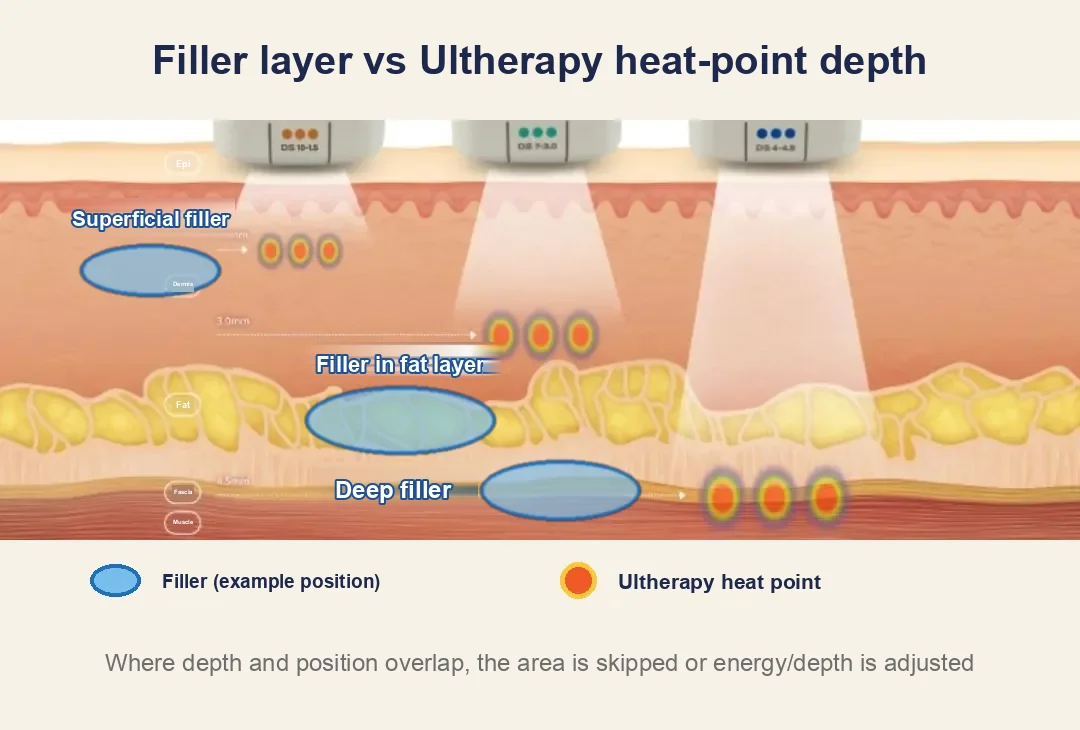
Dr. Lee’s Key Point: The real question is whether heat can reach the filler, and the answer depends on depth and location.
Does Ultherapy Melt Filler? What the Research Actually Shows
Search online and you’ll find two loud camps: “Ultherapy dissolves all your filler” and “it makes no difference at all.” The medical literature points somewhere in between.
Some filler loss when Ultherapy came within 2 weeks of injection
The most direct study on Ultherapy after filler is a small clinicopathological pilot by Vachiramon et al., Journal of Cosmetic Dermatology (2023). Hyaluronic acid (HA) filler was injected into the abdominal skin of 14 volunteers, and separate spots were treated with microfocused ultrasound 60 minutes, 14 days or 28 days later, then sampled at day 56.
In this 14-person study, roughly half of the spots treated at 60 minutes or day 14 showed some loss of HA filler, a statistically significant difference; spots treated at day 28 did not. No inflammation or granuloma (a lump of inflammation around foreign material) was seen. The authors concluded that ultrasound after HA filler appears safe, but that some filler loss can occur within 2 weeks of injection. That finding is where the “wait at least 2 weeks” advice comes from.
Same-day consensus: Ultherapy first, injections after
For several treatments in one visit, the reference point is the Carruthers et al., Dermatologic Surgery (2016) consensus, written by 15 specialists in facial aesthetics. It recommends performing MFU-V before injectables on the same day, adds that Botox and filler can be done in either order, and suggests spacing consecutive treatments 1 to 2 weeks apart so side effects settle and results can be judged.
The main way HA filler “melts” is an enzyme, not heat
Doctors dissolve HA filler on purpose with hyaluronidase, an enzyme that cuts it into small pieces the body can clear; each product breaks down at its own pace depending on how cross-linked (bound together) it is. By contrast, the evidence that Ultherapy’s heat breaks down filler is limited. A more accurate reading is that filler may be affected right after injection, before it has settled in.
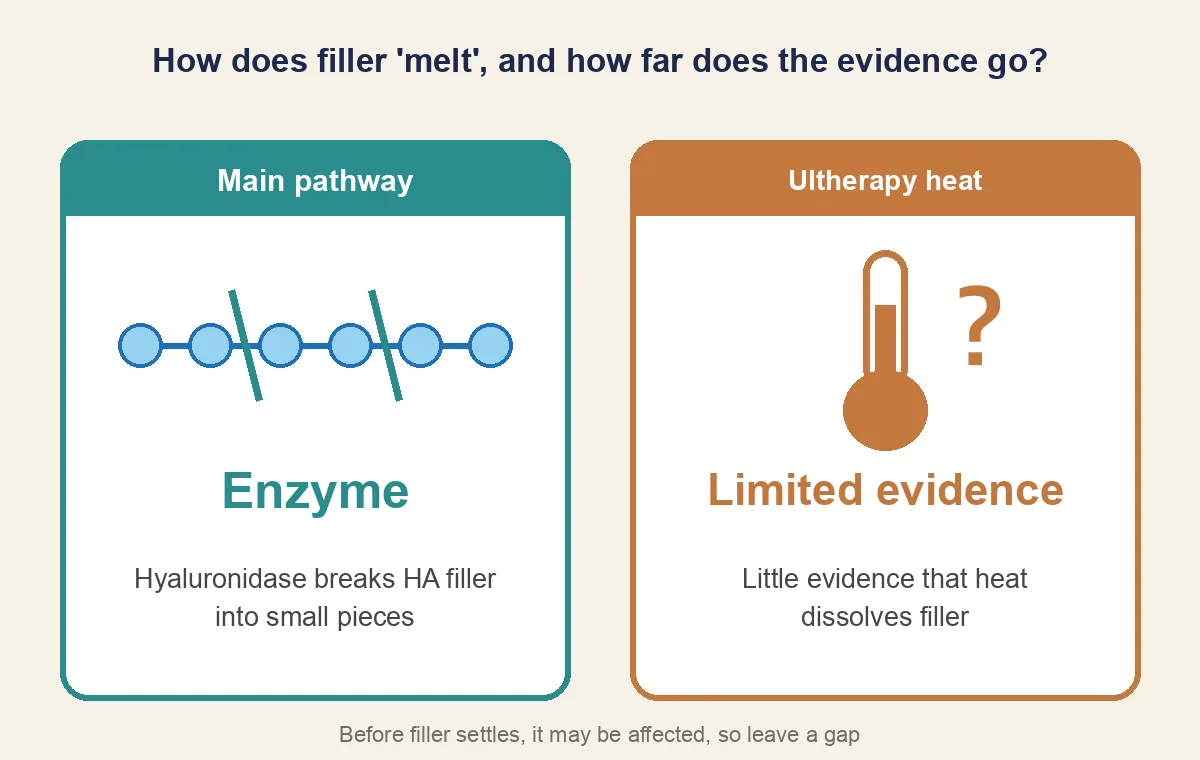
Dr. Lee’s Key Point: The evidence doesn’t say “never.” It says “mind the order and the interval.”
The Limits of the Evidence: What We Still Can’t Say
At this point you might think, “So Ultherapy after filler is completely risk-free once 2 weeks have passed.” Not quite. Speaking about unknowns as if they were settled only clouds a patient’s judgment, and the evidence here has real gaps.
Few studies, and none on deep facial filler
Very few studies look directly at Ultherapy after filler, and none use facial filler placed deep under the skin. The Vachiramon pilot had only 14 people, used abdominal rather than facial skin, and a shallow 1.5 mm transducer, so deep cheek filler may not behave the same way.
Other published work, such as a 2014 report by Casabona and Michalany in Dermatologic Surgery, explored combining MFU-V with fillers to stimulate collagen. Reports like this are small; they show a direction, and applying it to you still takes a clinician’s judgment.
No direct evidence that Ultherapy moves filler, either way
“Will Ultherapy push my filler out of place?” is another common worry. There isn’t enough direct evidence to say that Ultherapy moves filler, or that it doesn’t, so I don’t claim either. Instead, I check where the filler sits before treatment and plan around it.
Non-HA fillers (CaHA, PLLA, permanent) need separate assessment
The evidence above is almost entirely about hyaluronic acid filler. If you have calcium-based filler (CaHA), PLLA (a collagen stimulator), permanent filler, or a filler you can’t identify, the same 2-week rule can’t simply be applied. We may check its location with ultrasound and decide individually. You can read more about the filler types we use on our filler page.
Dr. Lee’s Key Point: Saying “we don’t know” when we don’t is where an honest consultation begins.
Ultherapy After Filler: Order and Interval Table
Now for the part most people want to know: timing. The gap depends on which treatment you had first.
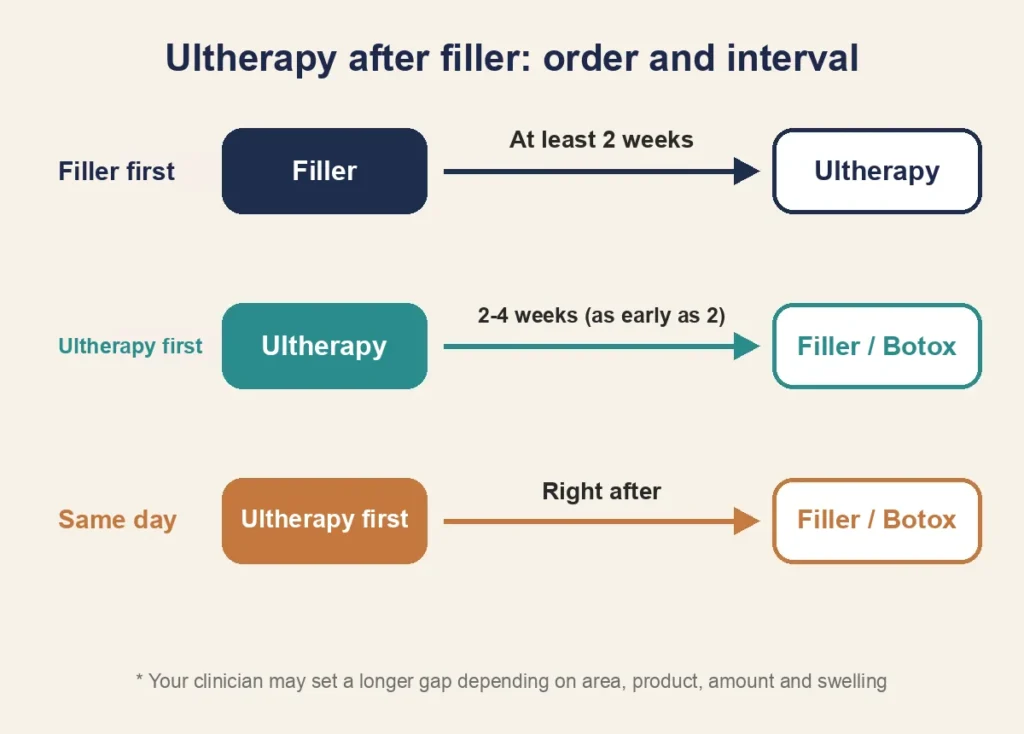
Filler first: wait at least 2 weeks
Because the 14-person study found some HA loss within 2 weeks of injection, the usual advice is to wait at least 2 weeks after filler before having Ultherapy. Treat that as a minimum; depending on the area, product and amount, the gap may be longer. When we schedule Ultherapy after filler, we look at whether the filler has settled, not just at the calendar.
Ultherapy first: filler or Botox 2–4 weeks later
If Ultherapy comes first, filler or Botox usually follows 2–4 weeks later (2 weeks at the earliest). Volume is easier to judge once any swelling has gone down.
Same day: Ultherapy first, injections after
If you are having several treatments in one day, we follow the expert consensus: Ultherapy first, filler and Botox afterwards. Any area that already contains filler is skipped during Ultherapy, or the energy and depth are adjusted.
Botox in the mix: wait until it has settled
Botox starts working in 2–3 days and peaks around days 8–10, so Ultherapy is typically scheduled about 2 weeks after Botox. The gap is for judging each result clearly, not because of a proven risk.
| Situation | Order | Typical interval | Note |
|---|---|---|---|
| Filler first | Filler → Ultherapy | At least 2 weeks | May be longer depending on area and product |
| Ultherapy first | Ultherapy → filler / Botox | Usually 2–4 weeks (2 at the earliest) | Volume judged after swelling settles |
| Same day | Ultherapy first → filler / Botox | Same day | Existing filler areas skipped, or energy and depth adjusted |
| Botox first | Botox → Ultherapy | Once settled (about 2 weeks) | Gap is for reading results |
These intervals are general guidance. Your clinician may adjust them based on your skin and filler history.
Is Ultherapy After Filler Safe? Side Effects and Warning Signs
Here is what to watch for once you’ve had Ultherapy after filler.
Common Ultherapy reactions: redness, swelling, tenderness, temporary numbness
- Redness and swelling: usually fade with time.
- Tenderness: treated areas can feel sore for a few days.
- Tingling or numbness: occasionally, from irritation near a nerve.
Signs to watch at the filler site: volume change, lumps, asymmetry
If a filled area seems to have lost volume, you notice a lump, or the two sides look different, please don’t massage it hard yourself. Have it checked first by the clinic that treated you.
Call the clinic right away if…
- The skin over a filler area turns white or bluish
- Pain keeps getting worse over time
- Swelling keeps growing and feels warm
These can signal an emergency, such as a filler-related blood-vessel problem. For day-to-day care after treatment, see our Ultherapy aftercare guide.
Dr. Lee’s Key Point: If something feels off, don’t guess. Ask the clinic that holds your treatment records first.
Before Your Consultation: What to Bring and Plan
When a patient comes in about Ultherapy after filler, I start by asking about their filler history. In my clinical experience, the more precise it is, the better we can plan.
Your filler history note: when, where, which product
- Date: when you last had filler
- Areas: cheeks, smile lines, chin, nose, forehead and so on
- Product type: hyaluronic acid (HA) filler or something else
- Amount and sessions: as far as you remember
- Botox and previous Ultherapy: the date of your last session

Don’t know what product was used? On high-frequency ultrasound, HA, CaHA and PLLA look different, so we can estimate the type and location before building the plan.
Aftercare to follow around Ultherapy
Keep irritation low, moisturize, use sun protection, and avoid strong massage or pressure over filler areas. We recommend the same aftercare for every patient who already has filler.
Planning Ultherapy in Seoul as an international patient
If you are travelling to Seoul and hoping to have both treatments, build your dates around these intervals: either both on the same day with Ultherapy first, or at least 2 weeks between filler and Ultherapy. Bring your filler history with you, and we can work out a treatment schedule that fits your trip. See more about Ultherapy at MINE.
Ultherapy After Filler: Frequently Asked Questions
How long after filler can I get Ultherapy?
For Ultherapy after filler, the usual advice is to wait at least 2 weeks. In a 14-person study, some HA filler loss was seen when ultrasound came within 2 weeks of injection, but not at 4 weeks.
Does Ultherapy melt filler?
There’s no evidence that Ultherapy melts filler away. Partial loss has been reported only within 2 weeks of injection; HA filler is actually dissolved with the enzyme hyaluronidase. The research is small, so neither “it melts” nor “it’s completely safe” is certain.
Can I get Ultherapy and filler on the same day?
Yes. A 2016 expert consensus recommends doing Ultherapy first and then filler or Botox on the same day. Existing filler areas are skipped or treated at adjusted energy and depth.
How long after Ultherapy can I get filler?
Usually 2–4 weeks, and 2 weeks at the earliest. The gap is about letting swelling settle so facial volume can be judged accurately.
When should I get Ultherapy after Botox?
Around 2 weeks after Botox is a common choice. By then its effect has settled, and there’s no direct evidence that Ultherapy’s heat spreads Botox.
Does Ultherapy make filler move?
There’s no direct evidence either way. Filler migration is mainly linked to injection technique, the volume injected, and strong pressure or massage. Clinicians check where it sits and plan around it.
The Bottom Line — and How to Book
When it comes to Ultherapy after filler, what matters more than the date is knowing where your filler is and what kind it is. Your schedule depends on your skin and filler history, so I recommend an in-person consultation first. For a 1:1 consultation with MINE Plastic Surgery & Dermatology in Seoul, call +82-2-516-1175.
Written and medically reviewed by: Dr. Lee Sung-wook, Board-Certified Plastic Surgeon, Representative Director of MINE Plastic Surgery & Dermatology
※ This content is for informational purposes only and does not replace professional medical advice, diagnosis, or treatment. Individual results may vary, and side effects may occur. Please consult with a board-certified plastic surgeon for personalized advice.