EN



Salivary gland Botox results are the gradual changes that follow botulinum toxin injections into enlarged salivary glands: saliva usually decreases within about two weeks, and a slimmer under-jaw contour typically becomes visible from four to six weeks.
Many people who come to us say something like this: “My face got slimmer after I lost weight, but the area under my jaw is still full.” Others notice that both sides of the jaw bulge every time they chew. If that sounds familiar, the cause may be enlarged salivary glands rather than fat or muscle.
This guide explains what salivary gland Botox results actually look like, the order in which changes appear, the four main types of change, and how to judge your own results fairly so you do not decide too early.
What Are Salivary Gland Botox Results?
Salivary gland Botox is a non-surgical treatment in which botulinum toxin is injected directly into enlarged salivary glands, mainly the submandibular glands (the glands under the jawline) and the parotid glands (the glands in front of and below the ears). There is no incision and, for most people, no real downtime.
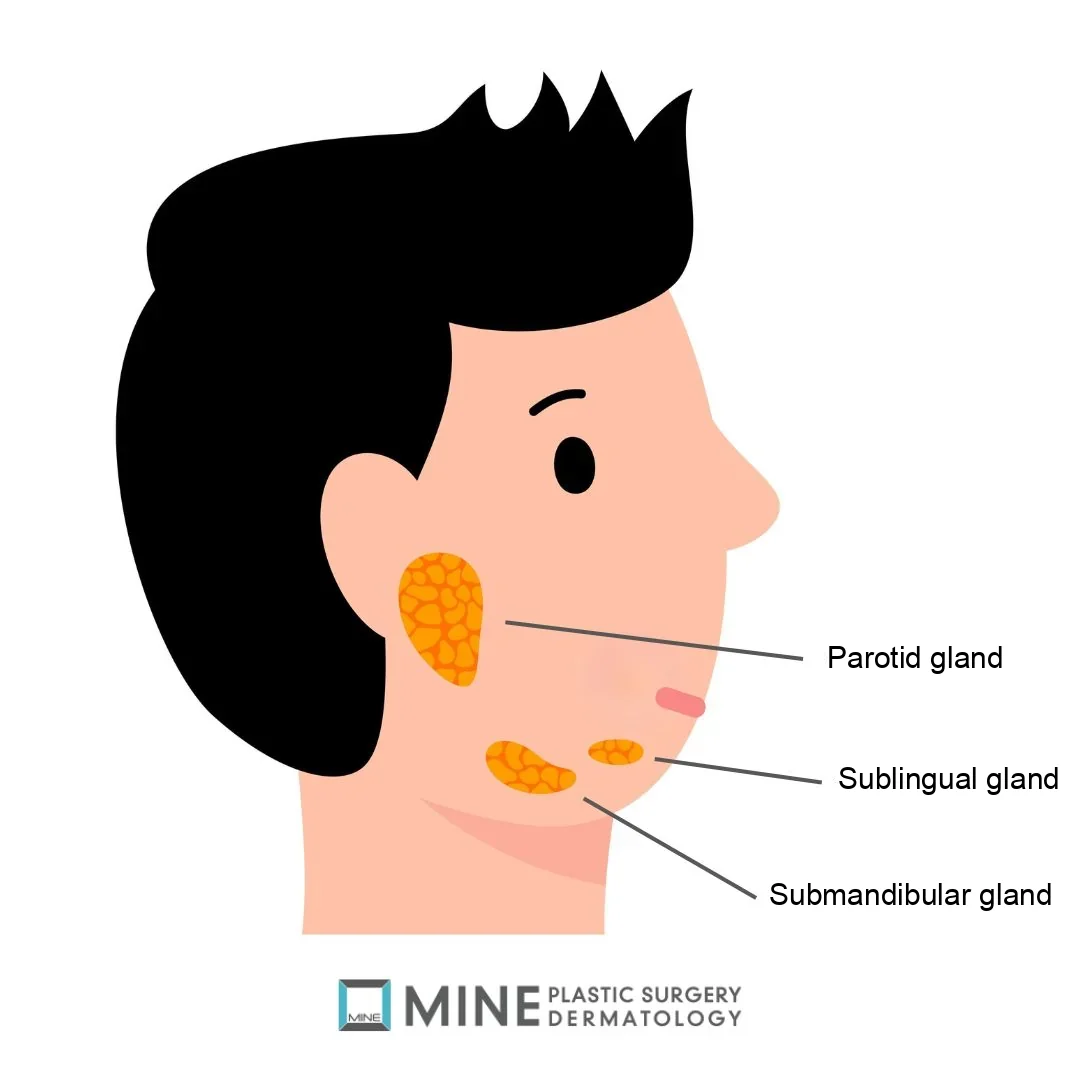
Here is the simple version of how it works. When a nerve tells a salivary gland to “make saliva,” it sends that message using a chemical messenger called acetylcholine. Botulinum toxin blocks the release of this messenger at the point where the nerve meets the gland. With fewer “work” signals, the gland makes less saliva and, over the following weeks, gradually becomes smaller. For a general overview of how the toxin acts on nerve signals, see this overview of botulinum toxin (NCBI StatPearls).
That last point explains why the results are gradual. Muscle Botox (for example, in the forehead) changes how a muscle moves, so the effect shows fairly quickly. With a gland, the tissue itself has to shrink before the face looks different, and shrinking takes weeks rather than days.
Glands can enlarge for several reasons, including diet, frequent chewing, alcohol, and simple inherited build. We cover those in detail in what causes salivary gland hypertrophy, so this article stays focused on results.
Who Tends to See Clear Results
The people who usually notice the most obvious results share a few patterns:
- Fullness under the jaw that stays even after weight loss
- A bulge under the jaw or just below the ear that becomes more visible when chewing
- A lower face that looks wide or square even though the rest of the face is slim
How much change you see depends on the size of the gland, the dose, and your individual build. Just as important, the fullness has to actually come from the gland. Fat, the chewing muscle (masseter), and even the jawbone can all create a similar look, and they sit close together. That is why we confirm true gland enlargement by examining the area at rest and while chewing, and with ultrasound, before planning treatment. If the fullness is mostly fat, gland injections will not give the result you are hoping for.
In my clinical experience, some patients who also have masseter Botox see a smoother lower face when the parotid gland is treated at the same time. When the masseter shrinks, a prominent parotid gland behind it can become more noticeable. Aesthetic dermatology textbooks describe parotid injection as a useful add-on to masseter Botox for slimming the lower face and making the angle of the jaw more defined. Whether you need this combination depends on your facial structure, so it is decided after an exam.
Salivary Gland Botox Results Timeline: What You Notice First
When does salivary gland Botox start working? Most people first notice a decrease in saliva within about two weeks. Visible change in the under-jaw contour usually starts around four to six weeks, because the gland itself has to shrink before the outline changes. Timing varies with gland size, dose, and individual response.
Think of these changes as an order of events rather than a fixed schedule: saliva changes first, and the shape follows later.
Treatment Day: Little Visible Change
Right after the injections, your face looks almost the same as before. You can return to normal daily activities the same day. Over the first one to three days, you may see small injection marks or mild swelling, and any minor discomfort usually settles within one to two weeks.
Within About 2 Weeks: Less Saliva
The first real change is usually something you feel rather than see. Clinical textbooks on salivary gland treatment report a significant drop in saliva production within the first 2 weeks after injection. Some people notice they swallow less often or that their mouth feels slightly less wet during meals.
Weeks 4–6: The Contour Starts to Change
Visible under-jaw contour change usually starts around 4–6 weeks, because the gland itself has to shrink. This is when most of the change becomes visible in the mirror. The fullness under the jaw or below the ear begins to look flatter, and the line from ear to chin starts to look cleaner. Some people see it a little earlier and some a little later.
Around the Peak: What “Full Results” Look Like
Full results do not mean a dramatically different face. They usually mean a smoother, less bulky outline under the jaw that looks natural in photos and in the mirror. Medical literature on the neck shows that submandibular gland volume can be measured on imaging. In other words, what changes here is the gland tissue itself, not just surface swelling.
| Timepoint | What you may notice | What not to expect yet |
|---|---|---|
| Treatment day | Normal routine; small marks possible | Any change in face shape |
| Days 1–3 | Mild swelling or tenderness at injection points | Slimming (swelling can even look fuller) |
| Within about 2 weeks | Less saliva, especially at meals | A clear contour change |
| Weeks 4–6 | Flatter under-jaw, cleaner jawline | Identical results on both sides from day one |
4 Types of Salivary Gland Botox Results
Patients often ask what exactly will change. In practice, the results fall into four types. Most people experience more than one.
1. A Slimmer Under-Jaw and Jawline
As the submandibular and parotid glands lose volume, the lower-face outline from below the ear to the jawline becomes smoother. People whose under-jaw looked heavy, or whose side jawline looked blurred, tend to notice this most. The change usually appears from about 4–6 weeks, and how much it shows varies from person to person.
2. Less Saliva — Reduced, Not Dry
Botulinum toxin dampens the automatic nerve signals that tell the gland to produce saliva, so excess saliva decreases. This is usually the earliest change. But saliva matters: it keeps the mouth moist, starts digestion, and protects your teeth. The goal is a moderate reduction, not shutting saliva off, which is why dose control is a key part of planning.
3. Less Bulging When You Chew
Before treatment, the area under the jaw or below the ear may pop out each time you chew. After the gland shrinks, that bulge usually becomes less prominent, so your outline looks steadier while you eat or talk.
4. Better Lower-Face Proportion
When unnecessary volume in the lower face is reduced, the jawline looks more defined and the overall impression of the face can look neater. If fat or skin laxity is also part of the picture, those causes are addressed separately with other treatments, because gland injections only work on the gland.
How to Judge Your Salivary Gland Botox Results Fairly
The most common reason people feel disappointed with their results is not that nothing happened, but that they judged too early or compared the wrong photos. A fair “before and after” comparison takes a little planning.

Take a Baseline Photo Before Treatment
Before your appointment, take a small set of photos:
- Front view
- Both sides at a 45-degree angle
- Both profiles
- One photo mid-chew, since that is when gland bulging shows most
Keep a neutral expression with your teeth lightly together, and tie your hair back so the jawline is visible.
Compare at 4–6 Weeks, Not the Next Day
Compare photos taken at 4–6 weeks with a baseline photo in the same light and from the same angle — not photos from the day after treatment. In the first few days, mild swelling can make the area look the same or even slightly fuller.
Same Light, Same Angle, Same Expression
To read your results accurately, use the same room, the same time of day, and the same distance from the camera. Overhead light can create shadows under the jaw that look like fullness, while window light from the front can hide it. Small changes in head tilt also make a big difference to how the jawline looks.
Remember that the two kinds of change run on different clocks. Saliva change is something you feel, usually within two weeks. Contour change is something you see, usually from four to six weeks. Judge each one on its own timeline.
If Nothing Has Changed by 6 Weeks
If your photos at around six weeks show no difference, it is worth reviewing your results with your doctor. The usual questions are whether the fullness was really gland rather than fat or muscle, whether the dose was suitable, and whether the injection placement reached the gland well. We explain these causes in salivary gland Botox not working.
How Long Do Results Last?
The results are temporary. A single session’s contour effect often lasts around 4–5 months, with individual variation, and published figures differ between sources. The decrease in saliva may wear off earlier than the contour change, and most people are re-evaluated around four to six months. For details, read how long salivary gland Botox lasts and the signs your salivary gland Botox is wearing off.
How Technique and Safety Shape Your Results
Good results depend less on the product than on where and how it is placed. Salivary glands do not have clearly visible borders, and nerves and blood vessels run nearby.
Ultrasound-Guided, Multi-Point Injection
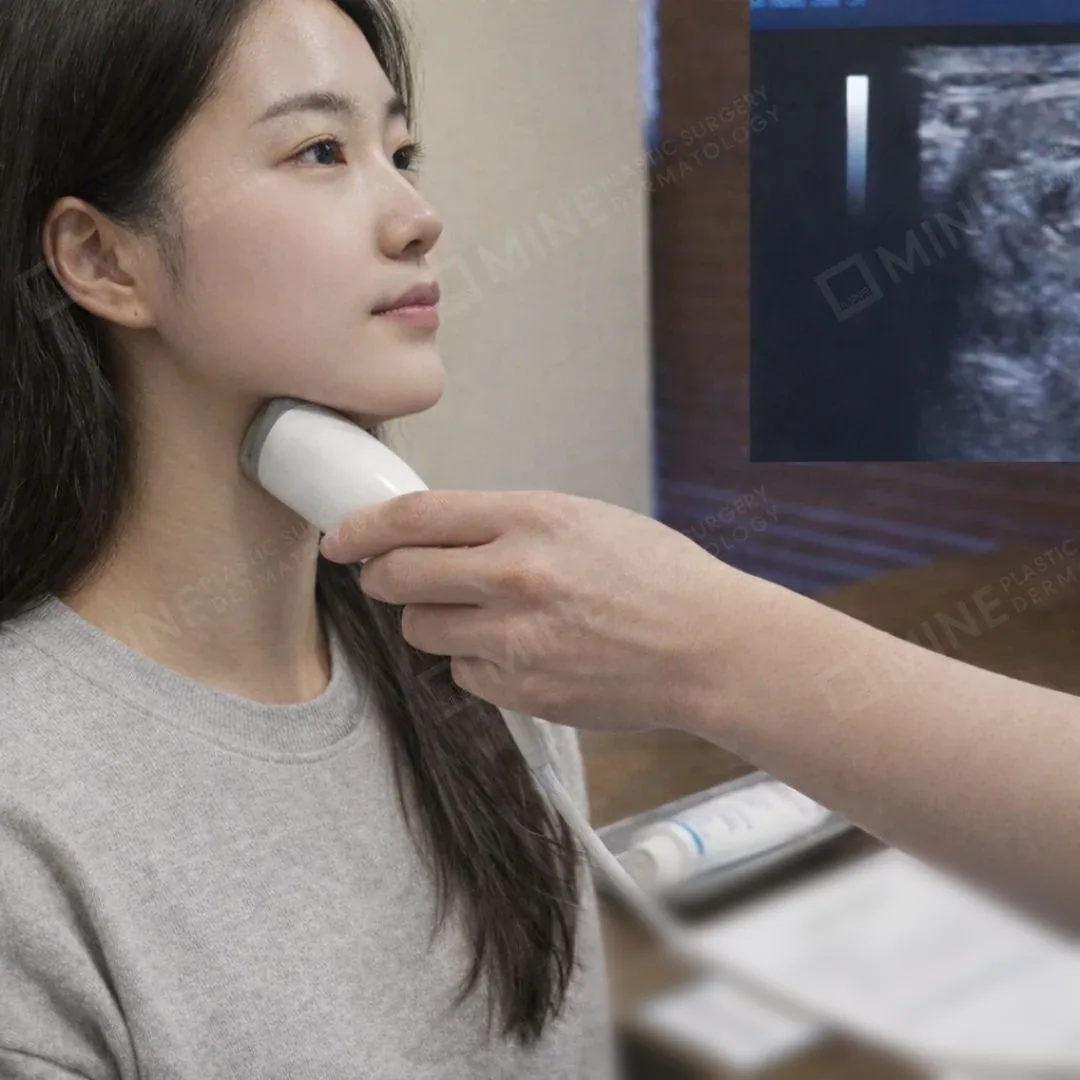
Before injecting, we check the size and position of each gland with high-resolution ultrasound. The dose is then divided across several points within the gland rather than placed in one spot, so the toxin spreads evenly through the tissue and the results look balanced on both sides. Textbooks describe splitting the dose across about 4–10 injection points on the parotid gland, depending on its size, usually under ultrasound guidance.
The submandibular gland needs extra care. It sits deep under the jaw, wrapped in a firm layer of connective tissue, and a muscle in the floor of the mouth (the mylohyoid, which helps you swallow) passes right through it. Aesthetic surgery textbooks note that careful placement here helps avoid swallowing discomfort. This is one reason precise, image-guided injection matters.
Possible Side Effects and What They Mean
| Possible effect | What it usually means |
|---|---|
| Bruising or swelling | Common at injection points; usually settles in 1–3 days |
| Temporary soreness | Mild and short-lived |
| Dry-mouth feeling | Usually manageable by drinking enough water; dose is adjusted next time if needed |
| Mild early asymmetry | Glands can respond at slightly different speeds; a touch-up can be considered after review |
| Swallowing discomfort | Very rare; reduced by accurate placement |
| Little or no response | Varies between individuals; reviewed with your doctor |
For a fuller explanation, see our guide to the effects and side effects of salivary gland Botox.
Frequently Asked Questions About Salivary Gland Botox Results
When does salivary gland Botox start working?
Most people notice less saliva within about two weeks. A visible change in the under-jaw contour usually begins around four to six weeks, because the gland has to shrink first. Timing varies from person to person.
How do I know if my salivary gland Botox results are working?
Compare a baseline photo with photos taken at four to six weeks, using the same light, angle, and expression, including one shot while chewing. Note any change in saliva separately, since it appears earlier than the change in shape.
Why is my saliva lower but my jaw looks the same?
That is the normal order of changes. Saliva decreases first, while gland volume shrinks more slowly. Wait until the four-to-six-week mark before judging the contour.
Will salivary gland Botox make my mouth dry?
The aim is a moderate reduction in saliva, not a dry mouth. A temporary dry feeling is possible and is usually managed by drinking enough fluids. Careful dose control helps keep saliva at a comfortable level.
What if I see no change after 6 weeks?
Book a review with your doctor. The cause may be the diagnosis (fat or muscle rather than gland), the dose, or the injection placement. See salivary gland Botox not working for common reasons.
Planning Your Salivary Gland Botox at MINE

At MINE Plastic Surgery in Gangnam, Seoul, board-certified plastic surgeon Dr. Lee Sung-wook personally examines the lower face at rest and while chewing and checks the glands with ultrasound before recommending treatment. If you are traveling from abroad, we can also help you plan when to take your follow-up photos at home, so you can compare your results at the right time.
To ask about an assessment, use the consultation form on this website or call +82-2-516-1175.
※ This content is for informational purposes only and does not replace professional medical advice, diagnosis, or treatment. Individual results may vary, and side effects may occur. Please consult with a board-certified plastic surgeon for personalized advice.