EN


Had jaw Botox several times, but the soft fullness under your chin is still there? Masseter Botox vs salivary gland Botox comes down to the target: masseter Botox relaxes the chewing muscle at the outer jaw angle to narrow a square jaw, while salivary gland Botox is a non-surgical injection into the submandibular glands under the jawline that temporarily shrinks an enlarged gland and softens the bulge beneath the chin.
Hello, I’m Dr. Lee Sung-wook, a board-certified plastic surgeon at MINE Plastic Surgery & Dermatology in Seoul. One question I hear again and again in consultation is: “I’ve had jaw Botox so many times. Why won’t the bulge under my chin go away?” When I examine these patients, the cause often isn’t the chewing muscle at all. It’s the submandibular gland, a salivary gland tucked under the jawbone.
The short answer:
- Masseter Botox targets a muscle. It narrows the jaw angle you see from the front.
- Salivary gland Botox (submandibular) targets a gland. It softens the bulge under the jaw that you see from the side.
- Injecting the wrong tissue usually means little visible change, however many times you repeat it.
- Three simple self-checks can point you toward muscle, gland or fat before you book anything.
This article focuses on how the two injections differ and how to tell which tissue is behind your lower-face fullness. For a broader overview of the treatment itself, see our guide to salivary gland Botox effects and side effects. Results timing, side-effect details and cost each have their own article, linked where they come up below.
Masseter Botox vs Salivary Gland Botox: What Is the Difference?
When people compare masseter Botox vs salivary gland Botox, they’re often surprised to learn that the product is the same. What changes is where it goes and what it does once it’s there.
Same toxin, different target tissue
Masseter Botox (often called jaw Botox) goes into the masseter, the chewing muscle that hardens when you clench your back teeth. An injection-technique textbook describes the masseter as running from the cheekbone area down to the outer side of the jaw angle and the back of the jawbone, with a superficial and a deep layer. When this muscle is overdeveloped, the lower face looks square from the front, and relaxing it gradually reduces its bulk.
Salivary gland Botox, in the sense used in this article, goes into the submandibular gland. This is a paired gland sitting on the inner underside of the lower jawbone, one on each side. Rather than relaxing a muscle, the injection asks an overworked gland to rest, and the gland slowly becomes smaller.
How the toxin quiets a muscle and a gland
Botulinum toxin blocks the release of acetylcholine, a chemical messenger, at nerve endings. That same messenger tells muscles to contract and also tells salivary glands to produce saliva. The nerves that send this “make saliva” signal belong to the parasympathetic nervous system (the part of the nervous system that runs rest-and-digest functions). So in a muscle, the toxin reduces contraction and bulk; in a gland, it reduces secretion, and a gland that works less gradually shrinks.
Side-by-side comparison table
| Masseter (jaw) Botox | Salivary gland Botox (submandibular) | |
|---|---|---|
| Injection site | Outer jaw angle, below the ear | Under the jawline, on the inner side of the jawbone |
| Target tissue | Chewing muscle (masseter) | Salivary gland (submandibular gland) |
| How it works | Reduces muscle contraction, so muscle volume decreases | Reduces the secretion signal, so gland volume decreases |
| Where the change shows | Width of the jaw angle, seen from the front | Bulge under the jaw, seen from the side and below |
| Reaction to watch for | Chewing may feel weaker for a while | Dry mouth; rarely, swallowing discomfort |
In short, masseter Botox narrows the jaw angle seen from the front, while submandibular gland Botox softens the bulge under the jaw seen from the side. That is why someone with a square jaw angle who only has gland injections, or someone with a bulge under the chin who keeps repeating jaw Botox, often sees little change. When both causes are present, the two areas can be treated in the same visit.
Dr. Lee’s Key Point: The masseter is a chewing muscle; the submandibular gland makes saliva. Inject the wrong one and the lower face stays the same no matter how many times you repeat it, so the diagnosis has to come first.
Where Is the Submandibular Gland — and Why Does It Bulge?
Most people have heard of jaw Botox, but few know they have a salivary gland sitting right under the jawline. Knowing where it is makes the difference between the two treatments much easier to picture.
Location in the submandibular triangle
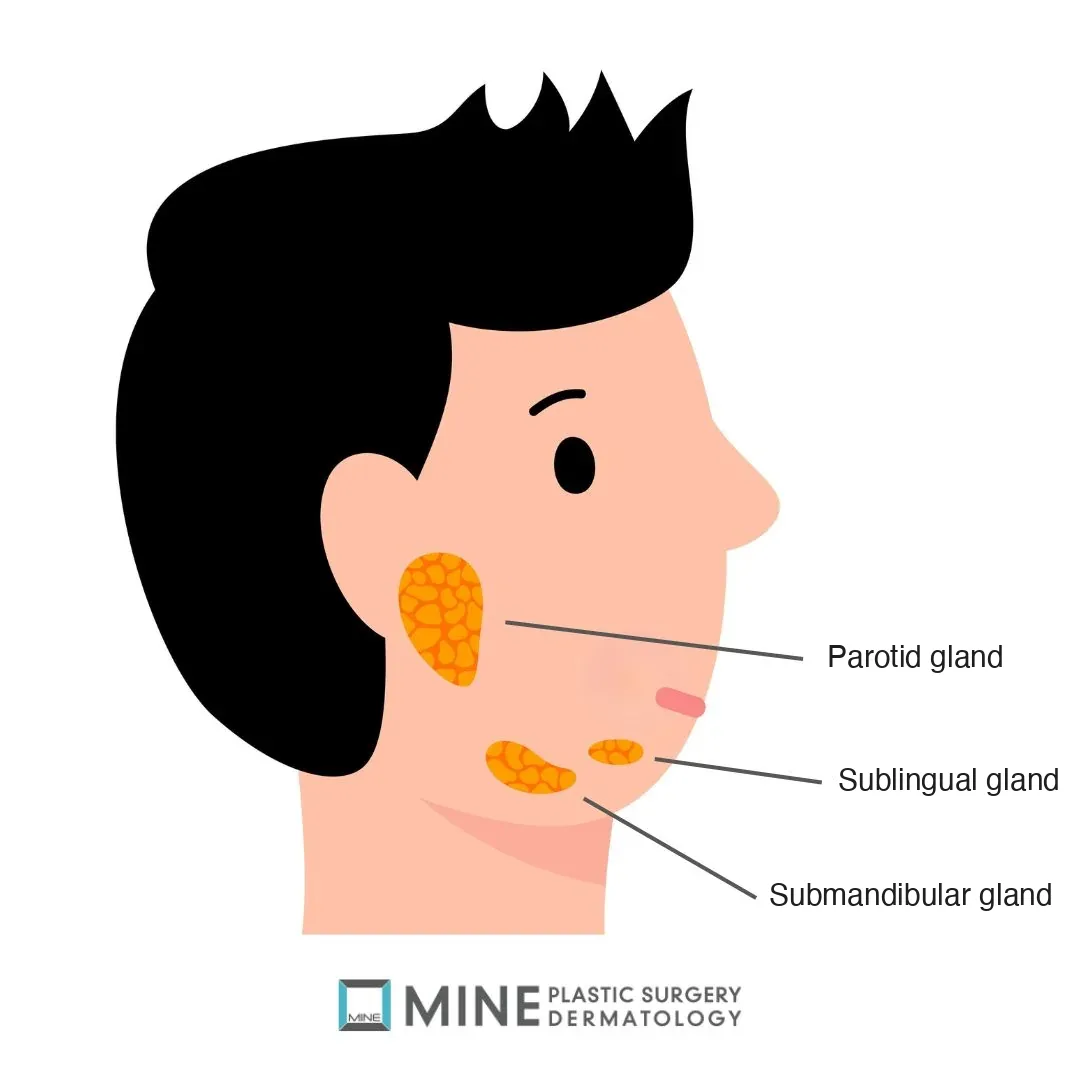
The submandibular gland lies in what surgeons call the submandibular triangle, a small area under the jaw bordered by the digastric muscle (a two-part muscle that helps open the mouth) and the lower border of the jawbone. Together with the parotid gland (in front of the ear) and the sublingual gland (under the tongue), it is one of the three major salivary glands.
It is also a hard-working gland. According to a salivary gland textbook, the submandibular glands produce about 65% of resting saliva, compared with about 20% from the parotid glands. When you eat and saliva flow is stimulated, the parotid glands take over a larger share, about half. This is why salivary gland Botox under the jaw is also called submandibular gland Botox.
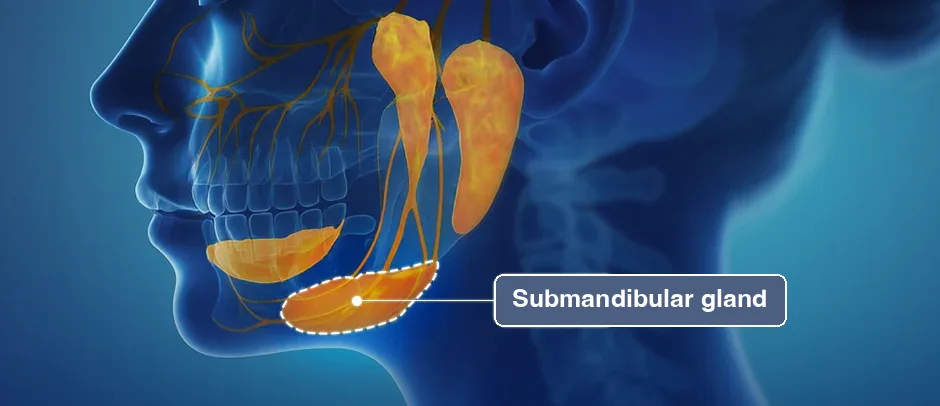
The gland doesn’t sit alone. Plastic surgery references describe the facial artery and vein, the lingual nerve (which carries sensation from the tongue) and the marginal mandibular branch of the facial nerve (which moves the corner of the lower lip) in the same area, and the facial artery can run behind or even through the gland. That is one reason injection depth and position matter so much here.
Common reasons the gland looks enlarged
- Natural size: some people simply have larger glands, regardless of body weight.
- Clenching or grinding: in people who grind their teeth or clench often, both the masseter and the gland can be enlarged at the same time.
- Heavy drinking: long-term heavy alcohol use is a known cause of salivary gland swelling.
- Age-related laxity: as the skin and muscles under the jaw loosen, a gland that was always there can become more visible.
Jaw Botox Didn’t Slim Under Your Chin? 3 Self-Checks for Muscle vs Gland
Before choosing between masseter Botox vs salivary gland Botox, it helps to figure out which tissue is behind the fullness. Stand in front of a mirror and try these three checks in order.
Check 1: Clench your back teeth
Bite down firmly. If the jaw angle just below your ear pops up hard and square, the masseter is a major contributor. That is masseter Botox territory.
Check 2: Feel along the inner jawline
Run your fingers just under the jawline, between the tip of the chin and the jaw angle. If you feel a soft but springy mass, similar on both sides, it may be the submandibular gland. This is exactly where salivary gland Botox is injected.
Check 3: Tilt your head down and pinch
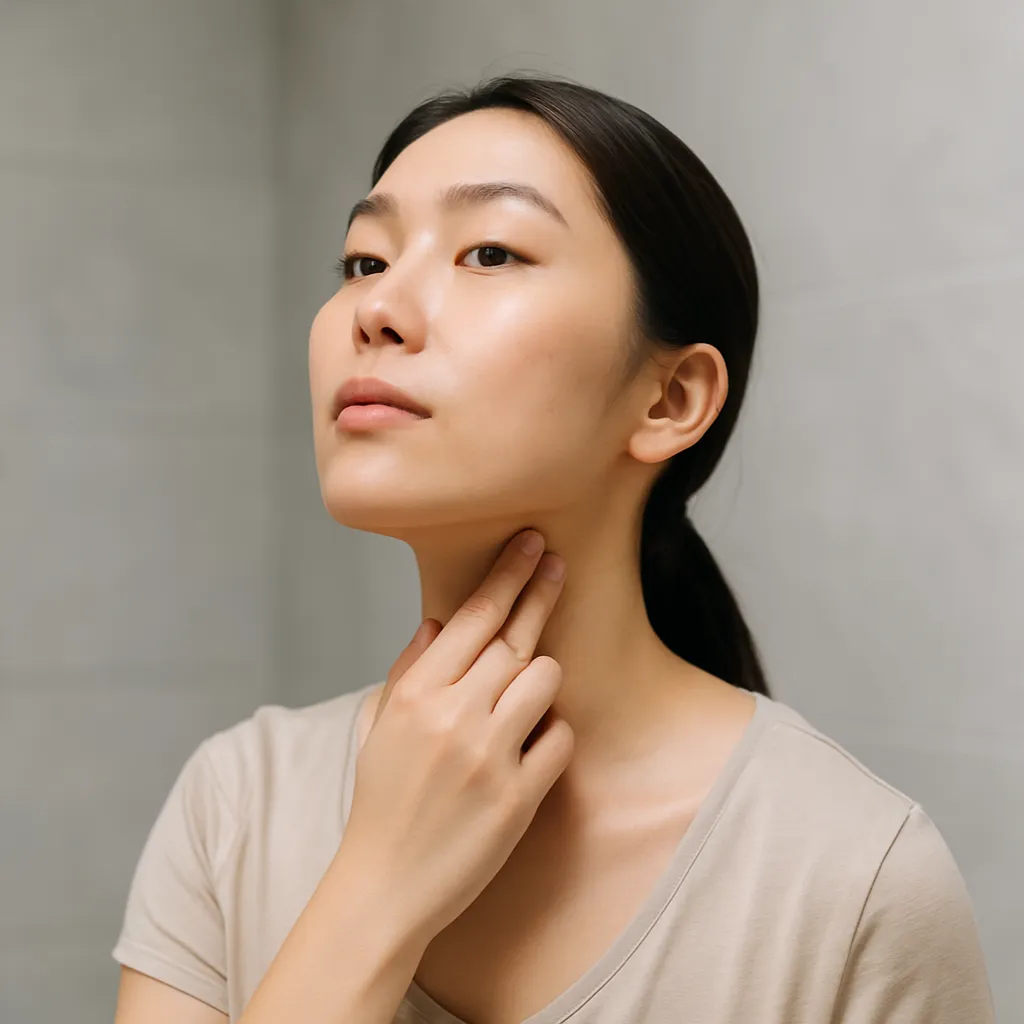
Lower your chin slightly and pinch the area under your jaw. If a thick layer lifts up together with the skin, that’s fat, which points more toward a double chin than an enlarged gland. We explain this distinction in more detail in our article on how to tell a double chin from an enlarged salivary gland.
- Clench: jaw angle hardens → muscle (masseter)
- Feel under the jawline: soft, springy mass on both sides → gland (submandibular)
- Pinch with head down: thick layer lifts with skin → fat (double chin)
One more note: fullness behind the jaw angle, in front of the ear, involves a different gland (the parotid), which is outside the scope of this article.
When to see a doctor before any cosmetic treatment
Self-checks are only a starting point. If only one side is enlarged, if it hurts when you press, if you have a fever, or if you feel a hard lump, see a doctor before considering any cosmetic treatment. Inflammation, salivary stones and tumours can also cause swelling under the jaw. The MedlinePlus overview of salivary gland disorders from the U.S. National Library of Medicine describes these conditions.
In our clinic, we confirm the cause in this order:
- Visual assessment: we look at the shape of the lower face from the front, side and at an angle.
- Palpation: we feel along the inner underside of the jawbone to check the gland’s size, firmness and position.
- Ultrasound, if needed: to see objectively how enlarged the gland is.
- Muscle vs gland vs fat: we decide which plays the biggest role and plan from there.
Dr. Lee’s Key Point: I don’t recommend salivary gland Botox unless an enlarged submandibular gland is confirmed on examination. Treating before diagnosing rarely gives the change you hoped for, and it can cost you time and money.
How Each Injection Is Done: Procedure and Injection Points
On the day itself, masseter Botox vs salivary gland Botox differs mainly in where the needle goes and how carefully depth is controlled. Both treatments are quick. In our clinic, the visit usually takes about 10–15 minutes including the examination and consultation. We use numbing cream or cooling to keep discomfort low.
Masseter Botox: outer jaw angle
For jaw Botox, the toxin is placed into the bulk of the masseter at the outer jaw angle, the part that hardened when you clenched in Check 1. The dose and number of points depend on how developed the muscle is.
Salivary gland Botox: under the jawline, with depth control
For salivary gland Botox, the toxin is divided among planned points in each submandibular gland. This area calls for more care. The mylohyoid muscle (a floor-of-mouth muscle used in swallowing) passes through the gland and splits it into a shallow part and a deep part. An injection textbook notes that the mylohyoid muscle passes through the submandibular gland, so injections must be placed carefully to avoid swallowing problems. Swallowing difficulty is the complication I guard against most, which is why I check depth and position point by point.
Can you have both on the same day?
Yes, when both the masseter and the submandibular glands are enlarged. The total dose and what each area needs are decided after the examination. You’ll find more on this in the FAQ below.
What Changes, How Fast, and Recovery — The Short Version
What to realistically expect from each
The results of masseter Botox vs salivary gland Botox show up in different places. Masseter Botox gradually narrows the jaw angle from the front. Salivary gland Botox softens the contour under the jaw, and the change is usually easier to see from the side or at an angle than straight on. The lower face as a whole can look lighter.
Neither works overnight. In a textbook protocol for therapeutic parotid injections (used to treat drooling, not for cosmetic slimming), saliva output fell within 2 weeks and the effect lasted 2–3 months on average. Cosmetic volume change under the chin tends to come more slowly and varies widely from person to person. In my clinical experience, patients usually start noticing a change under the jaw at around 2–4 weeks, it is most visible at about 4–8 weeks, and we discuss a repeat session at around 4–6 months. For the full breakdown, see our article on week-by-week changes after salivary gland Botox.
Botox also has a ceiling. If the gland is very large, or if fat and loose skin are adding to the fullness, other options may need to be considered (see the comparison table below).
Dr. Lee’s Key Point: Many people expect salivary gland Botox alone to fully redefine the jawline. In my experience, Botox alone often improves gland enlargement by only around 10%. It lets an enlarged gland rest for a while, but fat and muscle also shape the under-jaw contour, so it’s more realistic to decide from the start whether you need surgery, Botox or both.
Recovery: back to daily life the same day
Mild redness or swelling at the injection points usually settles within a few hours. Bruising or slight discomfort generally fades within a week, and you can go back to work or go out the same day.
Side Effects and Who Should Not Have These Injections
Recovery is short, but the injection itself needs care. The swallowing muscle sits right next to the gland, so a needle placed slightly too deep or off target can let the toxin spread toward it.
Common, temporary reactions
Localized pain, swelling, redness and bruising can appear at the injection sites. Studies report the needle pain of salivary gland toxin injection as minimal, about 2 out of 10 on a pain scale. Mild dry mouth can follow gland injections. If you also had masseter Botox, chewing may feel less powerful for a while.
Rare reactions that need a call to the clinic
- Asymmetry or swallowing discomfort: uncommon, and usually improves with time.
- Awkward mouth movement: if the toxin spreads to nearby facial muscles, the corner of the mouth can move unevenly for a while.
- Reduced effect over time: if the body forms antibodies against the toxin, the same dose can work less well. Large single doses and short intervals raise this risk, which is why we don’t shorten the interval between sessions even when the effect seems to fade quickly.
If you have difficulty swallowing or breathing, contact the clinic right away. For a fuller discussion of these risks, read why swallowing and dry mouth need extra care with submandibular gland Botox.
Contraindications
We do not perform these injections if you have:
- Myasthenia gravis, Lambert-Eaton syndrome or another neuromuscular disease
- A current pregnancy, or you are breastfeeding
- An infection at the injection site
- A previous allergic reaction to botulinum toxin (or to albumin, a protein in some products)
If you are taking or are allergic to aminoglycoside antibiotics, tell us beforehand. The same applies if you already have severe dry mouth.
Salivary Gland Botox, Masseter Botox, or Surgery? A 4-Way Comparison
Comparison table
Masseter Botox vs salivary gland Botox isn’t always an either-or choice, and sometimes neither injection is enough on its own. Here is how the four main options compare.
| Salivary gland Botox | Masseter Botox | Salivary gland reduction surgery | Double-chin surgery | |
|---|---|---|---|---|
| Target | Enlarged submandibular gland | Enlarged masseter | Markedly enlarged submandibular gland | Fat and loose skin under the chin |
| Method | Injection | Injection | Surgical removal of part of the gland | Liposuction and muscle tightening |
| How long it lasts | Several months (repeat usually every 4–6 months) | Several months (needs repeating) | Long-lasting | Long-lasting |
| Recovery | Same-day return to daily life | Same-day return to daily life | About 1–2 weeks | A few weeks |
| Note | Limited reduction | Does not affect the submandibular gland | Surgical burden and downtime | Considered when fat overlaps |
When surgery or a double-chin procedure fits better
Double-chin surgery (liposuction with muscle tightening) is considered when an enlarged gland comes with extra fat or loose skin under the chin. Removing the fat that covers the gland and tightening the muscle can make the jawline noticeably clearer. Salivary gland reduction surgery is considered when the gland is too large for Botox to make a meaningful difference. If skin laxity is significant, a lifting procedure may also be discussed.
The right choice depends on which plays the biggest role: gland, fat, muscle or skin. Cost also depends on the dose, the areas treated and whether you combine treatments, so it’s set after the examination. Our article on what determines the cost of salivary gland Botox explains the factors involved.
Frequently Asked Questions
Can I get masseter Botox and salivary gland Botox on the same day?
Yes. When both the masseter and the submandibular glands are enlarged, the two areas can be treated in one session. The total dose and what each area needs are set after the examination, which first confirms which cause plays the larger role.
Why didn’t my jaw Botox slim the area under my chin?
Jaw Botox targets the masseter at the jaw angle. A soft bulge under the jawline is often the submandibular gland, or fat, and masseter Botox doesn’t act on either. The three self-checks above can give you a first idea, and an in-person exam confirms the cause.
Does salivary gland Botox reduce saliva?
Somewhat. The submandibular glands make about 65% of resting saliva, so some people notice a dry mouth afterward. The gland doesn’t stop completely, and the parotid and sublingual glands keep working. Dry mouth is usually temporary. If you already have severe dry mouth, tell us before treatment.
How painful is each injection?
Most people describe a brief sting. We apply numbing cream and use a fine needle, and studies rate the needle pain of salivary gland toxin injection at about 2 out of 10. Sensitivity varies, and the whole visit, including the consultation, usually takes about 10–15 minutes.
How is the cost decided?
It depends on the dose, the areas treated and whether masseter Botox is combined with gland injections. We give a personalized quote after the examination rather than a fixed price, because every lower face is different.
Start With the Diagnosis, Not the Syringe
Salivary gland Botox only works when the premise is right: that the fullness in your lower face really comes from the submandibular gland. Whether it’s muscle, gland, bone or fat decides everything that follows, and that’s the real answer to the masseter Botox vs salivary gland Botox question.
I always tell my patients that an accurate diagnosis matters more than a good procedure. Because facial structure and gland size differ from person to person, I recommend an in-person consultation at MINE Plastic Surgery & Dermatology in Nonhyeon-dong, Gangnam, Seoul. For a 1:1 consultation, call +82-2-516-1175.
Written and medically reviewed by: Dr. Lee Sung-wook, Board-Certified Plastic Surgeon (Korea), Representative Director of MINE Plastic Surgery & Dermatology
References: Sakr M. Surgery of the Salivary Glands (Springer Nature, 2024) — Botulinum toxin A; 19.11.9 Side-effects; 19.11.10 Contraindications. Clinical Management of Salivary Gland Disorders (Springer) — share of resting saliva by gland. Minimally Invasive Aesthetic Surgery Techniques (Springer) — masseter muscle; 2.13 Submandibular gland. Neligan’s Plastic Surgery: Aesthetic, Vol. 2 — submandibular triangle. MedlinePlus, Salivary Gland Disorders (U.S. National Library of Medicine).
※ This content is for informational purposes only and does not replace professional medical advice, diagnosis, or treatment. Individual results may vary, and side effects may occur. Please consult with a board-certified plastic surgeon for personalized advice.