EN
EN


“My friend’s botox lasted nearly six months — mine seemed to wear off in two. Did something go wrong?” It’s one of the questions I hear most often in my clinic. Let me answer it right away: nothing went wrong.
Xeomin botox treatment areas refer to the specific facial zones — forehead, glabella (frown lines), crow’s feet, jawline, and neck — where the same botulinum toxin behaves differently in how fast it works, how long it lasts, and what you need to watch for. If you’re still wondering what Xeomin actually is and how it differs from regular botox, our overview of Xeomin vs. Botox: How Korea’s Purified Neurotoxin Differs is a good place to start.
I’m Dr. Lee Sung-wook, a board-certified plastic surgeon at MINE Plastic Surgery & Dermatology in Gangnam, Seoul. In my clinical experience, once you understand that single idea — that results differ by area — about half the anxiety around “why did mine fade so fast?” simply disappears. In this guide I’ll walk you through each of the xeomin botox treatment areas the way I explain them across the consultation desk, covering the science, the dosing logic, the timeline, and the cautions in plain English. For the full range of our injectable work, you can also see MINE Botox treatments.
Table of Contents
Why Xeomin Botox Treatment Areas Respond Differently
Why does the same drug act differently from one area to the next? The key is that the character of the muscle changes depending on where it sits. Botox (botulinum toxin type A) briefly interrupts the chemical messenger — acetylcholine — that tells a muscle to contract. When that signal is muted, the muscle relaxes, and the wrinkle or contour it created softens.
How Botulinum Toxin Blocks Muscle Movement (Plain English)
Here’s the mechanism without the jargon. A muscle only moves when it receives a signal from its nerve. Botulinum toxin temporarily blocks that hand-off by cutting a tiny “docking” protein called SNAP-25 (the protein that lets the nerve release its signal). With the signal interrupted, the expression muscle moves less, and the lines it normally folds into ease out. The crucial point is that this effect is temporary — over time the nerve regrows its connections and recovers its function, which is why every area, without exception, eventually needs a repeat treatment.
Upper Face vs. Lower Face: The Key Anatomical Difference
This is where the areas split apart. The upper face — forehead (frontalis), glabella (corrugator and procerus), and crow’s feet (orbicularis oculi) — is made of thin expression muscles. The lower and mid face — the jawline (masseter) and neck (platysma) — are thick, hard-working muscles built for chewing and posture. Because the muscles differ so much in size and workload, the same drug shows up at a different speed and fades on a different schedule.
This pattern is well documented in cosmetic dermatology textbooks, and I see it confirmed in my clinic every week. As a citable rule of thumb: upper-face areas (forehead, glabella, crow’s feet) typically last 3–4 months, while lower-face areas (jawline, neck) last about 2–3 months. Medical literature suggests the difference is driven by muscle activity level — the higher-load lower-face muscles appear to rebuild that SNAP-25 docking protein faster and regrow their nerve connections sooner, so the effect wears off earlier. These figures are commonly reported ranges; results still vary from person to person.
Dr. Lee’s Key Insight — Because each area shows up and fades on its own schedule, applying one identical dose and one identical interval to every area is a mistake.
Glabella & Forehead Botox — Two Areas That Must Be Designed Together
The glabella — the frown lines between your eyebrows — is the area most people picture first. But there’s something I always emphasize in consultation: the glabella and forehead should be treated as one set if you want a natural result.
Glabella (Frown Lines): Onset and Dosage Range
The glabella involves the muscles that pull your brows inward when you frown (the corrugator and procerus). I usually take around 20 units as a starting reference for the glabella — but that is only a reference. The exact amount is always individualized by your specialist: I have the patient make expressions and watch how the muscles actually move before deciding.
Why Forehead Must Be Treated Alongside Glabella
There’s a well-established textbook principle here. If you relax only the glabella without addressing the forehead muscle (frontalis), the outer brow can lift unnaturally — a look sometimes called the “Mephisto” or arched-brow sign. The forehead muscle’s job is to raise the brows, so when only the glabella is weakened, that balance can tip. Treating both areas together, watching how they counterbalance, is what produces a natural outcome. I typically start the forehead near 20 units as well, then add or hold back based on each person’s expression habits (individual variation applies).
Duration: When to Expect Results
Upper-face areas like the glabella and forehead usually begin to show within 3–5 days and hold for about 3–4 months, occasionally longer in some patients. Treat that as the average rhythm rather than a fixed promise — duration varies by individual.
Dr. Lee’s Key Insight — Treating the glabella alone, leaving the forehead untouched, can make the outer brow lift unnaturally. I always design both areas together to keep facial balance.
Crow’s Feet Botox — Preserving Natural Expression
Crow’s feet are the fine lines that fan out at the outer corner of the eye when you smile (the medical term is lateral canthal lines). Because this area is so central to expression, it’s where I emphasize subtlety the most.
What Crow’s Feet Botox Addresses
These lines target the orbicularis oculi — the ring of muscle around the eye that creases when you smile or squint. Softening them appropriately gives the whole face a more relaxed look. But the eye area is expression, so overloading it can actually read as unnatural.
How Many Units? Injection Point Distribution
For crow’s feet, a typical range is about 6–15 units per side, distributed across 2–3 injection points (a range that applies to both Xeomin and conventional botox). Combining both sides, I tend to start from a reference of roughly 24 units total. The reason for spreading the dose across several points rather than one concentrated spot is to keep the smile moving naturally while delivering an even effect. The precise amount and placement are decided by watching where your lines actually form when you smile — always individualized by your specialist.
The Minimum Effective Dose Principle
A principle that aesthetic medical literature consistently stresses is the minimum effective dose. In plain terms: to avoid a “frozen” look, you use the smallest amount that still balances the muscle. More is not better. The skill is reducing the lines while keeping the expression alive — not erasing every crease. One practical note: because the skin around the eye is thin and rich in fine blood vessels, bruising is a bit more common here than in other areas, so it’s worth planning your social schedule around it.
Dr. Lee’s Key Insight — Less is more around the eyes. The skill is keeping the twinkle in your smile — not erasing every line.
Jawline (Masseter) Botox — Slower Onset, More to Discuss
Now we move to an area with a different character. Masseter botox for the jawline isn’t about wrinkles — it’s about contour, and that means it works more slowly and carries more to discuss. It’s the area I spend the most consultation time explaining.
How Masseter Botox Slims the Jawline
The masseter is the chewing muscle along the jaw — the one many people call the “square jaw” muscle. Masseter botox gradually reduces its bulk so the jawline softens over time. The injection landmarks follow the mandibular angle (the corner of the jaw) at roughly 1 cm intervals, usually across 3–4 points. Published anatomical references for masseter injection include work by Lee and colleagues (2014) mapping the effective injection zone of the muscle.
Why Results Take 4–6 Weeks to Appear
Here’s the most important point for jawline botox: the result appears gradually over about 4–6 weeks, not in 3–5 days like the upper face. The contour only changes as muscle bulk slowly decreases. So I make a point of telling every patient — if nothing has changed at 2–3 weeks, that is expected, not a sign of failure. The masseter simply needs time.
Duration and Retreatment Intervals for Jawline
Jawline results typically last about 2–3 months — shorter than the upper face, because the masseter is such a high-activity muscle. Patients who clench or grind their teeth (bruxism) tend to rebuild the muscle faster, so the effect can feel shorter for them; we factor that into the plan. For the first few rounds I often keep the intervals closer together to bring the bulk down enough, then widen them once the contour settles. There’s also a longer-term pattern worth knowing: with repeated treatment over years, the effective duration can gradually lengthen as cumulative muscle atrophy develops.
One related note: in some cases, a parotid (salivary) gland adjunct injection alongside the masseter can further refine lower-face slimming, since a prominent parotid gland can add to lower-face fullness. If gland-related slimming interests you, our article on salivary gland botox effects and side effects covers it in depth. Whether any of this is appropriate is always decided individually by your specialist.
Dr. Lee’s Key Insight — I always tell patients: if nothing has changed at three weeks, that’s expected — not a reason to worry. The masseter takes time.
Platysma (Neck) Botox — The Area That Needs the Most Discussion
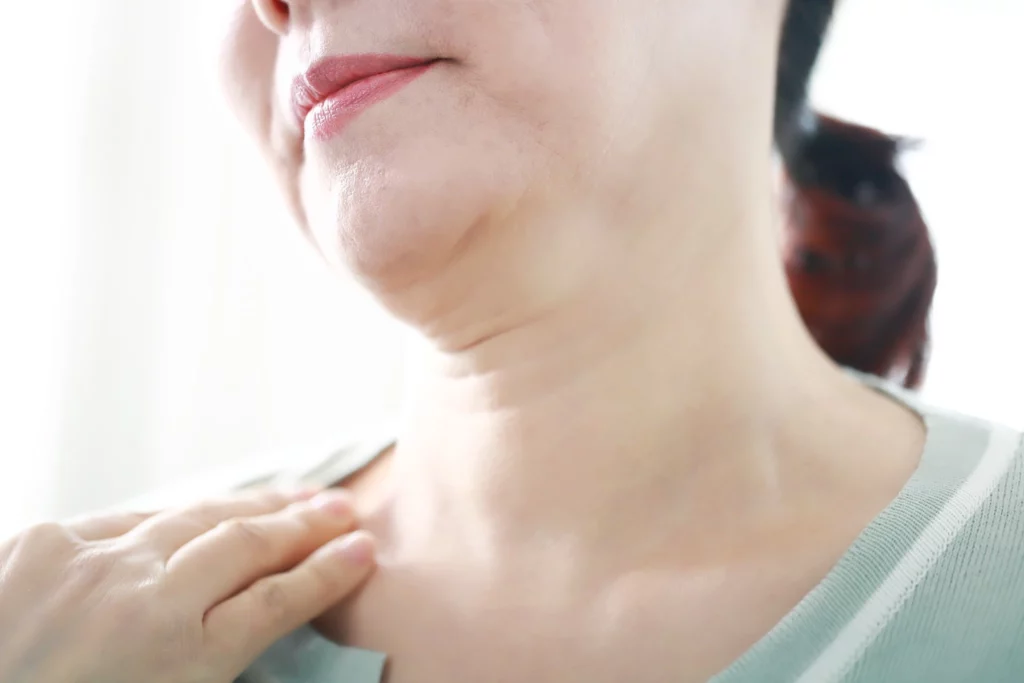
The neck is another contour area, and it’s the one I discuss most carefully of all. The platysma is the broad, sheet-like muscle that runs vertically down the front of the neck.
What Platysma Neck Botox Treats
Softening the platysma can ease the vertical neck bands that become more visible with age and help define the line between the jaw and neck. It addresses contour and banding rather than fine wrinkles.
Conservative Dosing and Why It Matters
For the platysma I stay deliberately conservative: roughly 8–12 units per band, with a maximum of about 25–30 units total for the neck. Conservative dosing isn’t caution for its own sake — it’s tied directly to the safety considerations below, and as always the exact dose is individualized by your specialist.
Swallowing and Voice Risks: What to Know Before You Decide
This is the part I never skip. If the toxin migrates to the neighboring sternocleidomastoid muscle, it can cause temporary difficulty swallowing (dysphagia) or changes in the voice (dysphonia). That’s why a thorough pre-procedure conversation is essential — you should understand these possibilities fully before deciding. In addition, people with neuromuscular disease (such as myasthenia gravis or ALS), and anyone pregnant or breastfeeding, should not have this treatment; we screen for these in consultation.
The trapezius (shoulder) muscle is a separate treatment area with its own considerations, so I won’t fold it in here. If a slimmer shoulder-neck line is your goal, see our guide to trapezius botox in Korea. For the neck-band treatment itself, you can read more about our neck wrinkle injection at MINE.
Dr. Lee’s Key Insight — Neck botox requires the most pre-procedure conversation. I keep doses conservative — and I always explain the swallowing risk before we proceed.
Duration by Treatment Area: Quick Reference + Repeat Injection Timing
Here are the xeomin botox treatment areas at a glance. These are commonly reported ranges, and results still differ from person to person. Rather than memorizing the numbers, it’s enough to remember the overall pattern: the upper face lasts longer, the jawline and neck fade sooner, and the jawline shows up the slowest of all.
Side-by-Side Duration Table
| Treatment Area | Onset | Duration | Key Note |
|---|---|---|---|
| Glabella (frown lines) | 3–5 days | 3–4 months (up to 6–8) | Co-treat with forehead |
| Forehead | 3–5 days | 3–4 months | Balance with glabella |
| Crow’s feet | 3–5 days | 3–4 months | Minimum effective dose |
| Jawline (masseter) | 4–6 weeks | 2–3 months | No 3-week results is normal |
| Neck (platysma) | 1–2 weeks | 2–3 months | Discuss dysphagia risk pre-procedure |
Scheduling Repeat Treatments by Area
Because duration varies across the xeomin botox treatment areas, it makes sense to set repeat intervals by area too. The upper face is usually reviewed and planned roughly every 3–4 months. For contour areas like the jawline and neck, I adjust the interval by watching how the effect appears and holds, rather than following a fixed calendar. Applying one single interval to every area isn’t something I recommend. And you don’t need to treat everything at once — many patients find it easier to start with the area that bothers them most, then add others as each one fades.
What About Tolerance and Antibody Resistance?
A common question is, “If I get treated often, won’t I build up resistance?” It’s a fair question — but antibody-mediated tolerance (neutralizing antibodies) is a different topic from site-specific duration, so I won’t go deep on it here. It’s worth noting that comparative studies have reported Xeomin’s efficacy to be on par with conventional botox, though neither can be declared definitively superior. For the formulation and resistance side of the story, our companion piece on Xeomin vs. Botox: How Korea’s Purified Neurotoxin Differs covers it.
Common Side Effects & Post-Injection Care (All Areas)
Some things are worth knowing regardless of which area you treat.
Typical Side Effects: Bruising, Swelling, Mild Headache
The common, universal effects are bruising, swelling, and occasionally a temporary mild headache. These are generally transient and settle on their own. They don’t affect everyone equally, and recovery patterns vary. In my experience, the thin, vascular skin around the eyes bruises a little more readily than the forehead or glabella, while thicker-muscle areas like the jawline and neck tend to feel heaviness or swelling more than bruising. Either way, it’s a temporary reaction that fades with time — and if you bruise easily or have an important event coming up, mention it in consultation so we can time the treatment around it.
Area-Specific Risks: Ptosis, Asymmetry, Neck Complications
The cautions differ by area. The upper face (forehead, glabella, crow’s feet) carries a rare risk of eyelid drooping (ptosis) or expression asymmetry if the toxin migrates. The neck and jawline carry the swallowing-difficulty (dysphagia) and voice-change (dysphonia) risks described earlier if the toxin reaches the sternocleidomastoid. And as a contraindication across the board: neuromuscular disease, pregnancy, and breastfeeding all rule the treatment out.
Day-of Instructions: The No-Rubbing Rule
Whatever area you treat, the single thing I ask of every patient on the day is this: do not rub or press the injection sites. The toxin needs to settle into the muscle where it was placed; rubbing it, or sleeping face-down and compressing it, can let it spread to a neighboring muscle you didn’t intend to treat. Around the glabella and forehead in particular, unwanted spread can lead to a heavy-eyelid feeling, so it’s safest not to touch the area right after.
For the same reason, avoid strenuous exercise, saunas, and alcohol on the day of treatment, since they raise blood flow to the face and can worsen bruising and swelling. The whole point comes down to one idea — leave the treated area alone for the day. Patients who follow just that one rule often get a more natural, even result.
For context on regulatory approval: Xeomin is approved by Korea’s Ministry of Food and Drug Safety (MFDS) for cosmetic use in the glabella, lateral canthal lines (crow’s feet), and forehead. Among the botulinum toxins sold in Korea, it also carries room-temperature storage approval (1–25°C), which is an advantage for handling and stability — though that property does not, on its own, guarantee a superior result.
Dr. Lee’s Key Insight — Watching how much the jaw muscle bulges when you chew, and where the lines form when you smile, is what guides the area and dose — and that’s how we keep side effects low.
Frequently Asked Questions
How long does Xeomin botox last at different treatment areas?
The upper face (forehead, glabella, crow’s feet) typically lasts 3–4 months, sometimes up to 6–8 months. The jawline and neck typically last 2–3 months — shorter because these are high-activity muscles. Results vary from person to person.
Why does masseter jaw botox take so long to show results?
Masseter results appear over about 4–6 weeks as the muscle bulk gradually reduces — unlike the upper face, which relaxes wrinkles in 3–5 days. No visible change at 2–3 weeks is completely normal and does not mean the treatment failed.
Do I need forehead botox if I get glabella treatment?
Usually yes. Treating only the glabella without the forehead can cause the outer brow to lift unnaturally (the “Mephisto” sign). The two areas are co-designed for a natural result — but the exact plan depends on your individual expression pattern and is decided by your specialist.
How many units of Xeomin are used for crow’s feet?
Typically about 6–15 units per side, distributed across 2–3 injection points, for a bilateral reference of roughly 24 units total. The minimum effective dose is used to preserve a natural smile, and the exact dose is customized based on how your lines appear when you smile.
What are the risks of neck (platysma) botox?
The main risk is toxin migration to the adjacent sternocleidomastoid muscle, which can cause temporary swallowing difficulty (dysphagia) or voice changes (dysphonia). Conservative dosing and a thorough pre-procedure consultation are essential, and neuromuscular disease, pregnancy, and breastfeeding are contraindications.
Can I combine Xeomin botox in multiple areas in one session?
Yes, multiple areas can be treated in a single session. However, because different areas recover on different timelines, many patients find it more practical to start with the area they care about most, then add others as needed.
Book a 1:1 Consultation at MINE Seoul
We’ve walked through how Xeomin botox treatment areas — forehead, glabella, crow’s feet, jawline, and neck — each work on their own timeline. But the average ranges you read about and the area and dose that actually suit your expression habits and muscle pattern can be quite different, and that can only be assessed accurately by examining your face in person. There’s no one-size-fits-all dosing plan.
Dr. Lee Sung-wook is a board-certified plastic surgeon and a member of ISAPS (International Society of Aesthetic Plastic Surgery). If you’d like a personalized assessment, you’re welcome to book a 1:1 consultation at MINE Plastic Surgery & Dermatology in Gangnam, Seoul. Online booking is available, or you can call +82-2-516-1175.
Reviewed by Dr. Lee Sung-wook, Board-Certified Plastic Surgeon, MINE Plastic Surgery & Dermatology.
※ This content is for informational purposes only and does not replace professional medical advice, diagnosis, or treatment. Individual results may vary, and side effects may occur. Please consult with a board-certified plastic surgeon for personalized advice.