EN
EN


Table of contents
Mini neck lift aftercare is the set of home-care rules you follow for roughly three months after surgery: keeping your head raised, cold and then warm compresses, drain and stitch care, a compression garment, and limits on exercise, alcohol and smoking. Its purpose is simple. It gives the tightened platysma muscle (the thin sheet of muscle at the front of the neck) time to heal in its new position, and it helps the small incisions under the chin and behind the ears close cleanly.
This mini neck lift aftercare guide follows the same post-operative instruction sheet we hand to patients at MINE Plastic Surgery in Seoul, rewritten so it is easier to follow at home. It covers what to do and what to avoid. If you are still deciding on surgery, our guide to mini neck lift vs. full neck lift explains which option suits which neck. If you want to know how small the scars are and how quickly people go back to work, see mini neck lift scars and recovery time.
Keep this page open on your phone during the first weeks. Most questions patients send us about mini neck lift aftercare are answered in the table below or in the sections that follow. When something does not match what you read here, contact the clinic rather than guessing.
Mini Neck Lift Aftercare at a Glance
The table below summarizes the key mini neck lift aftercare milestones. Every point is explained in more detail further down the page.
| When | What happens | What you do |
|---|---|---|
| Day of surgery to day 3 | Swelling and bruising build up | Cold compresses, head raised above heart level, rest |
| Day 3 | Drain and hemostatic netting sutures removed at the clinic | Start antibiotic ointment 1–2 times a day |
| Day 4 onward | Swelling has peaked and starts to settle | Switch to warm compresses |
| Day 7 | Skin stitches removed | Makeup allowed; schedule the three radiofrequency care sessions |
| About 3 days after stitch removal | White Steri-Strips come off | Begin skin-colored 3M tape under the chin (3 months) |
| Week 1 | Compression garment worn day and night | Remove only briefly to eat, brush your teeth or wash |
| Weeks 1–2 | Walking for exercise allowed | Short, easy walks |
| Weeks 2–4 | Most visible swelling and bruising fade | Garment at least 8 hours a day (home and sleep) |
| Month 1 | One-month limits end for sauna, alcohol, massage and hard exercise | Return gradually |
| Months 1–2 | Tightness and numbness feel strongest | Expected; it eases with time |
| Month 3 | Firm, bumpy areas soften; inner sutures dissolve | Start scar ointment; stop chin tape |
| Month 6 | Tissue has settled | Ultherapy or ultrasound devices on the chin allowed again |
The First Days: Position, Diet and Swelling Care
1. After-Surgery Position
After the procedure, keep your head higher than your heart, including while you sleep. Two pillows or a wedge pillow work well. Gravity helps fluid drain away from the neck, so swelling settles faster.
2. Post-Surgery Diet
You can eat a normal diet straight away. Avoid very spicy, salty or strongly seasoned food for the first weeks, because it can irritate the healing tissue and make swelling worse. Soft food is also easier while the neck feels tight.
3. Swelling Care
Swelling and bruising usually get a little worse for the first 2–3 days. After that they fade gradually over 2–4 weeks. How fast this happens varies from person to person.
Use cold compresses from the day of surgery up to day 3, then switch to warm compresses. The clinic gives you a reusable compress pack for both.
- Cold compress: keep the pack in the freezer and apply it wrapped in a cloth.
- Warm compress: heat the pack in the microwave for 15–20 seconds only. Heating it longer can make it burst.
- Check the temperature first. The treated skin is temporarily numb, so you may not feel heat properly. Always test the pack on the back of your hand before placing it on your neck, to avoid burns.
For the first two months the treated area tends to feel firm. It then softens gradually. This is part of normal healing, so give it time.
Mini Neck Lift Aftercare for the Incisions, Drain and Stitches
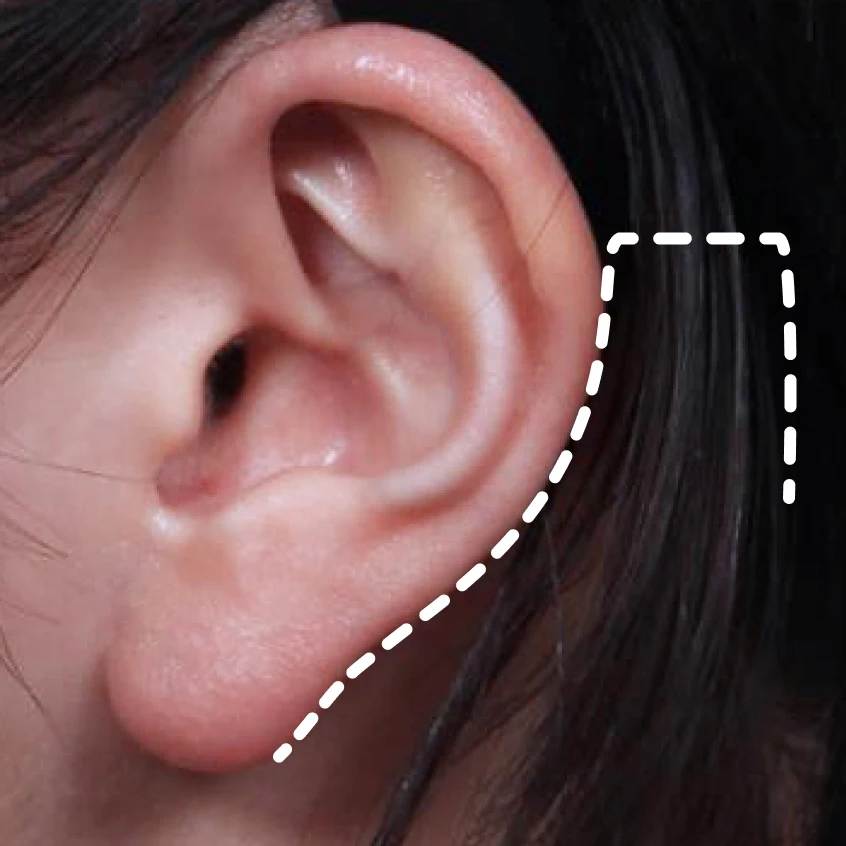
A mini neck lift at MINE uses a short incision under the chin and one behind each ear. The behind-ear incision follows the natural crease and continues a short way into the hairline, as the dotted line below shows. Most of your wound care in the first week happens along these lines.
4. Incision & Wound Care
- Skin stitches are removed 7 days after surgery.
- At stitch removal the clinic applies white Steri-Strips. Remove them yourself about 3 days later.
- After that, wear skin-colored 3M tape under the chin for about 3 months. Taping behind the ears is not needed.
- The drain and the hemostatic netting sutures (stitches that press the skin down to prevent bleeding) are removed at your day-3 visit. From then on, apply the antibiotic ointment (Esroban, which contains mupirocin) thinly to the treated areas 1–2 times a day.
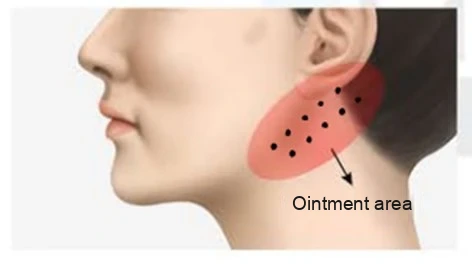
The compression garment is worn 24 hours a day for the first week. You may take it off briefly to eat, brush your teeth or wash. After the first week, keep wearing it while you are at home and while you sleep, for at least 8 hours a day, for about a month.
Do not over-tighten the garment. Pressure that is too strong can cut off blood flow to the skin and cause pressure damage (necrosis). Steady, comfortable pressure is the safest choice. If it pinches, hurts or leaves deep marks, loosen it.
- Three radiofrequency (RF) care sessions are included after stitch removal. Book them with the clinic.
- Visit the clinic if the incision becomes red or hot, or if severe pain does not settle.
- Do not touch or rub the incisions with your hands for 1 month, because this raises the risk of infection.
- If you can feel a thread poking out of one of the tiny puncture marks left by the lift, contact the clinic so we can take care of it.
Drain care. You go home with a small suction drain (bulb drain). Scan the QR code below, or watch our drain care video, to see how to empty and look after it. The drain usually comes out 2–3 days after surgery, so follow the instructions until then.

5. Sutures at the Incision Site
Blue or black dissolving sutures (such as Vicryl or PDS) are placed under the skin during surgery. From about one month after surgery they may show through the skin or poke out slightly. This is temporary and normal. These sutures dissolve inside the body within about 3 months.
If a suture comes through the skin, do not touch, pull or cut it yourself. Doing so can lead to infection, inflammation or a wound that reopens. Contact the clinic and we will manage it properly.
Mini Neck Lift Aftercare in Daily Life: Washing, Exercise, Medication and Alcohol
6. Showering & Washing
- Until the stitches are out, wash your face carefully without getting water on the surgical areas. Wipe gently around them instead.
- Until the stitches are out, shower your lower body only.
- Avoid saunas, public pools, hot tubs and the sea for 1 month after surgery (risk of infection).
- You can wear contact lenses from the next day.
- You can wear makeup after the stitches are removed.
7. Exercise
Everyday activities, including walking around the house, are fine from the first day. Walking for exercise can start 1–2 weeks after surgery. Strenuous exercise, heavy lifting and anything that strains the neck should wait until after 1 month.
8. Medications
- Take the medicine prescribed at discharge starting 30 minutes after your first meal following surgery, then regularly at the set times.
- If you develop diarrhea, a rash or any other reaction after taking it, contact the clinic.
- Do not take aspirin or vitamin E for one week after surgery, because both can increase bleeding.
If you also had salivary gland reduction: wear a motion-sickness patch (Kimite, which contains scopolamine) behind one ear for 2 weeks, replacing it every 2–3 days. Never wear more than one patch at a time. The patch reduces saliva production while the gland area heals. Our salivary gland reduction aftercare page has the full instructions for that part of the operation.
9. Alcohol & Smoking
Avoid alcohol and smoking for 1 month after surgery. Both raise the risk of bleeding, slow wound healing and make infection more likely.
What Is Normal After a Mini Neck Lift, and What Is Not
10. Progress / Recovery
- A tight or numb feeling in the skin is part of normal healing. It is usually strongest during months 1–2, then improves.
- The chin and neck may feel firm and look slightly uneven or bumpy for a while. This usually starts to improve from about 3 months.
- During surgery the skin is lifted off the deeper layers. As these layers stick back together, the skin can feel firm or lumpy. This is a normal stage of healing.
- Rarely, a small nerve branch near the corner of the mouth is stretched, so one corner of the mouth does not lift fully when you smile. This usually improves over 2–3 months.
- Avoid massage or pressing on the area for 1 month.
- Avoid Ultherapy and other ultrasound or laser lifting treatments on the chin and neck for 6 months.
- For 3 months, avoid tipping your head far back (toward 90 degrees) for long periods. The dissolving sutures that hold the muscle need that time to dissolve while the tissue heals in place.
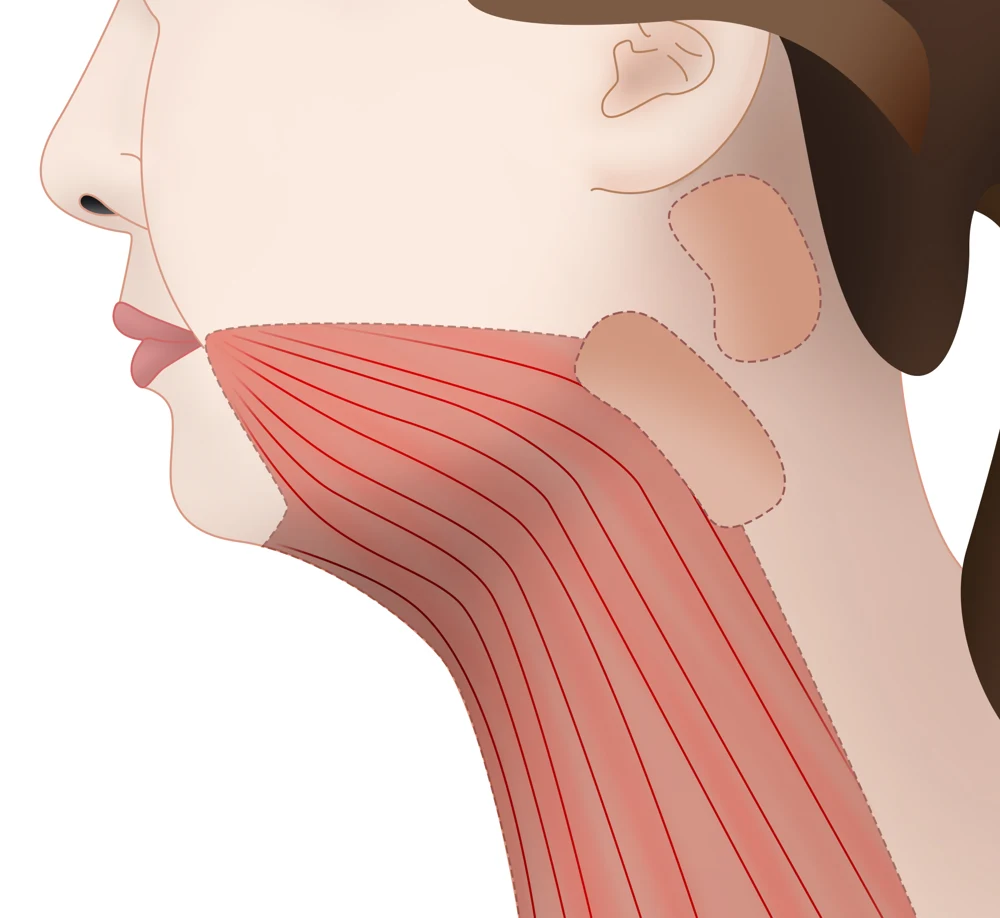
Red: the platysma muscle. Tan areas: the salivary glands (the parotid gland below the ear and the submandibular gland under the jaw).
The illustration shows why that last rule matters. A mini neck lift tightens the platysma muscle with internal sutures. Bending the head far back for long periods pulls on those sutures before the muscle has healed in place.
As for the weakness at the corner of the mouth mentioned above, the published evidence is reassuring. In a 2015 Plastic and Reconstructive Surgery review of 112 facelift patients who also had submandibular gland reduction, it occurred in about 4.5% of patients and resolved fully in every case within 3 months.
Warning Signs: When to Call the Clinic Right Away
Bleeding under the skin (a hematoma) is the most common early complication of any neck lift. Plastic surgery textbooks report rates from about 1% upward, depending on the study. Pockets of fluid under the skin (seromas) are another risk, and they form more often in the neck than in the face, which is why we place a drain. Several of the mini neck lift aftercare rules above (avoiding aspirin, vitamin E and alcohol, and not straining or lifting heavy objects) exist mainly to lower the risk of a hematoma.
A 2025 Aesthetic Surgery Journal review adds one detail worth knowing. A deep neck hematoma can form beneath the platysma muscle and may appear as late as 10–14 days after surgery, sometimes with no bruising on the surface. So do not ignore the symptoms below just because the first week went well.
- Swelling on one side that grows quickly, or a neck that feels increasingly tight or hard
- Pain that keeps getting worse instead of better
- Any difficulty breathing or swallowing. Seek emergency care immediately.
- Redness, heat or pus around an incision, or a fever
- Skin under the garment that turns dark, blistered or very pale
The American Society of Plastic Surgeons makes the same points in its neck lift recovery guidance: keep your head elevated above your heart, and follow your surgeon’s specific instructions on wound and drain care, including which warning signs to look for.
Scar Care: Months 3 to 9
11. How to Use Scar Ointment
- Use either Dermatix Ultra Gel or Contractubex Gel. Pick one of the two, not both.
- Start 3 months after stitch removal and keep going for at least 6 months.
- Clean the scar first, then gently pat it dry.
- Use it only once the wound has fully closed. Never apply it to an open wound.
- Spread a small amount thinly. A pea-sized amount is enough.
- Massage it gently into the scar, then let it dry for 1–2 minutes.
- Apply twice a day, morning and evening.
12. Scar Ointment Precautions
- Do not rub or scratch the scar after applying the gel.
- Sunlight can darken a healing scar, so use sunscreen whenever you go outside.
- If the gel irritates your skin or causes an allergic reaction, stop using it and contact the clinic.
Mini Neck Lift Aftercare: Frequently Asked Questions
How long should I wear the compression garment after a mini neck lift?
Wear it 24 hours a day for the first week, taking it off only briefly to eat, brush your teeth or wash. After that, wear it at home and while you sleep for at least 8 hours a day, for about a month. It should feel firm but never painful. The garment is one of the most important parts of mini neck lift aftercare, so try not to skip it.
When can I shower and wash my hair?
Until your stitches are removed on day 7, shower your lower body only and clean your face around the incisions without wetting them. Once the stitches are out, you can shower and wash your hair normally. Saunas, pools and the sea should wait one month.
When can I go back to work or exercise?
Everyday activities are fine right away, and many people return to desk work within days, although swelling and bruising may still be visible for 2–4 weeks. Walking for exercise can start after 1–2 weeks. Strenuous exercise should wait one month. For a week-by-week look at how people return to normal life, see mini neck lift scars and recovery time.
Is it normal for my neck to feel hard and lumpy after a month?
Yes. As the lifted skin reattaches, the area often feels firm or slightly uneven for the first two months or so. It usually softens from around three months. Do not massage it during the first month. Contact the clinic if one area is growing, painful or hot.
Why can’t I tilt my head back for three months?
The platysma muscle is tightened and held with dissolving internal sutures. Holding your head far back for long periods pulls on that repair before the tissue has healed in place. Normal movement is fine; just avoid long stretches of looking straight up, such as at a hair salon basin or while painting a ceiling.
A Note From Our Surgical Team
Good mini neck lift aftercare matters as much as the surgery itself, and we are grateful for your cooperation. If anything feels wrong, or you simply are not sure, contact us at any time. A quick question is always better than waiting. You can find more about the procedure itself on our mini neck lift in Korea page.
MINE Plastic Surgery & Dermatology, 813 Nonhyeon-ro, Gangnam-gu, Seoul, South Korea, 4th floor
T. +82 10 3476 1175 · Clinic hours: weekdays 10 AM–7 PM, Saturdays 10 AM–4 PM
References: Plastic Surgery, Volume 2: Aesthetic Surgery (Neligan), chapter on neck rejuvenation (hematoma and seroma after neck lift, drains); Morel S. et al., “Aesthetic Submandibular Gland Resection: A Review of Complication Incidence and Prevention,” Aesthetic Surgery Journal 2025; Mendelson B.C., Tutino R., “Submandibular Gland Reduction in Aesthetic Surgery of the Neck,” Plastic and Reconstructive Surgery 2015;136:463. Medically reviewed by Dr. Lee Sung-wook, board-certified plastic surgeon at MINE, Seoul. Last reviewed: October 2026.
※ This content is for informational purposes only and does not replace professional medical advice, diagnosis, or treatment. Individual results may vary, and side effects may occur. Please consult with a board-certified plastic surgeon for personalized advice.