EN
EN

Fat grafting aftercare is the set of recovery rules that protect transferred fat while it reconnects to a blood supply in its new location — the process surgeons call graft take. The surgery takes about an hour. The 3 months that follow decide how much of that fat is still there once the swelling has gone.
I am Dr. Lee Sung-wook, board-certified plastic surgeon and director of MINE Plastic Surgery & Dermatology in Seoul. In clinic I repeat one line: give it a month. Below is our own fat grafting aftercare sheet, with the reason behind each rule.
Table of Contents
- Why Fat Grafting Aftercare Decides the Result in the First Month
- 1. Sleeping Position and Head Elevation
- 2. Eating, Salt and Staying Hydrated
- 3. Swelling Care: Where Cold Is Safe and Where It Is Not
- 4. Wound Care and Donor-Site Dressings
- 5. Washing Your Face, Showering and Sauna
- 6. Exercise and Getting Back to Normal Life
- 7. Medication, Aspirin and Vitamin E
- 8. Alcohol and Smoking for the First Month
- 9. Graft Survival: Weight, Massage and the Second Session
- Normal Healing and the Side Effects Worth Knowing About
- Fat Grafting Aftercare by Area: Face, Breast and Donor Site
- Warning Signs That Mean You Should Call the Clinic
- Fat Grafting Aftercare: Frequently Asked Questions
- Planning Your Fat Grafting Recovery With MINE in Seoul
Why Fat Grafting Aftercare Decides the Result in the First Month
Every rule below exists to keep transferred fat alive long enough to build its own blood supply. Knowing that makes fat grafting aftercare much easier to follow.
How transferred fat survives in its new home
Fat is taken from your own thigh or abdomen, washed, and injected in fine threads rather than one lump, so every cell sits close to living tissue. For a few days it lives on fluid seeping in from around it. Then new capillaries grow in — that is graft take, the moment transferred fat gains its own blood supply.
Pressure, rubbing, heat and heavy movement all interrupt that ingrowth. It is why fat grafting aftercare loads almost every restriction into the first month.
What surgical textbooks set as the 72-hour, 1-week and 1-month lines
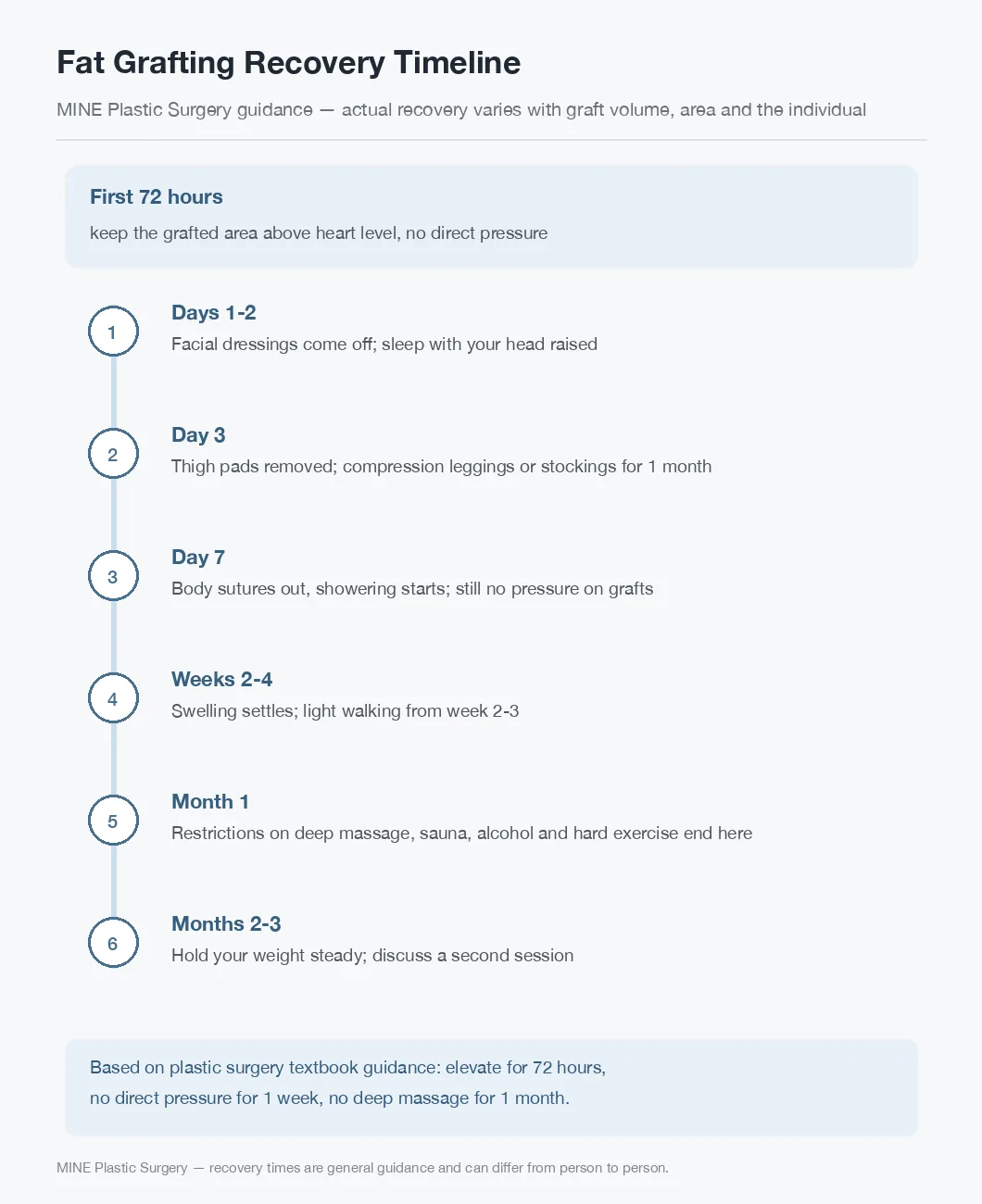
Plastic surgery textbooks describe the same three lines after fat grafting: keep the area above heart level for 72 hours, avoid direct pressure for 1 week, and avoid deep massage for about 1 month. That is why studies and clinic protocols alike settle on roughly 4 weeks of protecting the graft before anything presses on it.
Our fat grafting aftercare sheet says 1 month where the textbook minimum is 1 week — a margin, not a disagreement, because patients return to normal life faster than a graft does.
| Stage | What matters most |
|---|---|
| Surgery to 72 hours | Graft above heart level; no pressure, no direct ice |
| Day 7 | Body sutures out, showering starts; grafts still off limits |
| Month 1 | No deep massage, sauna, alcohol, smoking or hard exercise |
| Month 3 | Hold your weight steady; discuss a second session |
Who needs to be strictest about these rules
Large grafted volumes, smokers, anyone planning to lose weight and anyone flying home soon have the least room for error. For them fat grafting aftercare is a fixed schedule rather than a guideline. We plan the trip around the graft: stay until the body sutures come out on day 7, and photographs cover the rest.
1. Sleeping Position and Head Elevation
For the first week, sleep with your upper body raised so your head stays above heart level. For 1 month, sleep on your back — not on your side, not face down. After that month we confirm at your follow-up visit that face-down sleeping is safe again. Patients who go on to have a second grafting session wait longer, roughly 3 months from that second session.
Keeping the grafted area above heart level for the first 72 hours is the single most repeated instruction in the fat grafting literature. An extra pillow usually does it, with cushions on both sides if you roll over. Lying on one side rests your head on that cheek for hours — exactly the pressure fat grafting aftercare exists to prevent.
2. Eating, Salt and Staying Hydrated
You can eat normally. The point of fat grafting aftercare at the table is not eating less but eating well, because healing wounds and new vessels are built from protein and vitamins.
Salt holds water in the body and prolongs swelling, so cut it back for the first two weeks, while swelling is high. In Korea most of it hides in soup and stew broth, in kimchi, and in the small side dishes that arrive with every meal. In practice that means eating the solids and leaving the broth in the bowl, treating salty side dishes as a taste, not a serving, and seasoning at the table rather than in the pot, so you can see how much you are adding.
Dipping sauces, instant noodles and convenience-store meals are the other common sources, and the same rule travels home with you: restaurant and packaged food carries more salt than anything you cook yourself. This is about easing off, not cutting salt out. If you already follow a salt restriction for a medical reason, keep to the plan your own doctor set.
- Protein at every meal — eggs, tofu, lean meat or fish.
- Drink water steadily, and go easy on salty soups, broths and side dishes.
- Skip spicy food and very hot soup in the first week, when swelling is worst.
- Put any weight-loss diet on hold for 3 months.
3. Swelling Care: Where Cold Is Safe and Where It Is Not
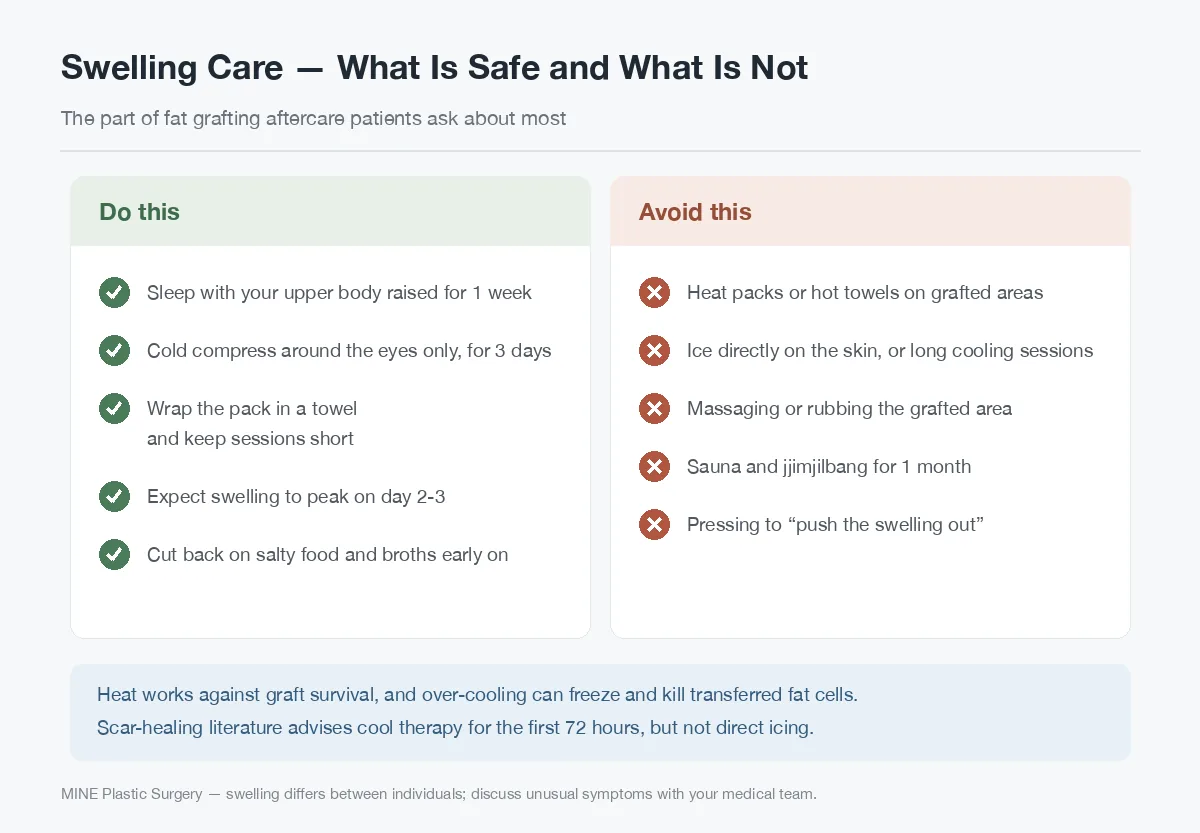
Swelling peaks on day 2 to 3 and settles over 2 to 4 weeks. Watching it climb on the second morning frightens people into rubbing the area, which is the most common way fat grafting aftercare goes wrong. Cold is the part of fat grafting aftercare that gets misread in both directions, so it needs two rules.
Do this
- Sleep with your upper body raised for the first week.
- Use a cold compress around the eyes only, for up to 3 days.
- Wrap the pack in a towel and keep each session short.
- Expect the peak on day 2 to 3 and let it pass.
- Cut back on salty food while swelling is high.
Avoid this
- Heat packs or hot towels on a grafted area.
- Ice straight onto the skin, or long cooling sessions.
- Massaging or rubbing a graft to speed things along.
- Sauna and jjimjilbang (the Korean bathhouse) for 1 month.
- Pressing on the area to push the swelling out.
Never ice a grafted area directly or cool it for long stretches: low temperatures can freeze and kill the fat cells you are trying to keep. Around the eyes, where nothing was grafted, a towel-wrapped cold pack helps for 3 days.
Scar-healing literature supports cool therapy over the first 72 hours but warns that direct icing can chill grafted fat enough to kill the transferred cells. Heat is simpler: hot packs, hot baths and saunas work against graft survival all month.
Dr. Lee’s Key Point: Swelling is waited out, not squeezed out — the rule patients ignore most often.
4. Wound Care and Donor-Site Dressings
Facial injection points are usually too small for stitches, so we cover them with Duoderm (a hydrocolloid dressing, the thin beige patch). Facial dressings come off in 1 to 2 days; body sutures come out on day 7, matching textbook practice.
The donor site (the thigh or abdomen the fat came from) keeps its pad for 3 days, then moves to compression leggings or stockings for 1 month. Clear fluid may leak on the first day — that is tumescent fluid, the solution injected to loosen the fat before harvesting. Blot it with a clean towel.
Compression is standard rather than a MINE preference: textbooks recommend compression garments or an abdominal binder after a large harvest. This part of fat grafting aftercare is really liposuction aftercare, so our liposuction recovery timeline and the American Society of Plastic Surgeons overview both apply.
5. Washing Your Face, Showering and Sauna
Wash your face from the day after surgery; shower once the body sutures come out on day 7. Textbooks allow a shower 48 hours after fat grafting, and our fat grafting aftercare is deliberately more conservative, because the donor site rather than the face needs protecting. To shower sooner, cover the sutured area with waterproof tape and start from day 3.
Gentle washing stays in place for a full month: lather in your hands, lay the foam on your face, rinse. No scrubbing, no brushes, no exfoliation. Sauna and jjimjilbang are out for 1 month, because heat works against graft take and humid heat raises the infection risk for incisions that have not closed.
6. Exercise and Getting Back to Normal Life
Exercise is where fat grafting aftercare collides with real life, because patients feel well long before a graft is safe. Ordinary daily activity resumes about a week after surgery. Light exercise such as brisk walking resumes at 2 to 3 weeks, and full training at 1 month.
Rushing causes two problems: raised blood pressure brings swelling and bruising back, and sweat and vibration irritate the incisions and the graft. Head-down positions such as yoga inversions, along with heavy lifting, wait until after the first month.
7. Medication, Aspirin and Vitamin E
Fat grafting aftercare includes a medication review. Take your first dose 30 minutes after your first meal following surgery, keep to the same times each day, and finish the course. If a dose brings on diarrhea, a rash or any allergic reaction, call the clinic rather than pushing through it.
Aspirin and vitamin E are paused for 3 weeks because they slow clotting, which after surgery means more bruising and bleeding at the graft and the donor site. One important exception: if you take aspirin daily for a heart or blood-vessel condition, do not stop it on your own. Tell the prescribing doctor and tell us, and we will work out a plan together.
Supplements count too. Fish oil, ginseng and high-dose vitamin E all affect bleeding, so list everything you take at your consultation.
8. Alcohol and Smoking for the First Month
No alcohol and no smoking for 1 month. This is the hardest item of fat grafting aftercare for most patients, and the one with the clearest evidence behind it.
Research on wound healing links nicotine to narrowed blood vessels and lower oxygen delivery, which is the basis for the 1-month no-smoking window after surgery. Nicotine also blunts the immune cells doing the early work of repair, and alcohol has been linked to a higher rate of surgical-site infection.
Transferred fat only lives if new vessels grow into it, so anything that narrows them works against graft survival at the worst possible moment. The same literature has a hopeful side: complication rates in people who stop smoking move back toward those of non-smokers.
9. Graft Survival: Weight, Massage and the Second Session
For 1 month, keep pressure, deep massage and bumps away from the grafted area — including how you sleep, how you carry a bag, and how glasses sit on your face. This is the core of fat grafting aftercare, and everything above serves it.
“Do not touch it at all” is not what the textbooks say. Deep massage of a grafted site should be avoided for the first 4 weeks, while light touch is fine throughout. Washing your face or resting a hand on your cheek does not damage a graft; sustained pressure and kneading do.
| Helps graft survival | Works against graft survival |
|---|---|
| Holding your weight steady for 3 months | Losing weight after surgery |
| Protein at every meal | Sleeping on your side or face down |
| Graft above heart level for 72 hours | Heat: sauna, hot packs, hot baths |
| No pressure, no deep massage for 1 month | Early deep massage to reduce swelling |
| No smoking or alcohol for 1 month | Nicotine narrowing the new vessels |
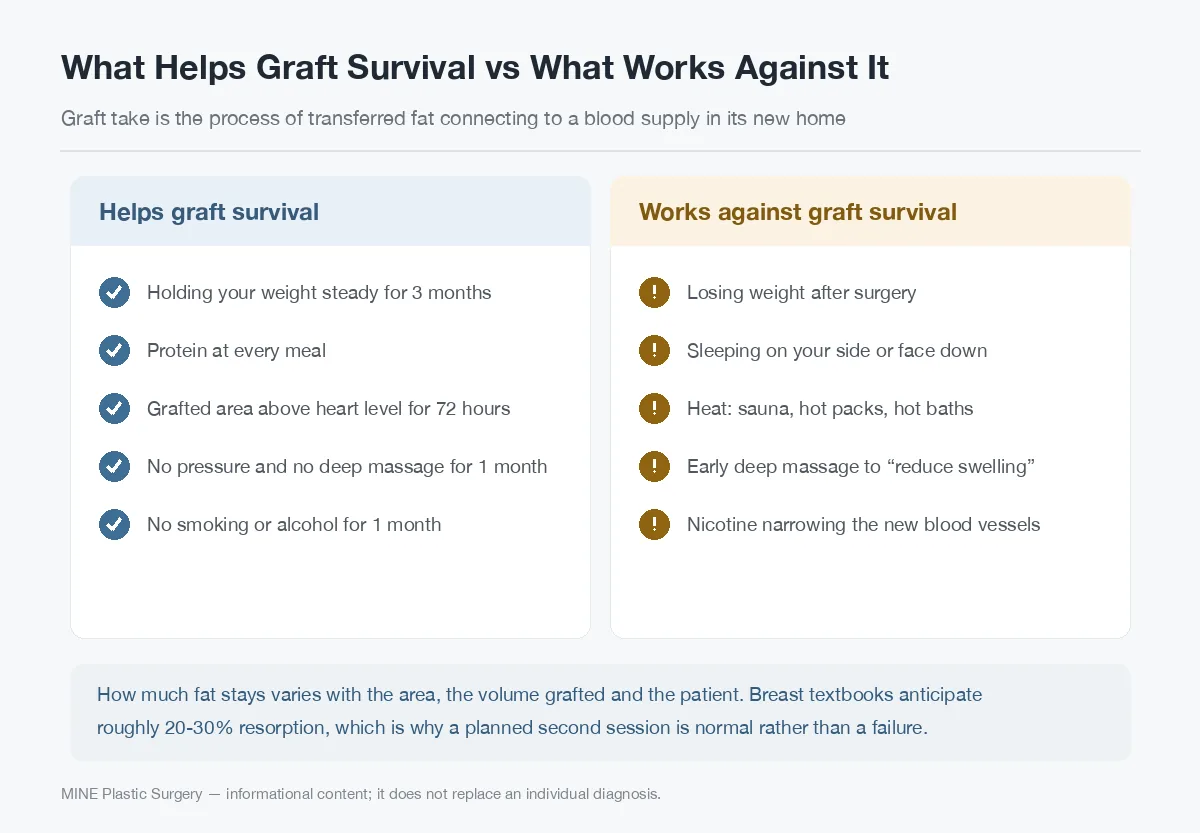
Weight is the part of fat grafting aftercare that runs longest. Grafted fat cells behave like every other fat cell you own, so when you lose weight they shrink too. Booking surgery and a diet in the same season means undoing one with the other.
How much fat stays is genuinely variable and depends on the area, the volume placed and the patient. Breast surgery textbooks expect roughly 20 to 30 percent of transferred fat to be reabsorbed, which is why surgeons slightly over-fill and plan a supplementary session a few months later. That figure is something to plan around, not a promise about your result.
The same textbooks warn against answering that with more volume in one sitting: saturated tissue cannot take up further fat, and over-filling risks fat necrosis — small areas of grafted fat that die and harden. A planned second session gives steadier results, and it rests on the same principle — support the graft and keep it still — set out by Khouri & Khouri, Plastic and Reconstructive Surgery 2017.
A second session usually falls at 2 to 3 months. Banked fat is stored for up to 5 months, after which it is discarded per the consent form you signed. If you live abroad, ask about a date before the three-month mark.
Normal Healing and the Side Effects Worth Knowing About
Because fat grafting uses your own tissue, rejection is not a concern. That does not make it a procedure without side effects, and honest fat grafting aftercare means knowing which changes belong to healing.
| What you notice | How to read it |
|---|---|
| Swelling and bruising | Peaks on day 2 to 3, then fades over 2 to 4 weeks |
| Firm spots you can feel | Common as fat is reabsorbed; report growth or pain |
| Left-right difference | Normal while swelling drains; judge at 3 months |
| Reduced sensation | Usually temporary while small nerves recover |
| Redness, warmth, fever, pus | Not part of normal healing — call the clinic |
Reabsorbed fat can leave small firm nodules, and a few may calcify (harden with calcium deposits). Most need only watching, but have a lump examined if it grows, turns painful, or appears months after everything else has settled. Our guide to breast fat transfer side effects and precautions covers nodules, calcification and asymmetry case by case.
Rarely, injected fat can enter a blood vessel. The surgical literature treats this as something to keep in mind at every injection, which is why grafting should be done by a surgeon who works layer by layer, guided by anatomy and by how much pressure the tissue is under.
Dr. Lee’s Key Point: The line between normal and abnormal is direction. Improvement that stalls is usually fine; anything actively getting worse should be checked.
Fat Grafting Aftercare by Area: Face, Breast and Donor Site
The nine rules apply wherever fat was placed; what changes is which of them bites hardest and how long each runs. Some breast surgery texts recommend supporting a graft for as long as 10 weeks, facial grafts are usually managed over about a month, and the volume placed shifts the answer as much as the site does.
Facial fat grafting recovery: what changes day to day
Faces are visible, so facial fat grafting aftercare is where patients want a day-by-day answer. Dressings come off in 1 to 2 days. Light makeup is usually possible once the injection points are dry, often around day 3 to 5, though the follow-up visit decides that. Sunscreen waits until the skin has closed.
For about a month, wash without rubbing, sleep on your back, and watch what presses on your face during the day. Glasses resting on grafted temples, a mask strap across grafted cheeks, a phone held to one side, a hand propping up your chin — in facial fat grafting aftercare these small repeated pressures matter more than any single event.
One thing you can stop worrying about: talking, chewing and laughing are not restricted. Muscle movement underneath a graft is not the same as pressure on top of it. If you are weighing the procedure itself, our page on facial line fat grafting at MINE explains which areas we treat.
Hollowing under the eyes is a separate matter. Undereye fat repositioning moves your own orbital fat instead of grafting harvested fat, so it follows its own schedule — see our undereye fat repositioning precautions.
Breast fat grafting: the short version
Breast fat grafting aftercare comes down to four rules: no firm touching or compression for 1 month, a sports bra instead of an underwire one, no wide, sweeping arm movements in the first week, and face-down sleeping from 1 month, confirmed at your follow-up visit. The process, timeline and side effects are covered in the full breast fat transfer recovery guide.
Donor site care after fat grafting (thighs and abdomen)
Donor-site fat grafting aftercare is simpler. Keep the pad on for 3 days, then wear compression stockings or leggings for 1 month. Expect clear fluid on the first day, and bruising that outlasts the graft site but usually fades over 2 to 4 weeks. Numbness and a firm, board-like feel are normal early on; one side becoming markedly harder, hotter or more painful than the other is not.
Warning Signs That Mean You Should Call the Clinic
Swelling, bruising and firmness almost always resolve on their own. Most of fat grafting aftercare is patience; this short section is the opposite.
- A fever of 38°C (100.4°F) or higher, or a low fever lasting more than a day.
- Swelling and pain still increasing after day 3, or suddenly getting worse.
- Redness that spreads, with warmth in the area.
- One side swelling or hardening suddenly when the other does not.
- Pus-like discharge or a bad smell from any incision.
- Diarrhea, a rash or any allergic reaction after taking your medication.
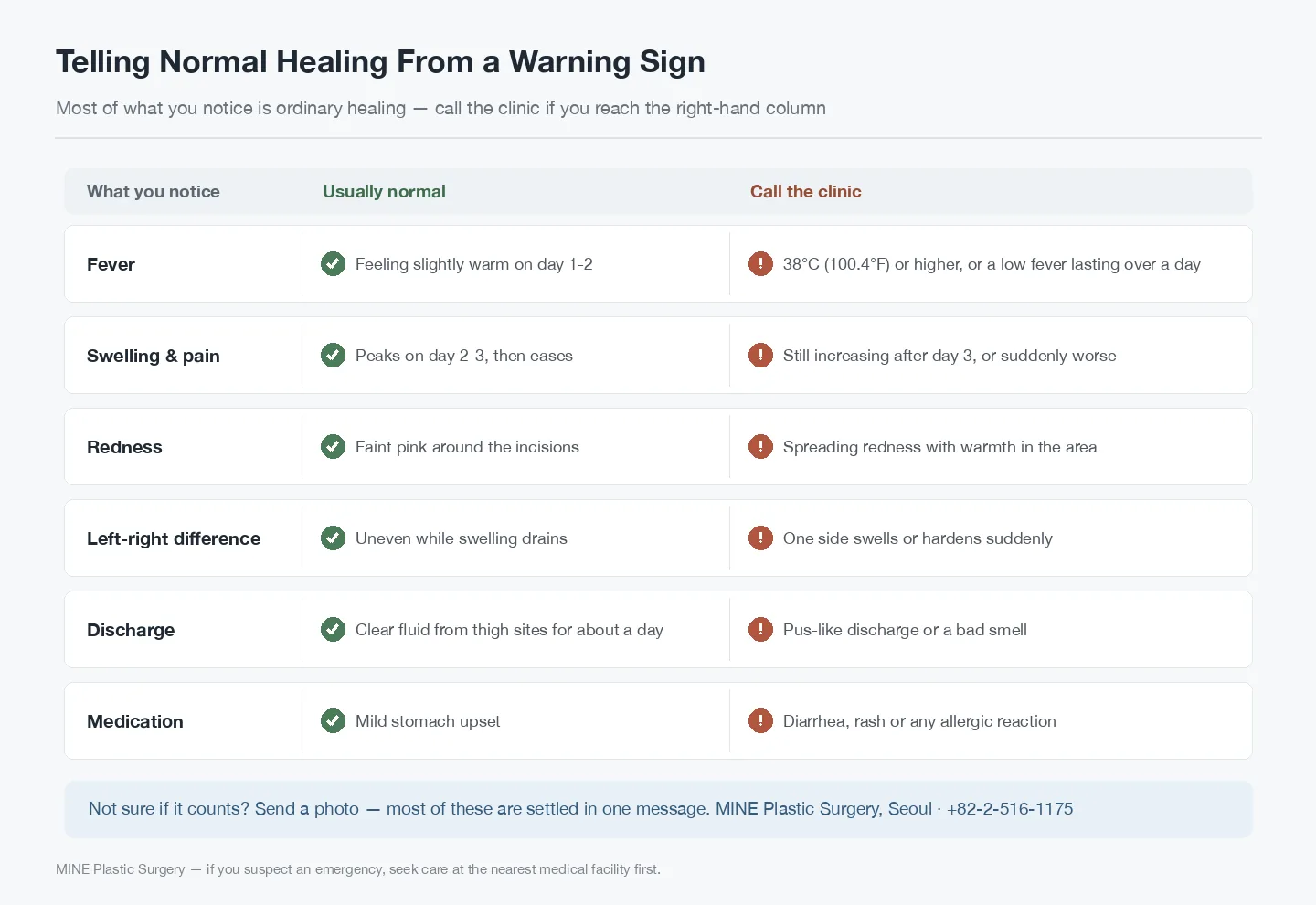
A fever of 38°C (100.4°F) or higher is a reason to call rather than wait. If you have already flown home, send photographs taken in good daylight with the date of your surgery. Our line is +82-10-3476-1175, and you can reach us on WhatsApp at the same number.
Dr. Lee’s Key Point: The moment you wonder whether something is worth calling about is the right moment to call.
Fat Grafting Aftercare: Frequently Asked Questions
When can I start massage after fat grafting?
Deep, pressing massage waits until about 1 month after surgery, confirmed at your follow-up visit. Textbooks advise avoiding deep massage of a grafted site for the first 4 weeks, while light touch is fine throughout. Kneading early to push swelling out is the most common mistake in fat grafting aftercare.
How long does swelling last after fat grafting?
Swelling and bruising are worst 2 to 3 days after surgery, then settle over 2 to 4 weeks. The volume grafted, the area treated and your own tissue change the pace, so two people who had the same operation rarely look alike at week 2. Judge the final shape at 3 months, when fat grafting aftercare is essentially over.
When can I wash my face and shower after fat grafting?
Wash your face from the day after surgery, and shower once the body sutures come out on day 7. To shower sooner, cover the sutured area with waterproof tape and start from day 3. For about a month, wash without rubbing: lather in your hands, lay the foam on, rinse.
How long do I have to stop drinking and smoking after fat grafting?
At least 1 month for both. Nicotine narrows the small vessels that need to grow into the graft, and alcohol has been linked to a higher risk of surgical-site infection. Nothing else on this list works against graft survival as directly.
Is a second fat grafting session always necessary?
No. It is offered because part of the first graft is reabsorbed, so patients who want more volume benefit from a touch-up rather than needing one. The usual window is 2 to 3 months, and banked fat is kept for up to 5 months before being discarded according to your consent form.
When can I wear makeup and sunscreen again after facial fat grafting?
Light makeup is usually possible once the Duoderm is off and the injection points are dry, often around day 3 to 5, although your follow-up visit decides it. Remove it without rubbing: hold a cotton pad soaked in micellar water against the skin, then wipe. Sunscreen goes on once the skin has closed.
What happens if I do not follow fat grafting aftercare exactly?
One or two slips will not decide your result. What matters is the pattern: repeated pressure, repeated heat or steady weight loss work against graft take. The time ahead of you counts for more than the days behind you, so tell us at the follow-up visit and we will adjust your fat grafting aftercare.
Planning Your Fat Grafting Recovery With MINE in Seoul
Keeping every rule perfectly for 3 months is exhausting, so I give patients a priority order. All of fat grafting aftercare reduces to three sentences. For 72 hours, keep the grafted area raised and never ice it directly — a towel-wrapped cold pack is for the skin around the eyes only. For 1 month, do not press the graft and do not heat it. For 3 months, eat well and hold your weight.
How long each rule runs depends on where the fat went, how much was placed and what else was done at the same time, so your own fat grafting aftercare schedule is set at the follow-up visit rather than by a blog post.
If it is the procedure you want to read about, our page on facial line fat grafting at MINE explains what the surgery involves. For an appointment or a question about your aftercare, call or message us on WhatsApp at +82-10-3476-1175, or visit us at 813 Nonhyeon-ro, Gangnam-gu, Seoul. Patients who have already flown home are welcome to send photographs — remote follow-up is part of how we work with international patients.
Written and medically reviewed by Dr. Lee Sung-wook, board-certified plastic surgeon, MINE Plastic Surgery & Dermatology.
※ This content is for informational purposes only and does not replace professional medical advice, diagnosis, or treatment. Individual results may vary, and side effects may occur. Please consult with a board-certified plastic surgeon for personalized advice.