EN
EN

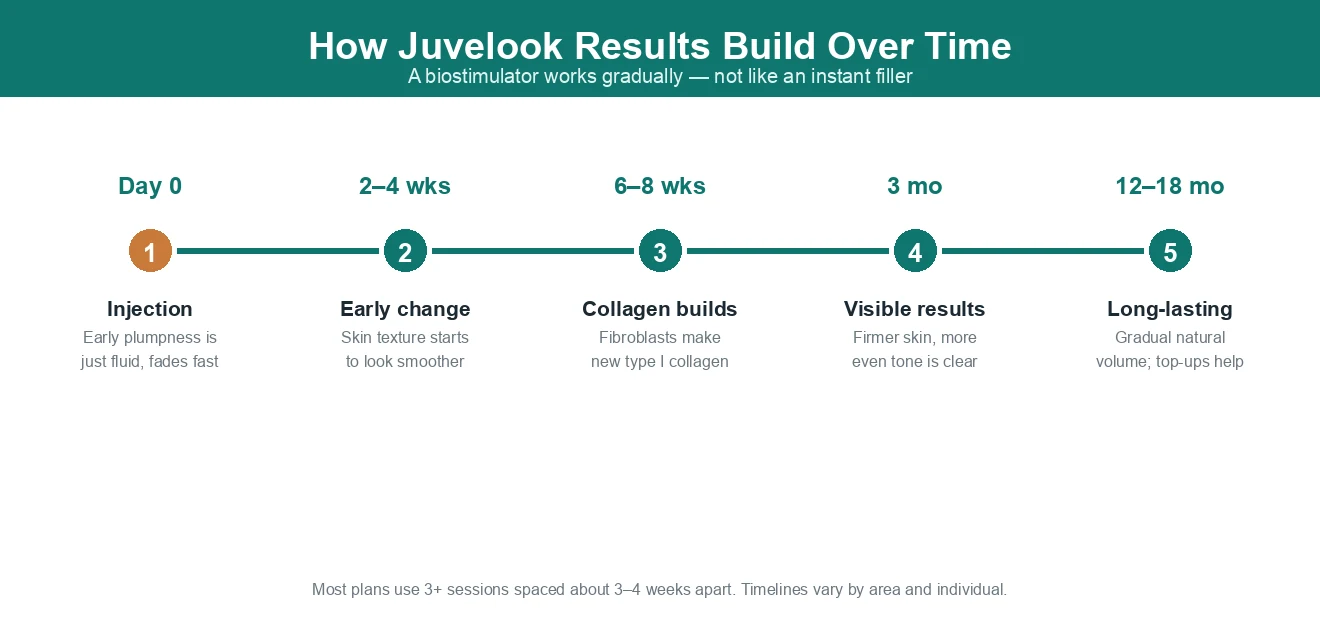
Quick answer: Juvelook is a PDLLA-based collagen stimulator (combined with hyaluronic acid) injected into the dermis to prompt your skin’s own collagen production, rather than simply adding volume like a filler. It is commonly used on the cheeks, forehead, jawline, nasolabial folds, neck, and hands, with results that build over a few weeks and typically last around 12–18 months over a course of sessions. Individual results vary.
Table of contents
Are you mapping out the right Juvelook treatment areas for your goals? Most people already grasp what Juvelook does, yet still wonder exactly where it can be injected.
Juvelook treatment areas are the specific face and body zones where this PDLLA-based collagen stimulator is placed into the dermis to prompt your own skin to build new collagen, instead of simply plumping a line the way a hyaluronic-acid filler does. In plain terms it is a “biostimulator,” not an instant filler: any early plumpness you see is mostly the carrier fluid, while the real, gradual improvement appears over the following weeks and months.
This guide walks through every one of the Juvelook treatment areas on the face and body, where both regular Juvelook and Juvelook Volume are used. (Regulatory clearance differs by country and product version — see the FAQ below.)
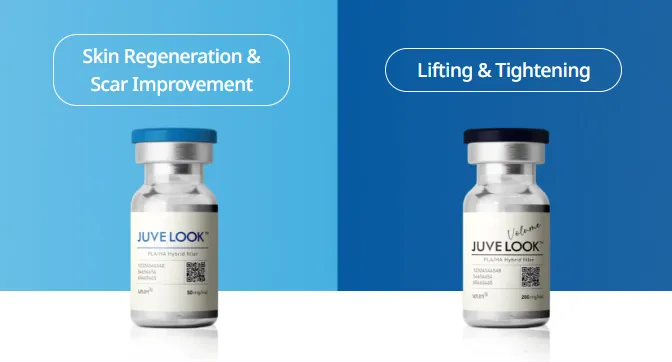
Understanding Juvelook vs Juvelook Volume Differences
Regular Juvelook treatment (Standard Formula)
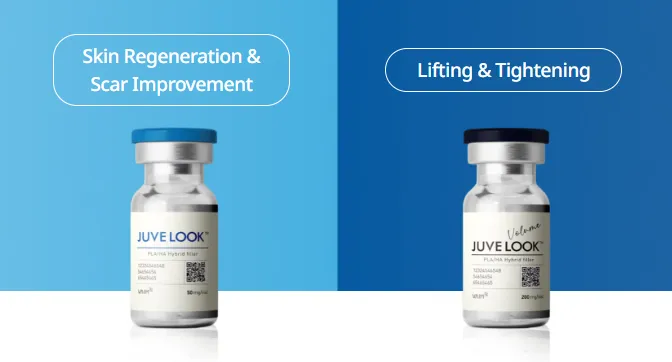
Regular Juvelook contains smaller particles suitable for thinner skin layers, making it ideal for addressing fine lines around the eyes and mouth, enlarged pores, and acne scars. This formulation primarily focuses on skin texture improvement and fine line reduction.
Juvelook Volume
Juvelook Volume features larger particles designed for deeper skin injection, delivering enhanced volume and firmness effects. The higher concentration PDLLA allows for deeper tissue treatment, making it well suited for volume enhancement in areas requiring more substantial correction.
Facial Treatment Areas by Zone
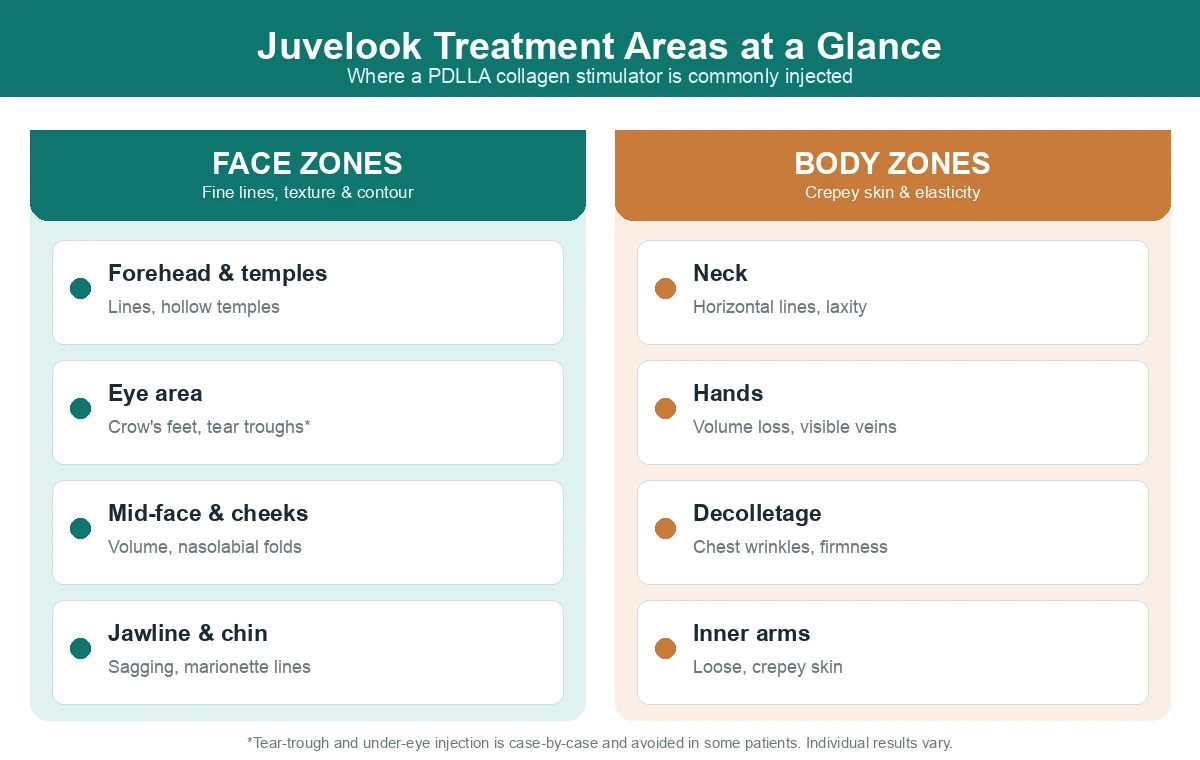
1. Forehead and Temple Region
Regular Juvelook Applications:
- Horizontal forehead lines and fine wrinkles
- Skin texture improvement and brightness enhancement
Juvelook Volume Applications:
- Volume restoration for hollow temples
- Creating more youthful forehead contours
2. Eye Area Treatment Zones
The eye area is particularly effective for fine line improvement with regular Juvelook. However, careful consideration is required for patients with significant under-eye fat or very thin skin.
Suitable Areas:
- Crow’s feet: Regular Juvelook for fine line improvement
- Tear troughs: Juvelook Volume for volume enhancement, though under-eye injection should be avoided in certain cases
- Upper eyelid: Safe for targeted treatment with proper technique
Important Considerations: For Juvelook Volume, under-eye injection is not recommended due to potential complications
3. Mid-Face and Cheek Areas
The cheek area benefits from Juvelook treatments for nasolabial folds, tear troughs, and hollow cheek volume restoration.
Treatment Options:
- Front cheeks: Juvelook Volume for natural volume enhancement
- Lateral cheeks: Gradual volume improvement through collagen stimulation
- Nasolabial folds: Requires careful technique with a 25G cannula to minimize tunneling
4. Lower Face and Jawline
Effective Areas:
- Marionette lines: Juvelook Volume provides effective improvement for these deeper lines
- Jawline: Lifting effects for sagging jaw contours
- Double chin area: Combined with other treatments for optimal results
Precautions: Excessive treatment may result in unnatural appearance, requiring expert injection technique.
Can Juvelook Be Used on Body Areas Too?
Many patients wonder whether Juvelook treatment areas extend beyond the face. The same collagen-stimulating science used in the Juvelook injection can be applied to several body zones where skin has grown thin or crepey. Yes — Juvelook is used on multiple body areas, not just the face.
1. Neck Area
Neck treatment is particularly effective for wrinkle improvement, benefiting both younger and older patients thanks to its strong collagen-stimulating properties.
Benefits:
- Neck wrinkle reduction: A particularly effective treatment area
- Neck elasticity improvement: Overall neck skin quality enhancement
- Smooths horizontal neck folds and tightens the neck skin
2. Hands
Treatment Benefits:
- Visible vein reduction: Hand treatments typically use 1-2 vials per session with 4-8 week intervals
- Hand wrinkle softening: Improved skin texture
- Enhanced skin elasticity: Overall hand rejuvenation
3. Décolletage Area
Applications:
- Décolletage wrinkle improvement: Often requires 1-2 vials for neck or décolletage treatment
- Skin elasticity restoration: Firming of chest area skin
4. Inner Arms
Benefits:
- Sagging arm skin improvement: Enhanced elasticity for loose arm skin
- Inner arm wrinkle reduction: Smoother arm contours
Area-Specific Effects and Duration
Thin Skin Areas (Eyes, Mouth)
Treatment Details:
- Product Used: Regular Juvelook
- Effect Timeline: Results visible 2-4 weeks after treatment
- Duration: 6-12 months
- Recommended Sessions: 3-4 treatments
Volume Enhancement Areas (Cheeks, Jawline, Temples)
Treatment Protocol:
- Product Used: Juvelook Volume
- Effect Timeline: Results develop 6-8 weeks after treatment
- Duration: 12-18 months, with results lasting up to 18 months
- Recommended Sessions: 3-5 treatments
Single treatments can be performed at 3-4 week intervals, with optimal results achieved through 3 or more sessions.
Key Considerations for Treatment Area Selection
1. Skin Thickness Assessment
Treatment Guidelines:
- Thin skin areas: Eyes, mouth – Regular Juvelook recommended
- Thicker skin areas: Cheeks, jawline – Juvelook Volume suitable
2. Desired Treatment Outcomes
Goal-Based Selection:
- Wrinkle improvement focus: Regular Juvelook
- Volume enhancement goal: Juvelook Volume
- Comprehensive anti-aging: Both products can be used in combination
3. Previous Treatment History
Many patients have previously received filler in the nasolabial fold area, which should be taken into account when planning Juvelook treatment.
4. Individual Constitutional Factors
Important Considerations:
- Keloid tendency: Mandatory specialist consultation
- Allergy history: Ingredient verification required
- Autoimmune conditions: Patients with rheumatoid arthritis or other autoimmune diseases should avoid treatment
Area-Specific Precautions
Contraindicated Areas
Experts recommend avoiding under-eye injection with Juvelook Volume. Additionally, the following areas require special attention:
High-Risk Zones:
- Vascular-rich areas: Around nose, central forehead
- High-mobility areas: Around mouth due to expression muscles
- Ultra-thin skin areas: Lateral neck, eyelids
Practitioner Expertise Requirements
Juvelook Volume requires significantly more technical skill from practitioners. Accurate injection depth and volume for each area is crucial, making selection of an experienced specialist essential. Because a biostimulator deposits microparticles that the body slowly remodels into new collagen, precise placement matters more than with a temporary filler.
Frequently Asked Questions
How long does Juvelook last?
Regular Juvelook results typically last about 6–12 months, while Juvelook Volume can last around 12–18 months. Some patients see longer-lasting effects with maintenance sessions. Individual results vary.
Is Juvelook a filler?
Not in the usual sense. Juvelook is a collagen stimulator (PDLLA with hyaluronic acid) that helps your skin build its own collagen over time, rather than adding immediate volume the way a standard hyaluronic-acid filler does.
How many Juvelook sessions do I need?
Most patients have about 3–4 sessions of regular Juvelook (or 3–5 for Juvelook Volume), spaced roughly 3–4 weeks apart. Your provider will tailor the plan to your skin and goals.
Is Juvelook FDA approved?
Juvelook is a PDLLA collagen stimulator, and its regulatory status differs by country and product version. Ask your provider to confirm the exact product used and its clearance for your treatment.
What is the difference between Juvelook and Sculptra?
Both stimulate collagen, but Juvelook uses PDLLA combined with hyaluronic acid and generally does not require post-treatment massage, whereas Sculptra uses PLLA and typically does. Your provider can advise which suits your skin.
What is Juvelook made of?
Juvelook is an injectable skin booster containing poly-D,L-lactic acid (PDLLA) microparticles suspended in hyaluronic acid. PDLLA is a biodegradable polymer that gradually stimulates the skin’s own collagen production, so the change comes from newly formed collagen rather than from the injected material adding volume directly.
Which face and body areas can Juvelook be applied to?
It is commonly applied to the cheeks, the area under the eyes, the forehead, and the chin and jawline, and on the body to the neck, decolletage, upper arms and abdomen. Suitable areas and injection depth are decided at consultation based on skin thickness and the concern being treated.
How is Juvelook different from Juvelook Volume?
Juvelook is placed in the superficial dermis and is used mainly for skin texture, enlarged pores and fine lines. Juvelook Volume uses a different particle formulation placed at a deeper level for structural volume. The two are selected by the layer that needs to be addressed, and individual results may vary.
How soon are changes seen, and how long do they last?
Because the effect depends on new collagen forming over time, changes are typically gradual over several weeks rather than immediate, and a course of sessions spaced several weeks apart is common. Duration varies with age, skin condition and lifestyle. A consultation with a specialist is needed to determine what is appropriate for you.
Choosing Your Optimal Juvelook Treatment Areas
Juvelook treatment areas vary significantly in their effects and characteristics. Treatment effects may differ based on individual skin conditions, making pre-treatment consultation essential to understand expected changes and limitations.
PDLLA injected between the dermis and fat layer gradually promotes collagen synthesis over time, eventually being replaced by natural tissue. This natural collagen production mechanism makes Juvelook applicable to diverse areas while providing long-term anti-aging effects.
When considering collagen stimulator treatments, understanding the science behind PDLLA is crucial. The inflammatory response triggered by PDLLA stimulates fibroblast cells to produce new collagen, with effects lasting up to 2 years. This natural collagen regeneration process sets Juvelook apart from temporary fillers.
At mineclinic, we provide personalized treatment area recommendations based on individual skin condition and desired outcomes. For comprehensive consultation on area-specific treatment plans, specialist evaluation helps determine the most effective injection sites and techniques.
Key Takeaways: Juvelook offers versatile treatment options for both facial and body areas, with regular Juvelook ideal for fine lines and texture improvement, while Juvelook Volume excels in volume enhancement applications. Professional assessment ensures optimal area selection and natural-looking results.
For detailed consultation or questions about area-specific Juvelook treatment protocols, contact mineclinic specialists for expert evaluation and personalized treatment planning. Explore our comprehensive guide to non-surgical facial treatments and discover how Juvelook integrates with other aesthetic procedures for enhanced results.
Medical disclaimer: This article is for general information only and is not medical advice. Juvelook is a collagen-stimulating injectable, and its approval status, suitable treatment areas, and expected outcomes vary by individual and by country. Results are gradual and differ from person to person. Always consult a qualified, licensed medical specialist who can examine your skin and review your medical history before any treatment. Rare side effects, including delayed inflammatory or nodule-type reactions, are possible, so honest screening and an experienced injector matter.
※ This content is for informational purposes only and does not replace professional medical advice, diagnosis, or treatment. Individual results may vary, and side effects may occur. Please consult with a board-certified plastic surgeon for personalized advice.