 EN
EN


Table of Contents
- Double Eyelid Surgery Types at a Glance
- Non-Incisional (Buried Suture) Method: A Crease Without an Incision
- Partial Incision Method: The Middle Ground That Can Also Lift a Sleepy Lid
- Full Incision Method: The Only Route When Excess Eyelid Skin Has to Go
- Why Asian Eyelid Anatomy Decides Which Double Eyelid Surgery Types Fit
- How to Choose Between the Double Eyelid Surgery Types
- Recovery: How the Three Double Eyelid Surgery Types Differ
- Risks, Limits and Honest Expectations
- Frequently Asked Questions About Double Eyelid Surgery Types
- Talk It Through With a Board-Certified Plastic Surgeon
Double eyelid surgery types are the three surgical routes used to create a crease in the upper eyelid — the non-incisional (buried suture) method, the partial incision method and the full incision method — and they are grouped by how much of the eyelid is actually opened.
Patients almost never open a consultation by asking which of the double eyelid surgery types is technically superior. They ask something far more practical: which one is right for my eyelids, and how many days do I need to clear? In my clinical experience, satisfaction tracks that second pair of questions much more closely than it tracks the name of the operation.
Double Eyelid Surgery Types at a Glance
Plastic surgery textbooks sort the double eyelid surgery types into incisional and non-incisional families, with partial-incisional techniques sitting somewhere in between. The classification has nothing to do with which method is fashionable. It describes how much access the surgeon needs in order to fix the crease and, where necessary, to remove tissue.
What all three double eyelid surgery types have in common
Every method produces the same thing: a fold that appears when you open your eye. That fold exists because the skin of the upper lid is tethered to the deeper structures that lift the eye. All three double eyelid surgery types build that tether — they differ in how they reach it and how firmly they hold it.
Double eyelid surgery is grouped into 3 types by how far the eyelid is opened: no incision, a partial incision, or a full incision. Everything else — the line height, whether skin comes off, whether a droopy lid is addressed at the same time — follows from that single decision.
The three methods side by side
The table below sets the three double eyelid surgery types against each other on the four points patients actually weigh: how the crease is made, who it suits, how long it holds and how much recovery it asks for.
| Method | How the crease is made | Who it suits | Crease durability | Recovery load |
|---|---|---|---|---|
| Non-incisional (buried suture) | Fine sutures passed through pinpoint openings; the knots are tied and buried under the skin | Thin, pliable lids with little or no excess skin | Holds well in the right lid, but the most likely of the three to fade | Lightest of the three |
| Partial incision | A row of small slit openings, with the skin fixed to the firm plate inside the lid at 5 or 6 points | No redundant skin, but a line that needs to hold better than a suture alone | Between the other two | Moderate |
| Full incision | One fine continuous incision; the skin edge is fixed to the deeper lid structures | Excess eyelid skin or fat that has to be removed | Longest-lasting of the three methods | Heaviest; the incision line matures over months |
Read the table as a map of trade-offs, not a scoreboard. Durability and recovery pull against each other — you cannot improve one without paying for it in the other — which is exactly why the choice belongs to your eyelid rather than to your preference.
Non-Incisional (Buried Suture) Method: A Crease Without an Incision
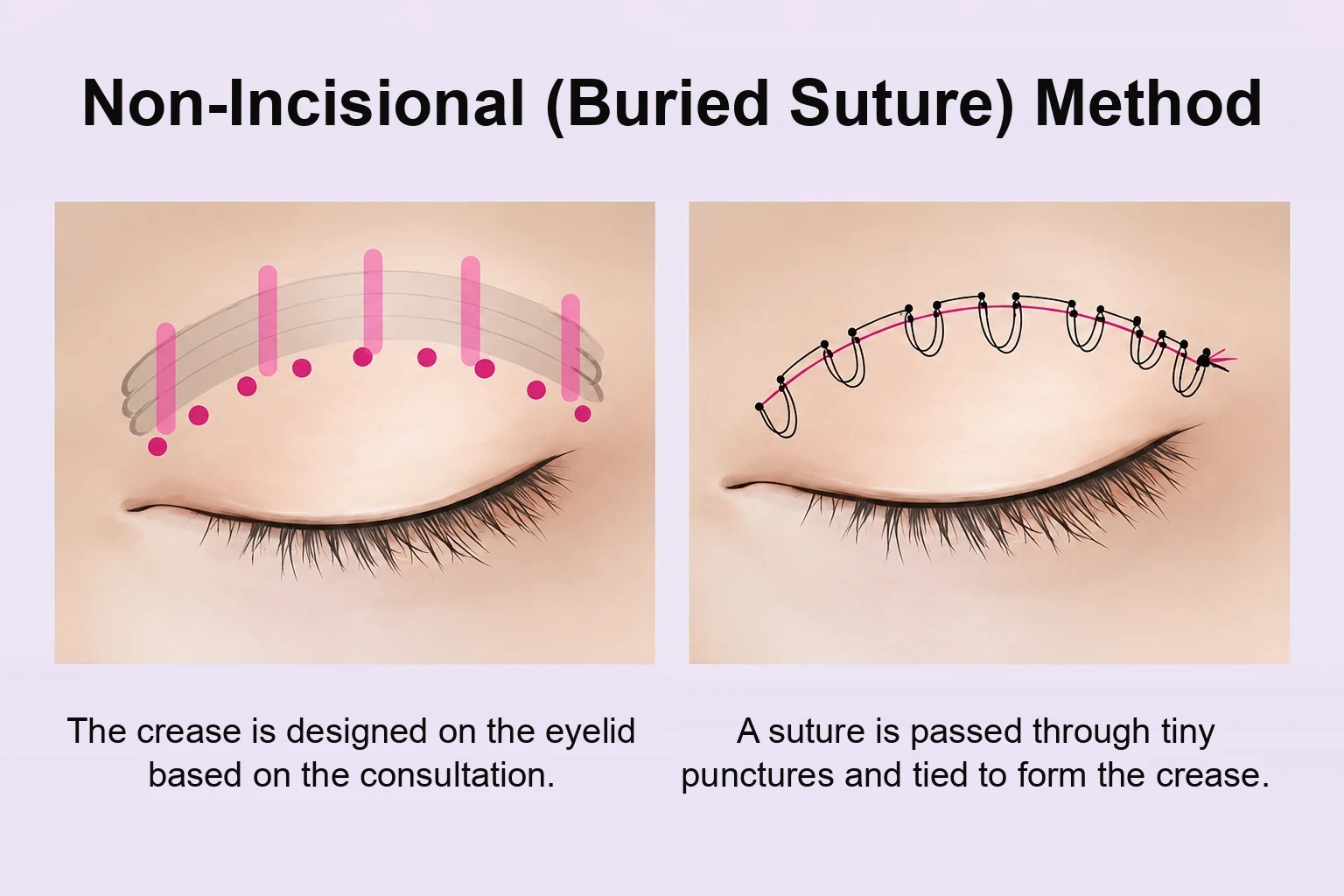
Of the three double eyelid surgery types, only the non-incisional method — usually called the buried suture technique — creates a crease without opening the eyelid. A fine suture is passed through the dermis (the inner layer of the skin) and across the thickness of the lid, catching either the tarsal plate (the firm plate that gives the eyelid its shape) or the levator aponeurosis (the tendon sheet that lifts the eyelid). The knots are then tied and buried out of sight.
How the buried suture method actually works
There is no continuous cut. The surgeon makes pinpoint openings with a needle or the tip of a scalpel, threads the suture through them, and ties it so the skin folds along the planned line. Because nothing is opened and nothing is taken out, the eyelid keeps all of its own tissue — which is the whole appeal of the technique.
Single-stitch vs multiple-stitch (3–5 per eyelid)
Plastic surgery textbooks split the non-incisional approach into two families — single-stitch and multiple-stitch techniques, the latter using 3 to 5 stitches on each eyelid. Both have their place, and the number of anchor points is worth asking about before you agree to a plan.
More anchor points spread the load along the line, which is usually why a surgeon reaches for them. Fewer anchor points mean less handling of the tissue. Neither version is automatically better; the choice follows the thickness of your lid and the line you are after.
Who the non-incisional method suits
- Good fit: younger lids with no dermatochalasis (loose, redundant eyelid skin)
- Good fit: thin, pliable eyelid skin that already folds easily
- Good fit: no overabundance of periorbital fat (the fat that sits behind the lid)
- Poor fit: thick eyelid skin, or a full fat pad the suture would have to hold up
- Poor fit: skin that has already begun to settle over the lash line
- Poor fit: wanting the most defined line available and the longest hold available at the same time
The trade-off no one tells you: where the suture is anchored
According to the same textbook chapter, the two anchor points behave differently: fixing the suture to the levator aponeurosis gives the more natural appearance with minimal swelling afterward, while fixing it through the upper part of the tarsal plate produces a more defined line.
The catch is that the more natural anchor — the levator aponeurosis — is also the one most often linked to the crease fading. That one fact explains most of what patients have heard about buried sutures “coming undone.”
Textbooks are also plain about the ceiling here: a fixation made without an incision may not be as durable as one made through an incision. If you want to read the primary source rather than a clinic’s summary of it, the published comparison of non-incisional and incisional techniques in Asian blepharoplasty is open to anyone on PubMed.
If this route sounds like your lid, our page on non-incisional double eyelid surgery at MINE sets out how we assess whether a lid is a good candidate.
Partial Incision Method: The Middle Ground That Can Also Lift a Sleepy Lid
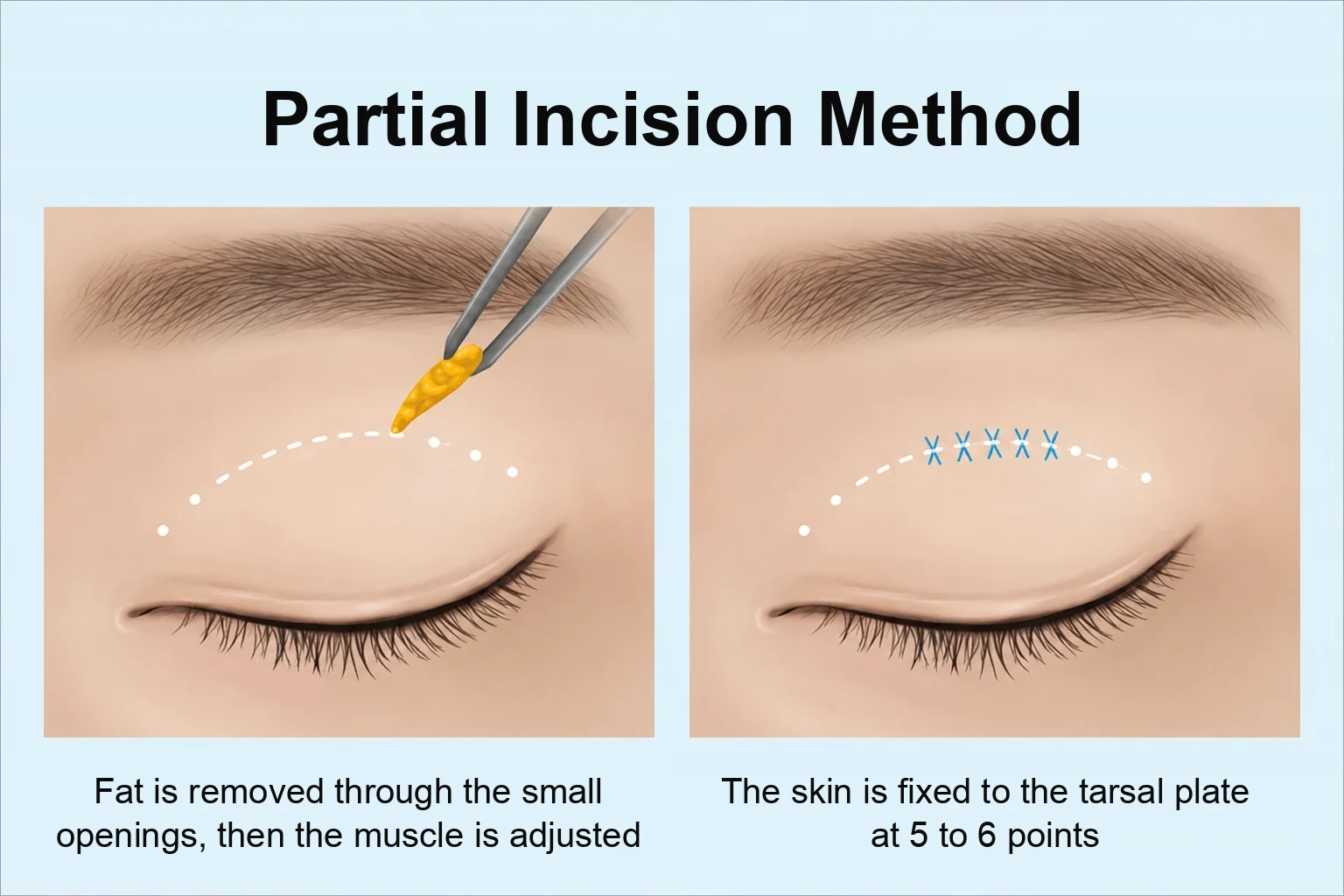
The partial incision method sits between the other two double eyelid surgery types. Instead of one continuous cut, the surgeon makes a short row of small slit openings along the planned crease line and works through them — small enough to keep the scar burden low, open enough to fix the crease more firmly than a suture alone can.
How the partial incision method works
The surgical literature describes the partial incision method as 5- or 6-point fixation between the skin and the tarsal plate, combined with 1 or 2 tucking loops on Müller’s muscle. In practice the operation runs in a fixed order.
- The crease height and shape are designed on the lid and checked with the patient before anything is opened.
- A short row of small slit punctures is made along that line, rather than one continuous cut along the eyelid.
- Triangular single-knot sutures fix the skin to the firm plate inside the lid at 5 or 6 points.
- Where a mild droop is present, tucking loops are placed on Müller’s muscle through one or two of the central slits.
- The lid is checked open and closed, and the small openings are closed.
Correcting mild ptosis at the same time — the Müller tucking step
Blepharoptosis, usually shortened to ptosis, is a weakness in the muscle that opens the eye, which makes the eye look smaller or persistently sleepy. Building a crease on a lid that does not open fully rarely satisfies anyone: the fold is there, but the eye still looks tired. This is the point at which the middle option stops being a compromise and becomes the better operation.
Mild ptosis can be corrected during the same operation with 1 or 2 tucking loops placed on Müller’s muscle. Müller’s muscle is a small helper muscle that adds a little extra lift; tucking shortens it slightly. Because the tucking suture passes through the conjunctiva (the moist lining on the inside of the lid), the adjustment needs no second external wound.
When the droop is more than mild, it is planned as its own operation rather than as an add-on — our page on ptosis correction explains where that line falls.
Who the partial incision method suits
This is the narrowest indication of the three double eyelid surgery types, and the textbook version is worth stating in plain language: the method is appropriate for patients without redundant eyelid skin. If skin has to come off, a partial incision is simply the wrong tool. Within that group, it is the natural choice for someone who is not confident a buried suture will hold, but for whom a full incision feels like more operation than the problem deserves.
Our procedure page on partial incision double eyelid surgery goes through how that assessment is made in the clinic.
Full Incision Method: The Only Route When Excess Eyelid Skin Has to Go
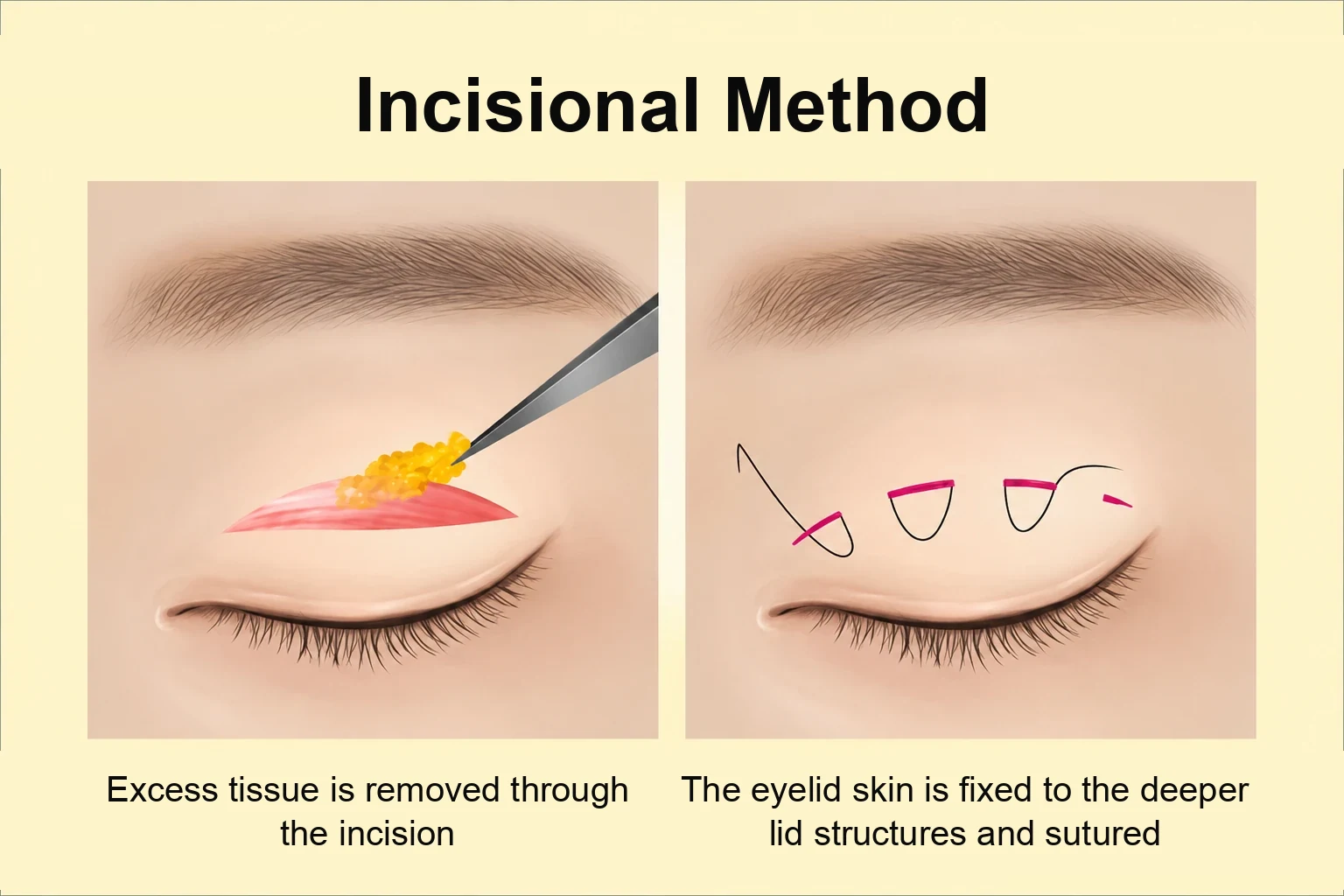
Of the three double eyelid surgery types, the full incision method is the traditional standard for creating a double fold, and textbooks still describe it that way. A fine incision is made along the designed crease, tissue that needs to go can be removed through it, and the skin edge is then fixed to the deeper structures of the lid.
How tarsodermal fixation works
Tarsodermal fixation means what the word suggests: the tarsus (the firm plate inside the lid), or the levator aponeurosis above it, is joined to the dermis at the skin edge. A non-absorbable suture is used, because this fixation is meant to stay. The surgeon then turns the lid inside out — everts it — to confirm that no suture has pierced the conjunctiva, a small step that prevents a great deal of irritation later.
Before any incision is made, the crease height and shape are demonstrated with a probe until the patient is satisfied with what they see. That conversation, rather than the cut itself, is where the shape of the result is settled.
Who actually needs a full incision
What can be corrected in the same operation:
- Redundant upper eyelid skin that has settled over the lash line
- Excess fat that has descended into the upper lid and makes it look heavy
- A crease that has faded after earlier buried suture surgery
- An asymmetry between the two lids that needs skin adjusted, not just a stitch moved
- Thick eyelid skin that a buried suture would struggle to hold indefinitely
A full incision is the only one of the three methods that can remove excess eyelid skin while the crease is being created. For anyone with heavy or hooded lids, that one fact replaces a lot of vague impressions about which operation is “bigger.”
What the incisional method can and cannot promise
It can offer the most reliable hold of the three. Fixing skin directly to the deeper lid structures holds the crease more reliably than a buried suture, and it is the longest-lasting of the three double eyelid surgery types. What no method can promise is that a crease will last forever — no textbook makes that claim, and neither should a clinic.
Nor can it offer a short recovery. Opening the lid means more swelling at the start, and the incision line itself takes months to settle into something you stop noticing in the mirror. Our page on incisional double eyelid surgery covers how that timeline is planned with patients who are traveling.
Why Asian Eyelid Anatomy Decides Which Double Eyelid Surgery Types Fit
Almost every English-language consultation about double eyelid surgery types reaches the same question sooner or later, usually asked carefully: is this an operation that makes Asian eyes look Western? The answer from the surgical literature is no, and the reason is anatomical rather than diplomatic.
Upper blepharoplasty is not a Westernization procedure
Textbooks state it directly: although the principles of blepharoplasty are similar for Asian and Caucasian patients, upper blepharoplasty is not a Westernization procedure. The operation does not import someone else’s eyelid. It builds a fold at the height where this particular eyelid is able to fold naturally — which, in most Asian lids, is not where a Caucasian crease sits.
Where the Asian upper lid is built differently
- The orbital septum (the thin wall that holds the fat pad back) inserts lower down onto the levator aponeurosis, so more fat is free to descend into the upper lid.
- That descended fat is why many Asian lids look fuller, and why a crease, where one exists, tends to sit lower.
- Less pretarsal skin is on display — that is the strip of lid visible between the crease and the lashes when the eye is open.
Anatomy research puts the Asian lid crease roughly 2 to 3 mm lower than a Caucasian crease, with noticeably less pretarsal skin on display. It is a structural difference, not an aesthetic ranking, and it is measurable in millimeters.
What that means for your crease height
A crease designed too high on a lid with a low septum and a full fat pad does not read as “bigger eyes.” It reads as surgery. The same anatomy decides the technique: a thick, fat-rich lid gives a buried suture more weight to hold, which pushes the choice between the double eyelid surgery types toward a partial or full incision regardless of what anybody hoped for going in.
How to Choose Between the Double Eyelid Surgery Types
There is no ranking of double eyelid surgery types, only a sequence of questions. Working through them in order usually narrows the field to one or two candidates before you ever sit down in a consultation room.
Start with skin laxity and lid thickness
This is the first fork in the road, and it settles most cases on its own. If there is little or no droop and the skin is thin, all three double eyelid surgery types remain open. Once excess skin enters the picture, the field narrows to one — and the other two stop being options rather than becoming second choices.
Definition vs durability — the trade you are actually making
Faster recovery and a softer result pull in one direction; a sharply defined line that holds for longer pulls in the other. You rarely get both at once. Deciding in advance which of the two you would rather protect makes the consultation considerably shorter and the decision considerably calmer.
- If your lids are thin and firm, with no excess skin, and you want the least downtime, the non-incisional method is usually first on the list.
- If a buried suture worries you but a full incision feels like too much, the partial incision method is the middle ground.
- If your eyes also look sleepy from a mild droop, a partial incision can address both in one operation.
- If excess skin has to go, a full incision is the only method that can do it.
- If an earlier crease has faded and you want the most reliable hold, a full incision is the usual revision route.
- If you are genuinely unsure, the deciding evidence is a physical examination of your lid, not an online comparison.
The right method at 25 may not be the right one at 45
Eyelid skin changes. Someone for whom a buried suture was the obvious answer at 25 may be a full-incision candidate twenty years later — not because the first operation failed, but because the lid did what lids do. Choose on the basis of the eyelid in front of you today rather than the one you had, or expect to have.
Male double eyelid surgery: what changes
Men’s eyelid skin tends to be thicker and to carry more fat, and the goal is usually a low, fine, in-fold line rather than a prominent one. Both facts shift the calculation: a heavier lid gives a buried suture more to hold, while a lower line leaves less margin in the design. Our page on male double eyelid surgery goes through how the planning differs.
Procedures that often get planned alongside
Where a prominent epicanthal fold covers the inner corner, epicanthoplasty (inner corner surgery) sometimes comes up in the same visit. It is a separate procedure with its own indications, not a part of crease surgery, and our guide to the types of canthoplasty explains where the two overlap. What friends and online reviews cannot tell you is which combination suits your lid — that answer comes from an examination.
Recovery: How the Three Double Eyelid Surgery Types Differ
Recovery after all three methods involves the same stages. What changes is how long each stage lasts. This section covers the comparison only. For the day-by-day care — cold compresses, stitch removal, washing, makeup and getting back to exercise — our eyelid surgery recovery and aftercare guide covers the full timeline.
Swelling and downtime, method by method
| Method | Early swelling | When the line looks settled |
|---|---|---|
| Non-incisional | Lightest of the three; no skin is opened | Days to around 2 weeks for most of the initial swelling |
| Partial incision | Moderate; the openings are small and few | Between the other two |
| Full incision | Most pronounced; the lid is opened and tissue removed | Initial swelling over 1–2 weeks, with the incision line maturing over several months |
Textbook accounts of recovery agree on one point: a buried-suture crease settles over days to 2 weeks, while a full incision line can take several months to look fully natural. The gap between them is not a difference in risk — it is a difference in how long the tissue needs to finish healing.
What is the same no matter which method you choose
Individual variation is wider than the gap between the double eyelid surgery types. Two people who had the same operation on the same morning can be a week apart in how they look. Plan with more room than the averages suggest, particularly if you are traveling for surgery, and treat any schedule you read online as a rough shape rather than a commitment.
Risks, Limits and Honest Expectations
All three double eyelid surgery types carry risk, as every operation on the eyelid does, and being specific about that is more useful to a patient than reassurance is.
Possible complications
Five complications are worth asking about: inflammation, bleeding, altered sensation, prolonged swelling and asymmetry.
- Inflammation — usually settles with the prescribed medication, but needs to be looked at if it worsens after the first few days.
- Bleeding — light bruising around the lid is expected; swelling that grows quickly is not, and should be reported.
- Altered sensation — numbness or tingling along the crease, which generally recedes over the following weeks.
- Prolonged swelling — more common after a full incision and after revision surgery than after a buried suture.
- Asymmetry — the two lids often settle at slightly different rates, and a difference that is still obvious once the swelling has gone should be reviewed at a follow-up visit.
How any of them present depends on your general health and on how you heal. General patient information from the American Society of Plastic Surgeons is a useful third-party cross-check on what eyelid surgery involves.
When a crease fades — and what revision involves
A fading crease is most often a buried-suture outcome, and the textbook explanation is the anchor point rather than the surgeon’s hand — the same trade-off described earlier in this article. Revision is possible, but it is planned differently from a first operation, because the lid now has a history of its own and the tissue behaves accordingly.
Questions worth asking at your consultation
- Is there redundant skin on my lid, and does any of it need to be removed?
- Is some degree of ptosis mixed into what I am seeing in the mirror?
- Which structure do you plan to anchor my crease to, and why that one?
- How likely do you think it is that this crease will fade over time?
- Is the design you are proposing revisable later if my lids change?
- How many days should I realistically clear for recovery?
Frequently Asked Questions About Double Eyelid Surgery Types
What are the three double eyelid surgery types?
The three double eyelid surgery types are the non-incisional (buried suture) method, the partial incision method and the full incision method. They are separated by how much of the eyelid is opened: none at all, a short row of small slits, or one continuous incision. Which one fits depends on the skin, thickness and fat of your own lid.
How is the non-incisional method different from the incisional method?
The non-incisional method ties a crease into place with sutures, while the incisional method opens the lid and fixes the skin edge to the deeper structures. Buried suture techniques use 3 to 5 stitches per eyelid in the multiple-stitch version. Recovery load and durability move in opposite directions between the two.
Which double eyelid surgery type lasts the longest?
The full incision method is the longest-lasting of the three, because the skin is fixed directly to the deeper lid structures with a non-absorbable suture. Textbooks describe incisional fixation as more durable than a fixation made without an incision. That is not the same as promising that a crease will hold for life.
How long does recovery take for each method?
Recovery is shortest after the non-incisional method and longest after a full incision, with the partial incision method in between. Most early swelling settles within about 2 weeks, but an incision line continues to mature for several months. What separates the double eyelid surgery types is the length of each stage, not the stages themselves, and our aftercare guide covers the day-by-day detail.
Can the partial incision method correct a droopy eyelid at the same time?
Yes, when the droop is mild. The same operation can include 1 or 2 tucking loops on Müller’s muscle, placed through one or two of the central slits, which adds a little lift to the eye-opening mechanism. A more pronounced droop needs ptosis correction planned as its own procedure.
Why do some creases disappear after buried suture surgery?
It usually comes down to where the suture was anchored. Fixing to the levator aponeurosis gives the more natural look but is associated with higher rates of the crease fading, while fixing through the tarsal plate gives a more defined line. Thick lids with a full fat pad put more load on either anchor.
Is double eyelid surgery different for men?
The planning differs more than the technique does. Men’s lids tend to be thicker and fattier, and the usual goal is a low, fine in-fold line rather than a prominent crease. Both of those change how much a buried suture is being asked to hold, which is why method selection often lands differently.
Talk It Through With a Board-Certified Plastic Surgeon
Satisfaction with eyelid surgery is rarely decided by which technique is superior. It is decided by which of the double eyelid surgery types matches the lid it is performed on. The buried suture method recovers fastest but can fade, the full incision holds longest but asks for months of patience, and the partial incision method balances the two while offering something neither of the others does on its own.
If you would like that assessment done properly, we will examine your eyelids in person before recommending anything. MINE Plastic Surgery & Dermatology is at 813 Nonhyeon-ro, Gangnam-gu, Seoul. You can reach the clinic at +82-2-516-1175 or through the online consultation form, and our international coordinators handle inquiries from patients traveling to Korea, including photograph-based pre-assessment before you book flights.
Written and medically reviewed by Dr. Lee Sung-wook, board-certified plastic surgery specialist and a member of the Korean Society of Plastic and Reconstructive Surgeons and the International Society of Aesthetic Plastic Surgery (ISAPS), MINE Plastic Surgery & Dermatology, Seoul.
※ This content is for informational purposes only and does not replace professional medical advice, diagnosis, or treatment. Individual results may vary, and side effects may occur. Please consult with a board-certified plastic surgeon for personalized advice.