EN
EN


Table of Contents
What to Expect During Eyelid Surgery Recovery
Eyelid surgery recovery is the four-to-six week healing period that follows double eyelid surgery, ptosis correction, epicanthoplasty or blepharoplasty, during which swelling and bruising subside, sutures are removed, and the eyes gradually start to look natural again. How carefully you follow the precautions below during those first weeks has a direct effect on how quickly your eyes look natural.
This is the same aftercare protocol our patients receive at MINE Plastic Surgery in Seoul. It is written with international patients in mind, so it also answers the questions that matter once you fly home — when contact lenses are safe again, when you can wear eye makeup, and how long visible bruising after eyelid surgery usually lasts.
Every one of the nine rules below exists because breaking it slows healing in a predictable way. None of them require special equipment; they mostly require patience.
Eyelid Surgery Recovery Timeline at a Glance
Most people want one thing first: a calendar. The timeline below is typical for double eyelid surgery and related eyelid surgery procedures. Individual healing varies, and incisional methods generally take longer to settle than non-incisional (buried suture) methods.
- Day 0–3: Swelling and bruising build up and peak. Cold compresses, head elevation, rest.
- Day 4–5: Swelling starts to turn the corner. Switch from cold to warm compresses.
- Day 5–7: Stitches are usually removed (7 days for epicanthoplasty/canthoplasty “trim” procedures). Washing your face becomes possible.
- Week 2: Most people are presentable in public. Eye makeup and contact lenses become possible.
- Week 3–4: The bulk of the swelling is gone. Light exercise can resume from two to three weeks; strenuous exercise still waits.
- Month 1: Strenuous exercise, saunas, alcohol and smoking are allowed again. Eyelash extensions and semi-permanent eyeliner become possible.
- Month 3: Scars soften noticeably. Any discussion of revision starts here at the earliest — never sooner.
- Month 6: The final eyelid shape stabilizes.
If your recovery is running behind this schedule it does not automatically mean something is wrong. Thicker eyelid skin, revision cases and procedures combining several techniques all take longer.
1. Post-Surgery Positioning
- For the first week after surgery, avoid bending your neck while sleeping. Keeping your upper body elevated so that your head stays higher than your heart will help reduce swelling more quickly.
- It’s best to sleep on your back with your face pointing toward the ceiling. Starting one week after surgery, you may sleep on your side.
The reason is simple plumbing. Eyelid tissue drains fluid through a lymphatic network that works with gravity, so lying flat lets fluid pool in the very place you want it to leave. Surgical textbooks list elevation alongside cold compresses and gentle massage as the standard way to limit swelling after eyelid surgery. Two pillows, or a wedge pillow, is usually enough.
2. Post-Surgery Diet
- You may eat all normal foods.
Unlike jaw or facial bone surgery, eyelid surgery places no restriction on what you eat. There is no medical reason to avoid spicy food, seaweed soup or any specific dish. Staying well hydrated and going easy on very salty meals for the first week is sensible, because sodium encourages fluid retention and fluid retention is exactly what makes eyelids look puffy.
3. Swelling Management
- For the first 2–3 days after surgery, swelling and bruising will gradually worsen, then subside over the following 2–4 weeks. This varies from person to person.
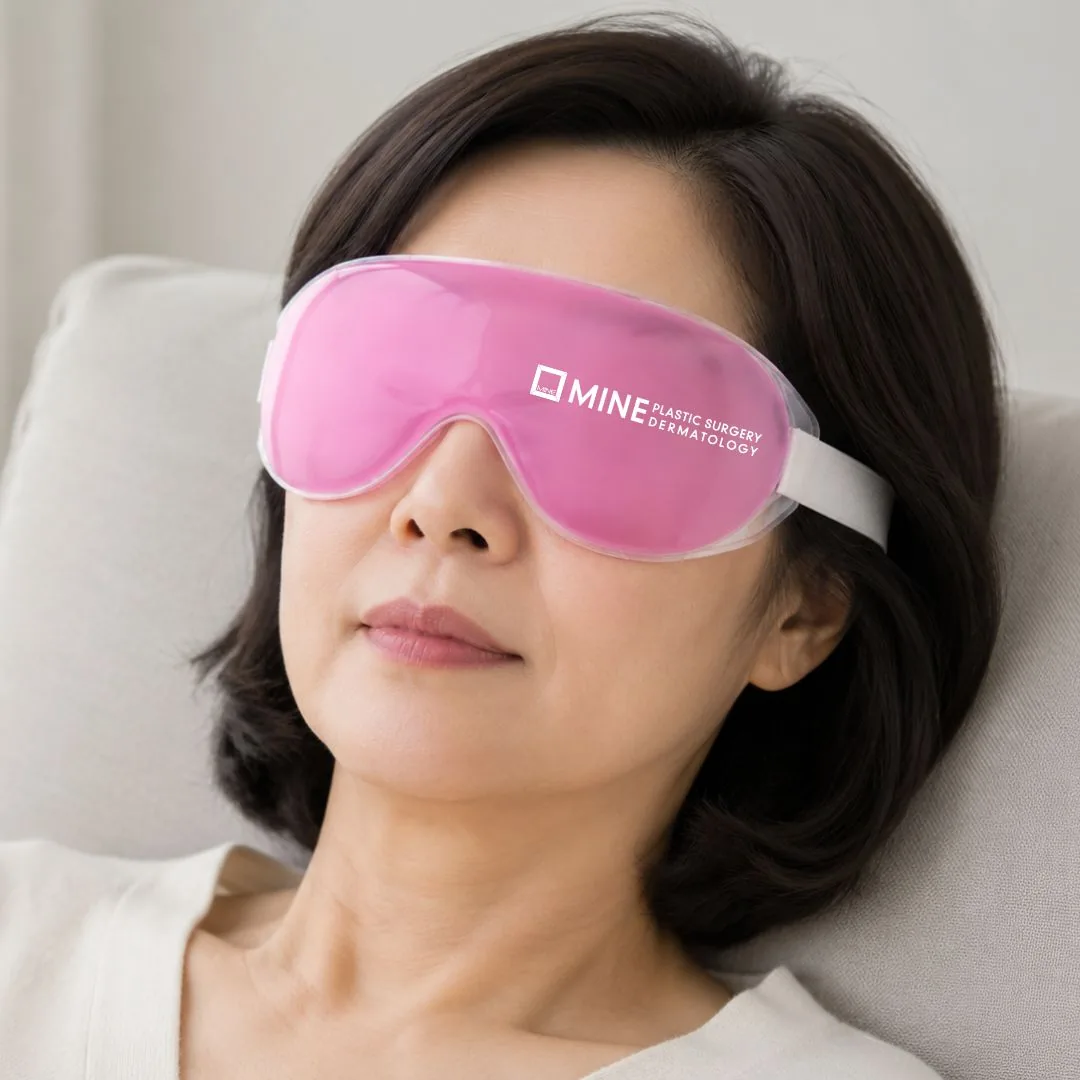
- Apply cold compresses through the third day after surgery (including the day of surgery), and switch to warm compresses after that. (Please use the compress pack we provided. For warm compresses, you can use a heated sleep eye mask or microwave the provided compress pack for about 15 seconds.)
The cold-then-warm switch trips people up, so it is worth being precise. Cold constricts blood vessels and limits how much fluid and blood leak into the tissue — useful only while that leaking is still happening, which is roughly the first 72 hours. After that the job changes: you now want to clear what has already accumulated, and warmth improves circulation to do that. Continuing to ice past day three simply slows the clean-up.
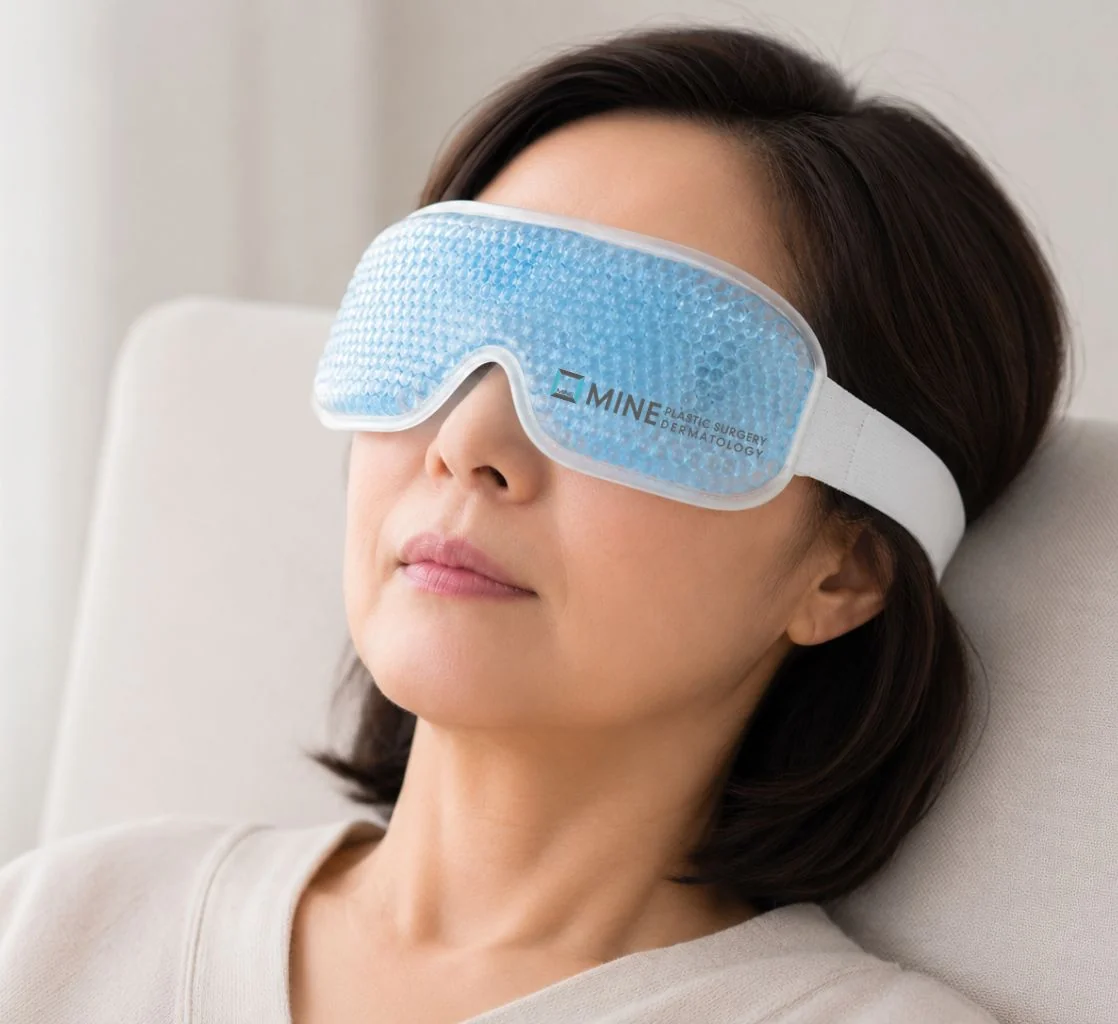
Apply either compress for about 15 minutes at a time with rest in between, and never press hard. Never apply ice directly to the skin, and check that a warmed pack is comfortably warm rather than hot before it touches an eyelid that may still be numb.
4. Wound Care
- Crying or rubbing your eyelids hard is not good for recovery.
- Straining your eyes may cause bleeding, so please be careful.
- The timing for suture removal varies depending on the surgical method, but stitches are usually removed within 5 days after surgery. (For epicanthoplasty/canthoplasty “trim” procedures, stitches are removed after 7 days.)
- If you have an incision site, we will prescribe an eye ointment. Gently apply the prescribed ointment to the incision site 2–3 times a day using a clean cotton swab. Do not apply too much—just enough to keep the suture area from drying out. (Applying it in the morning and evening is sufficient.)
“Straining your eyes” is broader than it sounds. Long stretches of phone or laptop use, reading in dim light, and squinting all make you blink forcefully and repeatedly, which tugs at fresh suture lines. For the first few days after eyelid surgery, work in short blocks and look away from the screen often.
Once the stitches are out, sun protection becomes the priority for the scar. Fresh eyelid scars darken easily with UV exposure, so wear sunglasses outdoors for the first few months. Sunscreen should not go directly on the incision until your surgeon confirms it has closed.
5. Washing & Showering / Makeup / Semi-Permanent Makeup
- Until the stitches are removed, please wipe areas other than the surgical site with a damp towel.
- You may wash your face on the day of suture removal, but if possible, please wait until the next day.
- When washing your face, do not rub the eye area hard—be gentle.
- It’s best to wait until 2 weeks after surgery to apply eye makeup, and be careful not to strain your eyes when removing it.
- Eyelash extensions and semi-permanent eyeliner tattoos should be done no earlier than 1 month after surgery. (If you had a “trim” procedure, wait until 3 months after surgery.)
- Contact lenses may be worn 2 weeks after surgery.
- Avoid saunas for one month after surgery (risk of infection).
- When visiting a hair salon, have your hair shampooed while avoiding the surgical site.
- When washing your hair at home, place a towel over your face (eye area) and tilt your neck back to keep water away from your eyes. You may shampoo normally after the stitches are removed.
- You may shower starting the day of surgery, avoiding the eye area.
Two of these deserve emphasis. Removing eye makeup is harder on the eyelid than putting it on, because it involves repeated rubbing and pulling — use a gentle micellar remover on a cotton pad held still for a few seconds rather than scrubbing. And saunas, jjimjilbang and hot yoga are restricted for a full month not only because heat worsens swelling, but because warm, humid, shared environments raise infection risk while the incision is still sealing.
6. Exercise
- Normal daily activities are generally possible right after surgery. Light exercise can be resumed 2–3 weeks after surgery, and strenuous exercise after 1 month.
The concern with exercise is blood pressure. Anything that makes your face flush or your head throb — heavy lifting, inverted yoga poses, sprinting — raises pressure in the small vessels of the eyelid and can restart bleeding or worsen bruising. Walking is fine from day one. Swimming waits until at least one month, for the same infection reason as saunas.
7. Medication
- Take the medication prescribed at discharge 30 minutes after your first meal following surgery, and please take it regularly at the designated times. If you experience symptoms such as diarrhea or an allergic reaction after taking the medication, please contact the clinic.
- For the first week after surgery only, please do not take aspirin or vitamin E, as they can cause bleeding.
Aspirin and vitamin E both interfere with normal clotting, which is why they are paused for the first week after eyelid surgery. The same caution applies to fish oil, ginkgo, ginseng and high-dose vitamin E supplements. If you take a blood thinner or aspirin for a heart or stroke condition, do not stop it on your own — tell us before surgery and follow your prescribing physician’s instructions.
For pain relief during this window, acetaminophen (paracetamol) is generally the safer choice over ibuprofen or other NSAIDs. Confirm with your surgeon before adding anything to what was prescribed.
8. Alcohol & Smoking
- Alcohol and smoking adversely affect bleeding, wound healing, and infection, so please abstain for one month after surgery.
Smoking is the single most damaging habit for eyelid surgery recovery. Nicotine narrows the small blood vessels that feed the healing incision, which means less oxygen reaches the wound edge; the practical results are slower closure, wider scars and a higher infection rate. Vaping and nicotine patches carry the same vascular effect. Alcohol works differently — it dilates vessels and promotes fluid retention, so it visibly prolongs swelling and bruising.
9. Recovery Course
- In the case of (epicanthoplasty/canthoplasty) procedures, chemosis—swelling of the white of the eye (conjunctiva)—may occur. There is no effect on your vision.
- Bruising, eye redness, and chemosis may persist for 2–3 weeks.
- The final shape after surgery stabilizes after about 6 months.
- After surgery, your eyes may feel sensitive to light or dry, causing tearing; this improves over time.
- Sensation around the eyes may feel dull, but this gradually recovers over several months.
Chemosis is one of the more common complications after eyelid surgery, and it looks far more alarming than it is. Surgery temporarily disrupts the lymphatic drainage of the eyelid and conjunctiva, so fluid collects in the white of the eye and forms a clear, jelly-like blister. It is self-limiting and usually resolves on its own; keeping the head elevated, gentle massage and short cold compresses (the one exception to the day-three switch above) all help, and a persistent case can be treated with prescription eye drops.
Dry eye is the other frequently reported sensation after eyelid surgery. Patients describe grittiness, burning, watering or frequent blinking. It happens because the blink mechanism is temporarily altered while the lid is swollen, and because pre-existing dry eye tends to be aggravated. Preservative-free artificial tears used liberally are the standard answer, and the symptom fades as the lids regain their normal closure.
Numbness around the incision follows the small sensory nerves that were crossed during surgery. Sensation returns gradually, typically over several months, from the outside of the numb patch inward.
Warning Signs: When to Contact Your Clinic
Almost everything on this page is normal and self-limiting. The following are not. Contact your clinic promptly, or seek local emergency care if you have already flown home:
- Sudden, severe or worsening pain in one eye, especially with hard swelling — this can indicate bleeding behind the eye and is the one true emergency after eyelid surgery.
- Any change in vision: blurring, double vision, dark spots or loss of vision.
- Swelling that is clearly increasing after day four, rather than decreasing.
- Spreading redness and heat around the incision, yellow or green discharge, or a fever — signs of infection.
- An incision that opens, or a stitch that pulls out early.
- Inability to close the eye fully, or a persistently red, painful eye.
Do not wait for your next scheduled follow-up if any of these appear. A phone call costs nothing and problems caught early are almost always minor to fix.
For International Patients: Planning Your Stay in Korea
If you are traveling to Seoul specifically for eyelid surgery, the schedule of your trip matters as much as the surgery itself. Suture removal is the fixed point everything else is built around.
- Minimum recommended stay: 7 days. This covers surgery, the swelling peak, and in-clinic suture removal on day 5–7.
- Flying home: generally comfortable from around day 7, after stitches are out. Cabin air is very dry, so bring artificial tears and drink water on the flight.
- Looking presentable: most people are comfortable in public around two weeks, when eye makeup also becomes possible. Sunglasses bridge the gap before that.
- If you must leave earlier: tell us before surgery. Suture removal can sometimes be arranged with a local clinic, but it should be planned rather than improvised.
- Follow-up from abroad: photo-based remote follow-up is available, and revision discussions are never scheduled earlier than three months after the original surgery.
Plan a quiet trip. Long sightseeing days, late nights and alcohol during the first week will show up on your eyelids, and you will have paid for a result you then have to wait longer to see.
Frequently Asked Questions About Eyelid Surgery Recovery
These are the questions our international patients ask most often after eyelid surgery.
How long does eyelid surgery recovery take?
Most visible swelling and bruising after eyelid surgery settle within two to four weeks, and most people return to work or social activities around two weeks. The eyelid crease continues to soften and refine for months, and the final shape stabilizes at about six months.
When can I wear makeup after eyelid surgery?
Eye makeup can generally be applied two weeks after eyelid surgery. Removal matters more than application — take it off gently, without rubbing or stretching the lid. Eyelash extensions and semi-permanent eyeliner wait one month, or three months after an epicanthoplasty or canthoplasty “trim” procedure.
When can I wear contact lenses again after eyelid surgery?
Contact lenses may be worn two weeks after surgery. Inserting and removing them earlier means pulling on a lid that is still healing. Wear glasses in the meantime, and keep artificial tears handy because eyes are often drier than usual during this period.
Is it normal for my eyes to look uneven after surgery?
Yes. Asymmetric swelling is extremely common in the first weeks, and each eyelid drains fluid at its own pace, so one side routinely looks larger or higher than the other. There is no point judging the final result before six months, and elective revision surgery is not scheduled earlier than three months after the original operation.
Can I shower and wash my hair after eyelid surgery?
You may shower from the day of surgery as long as you keep the eye area dry. Wash your hair with a towel over your face and your head tilted back, or have it washed at a salon. Normal face washing and shampooing resume once the stitches are removed.
What should I avoid in the first week after eyelid surgery?
Avoid lying flat, rubbing or straining your eyes, aspirin and vitamin E, alcohol and smoking, strenuous exercise, saunas, and getting the incision wet. Food is unrestricted. Cold compresses through day three, then warm compresses.
The Bottom Line on Eyelid Surgery Aftercare
Eyelid surgery recovery rewards patience more than any product. Keep your head up, ice for three days and switch to warm compresses after that, leave the incision alone, skip alcohol and cigarettes for a month, and give the result six months before you judge it.
Considering an eyelid procedure, or already booked? These pages explain the options and what each one involves: upper and lower blepharoplasty, partial incision double eyelid surgery, epicanthoplasty and canthoplasty, and revision eyelid surgery. If your procedure involved the lower lid, see our separate guide to precautions following under-eye fat repositioning.
For an independent overview of eyelid surgery and its risks, the American Society of Plastic Surgeons maintains a patient resource on eyelid surgery (blepharoplasty).
※ This content is for informational purposes only and does not replace professional medical advice, diagnosis, or treatment. Individual results may vary, and side effects may occur. Please consult with a board-certified plastic surgeon for personalized advice.