EN



A hyaluronic acid skin booster is a skin-quality treatment in which lightly cross-linked hyaluronic acid (HA) is micro-injected into the upper dermis to improve hydration, glow and texture, not to add volume the way a filler does. In Korea it is widely known as a “water glow” injection. In short, a hyaluronic acid skin booster works on how your skin looks and feels rather than on the shape of your face.
Patients often tell me that their skin looks dull and dry even with good makeup, and that they keep hearing about “skin boosters” online. The Korean name is mulgwang, which roughly means “water glow.” The trouble is that Rejuran and Juvelook are also sold as skin boosters, so it is hard to know what you are actually comparing. I’m Dr. Lee Sung-wook, a board-certified plastic surgeon at MINE Clinic in Gangnam, Seoul. In this article I answer the three questions I hear most in consultation: what an HA skin booster actually does in the skin, how long it lasts, and how it differs from Rejuran (PN) and Juvelook (PDLLA).
What Is a Hyaluronic Acid Skin Booster?
A hyaluronic acid skin booster places very small amounts of soft, lightly cross-linked HA in many closely spaced points just beneath the surface of the skin. The goal is skin quality: more moisture, a smoother texture and a dewy glow. It does not lift a sagging cheek or fill a deep fold.
“Water Glow” Is a Category, Not a Brand
One point clears up a lot of confusion: “water glow injection” is not a product name. It is the everyday Korean term for any skin booster that uses hyaluronic acid as its main ingredient, and several different HA products fall under it. Rejuran and Juvelook, which you will often see on the same clinic menu, are not water glow injections. They are separate skin boosters built on completely different ingredients. Once you know this, consultations become much easier, because you can ask about the ingredient instead of the marketing name.
How Hyaluronic Acid Draws Water Into the Skin
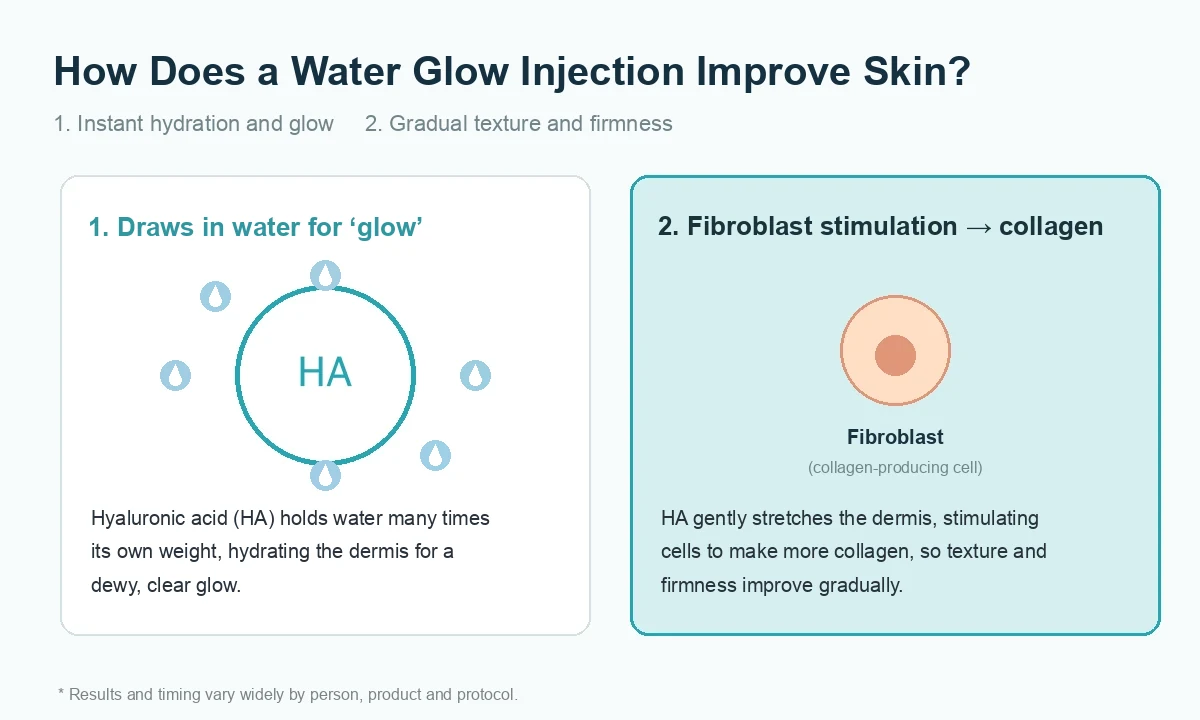
Hyaluronic acid is not a foreign substance. It already exists naturally in the dermis, the thick, supportive layer under the skin’s surface. It behaves a little like a sponge: it pulls in water and holds on to it. Hyaluronic acid can hold many times its own weight in water, according to medical textbooks. When a hyaluronic acid skin booster places extra HA in the upper dermis, that HA binds moisture right where it sits, so the skin starts to look plumper, clearer and more hydrated from the inside rather than just on the surface.
Skin Booster vs Filler: The Short Version
Both treatments can use hyaluronic acid, but they do different jobs. A filler uses a firmer, highly cross-linked HA gel placed in deeper layers to restore lost volume or reshape an area, such as hollow under-eyes or a flat chin. A hyaluronic acid skin booster uses a much softer, lightly cross-linked HA spread in tiny amounts through the upper dermis to improve hydration, texture and glow. Filler changes contour; a booster changes skin quality. That difference also explains why boosters are repeated more often. If you are deciding between the two, I explain the choice step by step in how a skin booster compares with filler.
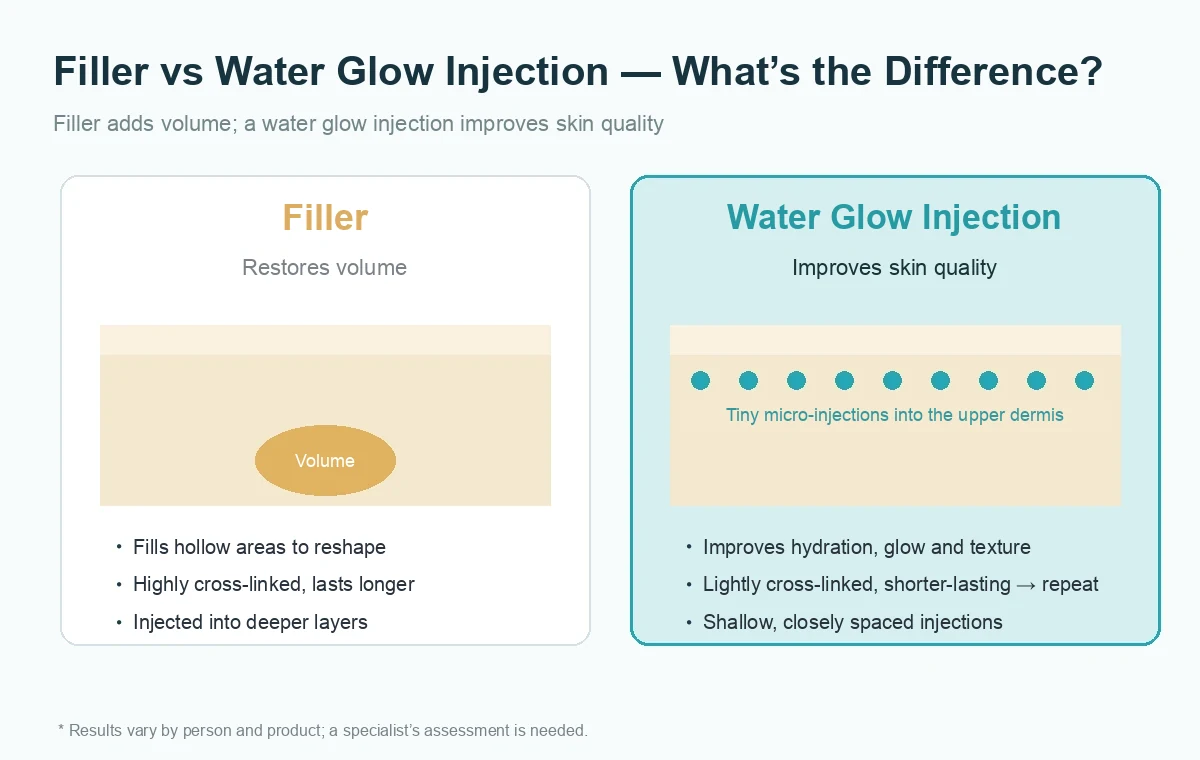
Dr. Lee’s Key Point: An HA skin booster does not fill. It uses hyaluronic acid to bring water and glow back into the skin, lifting its overall quality.
HA vs Rejuran (PN) vs Juvelook (PDLLA): Three Different Ingredients
If you research skin boosters, you will quickly run into Rejuran, Juvelook and exosomes. All of them are called skin boosters, but their main ingredients and their goals are different. Think of them as three tools that happen to share a family name.
Hyaluronic Acid: Hydration and Instant Glow
A hyaluronic acid skin booster is the hydration specialist of the group. Because HA holds water as soon as it is in place, the dewy look tends to show up early. Its strength is fast moisture and glow; its trade-off is that results do not last as long as some of the other options.
Rejuran: Polynucleotides for Repair and Calming
Rejuran’s main ingredient is polynucleotide, or PN (a skin-repair ingredient purified from salmon DNA). Instead of holding water, PN is used to support the skin’s own repair process and to calm stressed, sensitized skin. Patients usually choose it for skin that feels thin, tired or reactive rather than simply dry. You can read more on our Rejuran treatment page.
Juvelook: PDLLA + HA for Collagen Stimulation
Juvelook combines PDLLA (a biodegradable particle that prompts the skin to make new collagen) with hyaluronic acid. It belongs to the same broad family as PLLA, a poly-lactic acid ingredient used as a “biostimulator,” meaning it encourages your own tissue to rebuild instead of filling space directly. That makes it a very different product from a hyaluronic acid skin booster, even though both contain HA.
Dermatology textbooks describe poly-lactic acid biostimulators as working differently from HA: any initial fullness from the injected fluid fades within a few days, and the real result builds over the following months as the particles slowly break down and fibroblasts (the cells that make collagen) lay down new collagen. That is why Juvelook is aimed at firmness and elasticity, and why patience is part of the plan. Details are on our Juvelook treatment page.
Exosomes: A Supporting Role
Exosomes are tiny carriers of regenerative signaling molecules that help cells communicate. In skin care they are generally used in a supporting role, alongside other treatments, to help the skin recover. They are not a replacement for a hyaluronic acid skin booster, PN or PDLLA.
Onset and Duration at a Glance
According to MINE Clinic’s internal comparison, Rejuran typically shows results in about 2–4 weeks and lasts around 4–6 months, while Juvelook shows results in about 4–6 weeks and lasts around 8–12 months. A hyaluronic acid skin booster sits at the other end of the scale: the glow arrives faster, but it does not last as long.
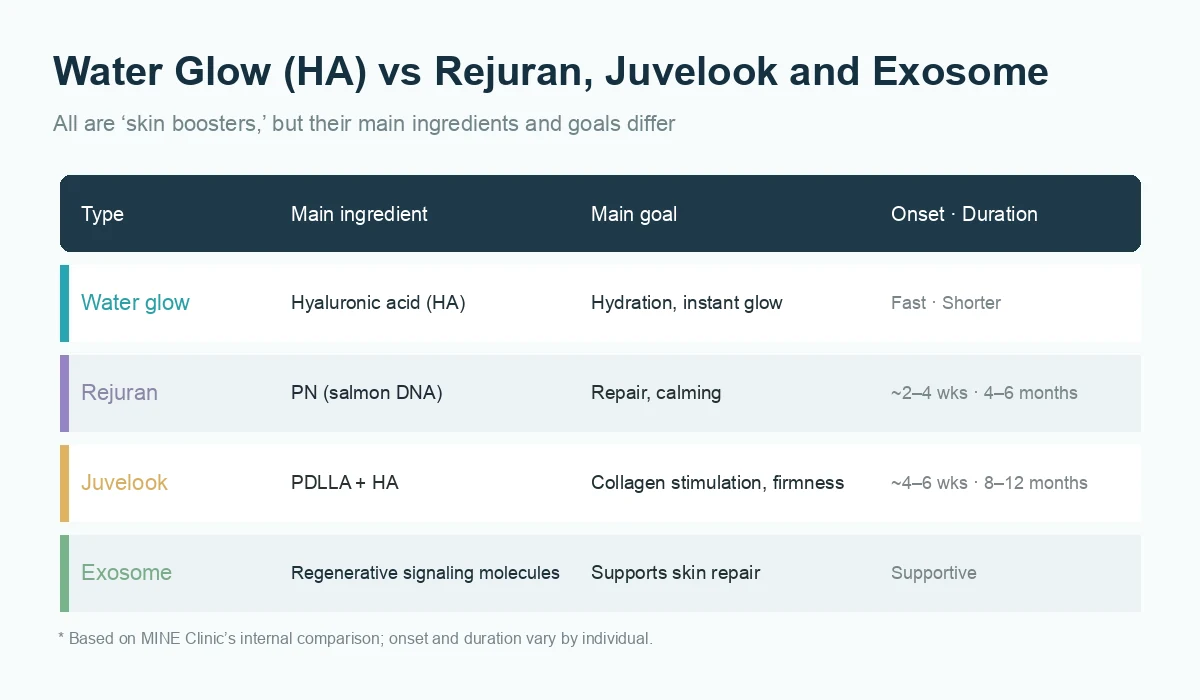
| Type | Main ingredient | Main goal | Onset | Duration |
|---|---|---|---|---|
| Water glow (HA skin booster) | Hyaluronic acid (HA) | Hydration, instant glow | Fast | Shorter |
| Rejuran | PN (from salmon DNA) | Repair, calming | About 2–4 weeks | About 4–6 months |
| Juvelook | PDLLA + HA | Collagen stimulation, firmness | About 4–6 weeks | About 8–12 months |
| Exosome | Regenerative signaling molecules | Supports skin repair | Supportive role | |
Based on MINE Clinic’s internal comparison. Onset and duration vary from person to person.
Choosing by goal keeps things simple. If you mainly want hydration and glow, look at a hyaluronic acid skin booster. If your skin needs repair and calming, PN is the better fit. If firmness is the priority, PDLLA makes more sense. Some patients benefit from combining two, but that decision needs a specialist’s assessment of your skin. For a full head-to-head between the two non-HA options, see our detailed Juvelook vs Rejuran comparison.
Dr. Lee’s Key Point: HA is for hydration and glow, PN for repair and calming, PDLLA for firmness. The goals differ, so the choice should follow your skin’s main concern.
What Results to Expect: Glow Now, Texture Later
The results of a hyaluronic acid skin booster come in two stages: a quick change in hydration and glow, and a slower change in texture and firmness.
Immediate Hydration and Glow
Most patients notice the first difference from a hyaluronic acid skin booster early. As the HA in the dermis binds water, the skin takes on the moist, luminous look that dermatology literature describes as a “glow.” Because this is a change in the water content inside the skin, how strongly you see it depends on your starting skin condition and on the product used.
Gradual Texture and Firmness
The second effect takes longer. When HA gently stretches the dermis from within, fibroblasts (the collagen-producing cells in your skin) receive a mechanical signal. Textbooks explain that this physical stretch supports collagen production and slowly improves the dermal environment. Over time, texture becomes smoother and the skin feels a little firmer. How much this happens varies widely with each person, the number of sessions and the protocol. For that reason, I don’t promise patients a percentage of improvement in my consultations. I would rather set realistic expectations than quote a number no one can guarantee.
Dr. Lee’s Key Point: Expect two things: quick hydration and glow, then gradual texture and firmness. The size of each change differs from person to person.
How Long Does a Hyaluronic Acid Skin Booster Last?
“How long will it last?” is the question I hear most. The honest answer is that it depends on how cross-linked the hyaluronic acid in the product is, and on your own skin.
Cross-Linking Decides Duration
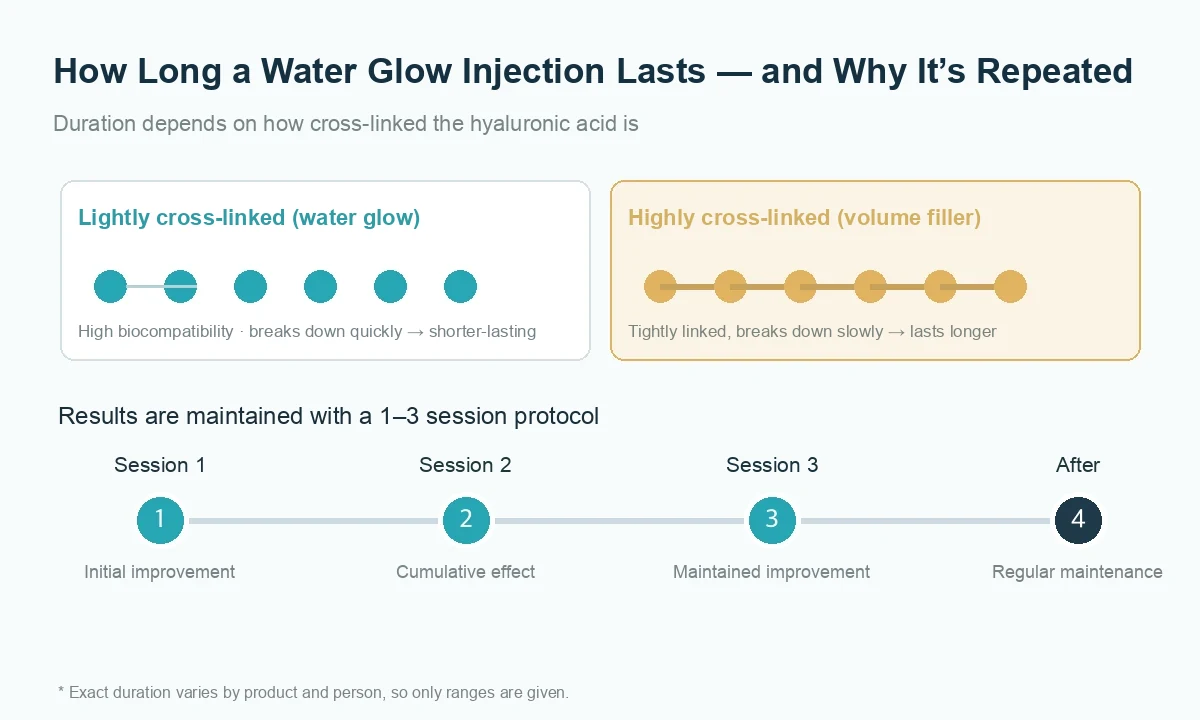
Cross-linking describes how tightly HA molecules are bound to one another. A simple way to picture it is thread: the more knots you tie, the harder it is to unravel. Natural HA on its own is broken down by the body quite quickly, so manufacturers cross-link it, often with a binding agent called BDDE, to make it last longer. Textbooks explain that less cross-linked HA is more biocompatible (gentler and more natural for the body) but breaks down faster, while more heavily cross-linked HA, such as the gel in volume fillers, stays in place longer.
A hyaluronic acid skin booster usually uses HA that is lightly cross-linked or not cross-linked at all. That is why it spreads softly and looks natural in the upper dermis, and also why it does not last as long as a volume filler. This is the basic reason boosters are repeated more often than fillers.
Why a 1–3 Session Protocol Is Recommended
Medical textbooks explain that less cross-linked hyaluronic acid breaks down faster, which is why an HA skin booster is usually planned as a 1–3 session protocol rather than a single visit. A typical hyaluronic acid skin booster plan looks like this:
- Session 1: builds the initial improvement in hydration and glow.
- Session 2: adds to that effect so it becomes more noticeable.
- Session 3: helps hold the improvement you have built.
- After the series: regular maintenance, timed to how your skin responds.
Because exact duration varies so much by product and skin condition, I don’t give patients a fixed number of months. I describe a hyaluronic acid skin booster as a treatment you maintain on a schedule, adjusted as we watch your skin.
Dr. Lee’s Key Point: Duration is set by the degree of cross-linking. Since it is shorter than filler, plan on 1–3 sessions followed by maintenance.
Who Is a Good Candidate?
A hyaluronic acid skin booster suits people whose main concern is skin quality rather than shape. The most common misconception I hear is that “one water glow injection and you’re done.” Because results are shorter-lasting, it is better to think of this as ongoing skin care matched to your skin, not a one-time fix.
Signs an HA Skin Booster Fits Your Goal
- Your skin feels dry and looks dull, and your main goal is quick hydration and glow.
- Makeup doesn’t sit smoothly and the texture feels rough, so you want to improve skin quality itself.
- You want skin care, not a change in facial shape from filler.
When PN or PDLLA May Suit You Better
Before your consultation, it helps to decide whether your biggest concern is hydration, repair or firmness. If your skin is sensitive or easily irritated, PN may be a better starting point. If loss of firmness bothers you most, PDLLA may fit better. If you are pregnant or breastfeeding, or have an infection or inflammation where you would be treated, please tell your doctor first (see the safety section below).
What Happens During a Session
Consultation and Skin Assessment
Every hyaluronic acid skin booster treatment starts with a face-to-face assessment. Your doctor looks at your skin’s hydration, texture and sensitivity, then chooses the product and the interval between sessions. This is also where we confirm whether HA is the right booster for you, or whether PN or PDLLA would serve your goal better.
Numbing and Micro-Injections
A numbing cream is usually applied first to keep you comfortable. The physician then places many tiny, closely spaced, shallow injections into the upper dermis. This shallow, even spread is what lets a hyaluronic acid skin booster hydrate the skin without adding visible bulk. Because the face has a dense network of blood vessels, these injections should be done by a physician who knows facial vascular anatomy well.
Recovery and Aftercare
The First Few Days
Redness, tiny bruises and mild swelling at the injection points are common and usually settle within a few days, although recovery speed differs between people. It is wise to avoid saunas and intense exercise for 1–2 days after a hyaluronic acid skin booster session, since heat and strain can make swelling and bruising last longer.
Aftercare and Planning Your Next Session
Afterward, the basics matter most: moisturize well and wear sunscreen every day. The timing of your next session should be adjusted to how your skin responds. Since the right booster and interval differ for each person, I encourage patients to get an accurate in-person assessment before deciding on a plan.
Dr. Lee’s Key Point: This is not a “once and done” treatment. It is regular care matched to your goal, and the right type and schedule are best decided face to face.
Side Effects and Safety Checkpoints
A hyaluronic acid skin booster is a relatively low-burden treatment, but it is still an injection, so you should understand the possible side effects before you book.
Common, Short-Lived Reactions
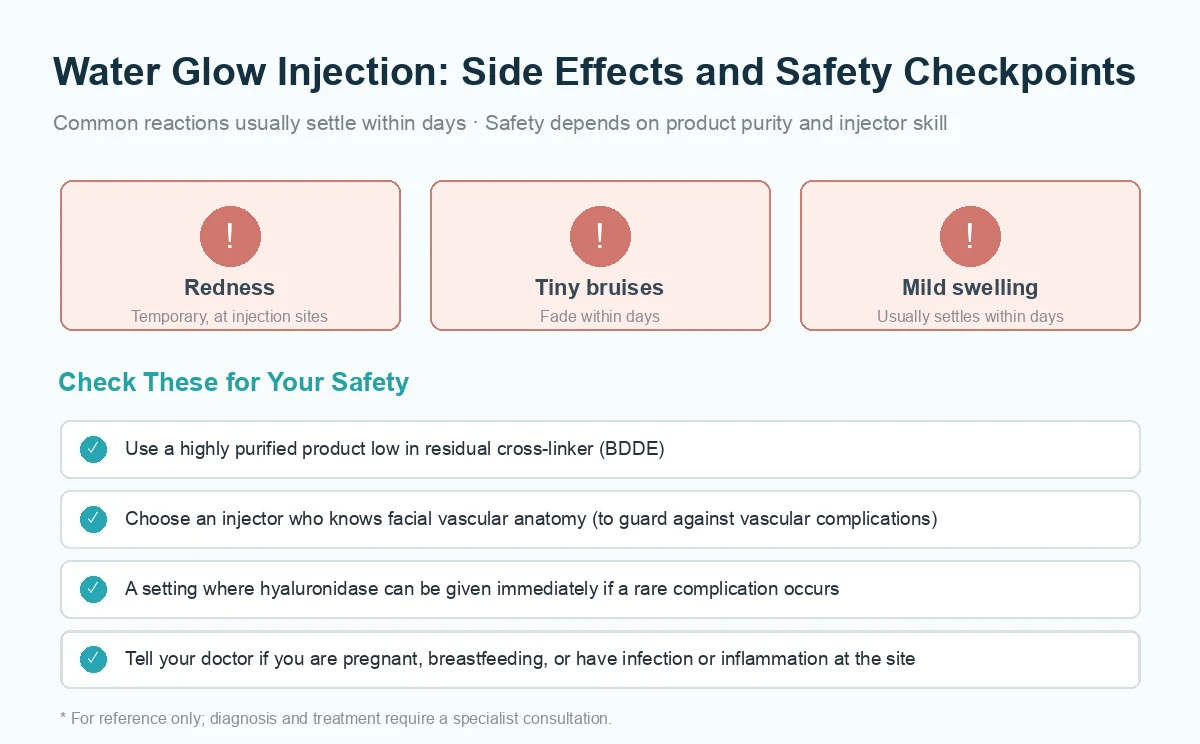
Temporary redness, small bruises and slight swelling at the injection sites are the reactions people notice most after a hyaluronic acid skin booster. They generally fade within days. If something feels unusual, such as pain that grows instead of easing, contact your clinic promptly.
Product Purity and Residual BDDE
One point I stress in consultation is product purity. Textbooks note that many adverse reactions to HA skin boosters are linked to impurities, such as leftover BDDE (the cross-linking agent mentioned above). Using a highly purified, well-documented product is one of the simplest ways to lower that risk, so it is reasonable to ask your clinic which product they use.
Rare Vascular Complications and Hyaluronidase
Rarely, injected material can affect a blood vessel and reduce blood flow to the skin, which in severe cases can lead to skin necrosis (tissue damage). This needs immediate treatment with hyaluronidase, an enzyme that dissolves hyaluronic acid. That is why it matters to choose an injector who understands facial vascular anatomy and works in a setting where hyaluronidase is on hand. These principles match the general safety guidance of professional plastic surgery societies; the International Society of Aesthetic Plastic Surgery (ISAPS) is a useful starting point if you want to learn how to check a specialist’s qualifications.
Finally, if you are pregnant or breastfeeding, or have an infection or inflammation at the treatment area, be sure to mention it during your consultation.
Dr. Lee’s Key Point: Redness, bruising and swelling usually pass within days. Product purity and the injector’s knowledge of anatomy are what keep this treatment safe.
Frequently Asked Questions About Hyaluronic Acid Skin Boosters
How long does a hyaluronic acid skin booster last?
It depends on how cross-linked the product is and on your skin. Because a hyaluronic acid skin booster uses lightly cross-linked HA, it breaks down faster than a volume filler, so results are kept up with repeat sessions. Your interval is set after your doctor sees how your skin responds.
How often should you get a water glow injection?
A 1–3 session protocol is usually recommended rather than a single treatment, followed by regular maintenance matched to your skin. The right interval for you is best decided in a face-to-face assessment.
What is the difference between an HA skin booster, Rejuran and Juvelook?
An HA skin booster uses hyaluronic acid for hydration and an early glow. Rejuran uses polynucleotides (a salmon DNA-derived ingredient) for repair and calming, and Juvelook uses PDLLA with HA to stimulate collagen and improve firmness. They are separate treatments with different ingredients and goals.
Does a hyaluronic acid skin booster hurt, and is there downtime?
Numbing cream is usually applied first, so most people find it manageable. Mild redness, tiny bruises and swelling are common afterward but usually settle within a few days, depending on the person.
Is a skin booster the same as a filler?
No. A filler adds volume to reshape an area, while an HA skin booster improves skin quality, meaning hydration, texture and glow, by placing soft HA in the upper dermis. Their purposes are different.
Planning a Hyaluronic Acid Skin Booster at MINE Clinic
We have covered how a hyaluronic acid skin booster works, what results to expect, how long it lasts and how it differs from Rejuran and Juvelook. The most important point bears repeating: the right booster depends on your skin and your goal, so an accurate in-person consultation matters more than any trend.
If you are wondering whether a hyaluronic acid skin booster, PN or PDLLA suits your skin, you are welcome to book a one-on-one consultation with Dr. Lee Sung-wook at MINE Clinic in Gangnam, Seoul. You can also explore our broader range of anti-aging skin treatments at MINE. For appointments and questions, call +82-2-516-1175 or use our online consultation form.
※ This content is for informational purposes only and does not replace professional medical advice, diagnosis, or treatment. Individual results may vary, and side effects may occur. Please consult with a board-certified plastic surgeon for personalized advice.
Written and reviewed by Dr. Lee Sung-wook, Board-Certified Plastic Surgeon, MINE Plastic Surgery & Dermatology