EN


A double chin self test is a short series of at-home checks — a pinch and tongue-press check, a chin-down fold test, a side-profile neck angle check and a four-question history quiz — that helps you estimate whether the fullness under your chin comes mainly from fat, loose skin and muscle, jaw structure or salivary glands. You only need a mirror, a phone and about ten minutes.
Maybe you noticed it on a video call: the line under your jaw folds the moment you look down, even though your weight hasn’t changed. That moment brings many people to my consultation room.
A double chin is not simply a sign of extra weight. In my clinical experience, nearly half of the people who consult me about a double chin are slim. That is why I ask patients to try a double chin test at home first; arriving with those results makes our conversation far more specific.
Below, I walk you through each step of the double chin self test and how to read your results. Please treat it as a guide, not a diagnosis.
What a Double Chin Self Test Can (and Can’t) Tell You
The purpose of a double chin self test is to get a rough answer to one question: “Is this fat, or is it something else?” That matters because each cause is treated differently. Removing fat will not tighten a loose muscle, and tightening skin will not change the shape of your jawbone.
The Four Things That Create Fullness Under the Chin
Medical textbooks group the causes of a double chin into four categories: fat under the chin (submental fat), a loose platysma muscle (the thin, sheet-like muscle covering the front of your neck), jaw and chin structure, and the position of the hyoid bone (a small U-shaped bone that sits above your Adam’s apple).
Two more factors can look similar from the outside. Skin that loses elasticity sags as collagen and elastin decline, and enlarged submandibular salivary glands (tucked just inside the jawbone on each side) can create a bulge that is easily mistaken for fat. Most people have a mix of several of these, such as fat, muscle laxity, reduced skin elasticity and gland size.
For the causes in more depth, I explain why a double chin can show up even when you’re slim in a separate article. Here, we stay focused on the double chin self test itself.
Dr. Lee’s Key Point: Different causes need different solutions. Identifying your likely type is the first step, and that is all this test is designed to do.
Who This Test Is For
It suits you if fullness under your chin bothers you and you don’t know why, or if you lost weight and it barely changed. It is not for sudden swelling or a painful, fast-growing lump; those need a medical check first.
How to Set Up a Double Chin Test at Home (So Your Results Are Reliable)
Before you start your double chin self test, take five minutes to set up. Most unreliable results come from poor photos or an unnatural posture, not from the checks themselves.
What You Need
- A mirror
- A smartphone with a self-timer, or a friend to take photos
- Bright, even light from the front (a window works well)
- A notes app to record each result
How to Take an Accurate Side-Profile Photo
Hold the camera level at about chin height, roughly an arm’s length away. A phone pointing up from below makes your neck look fuller; one pointing down makes it look slimmer.
Stand straight and look ahead. Don’t lift or tuck your chin, relax your shoulders and tuck your hair behind your ears.
Take three photos under the same conditions: left side, right side and front. You will use them in Step 4 and at your consultation, and repeating the double chin self test with the same setup lets you compare results fairly.
Steps 1 and 2: The Pinch Check and Tongue-Press Check (Quick Version)
Step 1, the pinch check: Gently gather the skin under the center of your chin between your thumb and index finger and estimate the thickness. My clinical rule of thumb, drawn from consultations rather than a textbook standard:
- 2 cm (about 3/4 inch) or more: fat under the chin is likely the main cause
- 1–2 cm: a mild amount, possibly with some loss of skin elasticity
- Barely anything to pinch: muscle laxity or jaw structure may matter more
Surgical literature describes three layers of neck fat, and a pinch test mainly picks up the layer just under the skin, above the platysma. Fat beneath the muscle cannot be pinched, so a thin pinch doesn’t always mean there is no fat.
Step 2, the tongue-press check: Press your tongue firmly against the roof of your mouth and feel under your jaw. A firm bulge suggests enlarged salivary glands may be involved; soft tissue that barely changes points more to fat. I ask patients to try this in my consultation room before anything else. For the full guide, see how to tell a double chin from enlarged salivary glands.
Step 3: The Chin-Down Angle Test
This step of the double chin self test looks at when, not just whether, your chin folds. It is a practical home check I use to gauge severity, not a standardized textbook test, so treat the angles as approximate.
How to Do the Chin-Down Test
Face the mirror and slowly lower your head in three stages, roughly 15, 30 and 45 degrees, watching for the moment a crease first appears under your jawline. About 15 degrees is a light nod; about 45 degrees is looking at the floor just in front of your feet; 30 degrees is halfway between.
What Your Fold Point Means
In my clinic, a fold that appears at just 15 degrees of head tilt usually signals a moderate or greater double chin.
| Fold first appears at | What it suggests |
|---|---|
| About 15 degrees | A moderate or greater double chin |
| 30 degrees or more | A mild double chin |
| No fold at any angle | Possibly a different concern, such as a softening jawline or jowls |
Notice the fold’s texture, too: a thick, soft roll suggests fat, while a thin, crepey line points to loose skin and muscle. Record which you see.
Step 4: The Side-Profile Chin Neck Angle Test
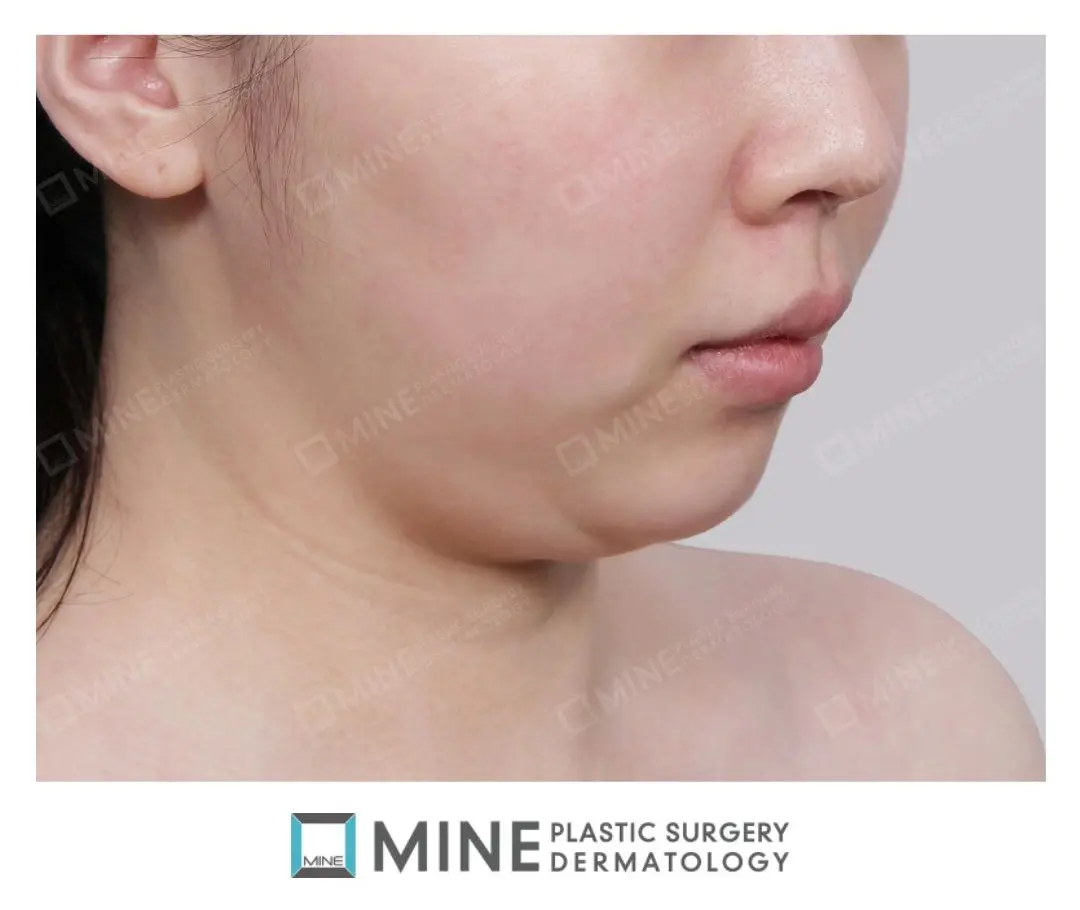
Now open your side-profile photos. This is the most informative step of the double chin self test, because the chin-neck angle reflects fat, muscle and bone at once.
How to Read the Angle on Your Photo
Imagine, or draw in an editing app, two lines. The first runs along the underside of your chin back toward your neck; the second runs down the front of your neck. Where they meet is the cervicomental angle, which simply means the angle between the underside of your chin and the front of your neck.
Plastic surgery textbooks describe a youthful neck as having a cervicomental angle of roughly 105 to 120 degrees. The more the angle opens up beyond 120 degrees, the fuller the area under the chin tends to look. A blunt profile that slopes almost straight from chin to collarbone is the classic double chin silhouette.
One study found that people rate a chin-to-neck angle of 90 to 105 degrees as attractive. Patients tended to want surgery once their angle reached about 110 degrees, whereas surgeons set the threshold closer to 125 degrees. Your photo won’t be precise, so simply judge whether your angle looks sharp, moderate or blunt.
Five Signs of a Well-Defined Neck
Surgeons often use five visual signs, first described by Ellenbogen and Karlin (1980). Check your photo against each:
- A clear lower jawline without sagging cheek tissue
- A slight hollow just below the hyoid bone
- A visible Adam’s apple area (thyroid cartilage)
- A visible front edge of the sternocleidomastoid, the long muscle down the side of your neck
- A chin-to-neck angle of 105–120 degrees
When the Chin Itself Sits Back
From the side, picture a line from your nose tip to the most forward point of your chin (the pogonion). This is called the E-line. The Riedel line, which links the front of your lips and chin, works in a similar way. If your chin sits well behind these lines, a skeletal cause may be involved. Textbooks note that a small, set-back chin (microgenia) can mimic a double chin even with little fat.
You can’t judge the hyoid bone at home. Textbooks explain that when it sits low, the angle stays blunt and removing fat alone brings only limited improvement, so ask about it at your consultation.
Step 5: The Genetics, Timing and Weight-Response Questionnaire
The last step of the double chin self test looks at your history, to separate fullness that tracks your weight from fullness built into your structure or genes.
The Four Questions
| Question | Yes | No |
|---|---|---|
| Q1. I recently lost about 3 kg (about 7 lb) or more, but the area under my chin looks the same. | ☐ | ☐ |
| Q2. One of my parents has similar fullness under the chin. | ☐ | ☐ |
| Q3. It has bothered me since my twenties. | ☐ | ☐ |
| Q4. Even when I diet, the area under my chin barely changes. | ☐ | ☐ |
Q2 and Q3 look for an inherited fat or jaw pattern that appears early. Q1 and Q4 check whether the fullness responds to weight; if not, stubborn local fat or a non-fat cause is likely.
How to Score Your Answers
In my clinical experience, if you answer yes to two or more of the four questions, weight loss alone is unlikely to resolve the fullness, which points to a structural double chin. To understand the reasons, read why fullness under the chin can stay after you lose weight.
Dr. Lee’s Key Point: The heart of a double chin self test is telling fat from non-fat. Note your answers and share them at your consultation; it makes the diagnosis more accurate.
Putting Your Double Chin Self Test Results Together
No single step gives you the answer. The value of a double chin self test comes from reading all five results side by side. Find the pattern below that best matches yours.
Result Combinations at a Glance
| Likely pattern | Typical self-test signs | What it usually points to | What to ask at your consultation |
|---|---|---|---|
| A. Mainly fat | Soft pinch of 2 cm or more; little change on tongue press; soft roll at 15–30 degrees; blunt angle | Localized fat under the chin | Is fat reduction enough, or is there laxity too? |
| B. Mainly loose skin and muscle | Little to pinch; thin crepey fold; blurred jawline; more common from your 40s | Platysma laxity and reduced skin elasticity | Does my neck need lifting rather than fat removal? |
| C. Mainly structure | Little fat, yet a blunt angle; chin behind the E-line or Riedel line | A small or set-back chin | Would chin correction change my profile? |
| D. Mainly salivary glands | Firm bulge on both sides on tongue press; no change with weight loss | Enlarged submandibular glands | Do my glands need to be assessed? |
Pattern A is usually a fat-reduction discussion, such as double chin liposuction at MINE. Platysma laxity tends to start in the mid-30s and becomes clearer in the 40s and 50s, so pattern B is more often a lifting conversation (see the American Society of Plastic Surgeons’ overview of neck lift surgery). Pattern C points to the chin itself; pattern D needs a gland assessment.
In practice, mixed patterns such as A+B or A+D are far more common than a single type, and textbooks likewise describe removing fat and tightening the platysma together as a common combination. So don’t settle on one procedure before your double chin self test results are confirmed by an examination.
Dr. Lee’s Key Point: Success depends on an accurate diagnosis of your type. The most common mistake I see is assuming that liposuction fixes every double chin.
What to Bring to Your Consultation
- Your three photos (left, right and front)
- Your double chin self test notes from Steps 1 to 5
- Weight changes over the past one to two years
- Medications, supplements and medical conditions
- The view that bothers you most: front, side or looking down
Useful questions include “Is it fat, skin, muscle, bone or gland, or a mix?” and “Would removing fat alone be enough for me?”
Limits of a Double Chin Self Test: When to See a Specialist
A double chin self test helps you estimate your type; it cannot replace an examination.
What Only an In-Person Exam Can Measure
The exact amount of fat, how loose the platysma is, gland size and hyoid position can only be confirmed by a specialist’s hands-on exam and imaging such as ultrasound. This is why an ultrasound consultation matters before any plan is made. Results also shift with photo angle, posture and weight, so repeat a borderline double chin self test on another day.
Signs That Need a Doctor Sooner
Skip the double chin self test and see a doctor promptly, rather than booking a cosmetic consultation, if you notice:
- Swelling that appeared suddenly
- Pain, warmth or redness under the jaw
- A firm lump on only one side
- Swelling that gets bigger when you eat
- A lump that is growing quickly
Frequently Asked Questions
Can a double chin self test tell me exactly what is causing my double chin?
No. A double chin self test gives you a working idea of your likely type, not a diagnosis. Fat volume, muscle laxity, gland size and hyoid position need a hands-on exam and ultrasound, but your results make that exam more focused.
How can I tell if my double chin is fat or loose skin?
Start with the pinch. In my experience, a soft pinch of 2 cm or more points toward fat. Little to pinch, plus a thin, crepey fold and a blurred jawline, suggests loose skin and muscle. Many people have both.
What is a normal chin-to-neck angle?
Textbooks describe a youthful neck as having a cervicomental angle of roughly 105 to 120 degrees. The blunter the angle beyond 120 degrees, the fuller the area under the chin tends to look. Take your photo at eye level with your head in a natural position.
Why hasn’t the area under my chin changed even though I lost weight?
Fullness under the chin often comes from causes weight loss doesn’t touch: stubborn local fat, loose skin or muscle, jaw structure or enlarged salivary glands. If you answered yes to two or more questions in Step 5 of the double chin self test, a structural cause is likely.
How do I improve a double chin without surgery?
For a mild, mainly fatty double chin, non-surgical radiofrequency or ultrasound treatments can bring some improvement. When loose skin or enlarged salivary glands are involved, non-surgical options alone are unlikely to give a satisfying result.
Next Step: Bring Your Results to a Consultation
The five steps of a double chin self test give you a working hypothesis about your type. Bone structure, fat distribution and skin elasticity differ from person to person, so two double chins that look alike can need very different solutions. An accurate diagnosis turns that hypothesis into a plan.
If you are abroad, you can start with an online consultation at MINE Plastic Surgery in Seoul. Send your three photos and your double chin self test notes, and I can give you a far more specific first opinion before you travel. You can also reach us by phone at +82-2-516-1175, or browse more double chin articles.
Written and reviewed by Dr. Lee Sung-wook, Board-Certified Plastic Surgeon, MINE Plastic Surgery | 813 Nonhyeon-ro, Gangnam-gu, Seoul | +82-2-516-1175
Sources: Aesthetic surgery textbooks; plastic surgery literature on the aging neck; research on chin-to-neck angle perception; MINE Plastic Surgery clinical experience.
※ This content is for informational purposes only and does not replace professional medical advice, diagnosis, or treatment. Individual results may vary, and side effects may occur. Please consult with a board-certified plastic surgeon for personalized advice.