EN


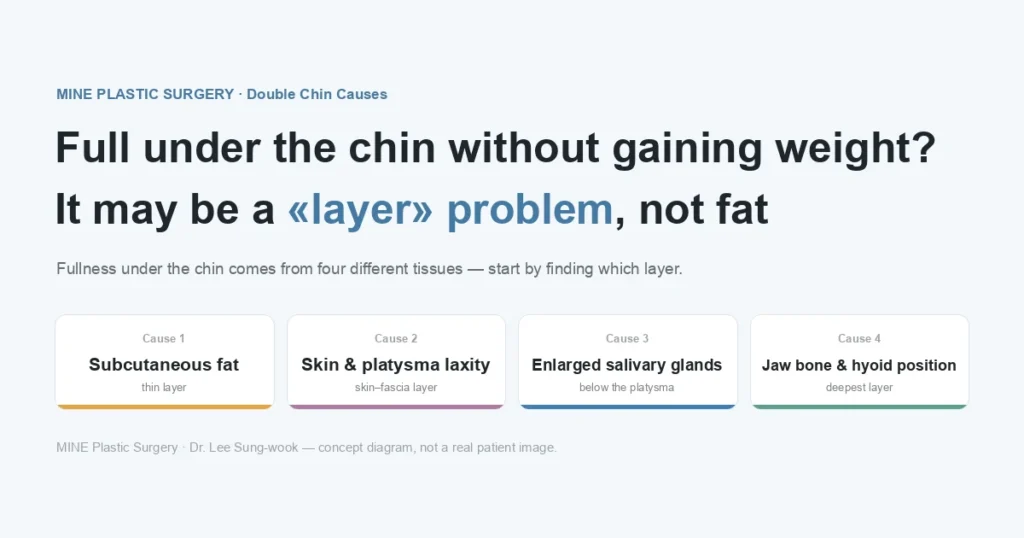
A double chin is a soft fold or fullness under the jaw that blurs the line where the chin meets the neck. Double chin causes fall into five types — fat, aging skin and SMAS, enlarged salivary glands, posture habits, and jaw–hyoid structure — and most people have two or three at once.
“I haven’t gained any weight, but every photo makes my jawline look soft.” I hear some version of this in my clinic almost every week. Your weight is normal, yet in profile the border between your chin and neck looks fuzzy, and the moment you tilt your head down, a second fold appears.
So what causes a double chin when weight isn’t the problem? In my clinical experience, it is rarely one thing. Bone structure, fat, skin aging and even the size of your salivary glands usually work together. Below, I break down the double chin causes type by type, because a different cause means a different part of the neck needs attention.
Dr. Lee’s Key Point: A double chin is very often a structural issue, not a weight issue. Finding your cause is the first step of any treatment.
Double Chin Causes at a Glance: Five Types, Four Tissue Layers
Many patients assume the fullness under their chin is simply “chin fat.” In reality, the area under the jaw is built in layers, and a double chin can start in any of them. Think of it like a layered cake: the bulge you see on the outside can come from the icing, the sponge or the plate underneath.

- Skin and fat (top layer): the skin and the fat directly beneath it.
- Platysma and SMAS (support layer): the platysma is a thin, sheet-like muscle covering the front of the neck; the SMAS is the fibrous support layer under facial skin that continues into the neck.
- Below the platysma: deep fat, the digastric muscles and the submandibular salivary glands.
- Bone (deepest layer): the lower jaw and the hyoid bone.
Plastic surgery textbooks list the same building blocks when they describe a full or aging neck: excess skin, fat, a loose platysma, bulky digastric muscles, changes in the submandibular glands and a low-sitting hyoid bone. One surgical text summarises the causes of a double chin in four headings — submental fat, platysma laxity, skeletal shape and hyoid position.
Posture sits on top of all of this. It doesn’t build a new layer, but it can make an existing fullness look more obvious. In real life, most people I examine have two or three of these double chin causes overlapping, which is why a single fix often disappoints.
Type 1: Fat Under the Chin
The most intuitive of the double chin causes is a build-up of subcutaneous fat (the fat just under the skin) beneath the jaw. When some people gain weight, fat collects first under the chin, in the cheeks and at the back of the neck. Where your body stores fat is largely set by your genes.
That is also why a slim body and a full chin can go together. Some people carry a small, stubborn pocket of fat under the jaw even when the rest of them is lean. This kind of localized fat is notoriously hard to shift with diet or exercise alone.
If this pocket is still there after you’ve slimmed down, I explain why a double chin stays after weight loss in a separate guide.
Type 2: Aging Skin and SMAS Laxity — the Double Chin That Arrives With Age
Here the issue isn’t fat at all; it’s a loss of support. Of all the double chin causes, this one surprises people most, because it can appear without a single extra kilogram. In my clinic, I typically see skin start to loosen from the late 30s as collagen and elastin, the proteins that keep skin firm and springy, gradually decline.
Why neck skin loosens before the face does
Plastic surgery textbooks describe neck skin as thinner and less elastic than facial skin, which is why neck laxity is among the first visible signs of aging. Once that skin can no longer hold the jawline against gravity, it slides downward and the clean edge under the chin softens. Many patients notice their neck changing years before their face.
When the support layer (SMAS and platysma) slackens
The deeper story is the support layer. With age, the platysma muscle gradually loses its anchoring to the deep tissue of the neck. Its front edges drift away from the angle under the jaw, and the sharp chin–neck angle of youth turns into a softer, more obtuse one. Sometimes those loose edges also show as vertical cords, often called neck bands.
Medical texts also explain that the fascia of the neck is a direct continuation of the SMAS from the face. So when the SMAS loosens, the skin and the layer holding it up sag together. That is exactly why someone who hasn’t gained weight can still develop what looks like a double chin.
Yo-yo weight changes speed it up
Textbooks list repeated weight loss and gain among the factors that age facial tissue, alongside sun exposure, genetics and smoking. Each cycle stretches the skin, and it may not fully spring back. Rapid weight loss can leave the same result: stretched skin that never returns to its old position.
Because the problem is loose tissue rather than extra tissue, removing fat alone rarely improves this type. It usually needs an approach that addresses both skin and the SMAS layer.
Dr. Lee’s Key Point: A double chin that develops with age is mainly about SMAS laxity, not the surface skin.
Type 3: Enlarged or Drooping Salivary Glands
When I explain this cause during a consultation, most people tell me they’ve never heard of it. Under each side of your jaw sits a submandibular gland, one of the paired salivary glands that make saliva. These glands lie below the platysma muscle, deeper than the fat most people picture.
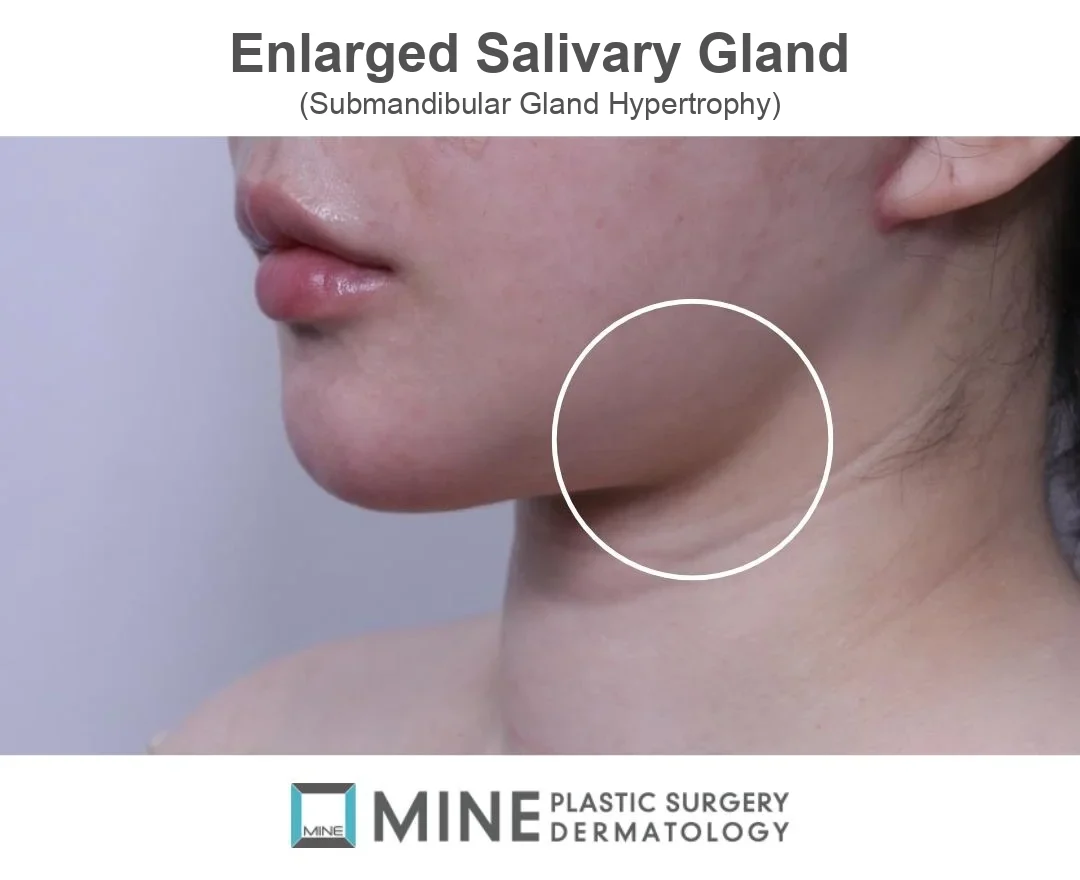
Gland size naturally varies from person to person. Some people are born with larger glands; in others, the surrounding tissue weakens with age and the glands drop lower. Research on neck anatomy notes that enlargement and drooping of the submandibular glands become common around age 50, and sometimes earlier. Either way, the result is a firm fullness on both sides under the jaw.
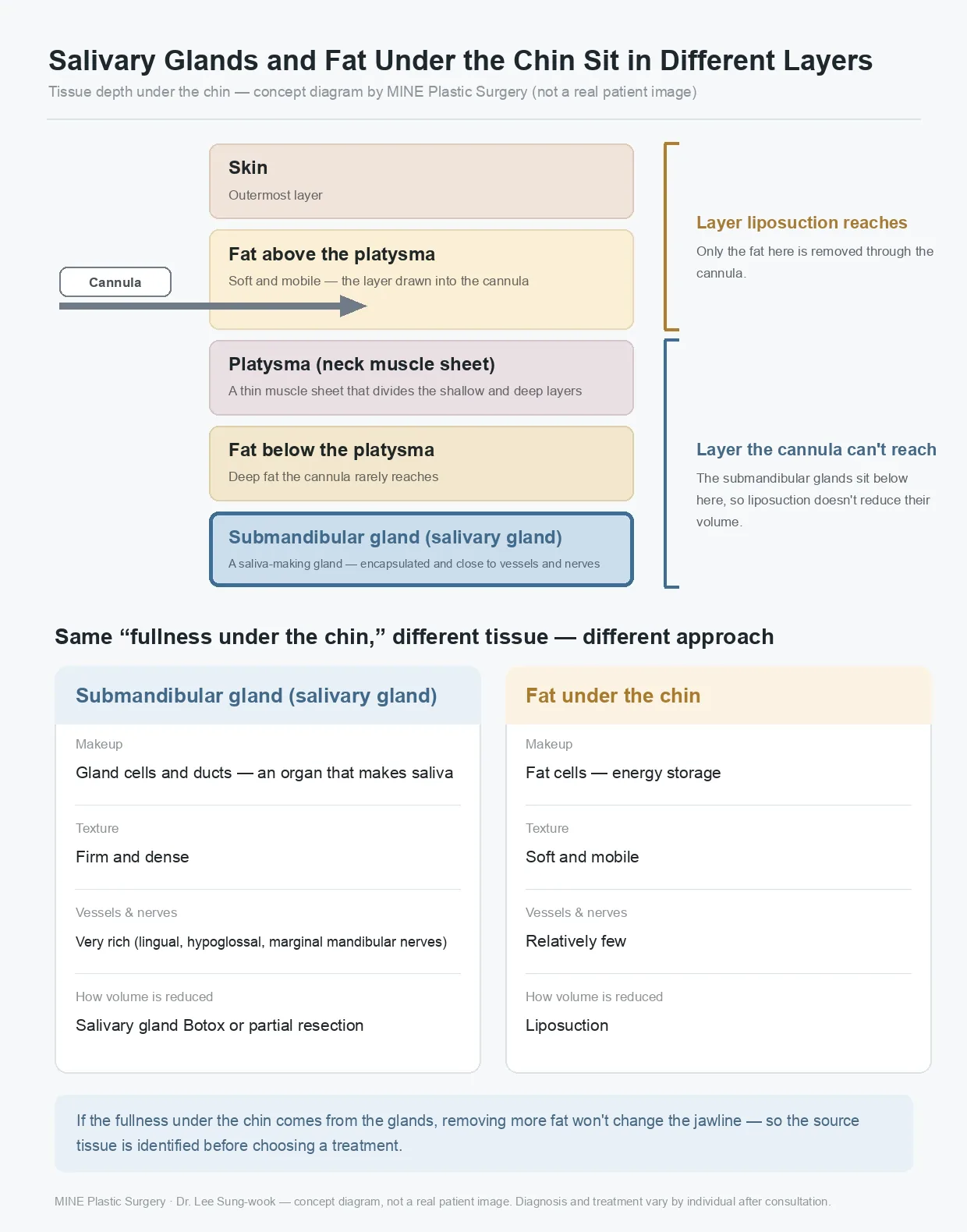
This explains a common frustration: “I had liposuction, but the bulge is still there.” Liposuction works in the fat layer above the platysma. If the fullness comes from the glands beneath it, more suction simply won’t change the jawline. Telling the two apart takes a few specific checks, which I cover in how to tell a double chin from a salivary gland.
Type 4: Posture and Daily Habits — Aggravators, Not Root Causes
Lifestyle is better understood as an aggravator rather than a direct cause of a double chin. Daily habits usually don’t create the problem on their own, but they can make an existing fullness look worse. If your chin seems to be changing faster than your friends’, these habits are worth a look.
Forward head posture and long screen time
Spending hours with your head bent over a phone or laptop bunches the soft tissue under your chin together, so the contour looks softer in that position. Some clinicians believe long-term forward head posture may also contribute to looser tissue in the front of the neck, but the evidence for that is limited. What I can say with confidence is that head-down posture can make an existing double chin look more pronounced.
Resting your chin on your hand
Habitually leaning your jaw on one hand puts steady pressure on one side. Some patients feel this may contribute to a slightly uneven jawline over time, although it is unlikely to be the main reason for a double chin.
What chin exercises can and can’t change
Chin lifts, tongue presses and massage can give a temporary feeling of tightness. They cannot move bone, shrink a salivary gland or re-anchor a loose SMAS layer. Treat them as a gentle supplement, not a solution. I go through the details in what double chin exercises can and can’t fix.
Dr. Lee’s Key Point: Habits are rarely the root cause of a double chin. They are accelerators that make other causes more visible.
Type 5: Jaw Shape, Hyoid Position and Deep Fat
This is the type my patients find most unfair. They are slim, sometimes very slim, yet their profile photos show fullness under the chin. In these cases the double chin comes from the position of bone and from structures deep in the neck, not from how much fat they carry.
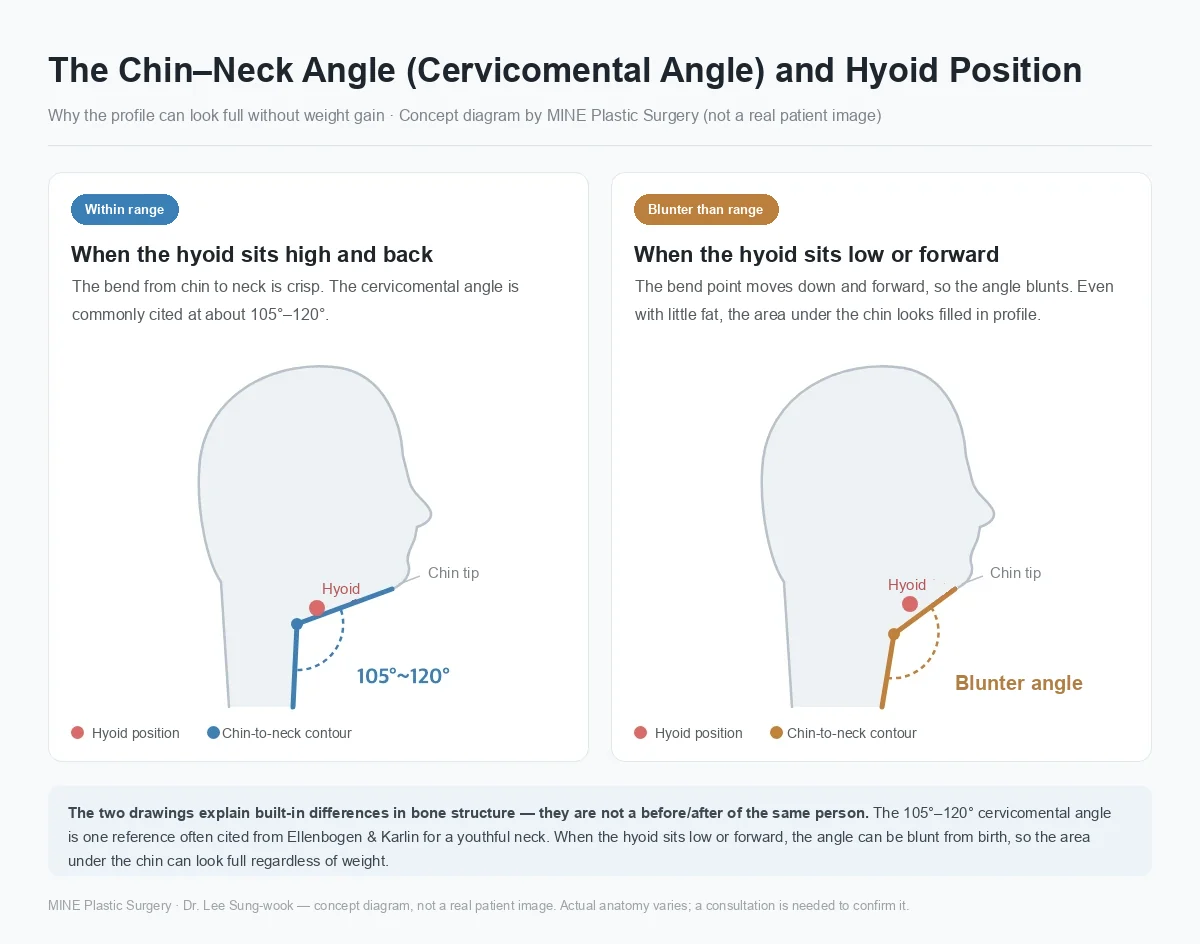
The hyoid is a small U-shaped bone in the front of the neck, just under the chin. It acts like a tent pole for the chin–neck border. If it naturally sits low or forward, the angle between chin and neck is soft from the start. A short or set-back lower jaw shortens the distance from chin to neck, so even a little fat looks like a double chin.
There is also deep fat that lies beneath the platysma. Textbooks explain that this deep fat can’t be suctioned and needs a separate approach, which is why some necks look full even when there’s little to pinch. A cervicomental angle (the chin–neck angle seen in profile) of roughly 105–120 degrees, a reference long cited in the plastic surgery literature from Ellenbogen and Karlin, is what reads as a defined jawline.
If you’re slim and this sounds like you, read our guide to a double chin when skinny, where I go deeper into this group of causes.
Dr. Lee’s Key Point: If you’re slim and have a double chin, check your hyoid position, jaw shape and deep fat before you blame fat under the skin.
Can You Get a Double Chin When Thin? Will Dieting Fix It? The 5-Type Verdict
Here are the five double chin causes side by side. Spotting which rows sound like you makes your first consultation much more focused.
| Cause type | What it looks/feels like | Can it happen in slim people? | Will weight loss help? |
|---|---|---|---|
| Fat under the chin | Soft, pinchable fullness | Sometimes | Partly / limited |
| Skin aging & SMAS laxity | Blurry jawline, loose skin | Yes | No |
| Enlarged salivary glands | Firm bulge on both sides under the jaw | Yes | No |
| Posture & habits | Looks worse head-down, softer contour | Yes | Partly (aggravator only) |
| Jaw shape & hyoid position | Retruded chin, blunt chin–neck angle in profile | Yes | No |
Of the five double chin causes, only fat under the chin reliably improves with weight loss. If your jaw is short, your skin has already lost elasticity or your glands are enlarged, the double chin can stay no matter how much weight you lose. I regularly meet people who tell me, “I lost 10 kg (about 22 lb) and my double chin didn’t change.” Almost all of them have more than one structural cause at work.
Dr. Lee’s Key Point: If dieting hasn’t touched your double chin, a structural cause beyond fat is almost certainly involved.
Your Cause Map: Where to Read Next
Each type has its own in-depth guide. Use this short map to jump to the one that matches what you see in the mirror:
- Slim, with a blunt chin–neck angle in profile: read about a double chin when skinny (jaw, hyoid and deep fat).
- Still there after you lost weight: see why a double chin stays after weight loss.
- A firm bulge on both sides under the jaw: learn how to tell a double chin from a salivary gland.
- Wondering whether workouts will do it: check what double chin exercises can and can’t fix.
How We Identify Double Chin Causes at MINE
The single most important question in treating a double chin is why it developed. Two chins that look alike from the front can come from completely different layers, so we start by finding the cause rather than choosing a procedure.
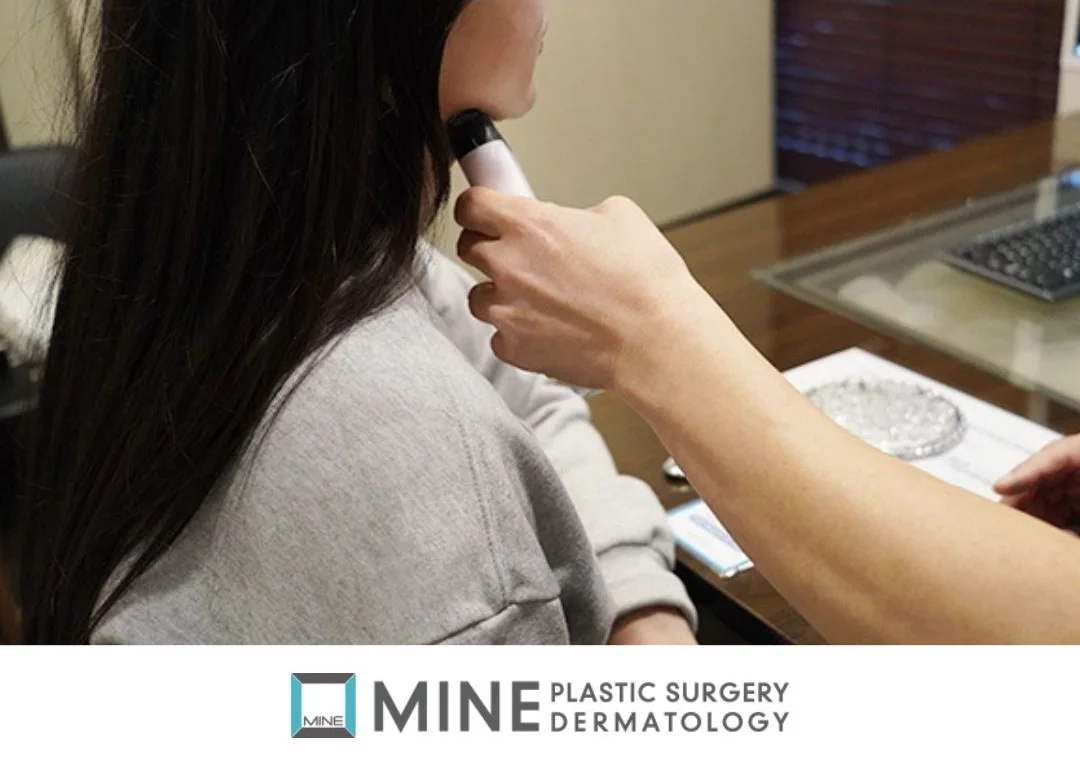
What the consultation checks
- Fat layer: we measure the amount and spread of fat under the chin by touch and with ultrasound.
- Skin and SMAS: we assess how far the skin has loosened and whether the SMAS support layer has slackened.
- Salivary glands: we check the size of the submandibular glands by careful palpation.
- Profile and bone: we look at your chin–neck angle, jaw projection and hyoid position from the side.
Matching the approach to the cause
- Mainly fat: submental liposuction or fat reduction, which works best when skin elasticity is still good.
- Loose skin and SMAS: a mini neck lift or neck lift that tightens the SMAS layer along with the skin.
- Enlarged glands: partial salivary gland reduction to slim the bulge under the jaw.
- Mixed causes: a combined plan, which is what most patients actually need.
You can read more about each option on our double chin treatment at MINE page.
Dr. Lee’s Key Point: “Double chin surgery” is not one operation. A plan matched to your causes is what shapes the result.
Recovery and Risks If You Do Treat It
Whatever the treatment, I believe a surgeon’s duty is to be honest about recovery and side effects. Here is what to expect.
Recovery timeline by treatment
| Treatment | Back to daily life | Final result visible |
|---|---|---|
| Submental liposuction | About 5–7 days | 1–3 months |
| Mini facelift / neck lift | About 2 weeks | 3–6 months |
| Partial salivary gland reduction | About 1–2 weeks | 1–3 months |
Most people return to daily life about 5–7 days after submental liposuction and about 2 weeks after a neck lift. Healing speed differs from person to person, so we set your own timeline during the consultation.
Common, temporary effects
- Bruising and swelling: usually around the chin and neck for 1–2 weeks, fading on their own.
- Tightness: a pulling sensation after lifting procedures that settles with time.
- Temporary numbness: the skin under the chin may feel dull, and this usually recovers within weeks to a few months.
Rare risks to know
- Inflammation or infection: keeping the area clean matters.
- Nerve injury: very rare, but surgery near the marginal mandibular nerve (the small nerve that moves your lower lip) needs care. Surgeons stress precise knowledge of the neck’s anatomy for exactly this reason.
- Asymmetry or dissatisfaction: healing varies, which is why a thorough consultation beforehand matters.
For a general overview of how the procedure works, see the American Society of Plastic Surgeons’ neck lift overview.
Before and after surgery: what to do
- Describe your concern in concrete terms, such as “no jawline in profile” or “it folds when I look down,” rather than “I don’t like my chin.”
- Stop smoking at least 2 weeks before surgery; nicotine reduces blood flow and slows healing.
- Tell the team about aspirin, omega-3 and any other medicines or supplements that affect bleeding.
- For 1–2 weeks after surgery, avoid bending your head down deeply and skip strenuous exercise.
- Follow your compression garment instructions; it helps swelling go down faster.
- Avoid alcohol and saunas for at least 4 weeks.
Dr. Lee’s Key Point: Half of a good result is the surgery itself; the other half is how well you look after it afterwards.
FAQ: Double Chin Causes
Why do I have a double chin if I’m not overweight?
Fat is only one of five double chin causes. Loose skin and SMAS, enlarged salivary glands, a low hyoid bone or a set-back jaw, and deep fat beneath the platysma can all create fullness under the chin in slim people. That’s why weight alone doesn’t predict who gets one.
What causes a double chin to appear with age?
Neck skin is thinner and less elastic than facial skin, so it loosens early. At the same time, the platysma and the SMAS layer it continues from lose their anchoring, softening the chin–neck angle. The submandibular glands may also drop lower, commonly from around age 50.
Can bad posture cause a double chin?
Posture is better seen as an aggravator. Looking down at a phone for long periods can make an existing double chin look more pronounced, but evidence that posture creates one on its own is limited. Improving posture can help how your profile looks, without changing the underlying cause.
Is a double chin genetic?
Genetics play a large role. The length and shape of your jaw, your hyoid position, where you store fat and your skin quality are all inherited to a degree. If a parent has a double chin, you are more likely to share a similar structure, even if you stay slim.
Can exercises or massage get rid of a double chin?
They can make the jawline feel tighter for a while, but they can’t change bone, salivary glands or a loose SMAS layer. When those are behind your double chin, exercise is a realistic supplement, not a fix.
How do I know which double chin cause I have?
An in-person exam is the reliable way. Touch and ultrasound separate fat from gland and from loose tissue, and your profile angle shows whether bone structure is involved. Most people turn out to have a mix, which is why the plan should follow the diagnosis.
Find Out Which Layer Is Behind Your Double Chin
Double chin causes differ from person to person. For one patient it’s bone structure; for another it’s fat or aging skin; for someone else it’s the salivary glands. The key is knowing exactly what is behind your double chin, because that sets the direction of any treatment.
Because diagnosis depends on your bone structure and skin condition, an in-person assessment is the most reliable step. If you live abroad, you can start with an online consultation at MINE Plastic Surgery in Seoul. Send clear front and side-profile photos, and I can give you a more specific first opinion before you travel. You can also reach us by phone at +82-2-516-1175.
Written and reviewed by Dr. Lee Sung-wook, Board-Certified Plastic Surgeon, MINE Plastic Surgery | 813 Nonhyeon-ro, Gangnam-gu, Seoul | +82-2-516-1175
Sources: Aesthetic and plastic surgery textbooks on neck anatomy and aging; plastic surgery literature on the submandibular glands and the cervicomental angle; MINE Plastic Surgery clinical experience.
※ This content is for informational purposes only and does not replace professional medical advice, diagnosis, or treatment. Individual results may vary, and side effects may occur. Please consult with a board-certified plastic surgeon for personalized advice.