EN


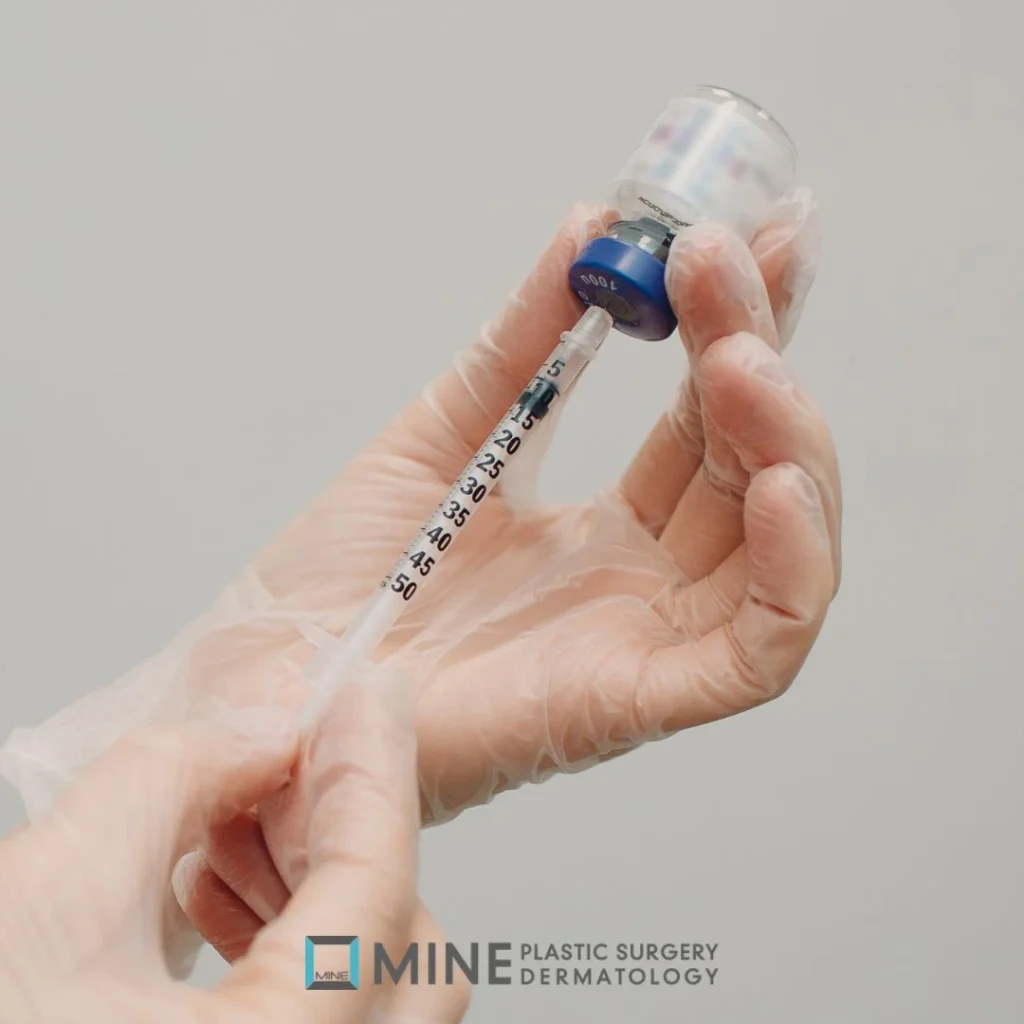
Submandibular gland Botox is an injection of botulinum toxin into the salivary gland under the jawline, given to reduce the gland’s activity and the fullness it can create below the jaw. It is temporary, and it needs more care around swallowing and dry mouth than injections near the ear.
Most articles on salivary gland Botox treat all the glands as if they were one. They aren’t. The gland under your jaw sits deeper, lies against a muscle in the floor of the mouth, and makes most of your saliva at rest. Those three facts change what you should check before and after treatment.
I’m Dr. Lee Sung-wook, a board-certified plastic surgeon at MINE in Gangnam, Seoul. This article focuses on the gland under the jaw and on the two risks to weigh with submandibular gland Botox: swallowing and dry mouth. The parotid gland near the ear and salivary gland Botox in general have their own guides, linked below.
What Is Submandibular Gland Botox?
Botulinum toxin blocks acetylcholine (the chemical messenger that tells the gland to make saliva) at the point where the nerve meets the gland. With that signal turned down, the gland works less. For the broader picture, see our overview of salivary gland Botox effects and side effects.
Where the gland sits, and how it differs from the parotid
You have two submandibular glands, one on each side, in a small triangular space under the lower jawbone. Anatomy textbooks describe this gland as deeply placed and wrapped in deep fascia (a tough sheet of connective tissue). The parotid gland, by contrast, sits in front of and below the ear. That difference in depth is one reason I don’t rely on touch alone when treating the gland under the jaw.
| Submandibular gland Botox | Parotid gland Botox | |
|---|---|---|
| Location | Under the lower jawbone, deep, inside deep fascia | In front of and below the ear |
| Share of resting saliva | Roughly 65-70% | About 20% |
| Main thing to watch | Swallowing and dry mouth | Confirming the gland, not the jaw muscle, is the cause |
| Where to read more | This article | parotid gland Botox and how it differs from masseter Botox |
A muscle runs through this area: the mylohyoid
The gland wraps around the back edge of the mylohyoid muscle, the muscle that supports the floor of the mouth. Textbooks describe a superficial lobe lying outside this muscle and a smaller deep lobe curling around its back edge. It is one gland, but part of it sits on each side of the muscle.
Picture a soft pillow folded over the back edge of a shelf. This arrangement is what sets submandibular gland Botox apart from injections near the ear, and it comes up again in the swallowing section below.
Who Might Consider Submandibular Gland Botox?
Signs that point to the gland
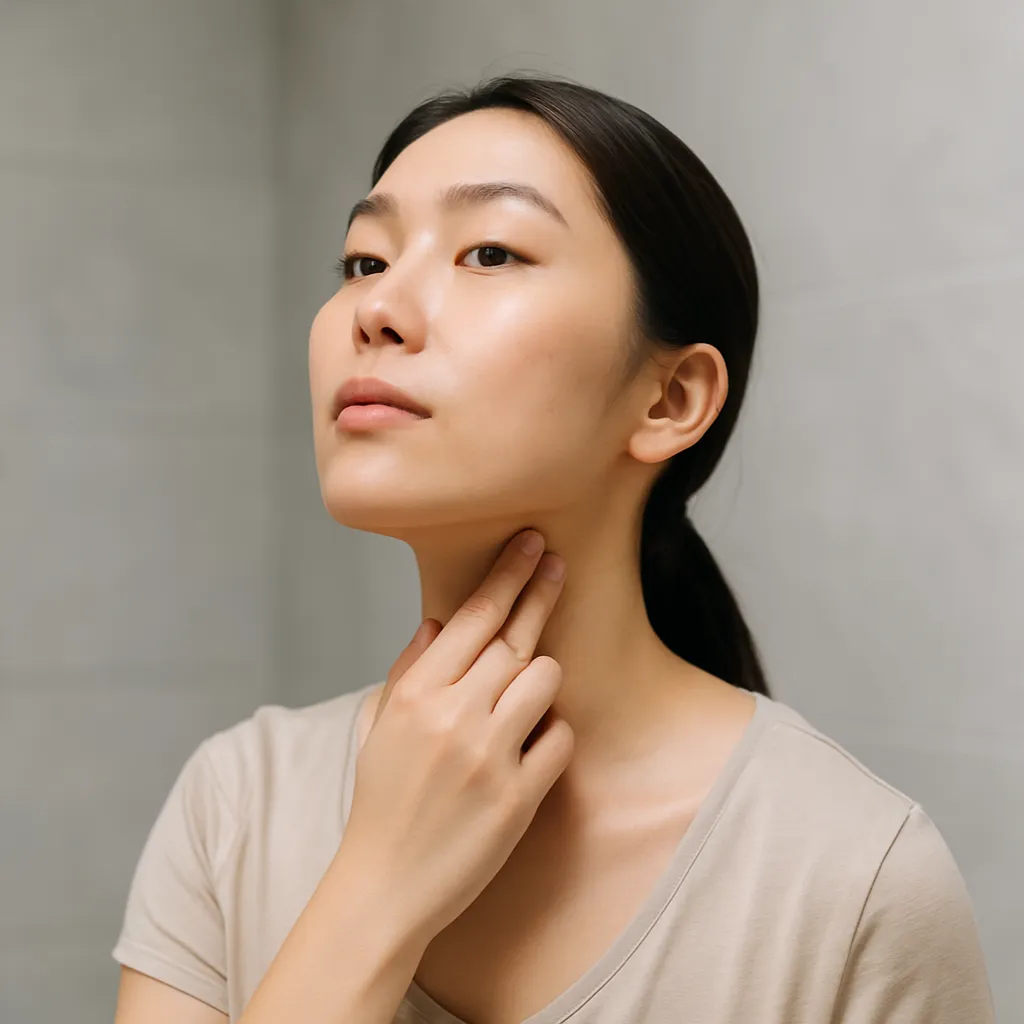
The usual reason people ask about submandibular gland Botox is fullness under the jawline that stays after weight loss or masseter Botox. In my clinical experience, many patients arrive assuming it is simple jawline fat, and only examination and ultrasound show that the gland is the cause. The gland may be naturally large, or it may droop with age.
If you are unsure what you are seeing in the mirror, start with our guide to telling a double chin from an enlarged gland.
When it may not be the right fit
Textbooks list the following as reasons not to have botulinum toxin:
- Motor neuron disease
- Myasthenia gravis
- Lambert-Eaton syndrome
- Allergy to botulinum toxin or albumin
- Pregnancy
- Infection at the injection site
Ask your doctor first if you already have trouble swallowing or breathing, because textbooks note a higher risk in people with underlying conditions. Mention any existing dry mouth as well, since this treatment could add to it.
If you want a permanent change or your glands are very large, an injection may not be the right tool. Our article on what to do when salivary gland Botox is not working covers the next options.
How the Injection Is Done, and Why Ultrasound Depth Matters
Before the injection: confirming what the swelling is
Ultrasound shows where the gland is and how large it is, and it also helps rule out other causes of a lump under the jaw. Before you agree to submandibular gland Botox, it is reasonable to ask:
- Have an examination and an ultrasound confirmed that this fullness is coming from the gland?
- Will the injection itself be guided by ultrasound?
- Do I have any swallowing, breathing or dry-mouth issue that changes the plan?
- Who do I contact if something feels wrong, especially after I fly home?
During the injection: placing the toxin inside the gland
The goal is easy to state and harder to achieve: the toxin should stay inside the gland, away from the mylohyoid and the swallowing muscles. At MINE we inject under ultrasound and adjust the dose to each gland’s size and activity, so depth is seen on the screen rather than estimated.
As one published example, Karapantzou et al. (2020) described 15 units per gland under ultrasound in 23 patients. This is a literature figure, not MINE’s protocol. Your dose depends on your own gland. That study reported no major complications, but a group of 23 is too small to show that a treatment is free of risk.
No technique brings the risk to zero. Ultrasound helps with placement, but it cannot make the side effects below impossible.
Risk 1: Why Swallowing Needs Attention After Submandibular Gland Botox
Why this gland carries the swallowing warning
Medical textbooks specifically warn clinicians to take care not to affect swallowing when injecting botulinum toxin into this gland, because of its depth and the muscle passing through it. The concern comes from the location. If toxin reaches the mylohyoid or nearby swallowing muscles, those muscles could weaken for a time.
Whether that happens depends on dose, placement and spread together, not dose alone. A sensible dose can still cause trouble if it is misplaced or spreads. I can’t give you a dependable figure for how often this happens with submandibular gland Botox, so I won’t quote one.
What you might notice, and when to seek urgent care
The U.S. prescribing information for Botox carries a boxed warning that the toxin’s effects may spread from the injection area, with symptoms reported hours to weeks after injection, and that swallowing and breathing difficulties can be life threatening. Watch for:
- Trouble swallowing
- Difficulty breathing
- Changes in your voice or speech
- Marked weakness
If swallowing or breathing becomes difficult, seek emergency care at once, and tell the medical team you received botulinum toxin.
If you traveled to Korea for treatment and symptoms start after you fly home, tell your local doctor about the injection, including the date it was given.
Risk 2: Dry Mouth After Salivary Gland Botox, and Which Gland Makes Your Saliva
Which gland makes your saliva, at rest and at meals
Medical textbooks report that the submandibular glands make roughly 65-70% of resting saliva, the saliva that keeps your mouth comfortable between meals. Salivary gland textbooks report that the parotid share rises to about half once chewing or taste stimulates saliva.
| Gland | Share of saliva at rest |
|---|---|
| Submandibular glands | Roughly 65-70% |
| Parotid glands | About 20% |
| Sublingual glands (under the tongue) | About 5-7% |
| Minor glands (small glands lining the mouth) | Up to about 10% |
These figures are approximate and differ slightly between textbooks. They describe a mouth at rest. When you chew or taste food, the parotid glands take on a much larger share, about half of the flow.
Why dryness could be more noticeable here
Dry mouth (xerostomia, the medical term for a lack of saliva) is a possible side effect of salivary gland Botox. Because this gland leads at rest, dryness could be more noticeable after submandibular gland Botox than after parotid injection, and more likely between meals than during them.
That is a reasoned inference from how much saliva each gland makes. I’m not aware of a study that compares the two injection sites directly, and I can’t offer a frequency figure. Please treat it as something to discuss with your doctor, not as a measured result.
Other glands keep working, so your mouth does not stop making saliva. Textbooks also note that dry mouth is usually not a problem until flow falls below about 0.2 mL per minute per gland. Severe dryness can make eating, swallowing and speaking harder, so don’t dismiss it. Sudden swallowing trouble is different and belongs on the urgent list above.
Managing a dry mouth
- Sip water often through the day.
- Try sugar-free gum or candy, since chewing and taste stimulate saliva.
- Use an oral moisturizer.
- Cut back on caffeine and alcohol.
If dryness interferes with daily life, tell your doctor. The dose at your next session can be reviewed.
Recovery and Timing: Saliva Changes First, the Mirror Later
The first days
Most people return to daily activities the same day. You may have some soreness, swelling or bruising at the injection site, which usually settles on its own.
Avoid alcohol, saunas and hard exercise, and avoid rubbing or massaging the area, for the period your doctor advises.
Two clocks: saliva and contour
After submandibular gland Botox, it helps to think of two separate clocks. Saliva tends to change first, and the change you can see in the mirror follows later.
| What changes | What the literature reports | What it means for you |
|---|---|---|
| Saliva | A marked drop within the first 2 weeks, lasting 2-3 months on average (textbook protocol for the parotid gland) | An indirect guide only, because the data come from the parotid gland |
| Gland size | A 23-patient study (Karapantzou et al., 2020) reported size improvement 2-10 days after injection; ultrasound showed 0.3-1.2 cm less in some cases | 13 of the 23 patients were treated for cosmetic reasons; the others had sialadenosis (benign gland swelling) or salivary stones |
| Mirror change | No fixed timeline; the study above is one small report | Gradual, and it varies from person to person |
In a small study of 23 patients, Karapantzou et al. (2020) reported that gland size improved 2 to 10 days after injection, and that ultrasound showed a decrease of 0.3 to 1.2 cm in some cases, especially in gland height. A measurement on a scan is not the same as a change you can see, though. Seeing no visible difference right after the injection is expected, and it doesn’t mean the treatment failed.
How long does it last?
The effect is temporary. Nerve signaling recovers, and the gland becomes active again, which is why textbooks describe repeat injections. Submandibular gland Botox should not be expected to shrink the gland permanently. How long your own contour change holds varies, and I would rather review it with you at a visit than promise a number here.
Repeat Sessions: How Soon Is Too Soon?
Why shorter intervals can backfire
Repeating too soon can work against you, because the body can form antibodies (proteins that neutralize the toxin and weaken its effect). Higher doses, shorter intervals, booster doses and young age are all listed as risk factors.
Dermatology textbooks recommend a 3-month interval between botulinum toxin sessions, with 1 month as the minimum, and advise against touch-ups. This is general toxin guidance rather than advice written for this gland, but it applies to submandibular gland Botox as well. An early top-up because you can’t see a change in the mirror yet is the kind of touch-up to avoid.
Planning the next session
In my clinical opinion, continuing while some effect remains can make maintenance easier. That is my view from practice, not a published finding, and it never means shortening the interval on your own. Schedule your next session at a visit, after your doctor has asked about saliva and swallowing.
Lasting change after repeat sessions has not been established. If a permanent change is what you want, the option to discuss is salivary gland reduction.
Submandibular Gland Botox FAQ
How long does submandibular gland Botox take to work?
Saliva may drop within 2 weeks, based on a textbook protocol for the parotid gland rather than this gland, but the change in your contour has no fixed number of weeks. That parotid figure is only an indirect guide here. Your contour follows gradually, at a pace that varies from person to person.
Can submandibular gland Botox cause difficulty swallowing?
Yes, it can, which is why medical textbooks single out this gland. Dose, placement and spread of the toxin all play a part. If swallowing or breathing becomes difficult at any point after the injection, seek emergency care at once and tell the medical team you received botulinum toxin.
Will salivary gland Botox give me a dry mouth?
It may. The submandibular glands make roughly 65-70% of resting saliva, so dryness could be more noticeable than after parotid injection, especially between meals. Your other glands keep working. If dryness interferes with daily life, tell your doctor so the dose at your next session can be reviewed.
How often can I repeat submandibular gland Botox?
Your doctor sets the schedule. General dermatology guidance recommends about 3 months between botulinum toxin sessions and advises against touch-ups, because short intervals raise the risk of antibodies that weaken the toxin’s effect. This guidance is not specific to the gland, but it is a sound starting point.
Is the result of submandibular gland Botox permanent?
No, the effect is temporary, and nerve signaling recovers over time. Some patients feel that the fullness comes back less after repeat sessions, but the evidence does not support claiming permanent shrinkage. If a lasting change is your goal, raise that at your consultation so other options can be discussed.
Who should not have submandibular gland Botox?
You should not have it if you have a neuromuscular disorder such as myasthenia gravis, are allergic to botulinum toxin or albumin, are pregnant, or have an infection at the injection site. Mention any existing swallowing or breathing problem at your consultation, as well as any dry mouth you already live with.
Considering Submandibular Gland Botox? Start With an Ultrasound Check
The first step is not the injection. It is finding out what the fullness under your jaw actually is, because the right answer may or may not be submandibular gland Botox.
If you would like that answer, you are welcome to book a consultation and ultrasound check with Dr. Lee Sung-wook, Board-Certified Plastic Surgeon, at MINE Plastic Surgery & Dermatology in Seoul. You can reach us at +82-2-516-1175.
Written and reviewed by Dr. Lee Sung-wook, Board-Certified Plastic Surgeon, MINE Plastic Surgery & Dermatology | 813 Nonhyeon-ro, Gangnam-gu, Seoul | +82-2-516-1175
Published: November 8, 2026 | Last reviewed: November 8, 2026
Sources: Karapantzou et al. Laryngoscope Investig Otolaryngol. 2020;5(2):217-220. BOTOX prescribing information, boxed warning (Allergan), DailyMed. Salivary gland surgery, aesthetic surgery and cosmetic dermatology textbooks.
※ This content is for informational purposes only and does not replace professional medical advice, diagnosis, or treatment. Individual results may vary, and side effects may occur. Please consult with a board-certified plastic surgeon for personalized advice.