EN


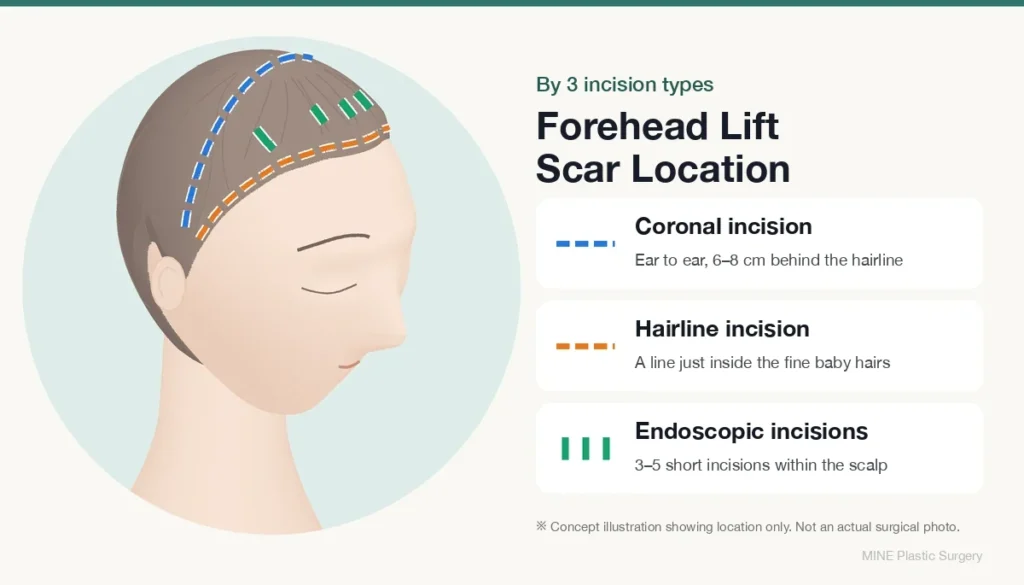
A forehead lift scar is the healed line left by the incision used to raise the brows and forehead. Depending on the technique, it sits inside the hair, just behind the hairline, or as a few short marks within the scalp.
Most patients ask about the scar before anything else. Will it show from the front? Will it show when I tie my hair up? Will the hair around it thin out? This article follows those questions, from where each incision leaves its mark to what can be done if a forehead lift scar still bothers you after a year.
I’m Dr. Lee Sung-wook, a board-certified plastic surgeon at MINE Plastic Surgery & Dermatology in Seoul. The figures below come from plastic surgery textbooks.
- Why Forehead Lift Scar Location Depends on the Incision
- Where Is a Forehead Lift Scar? A Map of Each Incision Type
- How Surgeons Make a Hairline Incision Scar Less Visible
- How a Forehead Lift Scar Changes Over 12 Months
- Hair Loss Around the Scar and Widened Scars: What Drives Them
- Still Bothered After a Year? Forehead Lift Scar Revision Options
- 4 Questions That Decide Where Your Scar Should Go
- Forehead Lift Scar FAQ
- Find Out Where Your Forehead Lift Scar Would Sit
Why Forehead Lift Scar Location Depends on the Incision
A forehead lift raises sagging brow and forehead tissue and fixes it higher. The surgeon needs a way in beneath the skin, and the line that entry point heals into is your scar.
The Three Factors That Set the Scar’s Position
Plastic surgery textbooks treat incision placement as a trade-off.
- Distance from the hairline. The farther back toward the crown the incision sits, the less numb the scalp tends to be. The closer it sits to the forehead, the more directly the pull reaches the brow.
- How the lift is held. If excess scalp is cut away and the wound is sewn shut, the incision has to be long. If the deeper layers are held with fixation devices or stitches, short incisions can be enough.
- Your starting hairline. A long incision with scalp removal moves the hairline back, which can make a tall forehead look taller.
A Forehead Lift Is Not a Forehead Reduction
When patients hear that an incision may follow the hairline, many assume this is the surgery that shortens the forehead. The two can use a similar line, but a forehead lift moves the brows up, while forehead reduction surgery brings the hairline down.
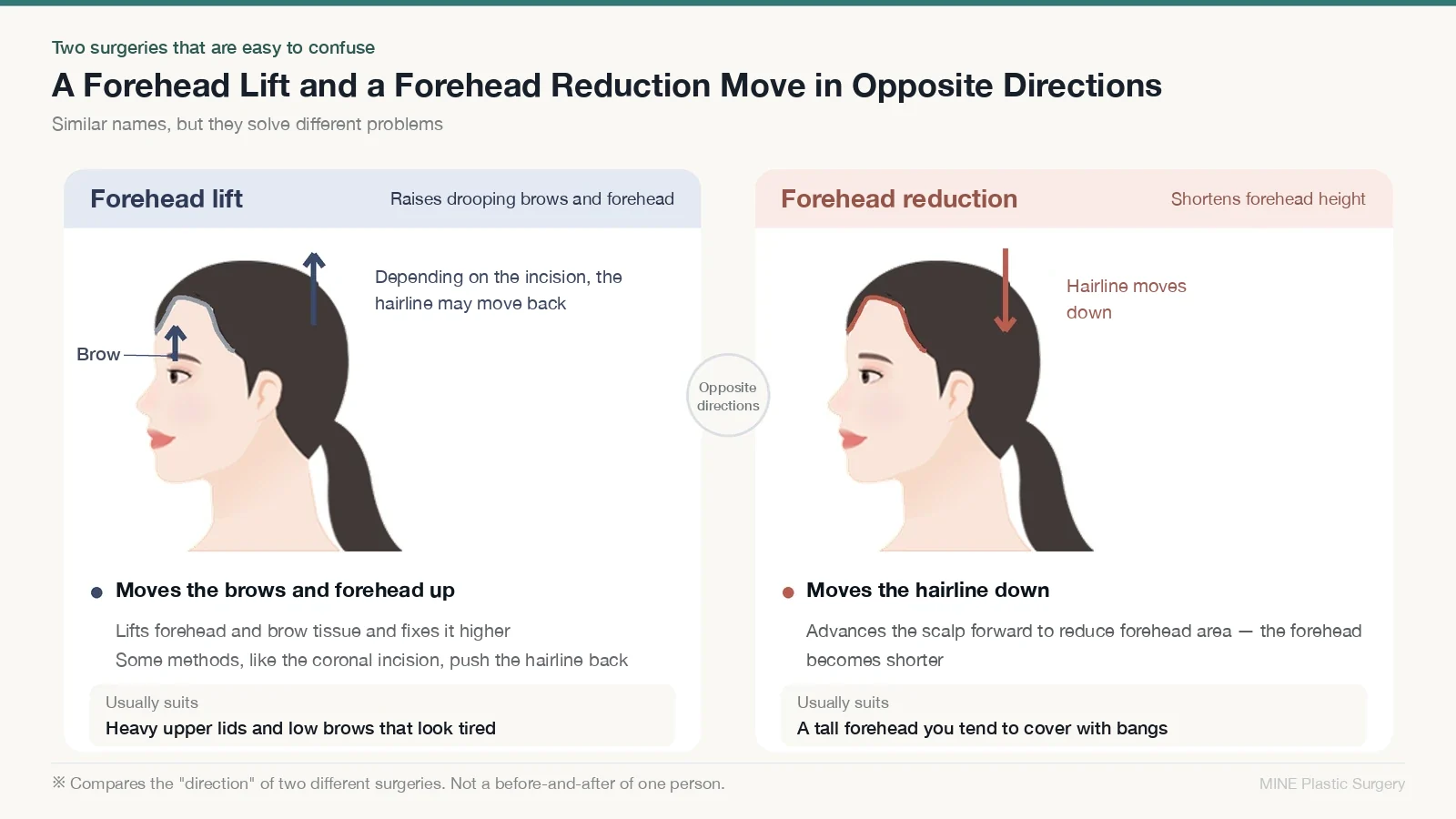
Dr. Lee’s Key Point: Scar position is the result of how far the brow is lifted and where it is fixed, not a concealment trick.
Where Is a Forehead Lift Scar? A Map of Each Incision Type
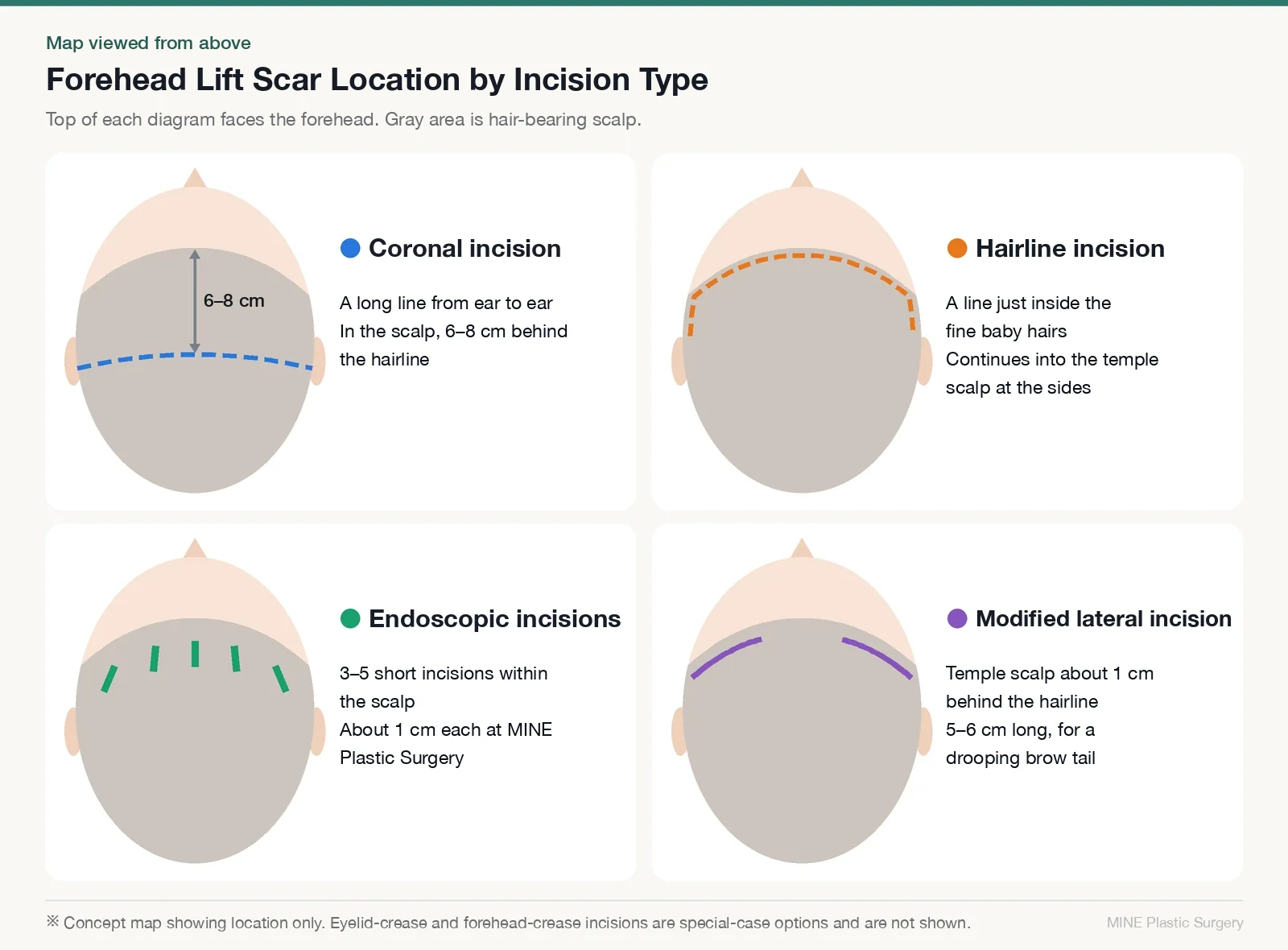
Picture looking down at the top of your head. A forehead lift scar usually follows one of three patterns: a long line across the hair, a line along the hairline, or a few short marks in the scalp.
Coronal Incision: Ear to Ear, 6–8 cm Behind the Hairline
A coronal incision (a cut across the top of the head, from ear to ear) is the classic open approach. Plastic surgery textbooks classically place the coronal incision about 6–8 cm (roughly 2.5–3 inches) behind the front hairline. Hair usually covers the scar from the front, but it’s a long line that can show if you part your hair near it or sweep your hair straight back.
Textbooks describe removing about 1–3 cm of scalp at the sides in a coronal lift, with little or none at the center. The front hairline moves back as a result, so you trade a covered scar for a higher hairline.
Hairline Incision: Just Inside the Fine Baby Hairs
A hairline incision follows the border between forehead skin and hair, then curves into the scalp at the temples. Unlike a coronal scar, it sits where it can be seen from the front. It doesn’t push the hairline back, and some authors in the surgical literature recommend it when the distance from eyebrow to hairline is more than 5 cm (about 2 inches).
The main drawback is a permanent scar along the hairline. It fades with time, but the line itself doesn’t go away. A full-thickness scalp incision here can also cause worse numbness than a coronal incision, and lifting all of the forehead skin can reduce its blood supply, which textbooks link to partial skin loss.
Endoscopic Forehead Lift Scars: A Few Short Marks in the Scalp
In the surgical literature, endoscopic access uses three to five small incisions of 1–2 cm within the hair-bearing scalp. At MINE, the endoscopic forehead lift is the method I perform, using three to five incisions of about 1 cm each behind the hairline. These heal as short marks that hair usually covers, and the broad scalp numbness of a coronal incision is reported to be largely avoidable.
A short incision is still an incision, and hair loss around endoscopic incisions has been reported in the literature.
Temple Scalp, Eyelid Crease and Forehead Crease Options
- Temple scalp. A textbook modified lateral brow lift uses a 5–6 cm scalp incision about 1 cm behind the hairline. It targets a drooping brow tail, and the scar lies within the hair at the temple.
- Upper eyelid crease. During upper eyelid surgery, the same incision can anchor the outer brow from underneath. The scar stays in the eyelid fold, but the lift is limited and may not last.
- Forehead crease or just above the brow. On men with very little hair or a close-cropped cut, a scalp scar can be more noticeable. For these cases the literature describes placing the incision inside a horizontal forehead crease or just above the brow.
Which position fits you depends on the shape of your forehead bone, how far your brows have dropped and the height of your hairline. For the whole procedure, see our complete guide to the endoscopic forehead lift or the American Society of Plastic Surgeons overview of brow lift incisions.
Dr. Lee’s Key Point: The same operation can leave a long line near the crown, a line at the hairline, or a few short marks in the hair.
How Surgeons Make a Hairline Incision Scar Less Visible
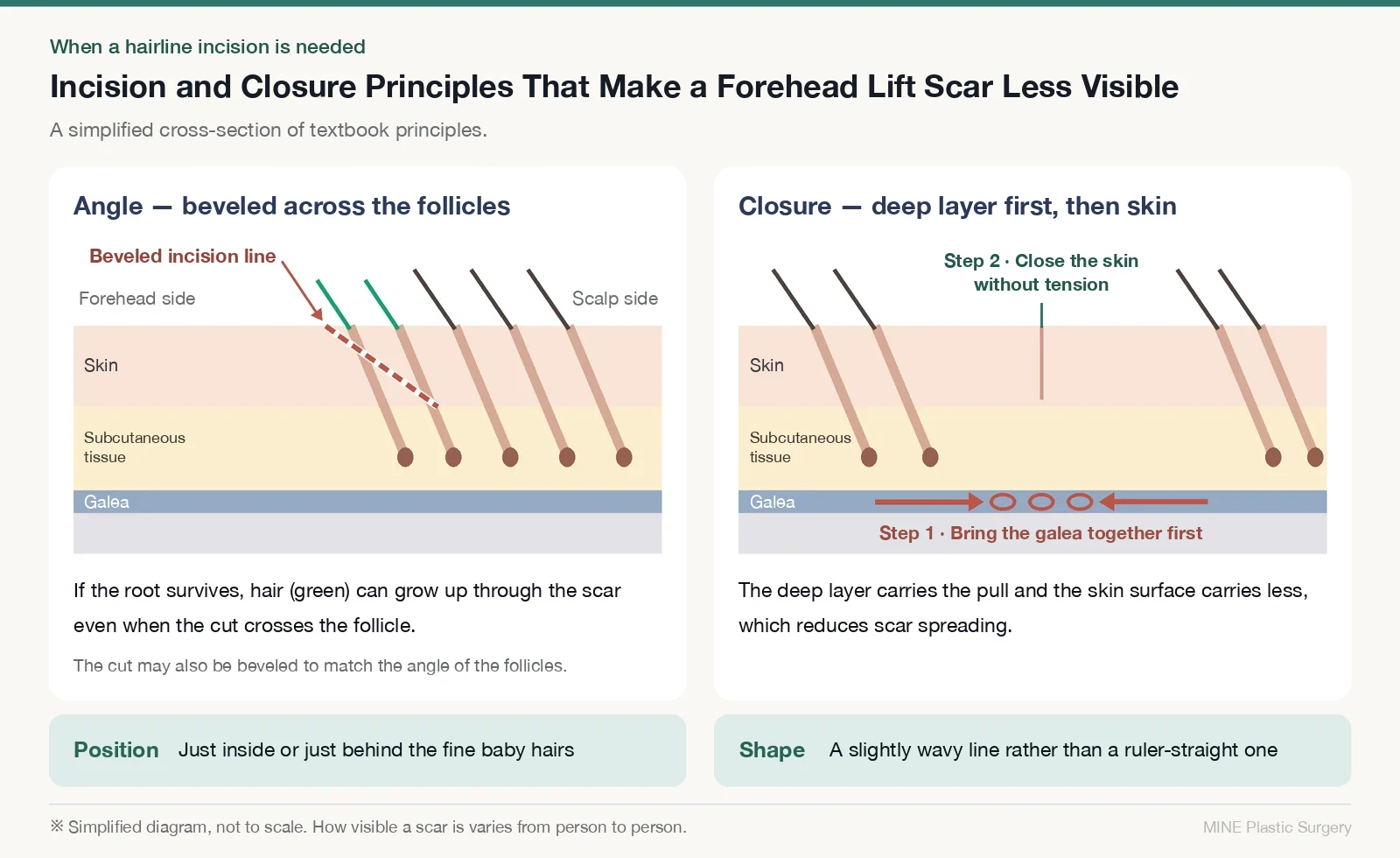
Surgical textbooks set out four principles for keeping a hairline scar discreet. These come from the literature; the forehead lift I perform at MINE is endoscopic.
- Position. The incision goes just inside or just behind the fine baby hairs.
- Angle. The blade is angled rather than held straight up and down, either along the hair follicles (the roots of each hair) or deliberately across them so hair grows up through the scar. Here’s more on the beveled incision and how it protects follicles.
- Shape. A slightly wavy line tends to be less noticeable than a ruler-straight one.
- Closure. The galea (the tough fibrous sheet just under the scalp) is brought together first to take tension off the skin, and then the skin is closed carefully.
The aim is to let hair grow over the line and make the deeper layer carry the pull. How visible the result is still varies from person to person.
How a Forehead Lift Scar Changes Over 12 Months
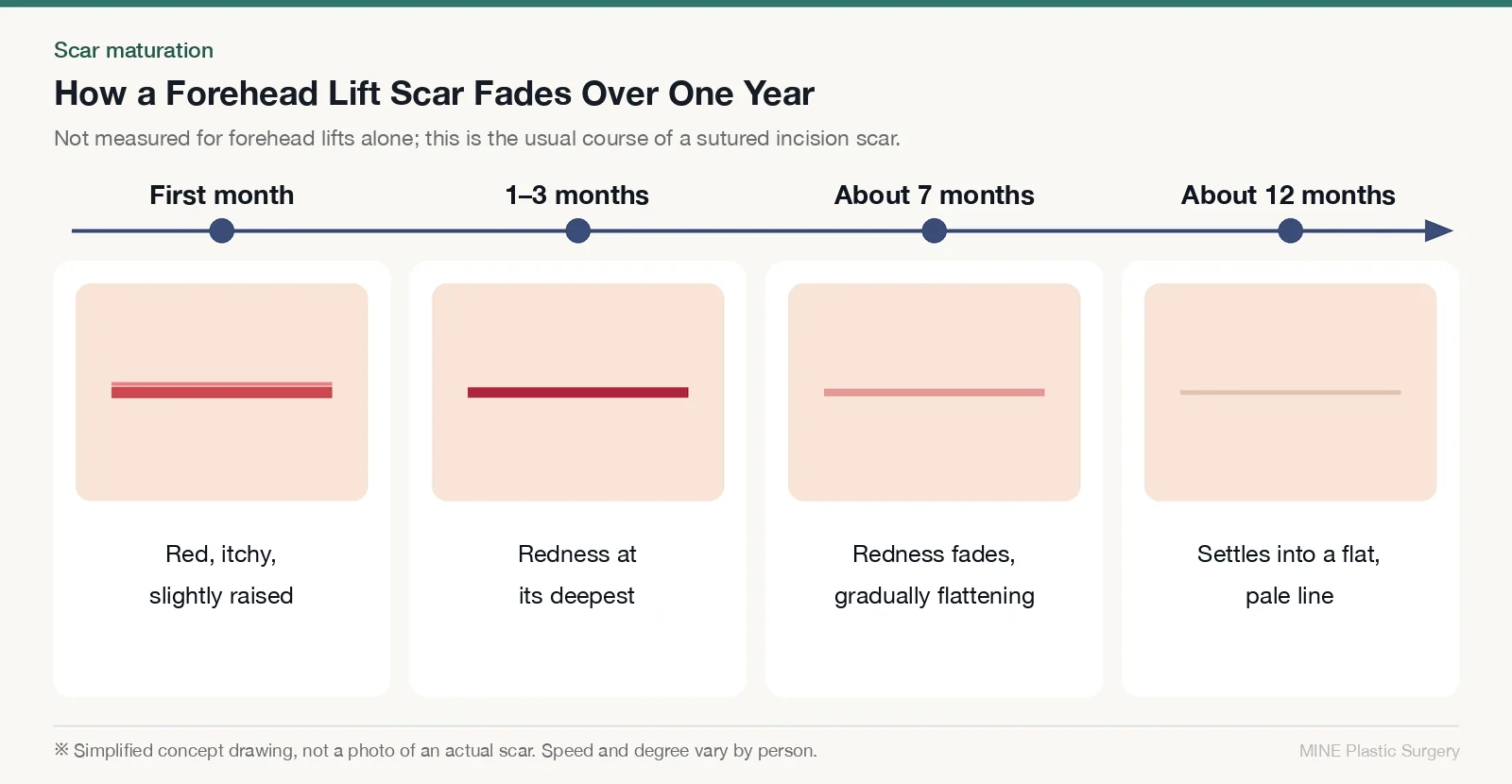
One caveat first. The timing below wasn’t measured for forehead lifts alone. It’s the usual maturation course of a sutured incision scar, and the speed and degree vary from person to person.
| Stage | What you see | What is happening |
|---|---|---|
| First month | Red, itchy, slightly raised | Inflammation is settling down |
| Months 1–3 | Redness at its deepest | Many tiny new blood vessels fill the scar |
| Around month 7 | Redness fades, raised areas start to flatten | The scar is gradually maturing |
| Around month 12 | A flat, pale line | Blood vessels in the scar have matured to a near-normal state |
First Month: Red, Itchy, Slightly Raised
Medical references on scarring describe inflammatory cells returning to normal levels at around one month, so it’s far too early to judge the result. Hair washing and stitch removal are covered in our forehead lift aftercare instructions.
Months 1–3: Redness at Its Deepest
Scar research places the peak density of tiny new blood vessels at around one to three months after surgery, so the scar may look redder now than at first. This is when patients with a hairline scar tend to worry most.
Around Month 7: Redness Fades
Studies following incision scars report that redness usually fades within about seven months, and raised areas begin to flatten. Some people take longer.
Around Month 12: A Flat, Pale Line
The vessels inside the scar mature at about 12 months, and the scar settles into a flat, pale line, sometimes whiter than the skin around it. A forehead lift scar fades, but it doesn’t vanish.
Dr. Lee’s Key Point: Judge the scar at about 12 months, not in the first weeks. Redness before then is part of normal maturation.
Hair Loss Around the Scar and Widened Scars: What Drives Them
After location, this is the question I hear most: will my hair fall out around a forehead lift scar? Hair loss at the scar (scar alopecia) and scar widening are recognized complications, so I’d rather explain them plainly.
Why Hair Can Fall Out Around the Scar
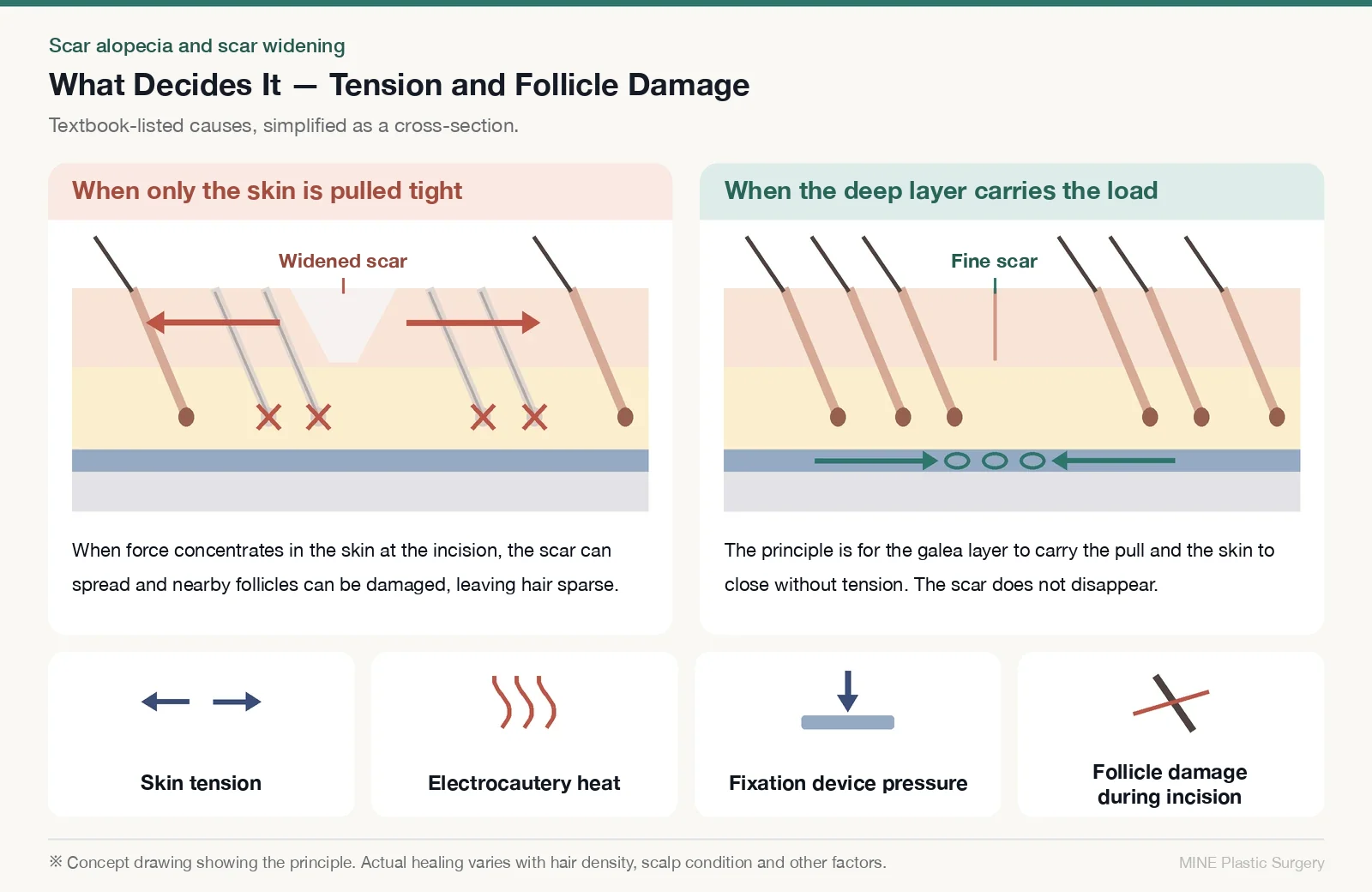
Textbooks trace localized hair loss to follicle damage from three sources: the incision itself, heat from electrocautery (a tool that seals bleeding vessels with electrical heat), and tension on the wound. This hair loss may be temporary.
The endoscopic method isn’t exempt. When surgeons fixed the scalp with screws and staples placed through the skin, pressure on the surrounding scalp could cause hair loss. The author of one textbook chapter writes that the problem went away in his own practice after he switched to fully buried, absorbable devices. That is one surgeon’s experience, not a general result.
Why Scars Widen: Tension at the Closure
The main reason a scar widens is tension, the force pulling the two stitched edges apart. Facelift chapters of plastic surgery textbooks warn that too much skin tension at a scalp incision can cause hair loss, pale scars, widened scars and a shifted hairline. Those descriptions come from facelift surgery, but a scalp closure behaves in much the same way.
That’s why the deeper layers should carry the load, with the skin closed without tension.
Other Changes: Numbness, a White Line, Infection
- Numbness. A coronal incision cuts the sensory nerves running toward the crown. Feeling often returns gradually over several years, though some numbness can be permanent. A full-thickness hairline incision can affect a larger area.
- A white line. On darker skin, a hairline scar can stand out as a white line.
- Infection. Plastic surgery textbooks put the infection rate after forehead lifts at under 1%, but give no fixed rate for scar hair loss or widening.
Rather than asking for a percentage, weigh the risk against your own hairline, hair density and scalp condition.
Dr. Lee’s Key Point: Hair loss at the scar and widened scars mostly begin with tension and follicle damage.
Still Bothered After a Year? Forehead Lift Scar Revision Options
Decisions about cutting out a forehead lift scar are usually made after about 12 months, once it has matured. Before that, it’s still changing.
When Not to Wait
That waiting period applies only to surgical excision. If a scar keeps getting thicker and is painful or itchy, or if it opens up or oozes, return promptly to the clinic where you had your surgery.
Scar Excision and Revision
A scar that has spread wide can be removed and closed again with less tension. Textbooks note that some scars widened by tension can improve with later revision. If the same tension returns, it can widen again.
Remaining Hair Loss: Scalp Advancement or Hair Transplant
Permanent hair loss at the scar can generally be corrected with scar excision or hair grafting. A narrow bare strip can be removed and the surrounding scalp drawn together over it. If that isn’t possible, hair can be transplanted into the scar.
Raised Scars: Steroid Injection
For a red, thick, raised scar (a hypertrophic scar), a steroid injection usually comes first, with revision surgery added if needed. This can be considered as soon as the scar is seen to be thickening, without waiting the full 12 months.
Results of any revision vary from person to person. Revision is surgery too, so confirm that your surgeon is a board-certified plastic surgeon. In Korea, the specialty’s professional body is the Korean Society of Plastic and Reconstructive Surgeons.
Dr. Lee’s Key Point: Most remaining scars and hair loss have correction options, but surgical revision should wait until the scar has matured.
4 Questions That Decide Where Your Scar Should Go
The position of a forehead lift scar isn’t decided on the operating table. In consultation I look at your hairline and hair first, then explain whether the endoscopic method suits you and where its incisions would sit. Think about these four questions beforehand.
- How high is your hairline in relation to your brows?
- How dense is your hair at the front and crown, and is it fine or coarse?
- Does hair loss run in your family?
- How do you usually wear your hair? Wearing it tied up, swept back or cut short exposes different areas.
Textbooks advise using a coronal incision cautiously, or not at all, when the hairline is already high, the hair is thin or hair loss may come later. The hairline would rise further, and the hair covering the scar could thin.
If you often tie your hair up, we check how the incision sites would look from the side and from above. Incision sites, surgical steps and fixation methods are covered on our page about the endoscopic forehead lift at MINE.
Forehead Lift Scar FAQ
How long does a forehead lift scar take to fade?
Redness usually peaks at one to three months and fades within about seven months, and the scar tends to settle into a flat, pale line at around 12 months. This is the usual course of a sutured incision scar rather than a forehead-lift-specific measurement, and it varies from person to person.
Will hair grow back around a forehead lift scar?
It depends on how badly the follicles were damaged. Hair loss can be temporary. If it’s permanent, it can be treated with scar excision or hair grafting, and that decision is made after the scar has matured.
Why are hairline incision scars more visible on some people?
The angle of the incision, the tension at closure, skin tone and everyday hairstyle all play a part. On darker skin the scar can stand out as a white line, and sweeping your hair back exposes more of it.
Why can a forehead lift raise the hairline?
A coronal incision removes about 1–3 cm of scalp at the sides and pulls the remaining scalp together, so the front hairline moves back. If your hairline is already high, the literature suggests alternatives such as a hairline incision. A raised hairline is also cited as a concern with endoscopic lifts when the brow is fixed too high.
Where do surgeons place the incision in men with short hair or hair loss?
The literature describes placing the incision inside a horizontal forehead crease or just above the brow. This differs from a lift that places the incision below the brow, so ask your surgeon which one is being proposed.
Find Out Where Your Forehead Lift Scar Would Sit
- The incision sets the location: a long line in the hair, a line at the hairline, or a few short marks in the scalp.
- Most scars take about 12 months to fade and settle.
- Hair loss at the scar and widening mostly come from tension and follicle damage.
Where your forehead lift scar would end up depends on your hairline, hair density and skin, and I need to see those in person to give you an answer. You can book through our online consultation form or by calling +82-2-516-1175.
Written and reviewed by Dr. Lee Sung-wook, Board-Certified Plastic Surgeon, MINE Plastic Surgery | 813 Nonhyeon-ro, Gangnam-gu, Seoul | Last reviewed November 10, 2026
※ This content is for informational purposes only and does not replace professional medical advice, diagnosis, or treatment. Individual results may vary, and side effects may occur. Please consult with a board-certified plastic surgeon for personalized advice.