EN


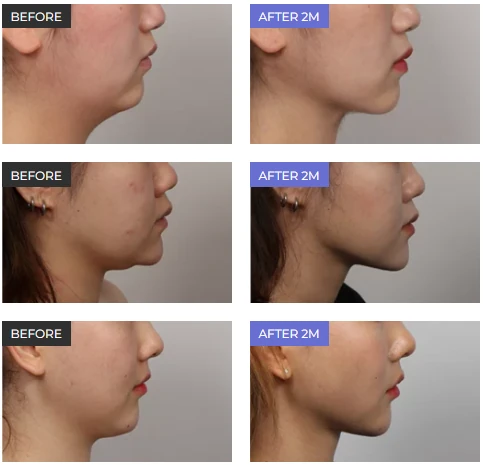
Platysmaplasty and salivary gland reduction is a combined double chin surgery in which the loose neck muscle (the platysma) is stitched together at the midline and an enlarged submandibular salivary gland is partially reduced — through the same small under-chin incision, under one anesthesia.
Many of the international patients I see have already had chin liposuction. They turn sideways in front of a mirror and the rounded bulge under the jaw is still there. In my clinical experience, the bulge under the chin is rarely just fat. Muscle and gland are usually part of the picture too.
This guide answers the question patients ask me most about this combination: can both be done in one operation, in what order, do you really need both parts, and what do week 1, week 2 and month 1 actually feel like?
What Is Platysmaplasty and Salivary Gland Reduction?
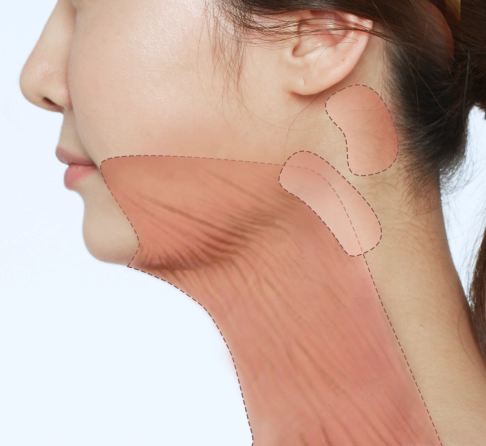
In plain terms, the combination treats two different structures in one sitting. Platysmaplasty tightens the platysma (the thin, sheet-like muscle that runs from the collarbone up to the jaw). Salivary gland reduction trims the part of the submandibular gland (the salivary gland that sits under each side of the jaw) that pushes the under-chin outward.
Three Layers Under the Chin: Fat, Muscle, Gland
The fullness under your chin comes from three stacked layers. Closest to the skin is fat above the muscle. Beneath the platysma there is a second pocket of fat (subplatysmal fat). The submandibular glands sit deepest of all.
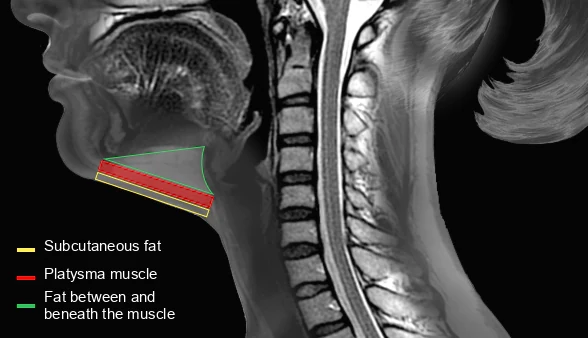
Neck-rejuvenation textbook data put fat above the muscle at about 44%, fat beneath the muscle at about 30.7% and the submandibular glands at about 24.5% of neck fullness — which means liposuction alone cannot reach roughly half of it.
That is why fat removal by itself often leaves a bulge when the muscle or the gland is the real cause. I won’t repeat the full explanation here; you can read why liposuction alone often leaves a bulge in a separate guide.
Why the Two Are Done Together
The gland lies directly beneath the platysma. To reach it, the surgeon lifts the muscle on that side. A plastic surgery textbook describes reducing a large gland through the under-chin incision after lifting the platysma on that side and before the midline muscle repair is stitched closed.
So one incision and one anesthesia serve both steps. Doing them on separate days would mean reopening the same tissue plane, going through a second anesthesia and a second recovery. Research on neck contouring also reports that removing fat above the muscle is often not enough in fuller necks when deeper structures — fat beneath the muscle, the digastric muscle and the glands — are left untreated. You can browse the published research on submandibular gland reduction if you want to see the clinical literature for yourself.
Dr. Lee’s Key Point: The gland and the muscle share the same space under the chin. When both need work, treating them through one incision spares you a second operation on the same area.
Do You Need the Combo? Three Paths for a Stubborn Double Chin
Whether you need platysmaplasty and salivary gland reduction depends on what is causing the bulge, not on how big it looks. Two necks that look similar in a photo can need very different surgery. Broadly, patients fall into one of three paths.
Platysmaplasty Alone: Normal-Sized Gland, Loose Muscle
If imaging shows a normal-sized gland and the problem is a loose platysma plus fat, platysmaplasty with fat removal is usually enough. Leaving a healthy gland alone avoids extra risk.
The Combo: Bulge Remains After Liposuction or Gland Enlargement on Ultrasound
The combined surgery is considered when a firm bulge survived earlier liposuction, or when ultrasound or CT shows that the gland is enlarged. In these patients, tightening the muscle alone can leave a visible lump just under the jawline.
Non-Surgical First: Early, Mild Fullness
For an early, small double chin, non-surgical care is a reasonable first step. Be aware of its limits, though: dermatology literature on Asian skin notes that Botox has only a limited effect on lax platysma bands, and surgery gives a more lasting structural change. If your fullness is mild, it is perfectly valid to start here.
| Platysmaplasty alone | Combo (platysmaplasty + gland reduction) | Non-surgical first | |
|---|---|---|---|
| Main cause | Loose platysma + fat | Loose platysma + fat + enlarged gland | Mild fat, early laxity |
| Typical sign | Soft fullness, blurred jawline | Firm lump under the jaw; bulge persists after liposuction | Early, small double chin |
| Gland on ultrasound/CT | Normal size | Enlarged (confirmed before surgery) | Not required |
| Approach | Corset platysmaplasty + fat removal | Same + intracapsular partial gland reduction, one anesthesia | Botox or high-intensity focused ultrasound lifting — limited effect on loose platysma bands |
For a fuller side-by-side comparison, see how to tell a fatty double chin from an enlarged gland.
How the Gland Is Checked: Self-Check vs Ultrasound or CT
A self-check can raise suspicion. If you press under the jaw and feel a firm, rubbery lump rather than soft fat, or if a bulge stayed put after liposuction, the gland may be involved. Only ultrasound or CT can confirm it, and I offer gland reduction only when enlargement is confirmed. Here is why an ultrasound check matters before surgery.
Dr. Lee’s Key Point: Treating a normal-sized gland adds risk without adding benefit. The scan decides whether the gland step belongs in your plan.
How Platysmaplasty and Salivary Gland Reduction Is Performed: STEP 1–4
Each step is chosen based on your diagnosis. Not every patient needs all four. Here is the order in which the layers are handled when they are.
STEP 1: A Small Incision in the Under-Chin Crease
An incision of about 2–3 cm is made in the natural crease under the chin. Because it follows an existing fold, the scar usually sits where it is hard to see from the front.
STEP 2: Removing Fat Above and Beneath the Muscle
Through that opening, fat under the skin is released and removed, including grape-cluster-like clumps and fibrotic (hardened) fat. When there are fat blocks beneath the platysma, they are taken out as well.
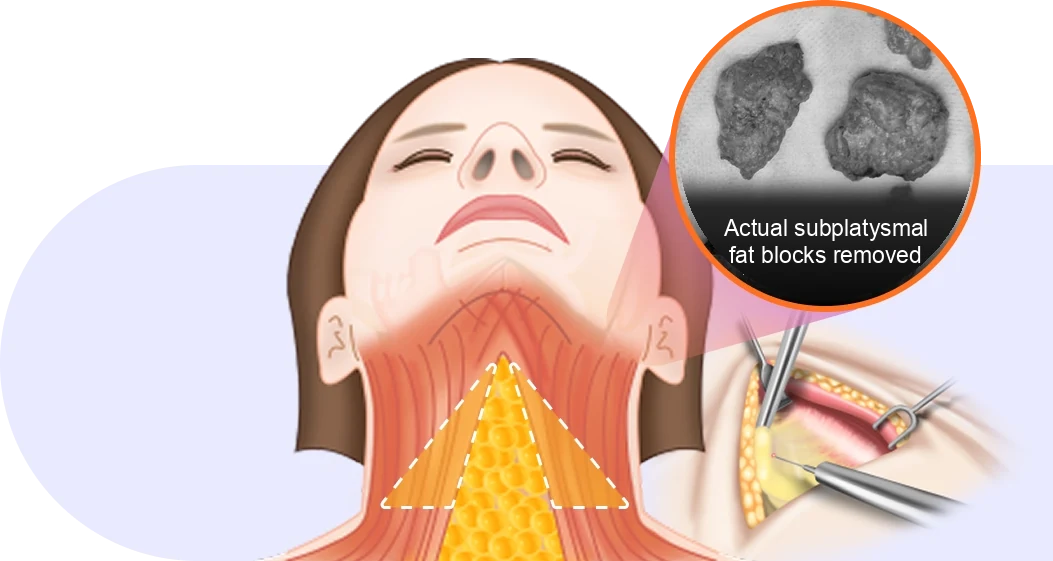
STEP 3: Intracapsular Partial Gland Reduction (Only If Diagnosed)
This step is done only for a gland confirmed as enlarged. The gland is reduced inside its own thin capsule (intracapsular), and only the portion that protrudes is trimmed. It is a partial reduction, not removal of the whole gland.
Why stay inside the capsule? The lingual and hypoglossal nerves (which control tongue sensation and movement) lie deep to the gland. Plastic surgery textbooks explain that working within the capsule lowers the risk of bleeding and nerve injury.
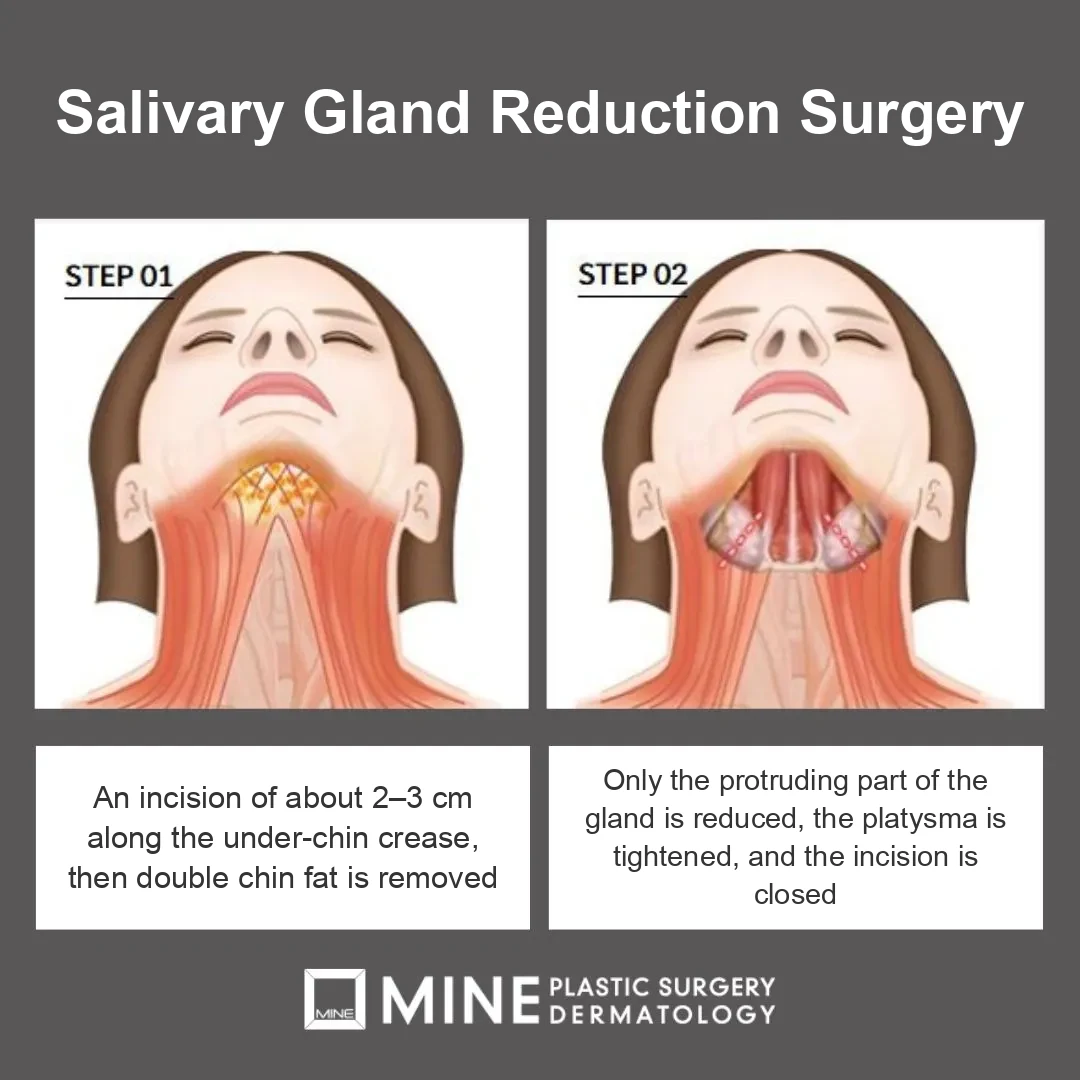
STEP 4: Corset Platysmaplasty at the Midline
Finally, the inner edges of the left and right platysma are stitched together down the center of the neck, much like lacing a corset. This is called corset platysmaplasty, and it redefines the angle between the jaw and the neck.
The order matters. STEP 3 comes before STEP 4 because the gland is reached by lifting the muscle on that side. Once the midline is sewn closed, the gland is covered.
Anesthesia, Operating Time and Same-Day Discharge
The combined procedure is done under sedation anesthesia and typically takes about 30 minutes to 1 hour, with same-day discharge. If you are traveling to Seoul, plan to stay at least 7 days so the stitches can be removed at the clinic.
Dr. Lee’s Key Point: The gland is always handled before the muscle is closed. That single detail is what makes one incision enough for both.
Recovery Timeline: Week 1, Week 2 and Month 1
The timeline below follows our clinic’s aftercare schedule for salivary gland surgery. Swelling and bruising usually increase for 2–3 days, then fade gradually over 2–4 weeks.
| Time | What to expect | What to do |
|---|---|---|
| Day 0–3 | Swelling and bruising increase for 2–3 days | Cold compress up to day 3, then warm compress; sleep with your head above your heart; light daily activity is fine |
| Day 1–7 | Little visible change in swelling during week 1 | Compression band 24 hours a day for 7 days (at least 3 days), loose enough to slip one finger under; gauze kept under the band; prescribed medicines for 7 days; no aspirin or vitamin E for 1 week; washing and makeup from the next day |
| Day 7 | Stitches removed | Skin-colored tape under the chin for 3 months afterward |
| Day 8 onward | Swelling begins to subside around week 2 | Compression band at home and while sleeping; light walking after 1–2 weeks |
| Weeks 3–4 | Clear improvement; swelling settles over 2–4 weeks | Avoid rubbing the incision for 1 month |
| Month 1 | Most daily-life limits lifted | Alcohol, smoking, sauna and strenuous exercise allowed after 1 month; be careful with massage or pressure until then |
| Months 2–3 | Tightness peaks around months 1–2, then firmness softens; any unevenness improves from about month 3 | Avoid long periods of tilting your head far back for 3 months; scar ointment from month 3 for 6+ months |
| Up to 6 months | Final contour typically judged at 1–3 months | No ultrasound, HIFU or laser treatments on the area for 6 months |
Week 1: Compression, Medication and Stitch Removal
You can return to light daily activity right away. The compression band stays on 24 hours a day for 7 days, and the stitches come out on day 7. Swelling may look about the same all week — that is expected.
Because the gland was involved, you will also receive a saliva-reducing tablet for 14 days and a scopolamine patch behind the ear for 12 days, changed every 3 days. Please don’t drive or operate machinery while wearing the patch.
Week 2: Swelling Starts to Ease
From day 8, the band is worn only at home and while sleeping. Most patients notice the swelling starting to go down during this week, and light walking can resume after 1–2 weeks.
Month 1 and Beyond: Firmness Softens, Final Contour
By weeks 3–4 the improvement is clear. Hold off on alcohol, smoking, saunas and strenuous exercise until one month after surgery. The area can feel firm and tight for 1–2 months, and any unevenness usually improves from about month 3. Avoid tilting your head far back for long periods for 3 months, to give the repaired muscle time to settle.
When the gland is left alone (platysmaplasty only), recovery is usually a little lighter than with the combined surgery. For the complete list of precautions, read our full aftercare instructions for salivary gland reduction.
Dr. Lee’s Key Point: Week 1 is about protection, not results. Most of the visible change comes between week 2 and month 3.
Risks and Precautions You Should Know
Every surgery carries risk, and this combination is no exception. Knowing what is normal and what is not helps you recover calmly.
Possible Side Effects
Possible risks include swelling, bruising, bleeding or hematoma (a collection of blood), infection, altered sensation and sialocele (a small pocket of saliva). Rarely, there is temporary weakness at the corner of the mouth from irritation of the marginal mandibular nerve, which typically recovers in 2–3 months.
A 2015 Plastic and Reconstructive Surgery series of 112 facelift patients who also had submandibular gland reduction reported sialocele in 4.5% (all resolved within 4 weeks), temporary lip-corner weakness in 4.5% (recovered within 3 months) and early hematoma needing re-operation in 1.8%.
Most sialoceles settle within 2–4 weeks with medication, compression and avoiding spicy or stimulating food. A larger one is checked by ultrasound and drained with a syringe.
When to Call the Clinic Immediately
- A fever of 38°C (100.4°F) or higher
- A sudden increase in swelling
- Pain that keeps getting worse
- Pus or a bad smell from the wound
- The wound opening
- Any difficulty breathing
Contact us within 2–3 days if swelling keeps getting worse after meals, returns despite compression or shows no improvement for 3 days or more, or if medication side effects such as dry mouth, blurred vision or difficulty urinating become severe.
Dr. Lee’s Key Point: Swelling that grows after meals points to saliva, not fat. Tell us early — it is usually simple to manage.
Over 50? When to Add a Neck Lift or Mini Neck Lift
For patients in their 50s or with marked skin laxity, the combined surgery may not be enough on its own. Loose skin can still drape below the jaw after the deeper layers are corrected.
Signs That Skin Laxity Needs Its Own Treatment
Warning signs include skin that stays creased after a pinch test, deep vertical neck bands and jowls that have dropped below the jawline. In these cases, a neck lift or mini neck lift that also re-drapes excess skin is considered together with, or instead of, the combination. For general background on the procedure, see this neck lift overview.
How the Decision Is Made in Consultation
Age alone does not decide it. I look at skin elasticity, the depth of the neck bands, how far the jowls have descended and the gland size on imaging. Some patients in their 50s do well with the combination alone; others clearly benefit from a skin procedure. That decision is made face to face.
Frequently Asked Questions About the Combined Surgery
How long is recovery after platysmaplasty and salivary gland reduction?
Light daily activity is possible right away, and stitches come out on day 7. The compression band is worn 24 hours a day for 7 days, then at home and during sleep. Swelling eases over 2–4 weeks; alcohol, saunas and strenuous exercise should wait until one month after surgery, and the final contour is judged at about 1–3 months.
Is it better to have double chin and salivary gland surgery at the same time or separately?
When both are needed, doing them together means one incision, one anesthesia and one recovery period instead of two, because the gland is reached through the same plane. The gland step can make swelling last a little longer, but the return to daily life is similar. It is only added when the gland is confirmed enlarged.
How do I know if my salivary gland is enlarged?
A firm lump under the jaw, or a bulge that remained after liposuction, raises suspicion. Confirmation requires ultrasound or CT during your consultation.
Can salivary gland reduction damage nerves?
The nerves that control tongue sensation and movement lie deep to the gland, and intracapsular partial reduction keeps the work away from them. Rare temporary weakness at the corner of the mouth usually recovers in 2–3 months. As with any surgery, risks cannot be reduced to zero.
How long do the results of combined double chin surgery last?
The muscle repair is a structural change, and the reduced portion of the gland does not grow back the way fat can return. Results are often long-lasting without major weight change, though natural aging continues and individual results vary.
I’m in my 50s — is platysmaplasty alone enough?
If skin laxity is significant, platysmaplasty alone may have limited effect, and a neck lift or mini neck lift may be added. This is decided after an in-person examination.
Consultation for Combined Neck and Gland Surgery in Seoul
Every double chin has its own mix of causes — fat, muscle, gland and skin — so the plan should follow the diagnosis, not the other way around. If you are wondering whether platysmaplasty and salivary gland reduction fits your neck, I am happy to review it with you in person or through an online pre-consultation with photos.
To book a consultation with Dr. Lee Sung-wook, call MINE Plastic Surgery & Dermatology at +82-2-516-1175.
Written and reviewed by Dr. Lee Sung-wook, Board-Certified Plastic Surgeon, MINE Plastic Surgery & Dermatology. Last reviewed: November 11, 2026.
※ This content is for informational purposes only and does not replace professional medical advice, diagnosis, or treatment. Individual results may vary, and side effects may occur. Please consult with a board-certified plastic surgeon for personalized advice.