EN
EN


Table of Contents
Why Do People Struggle with a Double Chin?
A double chin — medically known as submental fullness — is one of the most common aesthetic complaints among both men and women worldwide. Despite regular exercise and a healthy diet, many people find that the stubborn fullness beneath the chin simply refuses to go away. This is because a double chin is not always caused by excess fat alone.

For international patients exploring K-Beauty solutions in Korea, understanding the true anatomy behind a double chin is the first step toward choosing the right procedure. Too often, patients arrive in Seoul having already undergone liposuction elsewhere, only to find that their double chin has returned or was never fully corrected.
Key Takeaway: A double chin can be caused by multiple anatomical factors — not just fat. Treating only the surface layer with liposuction often leads to incomplete or temporary results.
Why Liposuction Alone Fails for Double Chin Removal
Liposuction has long been marketed as the go-to solution for double chin removal. While it can be effective at removing subcutaneous fat (the fat layer just beneath the skin), it only addresses one piece of a much more complex puzzle.
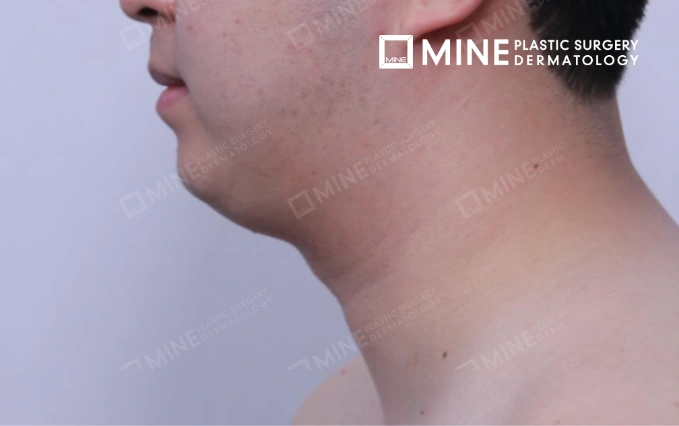
Here is why relying solely on liposuction for double chin surgery often disappoints:
1. It Only Removes Superficial Fat
Standard chin liposuction targets the subcutaneous fat layer above the platysma muscle. However, for many patients, a significant portion of the volume creating the double chin actually comes from fat pads located beneath the muscle. Liposuction cannot safely reach or remove these deeper fat deposits.
2. It Ignores the Platysma Muscle
The platysma is a thin, broad muscle that runs from the chest up to the jawline. Over time — or simply due to genetics — this muscle can become loose, separated, or banded. When the platysma muscle loses its tone and structure, it sags downward, creating visible fullness and a blurred jawline. No amount of fat removal will fix a structurally compromised muscle.
Anatomy also varies from person to person. Surgical textbooks report that in roughly 75% of necks the two halves of the platysma overlap across the midline under the chin. In the remaining necks the two halves meet differently, and that variation is one reason the same liposuction can produce a sharp jawline in one patient and a blunted one in another.

3. It Doesn’t Address Enlarged Salivary Glands
Some patients have naturally enlarged submandibular salivary glands (located beneath the jawline on either side). These glands can contribute significant volume to the submental area, and they are completely unaffected by liposuction. If enlarged salivary glands are part of the problem, liposuction alone will leave the patient with a still-prominent double chin.
4. Skin Laxity Can Worsen After Liposuction
When fat is removed without tightening the underlying muscle and tissue, the remaining skin may appear loose or saggy — especially in patients over 30 or those with naturally thin skin. This can actually make the jawline look worse than before the procedure.
Key Takeaway: Liposuction treats the symptom (superficial fat) without correcting the root causes (loose muscle, deep fat pads, and glandular volume). That is why a comprehensive double chin surgery approach is essential.
Understanding the Anatomy Behind a Double Chin
To understand why a multi-layered approach to double chin surgery is necessary, it helps to look at what lies beneath the skin in the submental region.

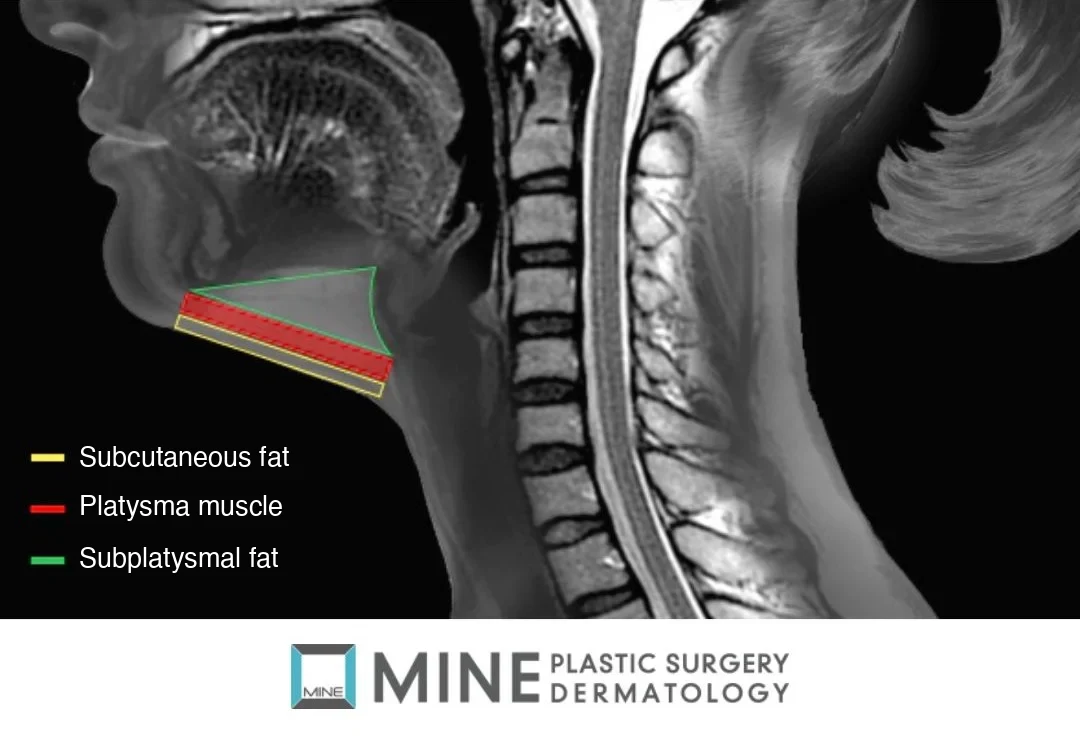
| Layer | What it is | Can liposuction reach it? | What it actually needs |
|---|---|---|---|
| 1. Subcutaneous fat | The fat sitting directly under the skin, above the muscle | Yes | Precision liposuction |
| 2. Platysma muscle | A thin sheet of muscle whose two halves can loosen, separate, or form visible bands | No | Platysmaplasty (stitching the muscle edges back together) |
| 3. Subplatysmal fat | Deeper fat pads that sit underneath the muscle | No — the muscle has to be opened first | Direct removal through a small incision under the chin |
| 4. Submandibular salivary glands | Paired glands under the jawline that are larger than average in some people | No | Partial gland reduction, only when the gland is a real contributor |
Layer 1: Subcutaneous Fat (Above the Muscle)
This is the fat layer most people think of when they picture a double chin. It sits directly beneath the skin and above the platysma muscle. This is the only layer that conventional liposuction can target effectively.
Layer 2: The Platysma Muscle
The platysma is a paired muscle, meaning there is one on each side. In a youthful, well-defined jawline, the two halves of the platysma sit closely together along the midline. With age, weight fluctuation, or genetic predisposition, these muscle bands can separate and sag, creating a visible curtain of tissue that contributes to the appearance of a double chin and jowling.
Layer 3: Subplatysmal Fat Pads (Beneath the Muscle)
Beneath the platysma lies another layer of fat — the subplatysmal fat pads. These deeper deposits are a major contributor to submental fullness in many patients, yet they are completely inaccessible through standard liposuction. Removing this fat requires direct surgical access beneath the muscle.
The surgical literature is blunt about this. Deep fat cannot be suctioned out, and there is no reliable way to judge from the outside how much of it is there. That is why the check happens during the operation itself: the surgeon opens the muscle and looks at the deep layer directly. It is also why an exam that relies on pinching the skin alone can underestimate how much volume is really there.

Layer 4: Submandibular Salivary Glands
Located deeper still, the submandibular salivary glands sit on either side of the midline beneath the jawbone. While they serve an important digestive function, some individuals have glands that are larger than average, contributing noticeable bulk to the area beneath the chin. In such cases, partial gland reduction can dramatically improve the contour.
Key Takeaway: A true double chin correction must evaluate and treat all four layers — superficial fat, the platysma muscle, deep fat pads, and potentially the salivary glands — for a complete and lasting result.
MINE Double Chin Surgery: A Comprehensive Approach
At MINE Clinic in Seoul, double chin surgery is not a one-size-fits-all procedure. The surgical team, led by board-certified plastic surgeons, performs a thorough evaluation of each patient’s submental anatomy to determine which combination of techniques will deliver the most defined and natural-looking result.
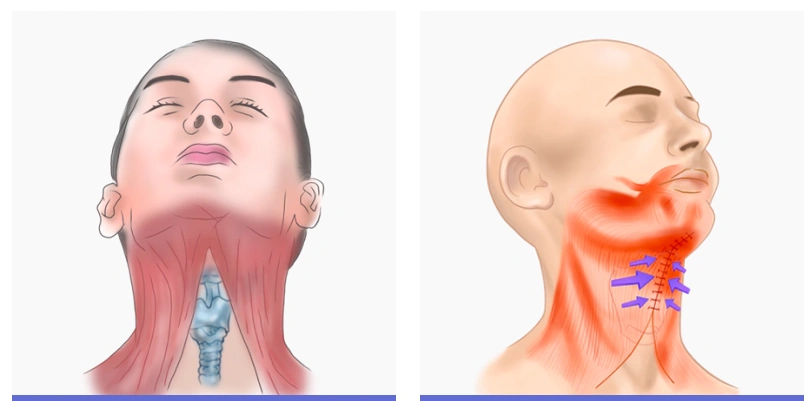
The MINE Double Chin Surgery Method: Three-Layer Correction
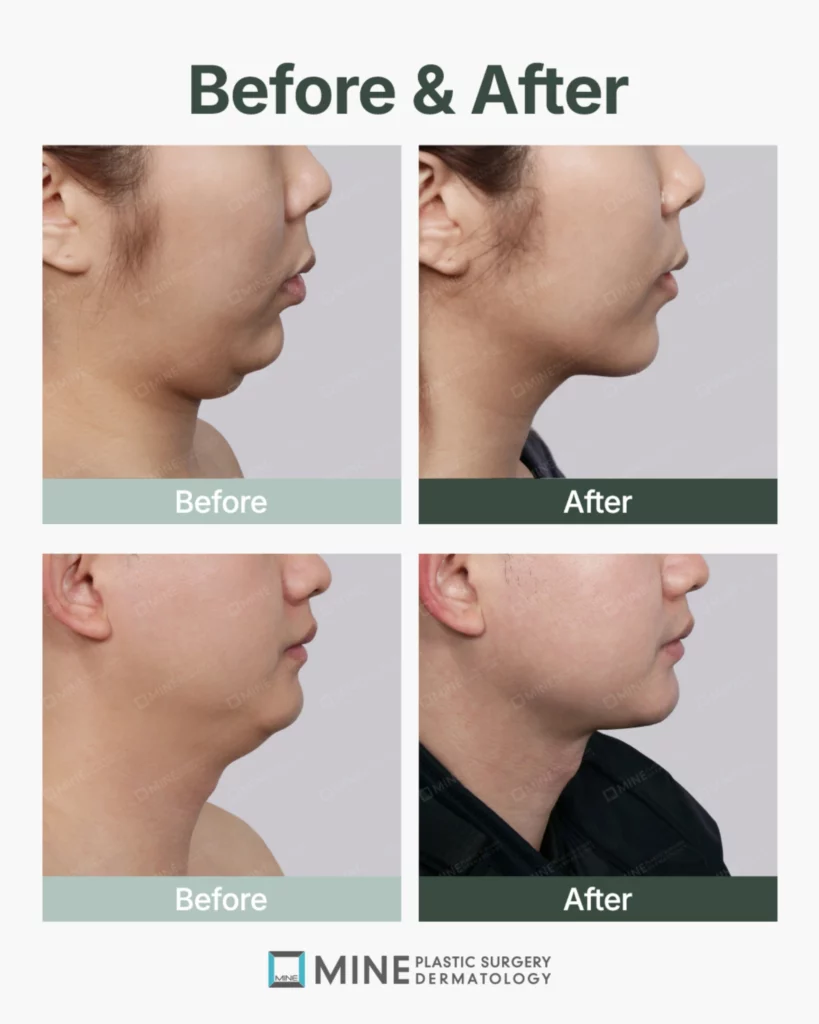
MINE Clinic’s signature double chin surgery combines three critical steps into a single procedure:
- Precision liposuction — removes the subcutaneous fat that sits above the muscle.
- Platysmaplasty — brings the separated halves of the platysma muscle back together and secures them, restoring the angle between the chin and the neck.
- Subplatysmal fat pad removal — excises the deep fat that liposuction cannot reach, once the muscle has been opened.
Step 1: Precision Liposuction (Subcutaneous Fat Removal)
The first step addresses the superficial fat layer. Using advanced liposuction techniques, the surgeon carefully removes excess subcutaneous fat from above the platysma muscle. At MINE Clinic, the focus is on precision — removing just the right amount of fat to create a smooth contour without over-suctioning, which can lead to irregularities or a hollow appearance.
Step 2: Platysmaplasty (Muscle Tightening and Repair)
This is the step that makes the difference between a mediocre result and a truly transformative one. Platysmaplasty involves surgically tightening, suturing, and repositioning the platysma muscle. Through a small incision beneath the chin, the surgeon brings the separated muscle bands back together along the midline and secures them with sutures. This creates a firm, internal “sling” that restores the sharp angle between the chin and neck — what many patients describe as their ideal jawline.
Step 3: Subplatysmal Fat Pad Removal
Once the platysma has been opened and repaired, the surgeon has direct access to the deeper subplatysmal fat pads. These are carefully excised to eliminate the hidden volume that liposuction alone cannot reach. This step is critical for patients who have persistent fullness despite previous liposuction attempts.

The combination of all three steps — liposuction, platysmaplasty, and subplatysmal fat removal — is what allows MINE Double Chin Surgery to deliver results that are more defined, more natural, and significantly longer-lasting than liposuction alone.
For more details on double chin liposuction as part of a comprehensive body contouring plan, visit our dedicated service page.
When You Need More: Salivary Gland Reduction
How Do You Know If Your Salivary Glands Are Contributing?
During the consultation process at MINE Clinic, the surgical team evaluates the size and position of the submandibular salivary glands through physical examination and imaging. If the glands are found to be enlarged or ptotic (drooping below the jawline), they may be a significant contributor to the double chin appearance — even after fat and muscle have been addressed.
Signs that salivary gland volume may be a factor include:
- Persistent fullness along the jawline rather than directly under the chin.
- Visible or palpable bulging just beneath the jaw angle.
- A double chin that does not improve with weight loss.
- Fullness that reappears or becomes more obvious after the neck has been tightened, because a gland sitting below the jawbone shows up more once the tissue around it is flattened.
MINE Double Chin Surgery + Salivary Gland Reduction
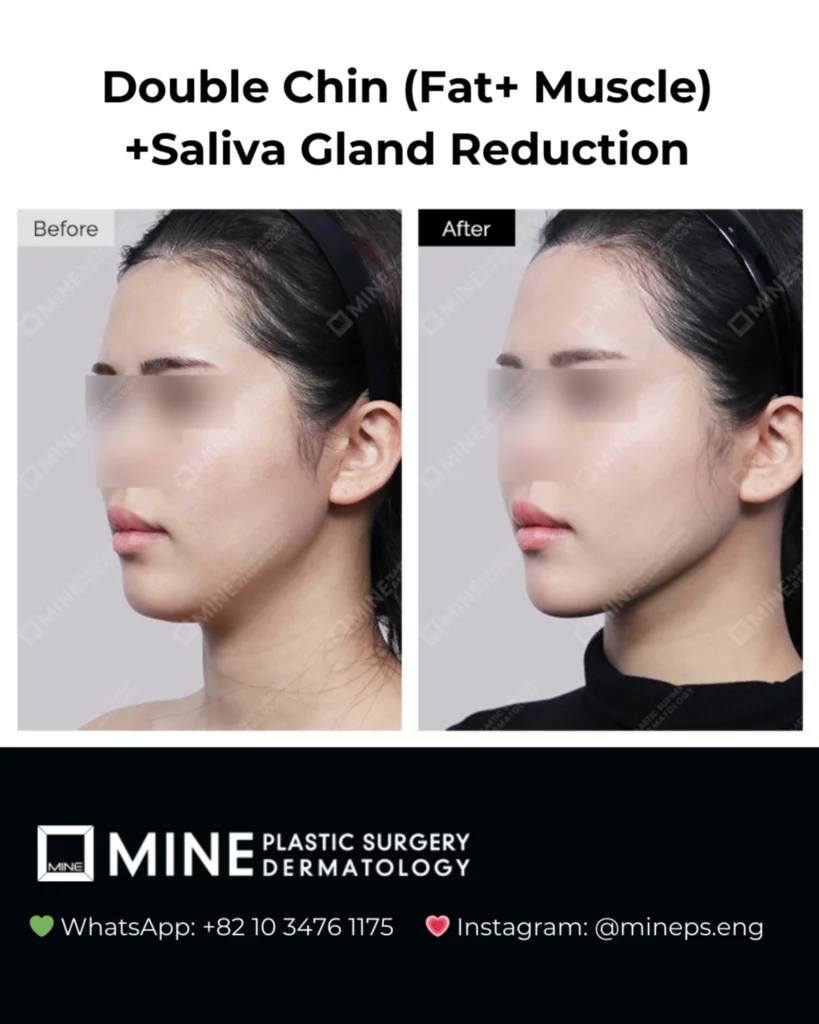
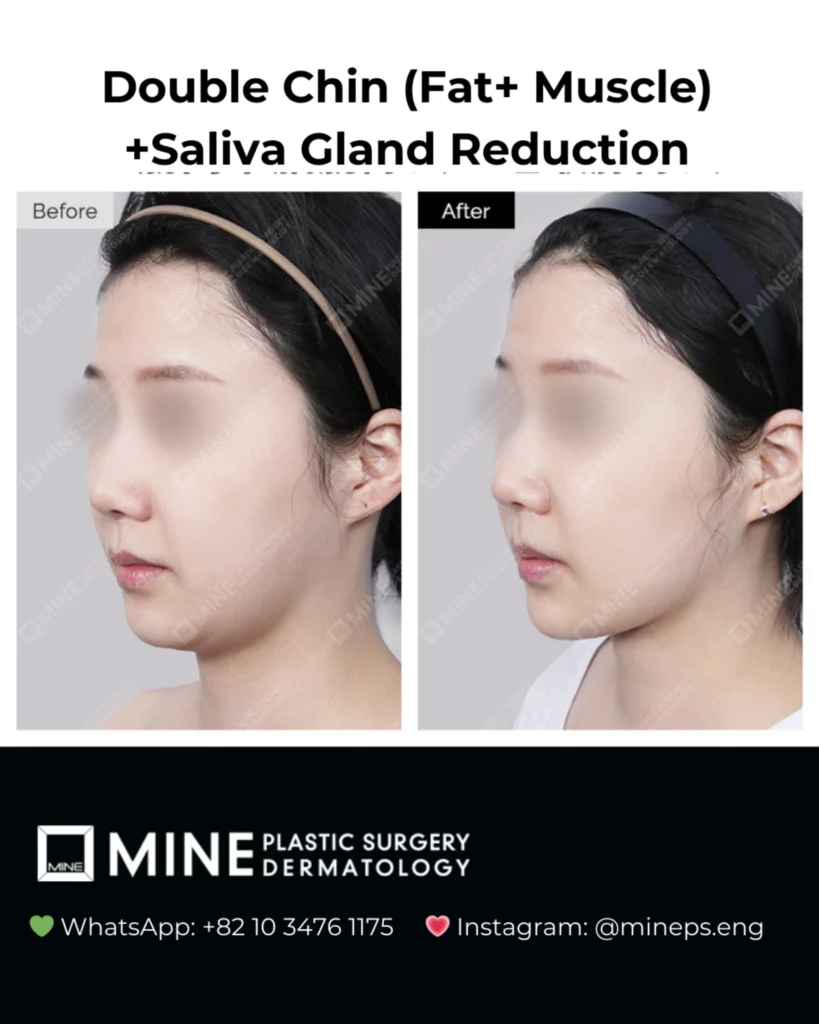
For patients with enlarged submandibular glands, MINE Clinic offers an extended version of the double chin surgery that includes salivary gland reduction. This procedure involves the partial and carefully controlled reduction of the submandibular gland to decrease volume while preserving adequate salivary function.
This combined approach — MINE Double Chin Surgery (liposuction + platysmaplasty + subplatysmal fat removal) together with salivary gland reduction — represents the most comprehensive double chin correction available. It addresses every anatomical layer that can contribute to submental fullness.
Who is this extended procedure for?
- Patients who have had double chin liposuction before but were not satisfied with the result.
- Individuals with naturally enlarged submandibular glands.
- Patients who want the most defined and longest-lasting jawline correction available.
- Those whose lower face looks square or wide because the gland is prominent.
It is an added step with its own trade-offs, so the pros and cons should be discussed openly before surgery. Peer-reviewed clinical research published in 2015 reported that adding submandibular gland reduction to a neck procedure carried an overall complication rate comparable to that of muscle tightening alone.
That same research named three risks specific to the gland. The first is bleeding deep in the neck, which is rare but can compress the airway and calls for emergency treatment. The second is a higher rate of temporary nerve weakness when the neck is being operated on for a second time. The third is a moderate incidence of benign sialocele, a collection of saliva at the surgical site.
The research also set out how to keep those risks down: free the gland inside its capsule before reducing it, close down the space left behind, and keep the patient under observation overnight. This is why MINE Clinic reduces the gland only partially, and only when the gland is genuinely contributing to the contour.

A section of submandibular salivary gland removed during combined double chin and salivary gland reduction surgery.
By combining liposuction, platysmaplasty, subplatysmal fat removal, and salivary gland reduction when needed, MINE Clinic offers a truly customized solution that addresses every cause of a double chin — not just the superficial fat. After surgery, the surgical team shows each patient the tissue that was actually removed.
Why Choose MINE Clinic in Seoul for Double Chin Surgery
Board-Certified Surgeons with Specialized Training
MINE Clinic’s medical staff consists of board-certified plastic surgeons who specialize in facial and body contouring. Dr. Lee Sung-wook and the surgical team bring years of dedicated experience in submental surgery, including the advanced combination techniques that set MINE Double Chin Surgery apart from standard liposuction procedures.
Comprehensive International Patient Support
MINE Clinic’s international service team assists patients from around the world with consultation scheduling, airport pickup, translation during consultations and surgery, hotel arrangements near the clinic in Gangnam, and post-operative care coordination throughout recovery in Seoul. Language barriers are minimized so that patients can communicate their goals clearly and feel confident throughout the process.
Advanced Safety Protocols
Patient safety is a core priority. MINE Clinic maintains rigorous care and safety observation protocols throughout every procedure, with fully equipped surgical facilities and continuous monitoring during and after surgery.
Risks, Side Effects, and Safety Considerations
As with any surgical procedure, double chin surgery carries potential risks and side effects. At MINE Clinic, transparency about these risks is an essential part of patient trust and informed decision-making.
Common Side Effects (Expected and Temporary)
Swelling is the most noticeable side effect and typically peaks around 48 to 72 hours after surgery. Moderate swelling can persist for two to four weeks, with residual mild swelling gradually resolving over two to three months. Bruising in the submental and neck area is common and usually fades within one to two weeks. Mild discomfort and tightness in the neck area are normal, especially after platysmaplasty, as the tightened muscle adjusts. Temporary numbness around the chin and neck may occur due to minor nerve irritation, and sensation typically returns within a few weeks to months.
Less Common Risks
Asymmetry is possible, though meticulous surgical technique minimizes this risk. Hematoma (blood collection beneath the skin) is rare but may require drainage if it occurs. Infection is uncommon with proper surgical protocols and post-operative care but is managed with antibiotics if needed. For salivary gland reduction specifically, temporary dry mouth may occur, though partial gland preservation is designed to maintain adequate salivary function. Bleeding deep in the neck is rare, but it is the most serious risk of this step: blood collecting in that closed space can press on the airway and needs emergency treatment. This is why the clinical research on gland reduction recommends keeping the patient under observation on the night of surgery.
How MINE Clinic Minimizes Risk
Pre-operative health screening and detailed imaging ensure each patient is a suitable candidate. Procedures are performed by experienced, board-certified plastic surgeons. Continuous intraoperative monitoring and fully equipped surgical suites are standard. A structured post-operative follow-up schedule allows the team to catch and address any concerns early.
According to the American Society of Plastic Surgeons (ASPS), combining complementary procedures under a single surgical session — as done with MINE Double Chin Surgery — can be both safe and effective when performed by qualified surgeons in accredited facilities.
Key Takeaway: Being honest about risks is important. While side effects like swelling and bruising are expected, serious complications are rare — especially when the procedure is performed by experienced surgeons with proper safety protocols.
Recovery Timeline in Korea
For international patients traveling to Seoul for double chin surgery, understanding the recovery timeline is essential for planning your trip. MINE Clinic provides a clear post-operative schedule to make your stay as smooth and comfortable as possible.
| Time after surgery | What to expect | Where you are |
|---|---|---|
| Day 1 | Surgery, compression bandage applied, rest | Seoul |
| Days 2–3 | Swelling and bruising peak; first follow-up visit | Seoul |
| Days 5–7 | Stitches removed and final check-up; most patients cleared to fly from day 7 | Seoul |
| Weeks 2–4 | Bruising resolves, light work and daily activity resume | Home |
| Months 1–3 | Residual swelling settles; the tightened muscle settles into place | Home |
| Month 6 | Final contour | Home |
The six-month mark is not an arbitrary number. By then the swelling has fully resolved and the internal healing that reshapes the contour is complete, so the jawline you see at that point reflects the settled result.

Day 1 (Surgery Day)
Surgery is performed under local or general anesthesia depending on the extent of the procedure. Patients rest at the clinic or a nearby hotel in Gangnam. A compression bandage is applied to minimize swelling and support the new contour. The clinic team provides post-operative care instructions and medications.
Days 2–3
Swelling and bruising peak during this period, which is completely normal. Patients attend their first follow-up visit at MINE Clinic for wound inspection and bandage adjustment. Light walking is encouraged to promote circulation, but strenuous activity should be avoided.
Days 5–7
Significant improvement in swelling is noticeable by this stage. Stitch removal is typically performed on day 5 to 7. After stitch removal and a final follow-up evaluation, most patients are cleared to fly home from day 7 onward.
Weeks 2–4 (After Returning Home)
Bruising resolves almost entirely. Swelling continues to decrease gradually. Patients can return to light work and normal daily activities. A follow-up via online consultation with MINE Clinic can be arranged.
Months 1–3
Residual swelling fully resolves, revealing the jawline contour. The tightened platysma muscle has healed and settled into its new position. From around month 3 after surgery, the result continues to improve as the tissues soften and settle.
Month 6 (Final Result)
Final results can be seen around six months after surgery, once most internal scarring and the healing cycle are complete.
How long should I plan to stay in Korea? A minimum stay of 7 to 10 days in Seoul is recommended for double chin surgery. This allows time for the procedure, initial recovery, stitch removal, and a final check-up before your flight.
For international patients, MINE Clinic can help coordinate your post-operative care both in Seoul and remotely after you return home through online consultation.
Frequently Asked Questions
How is MINE Double Chin Surgery different from regular chin liposuction?
Regular chin liposuction only removes the superficial fat layer above the platysma muscle. MINE Double Chin Surgery combines liposuction with platysmaplasty (muscle tightening) and subplatysmal fat pad removal, addressing all anatomical layers that contribute to a double chin. For patients with enlarged salivary glands, a salivary gland reduction can also be added for the most comprehensive correction possible.
Can I get double chin surgery if I’ve already had liposuction that didn’t work?
Yes. In fact, many patients come to MINE Clinic in Seoul after unsatisfactory results from previous liposuction procedures performed elsewhere. The reason their first surgery failed is often that only superficial fat was addressed, while the platysma muscle, deep fat pads, or salivary glands were left untreated. MINE Double Chin Surgery is designed to correct these remaining issues and achieve the defined jawline the patient originally wanted.
How much does double chin surgery cost at MINE Clinic?
The cost of double chin surgery varies depending on the specific combination of procedures required — whether that includes liposuction only, the full MINE three-layer approach, or the extended procedure with salivary gland reduction. A personalized consultation is required for accurate pricing. You can request a consultation through our online reservation page or contact us via WhatsApp.
Is the salivary gland reduction safe? Will it affect my ability to eat?
Salivary gland reduction at MINE Clinic involves a partial reduction of the submandibular gland — not a complete removal. The body has multiple salivary glands (parotid, sublingual, and submandibular, along with hundreds of minor glands), so reducing the size of one pair does not significantly impact overall saliva production. Some patients experience temporary mild dryness, which resolves as the remaining glands compensate.
When can I fly home after double chin surgery in Korea?
Most patients are cleared to fly home 7 to 10 days after surgery, following stitch removal and a final check-up at MINE Clinic. Wearing a compression garment during the flight can help manage any residual swelling. MINE Clinic’s international team can help you plan your travel schedule and arrange follow-up consultations online after you return home.
Interested in this procedure? Contact MINE Clinic today for a personalized online consultation. We are ready to assist you on WhatsApp and guide you through your K-Beauty journey in Seoul.
👉 Book Your Consultation Now | Learn About Our International Services | Read more: Double Chins and Submuscular Fat
Reviewed by Dr. Lee Sung-wook, Board Certified Plastic Surgeon at MINE Clinic.
※ This content is for informational purposes only and does not replace professional medical advice, diagnosis, or treatment. Individual results may vary, and side effects may occur. Please consult with a board-certified plastic surgeon for personalized advice.