EN


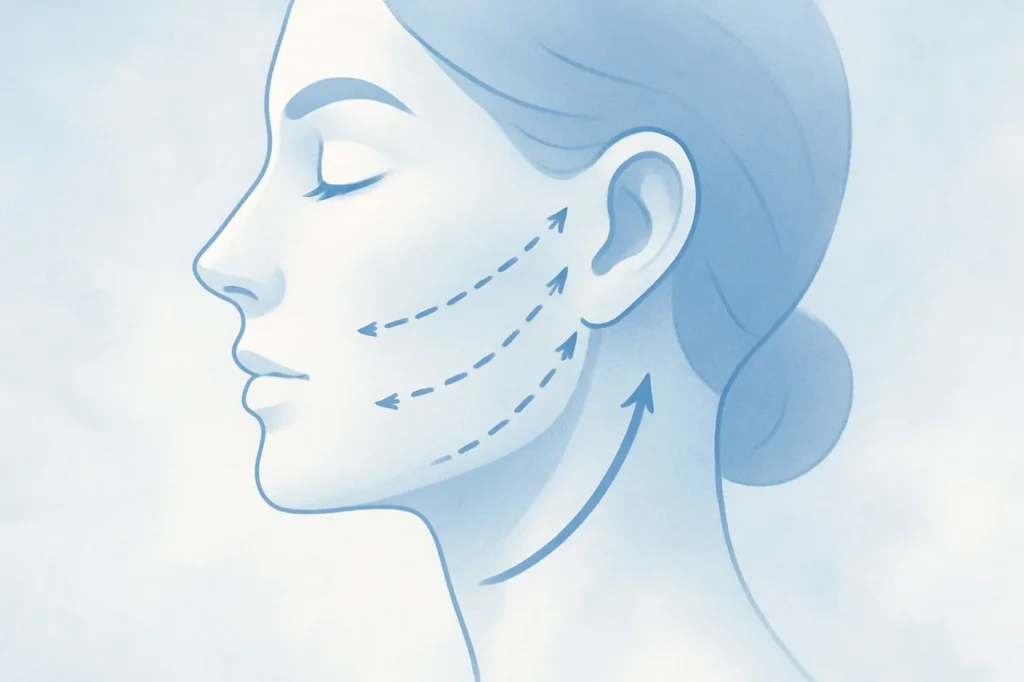
Facelift complication rates are the percentages of patients who develop problems such as a hematoma, skin slough or facial nerve weakness after surgery — and in a 3,500-case textbook series, the most common one, hematoma, occurred in about 1.5% of women and 4.0% of men.
If you are reading this, you are probably weighing a facelift and wondering, quietly, “What if something goes wrong for me?” My answer is always the same: vague fear is harder to live with than real numbers. Once you know how often each problem happens, and what pushes those odds up or down, you can actually do something about it.
In this article I walk you through facelift complication rates the way I explain them to my own patients: the textbook data first, then the factors that change your personal risk (your sex, blood pressure, smoking, the technique and a previous facelift), and finally the warning signs worth memorizing before you leave the clinic.
Facelift Complication Rates at a Glance: The 3,500-Case Data
What worries patients most is not a specific complication but the feeling that “it might happen to me.” So I start with numbers. One of the largest data sets in the plastic surgery literature is a textbook series of 3,500 facelifts performed with a technique called lateral SMASectomy (Baker DC). Its facelift complication rates are summarized below.
| Complication | Rate in the 3,500-case series | Who it tends to affect |
|---|---|---|
| Hematoma (pooled blood under the skin) | 1.5% in women · 4.0% in men | Men, people with high blood pressure, people on blood thinners |
| Skin slough (a patch of skin that loses its blood supply) | 2.0% | Smokers and people with diabetes |
| Scar revision (a minor second procedure to refine a scar) | 2.0% | Earlobe, behind-the-ear and temple scars |
| Recurrent laxity (some sagging returning) | About 2% at 1 year | Varies with skin quality and aging |
| Infection | 1.0% | People with diabetes or on immunosuppressants |
| Facial nerve weakness | 0.1% | Rare; reported cases recovered within 6 months |
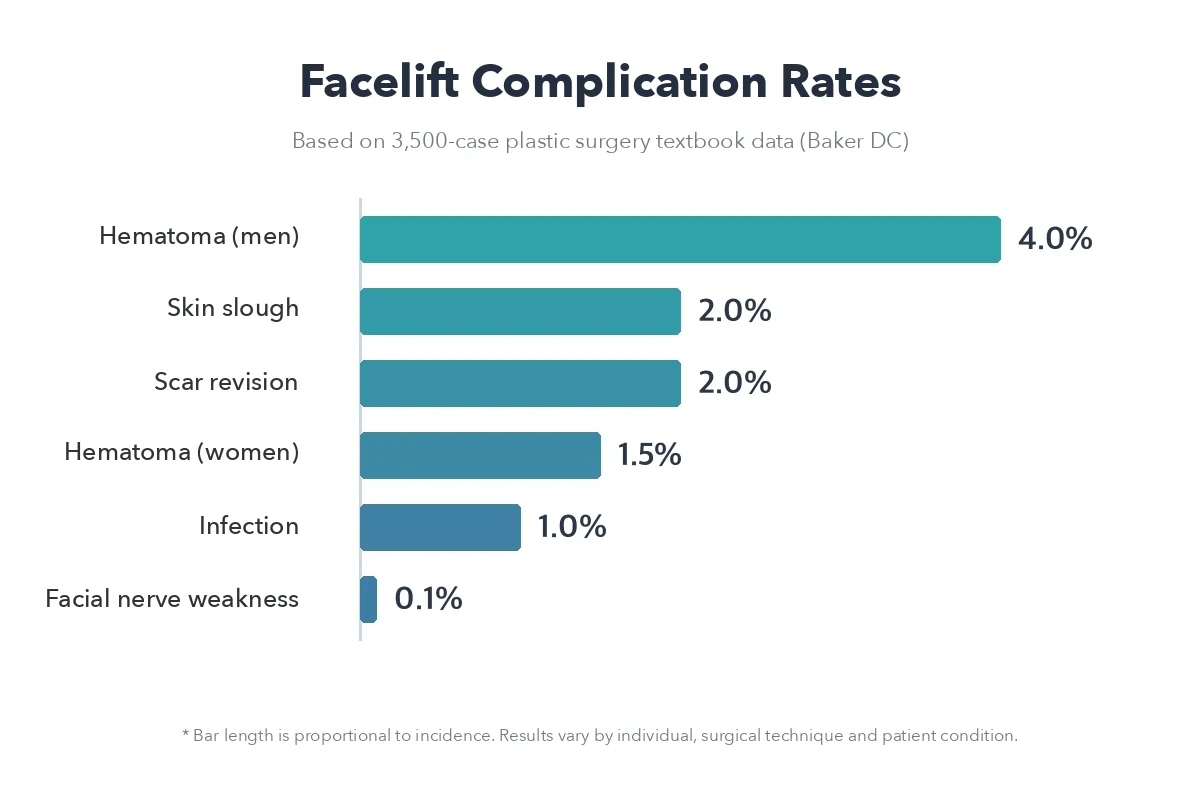
Keep two things in mind when reading facelift complication rates. First, these are averages across thousands of patients, not a prediction for you. Second, the figures depend heavily on technique and on how carefully blood pressure is controlled. That is why published facelift complication rates vary between surgical teams.
Hematoma: 1.5% in Women, 4.0% in Men
A hematoma is blood that collects under the lifted skin after surgery. It is the most common problem after a facelift. In the 3,500-case textbook series, hematoma occurred in about 1.5% of women and 4.0% of men, so men were affected nearly three times as often.
Across the wider literature the picture is similar. Plastic surgery textbooks report an overall hematoma rate of about 2–3% in women, while some series of male patients have reported rates as high as 8%. The same textbooks note that meticulous surgery and careful blood pressure control after the operation can bring the rate in men down to around 4%. In other words, hematoma rates are not fixed; they respond to what the surgical team and the patient do.
The reassuring part is that most hematomas are found within hours of surgery, while you are still under close observation. Small ones are often absorbed by the body; larger ones are drained and, when caught early, usually heal without lasting effects.
Skin Slough, Infection and Scar Revision
Skin slough means a small area of skin, usually behind the ear, does not get enough blood while it heals. In the textbook series it occurred in about 2.0% of cases, and it is heavily concentrated in smokers and people with diabetes. For a healthy non-smoker the risk is markedly lower. Textbooks also note that most established areas of skin loss heal on their own with conservative wound care, and any scar can be refined later.
Infection is among the less common complications: about 1.0% in this series, and various published series report an infection rate below 1% for facelift surgery.
Scar revision, a small touch-up of a scar around the earlobe, behind the ear or at the temple, was needed in about 2.0% of patients. A further 2% or so noticed some sagging return at one year.
Facial Nerve Weakness: 0.1%, and Reported Cases Recovered
The facial nerve controls your expressions, and nerve injury is the complication patients fear most. In reality it has the lowest of all the facelift complication rates in the table. Facial nerve weakness occurred in about 0.1% of cases in the same textbook data, roughly 1 in 1,000 patients, and every reported case recovered within six months. Permanent injury is very rare. If you want to understand this topic in depth, read our article on what facial nerve weakness after a facelift involves.
Dr. Lee’s Key Point: The most common problem is hematoma (about 1.5% in women and 4.0% in men). The one people fear most, facial nerve weakness, is about 0.1%, and the reported cases all recovered within six months.
Who Has a Higher Facelift Hematoma Risk? Men, Blood Pressure and Smoking
Facelift complication rates are averages, and averages hide the individual. Some patients start with a noticeably higher risk, and the reasons are well understood. The good news is that most of these factors can be managed before surgery.
Why Men Bleed More After a Facelift
Across the medical literature, hematoma rates after a facelift are about twice as high in men as in women; in the 3,500-case series the gap was closer to three times. There are two main reasons. Men’s facial skin has a richer blood supply, because every beard follicle is fed by tiny blood vessels. And high blood pressure is more common among male patients.
Blood pressure deserves special attention. In a study of 1,236 consecutive facelifts (Rees, 1994), a systolic blood pressure above 150 mmHg before surgery was linked to a higher hematoma rate. Plastic surgery literature therefore treats blood pressure control, before and after the operation, as the main lever for lowering facelift hematoma risk. If you are a man considering surgery, it is worth reading about how facelift surgery differs for men.
Smoking and Diabetes: The Skin-Slough Factor
Nicotine narrows small blood vessels, and the lifted skin depends on exactly those vessels while it heals. That is why skin slough clusters in smokers. Diabetes affects small vessels and wound healing in a similar way, and it also raises the chance of infection. Put simply, for a non-smoker without diabetes, the skin-related risks sit well below the 2.0% average.
Dr. Lee’s Key Point: Being male, having high blood pressure, smoking and having diabetes each push your personal risk up. The first two mainly affect bleeding; the last two mainly affect skin healing.
Does the Facelift Technique Change Your Risk?
Yes, clearly. Two facelifts can look similar on a consent form and still carry different risks, because they handle the SMAS differently. The SMAS (superficial musculoaponeurotic system) is the supportive layer under the skin that wraps the facial muscles. How deep the surgeon goes beneath it, and where, shapes both the result and the risk of nerve injury.
Lateral SMASectomy: Working Above the Parotid Gland
In a lateral SMASectomy, the surgeon removes a strip of SMAS and closes the gap, working over the parotid gland (the salivary gland in front of the ear). The facial nerve branches run beneath this gland, so the gland acts as a natural shield. Because the SMAS does not need to be lifted off as a whole sheet in this area, the risk of nerve injury is relatively low. This is the technique behind the 3,500-case facelift complication rates above.
Deep Plane Facelift: Natural Results, Surgeon-Dependent Safety
A deep plane facelift lifts the skin and the deeper SMAS and platysma (the thin neck muscle) as separate layers, each in its own direction. Done well, this gives a natural, longer-lasting result. But the dissection goes deeper, closer to where the nerve branches travel, so facelift complication rates with this technique depend more on the surgeon’s experience than with more superficial methods.
When the Nerve Isn’t Clearly Seen, Dr. Lee Switches to Plication
My rule in the operating room is simple: no cosmetic gain is worth a nerve. If, during dissection, I cannot clearly confirm where a nerve branch lies, I do not push deeper. Instead I switch to plication, folding and stitching the SMAS in place rather than releasing it further. The lift may be slightly less, but safety comes first.
At MINE we use what we call the Dual Tight approach. We precisely release the retaining ligaments (the fibrous anchors that hold facial tissue to the bone), then lift and fix the skin and the SMAS layer by layer. Spreading the tension across two layers, instead of loading it all on the skin, is designed to reduce strain on the scar. You can compare the approaches in MINE’s facelift options.
Dr. Lee’s Key Point: Lateral SMASectomy works where the parotid gland protects the nerve; a deep plane lift looks natural but depends more on the surgeon. When the nerve is not clearly seen, I choose a slightly smaller lift over a riskier one.
Warning Signs in the First 24 Hours (and What’s Normal After That)
Facelift complication rates tell you how often a problem happens; how quickly it is spotted often shapes how it turns out. Before patients go home, I ask them to memorize the signs below. If any one of them appears, contact us straight away rather than waiting to see if it settles.
Hematoma Alarm: Sudden One-Sided Swelling and Tightness
Most hematomas after a facelift appear within the first 24 hours. The typical picture is one side of the face swelling suddenly, feeling hard when you touch it, with pain or a sense of tightness that builds quickly.
Nerve, Skin and Infection Red Flags
- Facial movement: trouble closing one eye, or a smile that pulls to one side, lasting more than 24 hours.
- Skin color: skin near the incision turning purple or black, or forming blisters. These can be early signs of skin slough.
- Infection: a fever of 38°C (100.4°F) or higher together with heat, redness or discharge at the incision.
Normal vs Not Normal: A Quick Recovery Check
| Time after surgery | What is normal |
|---|---|
| Days 0–3 | Swelling and bruising at their peak. Rest; avoid straining. |
| About 1 week | Stitches removed. Cold compresses until day 4–5, then warm compresses (check the temperature, as numb skin burns easily). |
| About 2 weeks | Most bruising and 70%+ of swelling gone; most patients return to social activities. |
| 3–6 months / 6–12 months | Final facial contour settles / scars mature and fade. |
For international patients: these warning signs still apply after you fly home. Keep our number, +82-2-516-1175, saved on your phone and message or call us if anything worries you. If one of these happens, here is what treatment usually looks like — see our step-by-step guide to managing facelift complications.
Dr. Lee’s Key Point: Sudden one-sided swelling, expression changes lasting over 24 hours, purple or black skin, and fever of 38°C (100.4°F) with a hot incision: any one of these means call us now.
How to Lower Your Facelift Complication Rate Before Surgery
A large part of the risk is decided before you ever reach the operating room. These are the three things I check with every patient in the pre-surgery consultation, and each one directly targets one of the facelift complication rates in the table above.
Stop Smoking for at Least 4 Weeks
Stopping smoking for at least four weeks before and after surgery is the most reliable way to lower the 2% skin-slough rate. That includes cigarettes, cigars and nicotine products. If stopping is not realistic for you right now, we discuss postponing surgery; it is a safer choice than operating on skin with a reduced blood supply.
Pause Blood Thinners and Supplements (With Your Doctor)
Aspirin, warfarin and supplements such as omega-3 and some herbal remedies thin the blood and raise the chance of a hematoma. Pausing them is one of the simplest ways to lower your risk of bleeding. Plastic surgery textbooks advise avoiding anticoagulant and antiplatelet medicines for 1–2 weeks before a facelift; we usually ask patients to stop about 2 weeks ahead. Never stop a prescribed medicine on your own, though. The timing must be agreed with the doctor who prescribed it.
Get Blood Pressure and Diabetes Under Control
For men in particular, blood pressure control is the key lever for reducing hematoma risk. Textbooks also list avoiding high blood pressure, nausea and vomiting after surgery as long-standing ways to reduce bleeding. If you have diabetes or take immunosuppressants, tell us at consultation, since both raise the risk of infection and slower healing.
For overseas patients, plan to stay in Seoul at least through the first week, until your stitches are removed and we have checked you in person. For everything to arrange in advance, see our pre-facelift checklist. When comparing surgeons, it is also sensible to check board certification and membership of professional societies such as ISAPS.
Dr. Lee’s Key Point: Four weeks smoke-free before and after surgery, blood thinners paused about two weeks ahead with your doctor’s approval, and honest disclosure of blood pressure and diabetes are the core of prevention.
Revision Facelift: Why a Second Surgery Carries Extra Risk
Many patients who come to us have already had a facelift elsewhere and are considering a second one. Revision facelift risks are different from the facelift complication rates of a first operation, so it is worth knowing them in advance.
Scar Tissue Makes the Nerve Harder to Find
After the first surgery, tissue layers stick together (adhesion) and become firmer (fibrosis). These changes blur the normal planes a surgeon relies on, which makes it harder to identify where the nerve branches run. As a result, a revision is noticeably more demanding than a first facelift, and the margin for error is smaller.
Setting Realistic Expectations and Waiting 6–12 Months
Not every change from a first operation can be fully corrected by a second one. Before any revision, I explain honestly what can be improved and what is difficult, so that we share realistic expectations. As a rule, a revision should be decided only after the scars have stabilized, at least 6–12 months after the first surgery.
Dr. Lee’s Key Point: Scar tissue makes a revision harder than a first facelift. Wait 6–12 months, and choose a surgeon who will tell you clearly what can and cannot be corrected.
Facelift Complication Rates: Frequently Asked Questions
What is the most common facelift complication?
Hematoma, a collection of blood under the skin, is the most common facelift complication. In a 3,500-case textbook series it occurred in about 1.5% of women and 4.0% of men. Most appear within the first 24 hours, and when a larger one is caught early, it is usually treated at the bedside under sedation, with blood pressure control and washing out of the pooled blood.
Is a facelift safe for men?
Yes, with good blood pressure control. In the textbook data, men’s hematoma rate is about three times that of women, because of a richer facial blood supply and more frequent high blood pressure. Managing blood pressure before and after surgery is the key step.
How likely is permanent nerve damage after a facelift?
Very unlikely. Facial nerve weakness occurred in about 0.1% of cases in the 3,500-case series, and all reported cases recovered within six months. More detail is in our article on facial nerve weakness after a facelift.
Does smoking increase facelift complication rates?
Yes. Smoking is the biggest single factor behind skin slough, which affects about 2.0% of patients overall and is concentrated in smokers and people with diabetes. Stop for at least four weeks before and after surgery; if you cannot, postponing is safer.
When can I fly home after a facelift in Korea?
Usually after your stitches are removed at around one week, once the high-risk first 24 hours and early checks are behind you. Most bruising and swelling settle by about two weeks. Your exact timing is confirmed at your follow-up visit.
Talk Through Your Personal Risk With Dr. Lee
Facelift complication rates tell you what happens across thousands of patients. Your own risk depends on your anatomy, your health and your habits, and that is something we assess together in a consultation. If you are abroad, you can start with an online pre-consultation by sending photos through the consultation form on our website.
At MINE Plastic Surgery in Gangnam, Seoul, board-certified plastic surgeon Dr. Lee Sung-wook will review your blood pressure, medications, smoking history and any previous surgery, and explain how they shift your own risk, before anything is planned. To book, call or message +82-2-516-1175, or visit us at 813 Nonhyeon-ro, Gangnam-gu, Seoul.
Written and reviewed by Dr. Lee Sung-wook, Board-Certified Plastic Surgeon, MINE Plastic Surgery
※ This content is for informational purposes only and does not replace professional medical advice, diagnosis, or treatment. Individual results may vary, and side effects may occur. Please consult with a board-certified plastic surgeon for personalized advice.