EN



Written & reviewed by Dr. Lee Sung-wook, Board-Certified Plastic Surgeon (Korea) · MINE Plastic Surgery, Seoul
Deep plane vs SMAS facelift recovery time compares healing after two kinds of lift: a deep plane lift, which releases the retaining ligaments and moves skin and SMAS together, and a SMAS lift, which tightens the SMAS by folding or trimming it (plication or SMASectomy). For most patients, the two timelines overlap more than they differ.
That is not the answer most comparison charts give you. Online, the deep plane lift is often described as either “much longer to heal” or “surprisingly fast.” In my clinical experience, neither label fits. Stitches come out on a similar schedule, people go out on a similar schedule, and the face settles on a similar schedule. What does differ is where the swelling sits, how wide the numb area is, and how the face feels during weeks 1–6.
This article puts the two techniques side by side, week by week, and then turns that comparison into a practical plan for a surgery trip to Seoul. If you want a detailed, single-technique walkthrough instead, read our stage-by-stage guide to healing after a deep plane lift. Here, every row asks one question: same or different?
Table of contents
Why the Two Recoveries Differ: It Is the Dissection Plane, Not the Name
Facelift names are used loosely. For recovery, the useful questions are which layer was lifted and how much tissue was separated. Healing follows the surgery, not the label.
The key layer is the SMAS (superficial musculoaponeurotic system — the firm, fibrous sheet under your facial fat that holds the face up, a bit like the lining inside a jacket). Almost every modern facelift works on the SMAS in some way. The difference is whether the surgeon folds it, trims it, or goes underneath it.
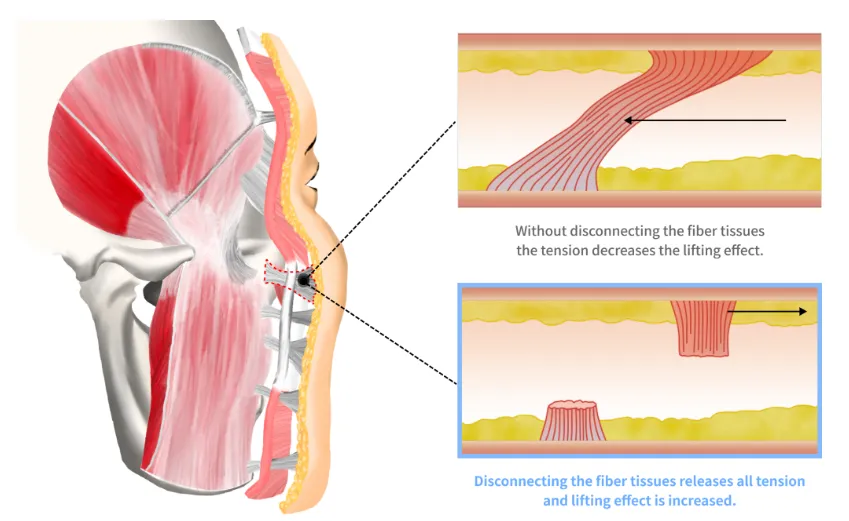
What the surgeon actually does in SMAS plication and SMASectomy
Surgical textbooks describe SMAS plication as raising a skin flap and then folding the SMAS and the neck muscle (platysma) on themselves with stitches, like taking in a seam. The surgeon does not go beneath the SMAS. In a lateral SMASectomy, a strip of SMAS is cut away along the side of the face and the edges are stitched together, which tightens the layer in a similar direction.
In both methods, the main separation is just under the skin, around the ear and along the jawline — which is where most early swelling and numbness will be felt.
What changes when the retaining ligaments are released (deep plane / extended SMAS)
In a deep plane or extended SMAS lift, the surgeon works beneath the SMAS. The aim is to release the retaining ligaments (fibrous “anchor ropes” that tie facial tissue to the bone — the zygomatic, masseteric and mandibular ligaments). Once they are released, skin and SMAS can be moved together as one unit, called a composite flap.
Here is the part many patients find surprising. According to the surgical literature, in a composite deep plane lift only the skin that will actually be removed needs to be separated on its own. So the skin-only dissection is often smaller than in a lift that separates skin and SMAS as two flaps. The deeper work is wider in the midface; the shallower work under the skin can be more limited.
Anatomy research explains why this demands precision: the zygomatic and buccal branches of the facial nerve (the nerves that move your cheeks and smile) cross the same sub-SMAS space just inside the cheek ligaments, so the ligaments serve as landmarks.
Why “deeper” does not automatically mean “longer recovery”
Surgical textbooks describe sub-SMAS dissection along the natural glide planes as relatively atraumatic, which is why a deeper lift does not automatically mean a longer recovery. Glide planes are spaces that already exist between facial layers — they let your face move when you talk. Opening a space that is already there tends to cause less bleeding than cutting through solid tissue.
Published work on composite facelifts makes the same point from the other direction: downtime is driven mainly by bleeding and the total amount of tissue trauma, and keeping under-the-skin dissection to what is necessary helps reduce it. Depth on its own is not the clock.
There is one more shared mechanism. As the face heals, released ligament tissue reattaches in its new position and begins to resist gravity again. This happens over the healing weeks, and it is a large part of why the contour “settles” over about 3 months — with either technique. Only the way the lift is held changes.
Dr. Lee Sung-wook’s Key Point: When a patient asks me which lift heals faster, I first ask which layer, which area, and how much. Two operations with the same name can have very different dissections, and two different names can heal almost identically.
Deep Plane vs SMAS Facelift Recovery Time, Side by Side
For most patients, the deep plane and SMAS recovery timelines are a story of overlap. With either technique, sutures usually come out at 7–10 days, most people go out with light makeup at 2–3 weeks, and the contour settles at around 3 months. The real differences are qualitative: where swelling collects, how wide the numb zone is, and what the early tightness feels like.
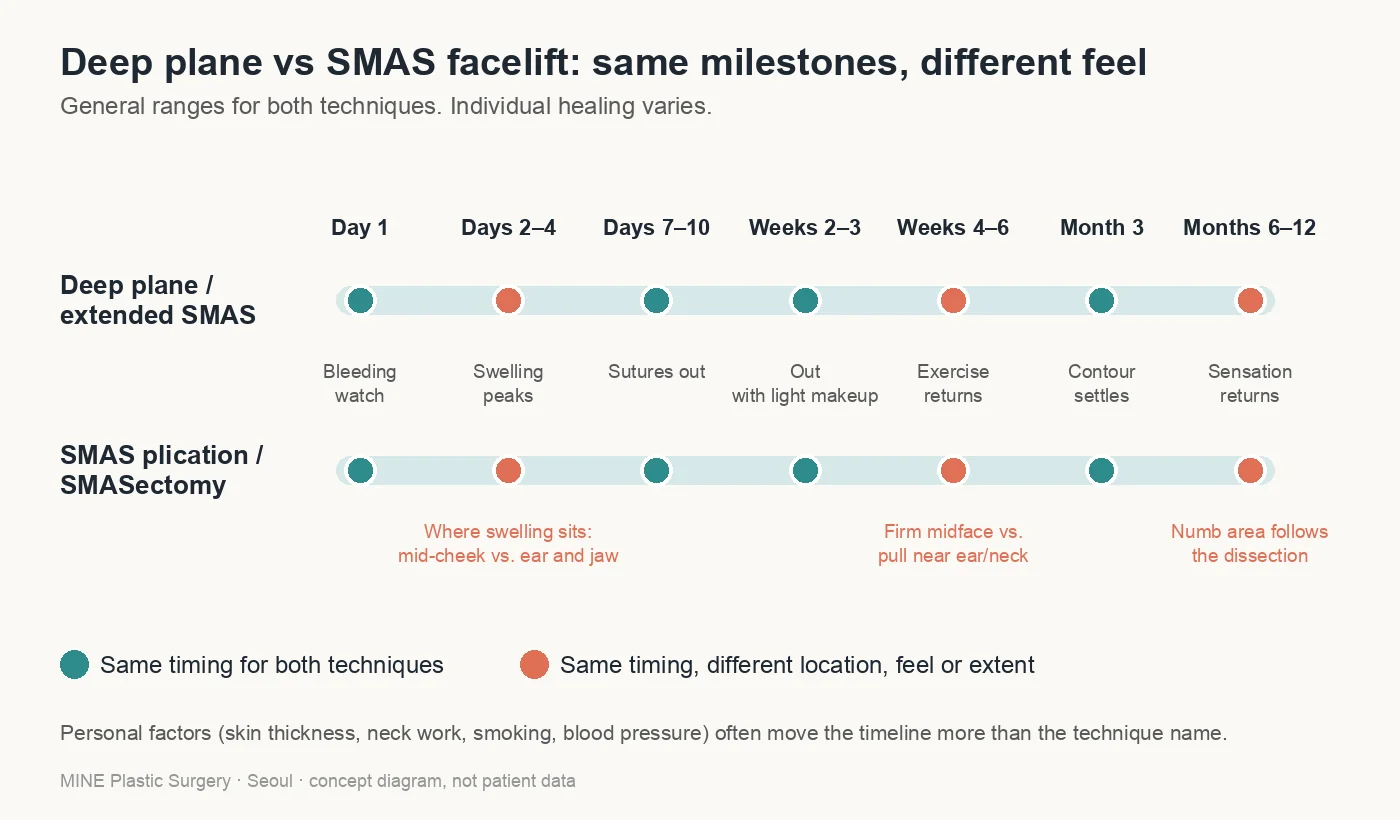
The week-by-week comparison table
| Recovery window | Deep plane / extended SMAS | SMAS plication / SMASectomy | Same or different? |
|---|---|---|---|
| Night of surgery – Day 1 | The period when bleeding (hematoma) needs the closest watch. Head elevated, blood pressure kept steady. | Exactly the same priority and the same precautions. | Same |
| Days 2–4 | Swelling peaks. It can spread toward the mid-cheek and below the cheekbone, where the deeper release was done. | Swelling peaks. It tends to sit in front of the ear and along the jawline, where the skin was lifted. | Different in location |
| Days 7–10 | Sutures removed, as a general range. | Sutures removed, as a general range. Same incisions, same timing. | Same |
| Weeks 2–3 | Most people go out with light makeup. Any leftover fullness is more often in the front of the cheek. | Most people go out with light makeup. Leftover fullness is more often near the ear and jaw. | Mostly the same |
| Weeks 4–6 | Exercise and full social life usually return. Some describe a firm, “set” feeling in the midface. | Exercise and full social life usually return. Some describe pulling near the ear or along the neck. | Same timing, different feel |
| Month 3 | Contour has largely settled. | Contour has largely settled. | Same reference point |
| Months 6–12 | Sensation keeps returning; scars soften and fade. | Sensation keeps returning; scars soften and fade. | Different in extent (numb area follows the dissection) |
These are general ranges that apply to both techniques. Individual healing varies, and your surgeon’s instructions take priority.
How to read the table: overlap first, differences second
Read the last column first: most rows say “same” or “mostly the same.” No reliable medical data shows that one technique adds a fixed number of days, so a chart claiming “deep plane takes X days longer” is a guess, not evidence.
In practice, personal factors move the timeline more than the technique label does:
- Skin thickness — thicker, heavier skin often holds swelling longer.
- Neck work at the same time — adding a platysma (neck muscle) tightening widens the treated area.
- Smoking — reduces blood flow to the skin and slows healing.
- Blood pressure — spikes raise the chance of bleeding in the first days.
- How much was dissected — the size of the treated area, under either name.
If you are weighing a shorter-incision option instead, see how mini facelift recovery compares.
Where the Timelines Actually Split: Swelling, Numbness, Tightness and Scars
Where the two recoveries do split, a simple rule explains it: the part of the face that was separated is the part that swells and feels different.

Swelling location: midface versus the area in front of the ear
After a deep plane lift, the release under the SMAS reaches toward the middle of the cheek, so early swelling can spread further forward — into the mid-cheek and below the cheekbone. After plication or SMASectomy, the work is concentrated under the skin near the ear and jaw, so swelling usually gathers there.
Numbness: why the area, not the duration, is what differs
Numbness comes from small sensory nerve endings in the skin being stretched or divided when the skin is lifted. The wider the skin-only dissection, the wider the numb zone. A lift that separates skin widely and then folds the SMAS tends to leave a numb area around the ear and cheek. A composite lift limits the skin-only dissection, so the pattern is often different.
With either approach, feeling usually returns gradually over several months, and the pace varies from person to person. Numbness of the skin is not the same as weakness of facial movement, which is a different and much less common issue.
Tightness and skin tension at the incision
Surgical texts describe a useful principle: when the deeper layer carries the tension of the lift, the skin can be closed with very little pull. Less pull at the skin edge tends to mean a finer, less noticeable scar. A composite flap is built around this idea.
The same principle applies to plication and SMASectomy when the SMAS is doing the work rather than the skin. So the better question for your consultation is not “which technique?” but “which layer is holding the tension?”
What does not differ: sutures, bruising timeline, the 3-month mark
Just as important is what stays the same. Suture removal timing, the order in which bruises change color (purple, then green, then yellow) and the 3-month settling point follow similar patterns with both approaches. If the incisions are in the same places, the scar care is the same too.
Dr. Lee Sung-wook’s Key Point: I would rather patients arrive in Seoul expecting overlap than expecting a dramatic difference. When you know the swelling may sit in your mid-cheek rather than by your ear, you can plan your video calls, your scarf and your photos around it.
Planning a Facelift Trip to Seoul: What Changes Between the Two Techniques
For international patients, recovery time after either lift is really a scheduling question: how many days off, when to fly, when to face clients, when to book photos. Suture removal at 7–10 days and a final check-up — not the technique label — set the minimum stay in Seoul.

| Milestone | What sets the timing | Does technique change it? | Planning tip for international patients |
|---|---|---|---|
| Stay in Seoul | Suture removal (7–10 days) and a final check-up | Rarely | Book flexible dates; add margin if you are having neck work or have high blood pressure. |
| Flight home | Your surgeon’s go-ahead after suture removal and check-up | No — same principle for both | Keep your head elevated, drink water and keep blood pressure steady on board. |
| Desk work / remote work | Comfort, medication, light daily activity | Rarely | Camera-off days help in weeks 1–2. |
| Client-facing work | How visible your remaining swelling is | Sometimes — through swelling location | Allow 2–3 weeks or more, depending on how you heal. |
| Cardio & lifting | Bleeding risk and swelling | No — usually weeks 4–6 for both | Walk gently early on; leave hard training until you are cleared. |
| Photos / events | Final contour | No | Schedule after the 3-month mark. |
How many days to stay in Seoul
The stay is built around two fixed points — suture removal at 7–10 days and a last in-person check — and both are the same for deep plane and SMAS techniques. Choosing one over the other should not, by itself, change the length of the trip.
What can change it is you. Neck work at the same time, being male (men have a higher bleeding risk after facelifts) and high blood pressure are reasons to add a few spare days — and they matter more than the technique name.
When flying home is reasonable
Fly once your sutures are out and your surgeon has checked you — the same rule applies to both techniques, so we do not give a different flight date for each. On a long-haul flight, keep your head raised, stay well hydrated, avoid alcohol and take your prescribed blood pressure medicine on time. The American Society of Plastic Surgeons facelift overview also stresses following your surgeon’s individual aftercare instructions.
Returning to work: desk job versus client-facing
At MINE, the Dual-Tight facelift takes about 3 hours, patients go home the same day, and light daily activities resume in about 5 days. “Light daily activities” means moving around the hotel, eating out nearby and working on a laptop — not exercise or a full social calendar, which usually come back at weeks 4–6.
Remote workers are often back at the desk within the first week or so. Client-facing work needs 2–3 weeks or more — and here the technique can be felt, because swelling in the front of the cheek is harder to hide than swelling near the ear.
Exercise, flights of stairs and heavy lifting
Gentle walking helps circulation early on. Anything that sharply raises blood pressure — running, heavy lifting, saunas — usually waits until around weeks 4–6 with both techniques. Take hotel stairs slowly and let someone else carry heavy luggage in the first week.
Photos, weddings and events: when to schedule them
Place important events after the 3-month mark, when the contour has largely settled with either technique. Before then, small asymmetries or firmness are common and do not reflect the final result.
Dr. Lee Sung-wook’s Key Point: Many of our international patients plan the trip around the surgery date. I suggest planning it around the suture-removal day and the final check instead. Those two dates do not move with the technique, and they are what actually let you fly home safely.
What Slows Recovery With Either Technique
The factors that most often stretch recovery are shared by both techniques, and most of them are within your control.
The first 24 hours: hematoma risk is the shared priority
A hematoma (a collection of blood under the skin) is the most common early complication after a facelift, and it usually appears within the first 24 hours. That makes the first night the most critical window for every technique. Men and patients whose blood pressure rises after surgery have a higher risk.
In a textbook series of 3,500 lateral SMASectomy facelifts, hematoma occurred in 1.5% of women and 4.0% of men, and facial nerve weakness in 0.1%, all resolving within 6 months. A 2010 study of 117 platysma-SMAS plication facelifts reported hematoma in 3.4% and temporary facial nerve palsy in 3.4% (Berry & Davies, 2010).
These numbers come from different surgeons, different patient groups and different definitions, so they cannot tell you which technique is safer. They simply show that serious problems are uncommon, and that bleeding in the first day is the shared risk to watch. You can read more about facelift complication rates in detail.
Temporary facial nerve weakness: how often and how long
Weakness of facial movement — for example, a slightly uneven smile — is uncommon and usually temporary. In the case series above, it resolved within months. Because the facial nerve branches pass close to the retaining ligaments, careful technique matters in deep plane work. For what this feels like and how it is followed up, see our article on temporary facial nerve weakness after a facelift.
Smoking, blood pressure and other factors you control
Smoking narrows the small blood vessels that feed the lifted skin and raises the risk of skin breakdown (skin slough). Stopping well before and after surgery is one of the most effective things you can do for either technique. Keep blood pressure steady, avoid alcohol early on, sleep with your head raised, and follow your medication instructions. For a full list of what to do before surgery, see our pre-surgery checklist.
How Dr. Lee Matches the Technique to Your Face at MINE
At MINE, the technique is chosen for the face, not the calendar. The Dual-Tight facelift uses four approaches, selected by skin quality and sagging pattern.

The four Dual-Tight approaches: SMAS Plication, SMAS Ectomy, Low SMAS, High SMAS
- SMAS Plication — for thin skin with a hollowed look; the SMAS is folded in several layers and lifted.
- SMAS Ectomy (MINE’s name for its SMASectomy approach) — for thick, firm skin; part of the SMAS is removed and the edges are closed.
- Low SMAS — for sagging mainly in the jaw and lower cheek.
- High SMAS — for sagging across the whole face; the lift starts above the cheekbone and adds a 90° vertical vector to the usual 45° pull, reaching the front of the cheek and the smile lines.
Each follows the same sequence: an incision from the temple hairline along the crease in front of the ear to behind the ear, release of the SMAS and retaining ligaments, layer-by-layer repositioning starting from the SMAS, then removal of excess skin and closure, with the pull adjusted area by area. Anesthesia is administered and monitored by an anesthesiologist.
Why skin thickness and the pattern of sagging matter more than the technique label
Whichever approach suits you, the backbone of your trip stays the same: suture removal, a final check, then the flight home. What you should ask in consultation is how wide the dissection will be, whether the neck is included, and where you are likely to see swelling. You can learn more about MINE’s Dual-Tight facelift and its four approaches.
Dr. Lee Sung-wook’s Key Point: Choosing a less suitable technique just to save a few days is rarely a good trade. The recovery calendars overlap so much that the better question is which approach fits your skin and your sagging pattern.
Frequently Asked Questions
Is recovery from a deep plane facelift longer than from a SMAS facelift?
Usually not by much: deep plane vs SMAS facelift recovery time overlaps for most patients. Suture removal, going out in public and the 3-month settling point fall within similar ranges for both. The differences are in where swelling sits, how wide the numb area is and how tight the face feels early on. Personal factors such as skin thickness, neck work, smoking and blood pressure often matter more than the technique name.
How long should I stay in Seoul after a facelift?
Your stay is set by suture removal at 7–10 days and a final check-up before you leave, and those dates do not depend on the technique. Allow extra days if you are having neck work at the same time, are male or have high blood pressure. Your surgeon will confirm the exact plan during consultation.
When can I fly home after a deep plane or SMAS facelift?
The rule is the same for both techniques: fly after your sutures are out and your surgeon has examined you. On the plane, keep your head elevated, drink plenty of water, avoid alcohol and take any blood pressure medication on schedule. We do not set different flight dates for different techniques.
Why does my cheek feel numb after a facelift, and how long does it last?
Numbness comes from small skin nerves being affected where the skin was lifted, so the numb area follows the dissection and differs between techniques. Feeling usually returns gradually over several months, at a pace that varies by person. Numb skin is different from weak movement; for that, see temporary facial nerve weakness after a facelift.
When can I go back to work after a facelift?
At MINE, light daily activities usually resume in about 5 days, meaning gentle activity and laptop work, not exercise. Remote or desk work can often restart within the first week or two. Client-facing work usually needs 2–3 weeks or more, depending on how visible your remaining swelling is, and the swelling location can feel different between techniques.
Which facelift technique is right for me if I have limited time off?
Choose the technique for your face, not your calendar. Because the recovery timelines overlap heavily, picking a less suitable technique rarely saves much time. At MINE, the choice among SMAS Plication, SMAS Ectomy, Low SMAS and High SMAS depends on your skin thickness and sagging pattern, and your schedule is then planned around suture removal.
Planning Your Facelift and Your Seoul Schedule
If you are comparing deep plane vs SMAS facelift recovery time for your own trip, the most useful next step is a consultation that looks at your face, not a chart. Send us clear front and side photos through an online consultation, and our team will explain which Dual-Tight approach may suit you and how to plan your days in Seoul around suture removal and your final check-up. You can also call us at +82-2-516-1175.
Written and reviewed by Dr. Lee Sung-wook, Board-Certified Plastic Surgeon (Korea), MINE Plastic Surgery, Seoul
※ This content is for informational purposes only and does not replace professional medical advice, diagnosis, or treatment. Individual results may vary, and side effects may occur. Please consult with a board-certified plastic surgeon for personalized advice.