EN


Written and reviewed by Dr. Lee Sung-wook, Board-certified Plastic Surgeon — MINE Plastic Surgery & Dermatology
One month after surgery, do your breasts look smaller again? That moment in front of the mirror is one of the most common reasons patients call my clinic.
The breast fat transfer results timeline is the months-long process in which grafted fat gains a new blood supply and becomes a permanent part of your breast tissue. Because of this, the size you see right after surgery is not your result. Results start to become clear at 3 to 6 months, and final volume is judged at 6 to 12 months.
The question I hear most in consultation is simple: “When will I know my final size?” So this article follows one thread only — what you can see and what can actually be judged at 1 week, 1 month, 3 months, 6 months and 12 months, and how the decision about a second session is made. How the operation itself is done, and what to do during recovery, are covered in separate articles linked below.
Breast Fat Transfer Results Timeline: What “Graft Take” Means
It all starts with one biological fact. The moment fat is moved from your abdomen or thighs into your breast, it has been cut off from its blood supply. Fat cells cannot build new blood vessels on their own, so they have to hold on until vessels from the surrounding tissue grow in and reach them.
Graft take = transferred fat gaining a new blood supply
Surgeons call this process “graft take.” Fat that connects to a new blood supply stays and becomes part of your breast. Fat that doesn’t connect is gradually broken down and cleared away by the body.
It is easiest to picture in three stages:
- The first few days: the grafted fat survives by soaking up nutrients from the tissue fluid around it — a bit like a cutting kept alive in a glass of water.
- The following weeks: tiny new blood vessels grow in from the surrounding tissue and connect to the graft.
- The following months: fat that never got a blood supply is cleared, and what remains settles into stable tissue.
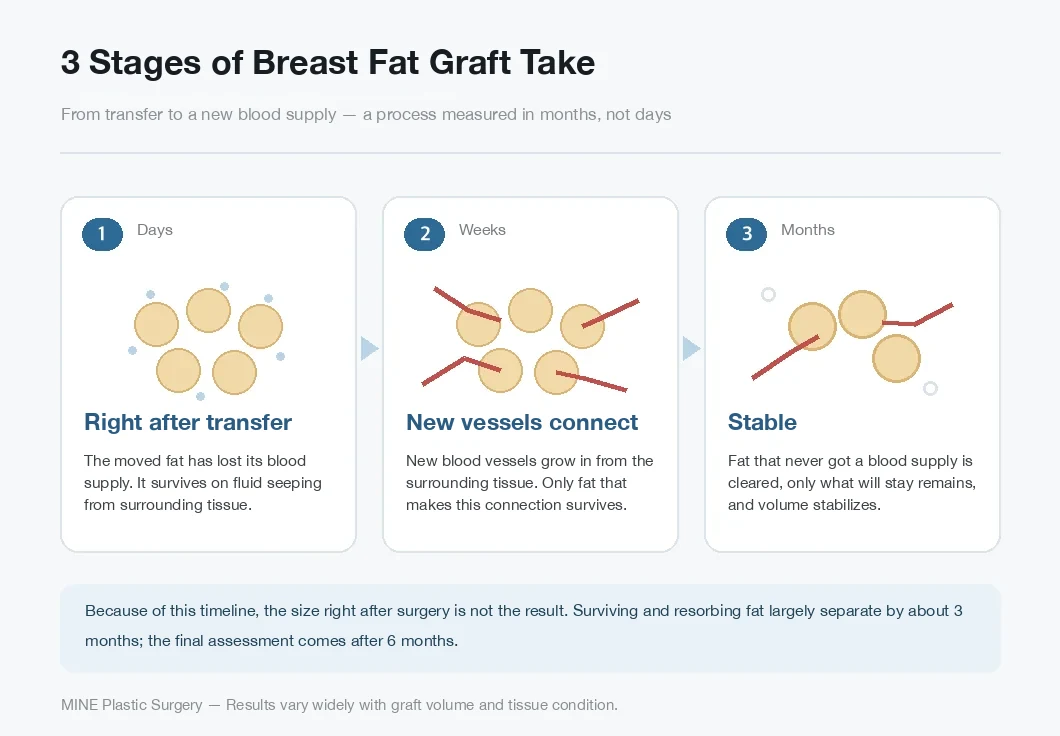
That is why the breast fat transfer results timeline is measured in months, not days. In that sense, the final outcome is less a product of the operating room and more a biological process your body completes over the months that follow.
Plastic surgery textbooks are frank about this. They describe the unpredictable degree of volume retention after fat grafting as the most persistent challenge in the field. Studies report a wide range of resorption (the share of fat the body absorbs), and despite many attempts to find the ideal way to harvest, process and inject fat, there is still no general agreement on which technique works best.
Why the size right after surgery is not your result
This is where most misunderstanding begins. Many patients treat the size they see on the first day as “the result,” then read every change afterward as failure. But the early volume contains swelling and a planned extra margin on top of the grafted fat, so it is actually not normal for that size to stay the same.
To give you the conclusion up front: I start looking at fat transfer results only after 3 to 6 months, and I make the final assessment after 6 months. Anything before that is a midpoint in a process that is still running.
This article does not cover the surgery itself — how fat is harvested, purified and placed. If that is what you want to know, the step-by-step breast fat transfer procedure and early recovery guide is the right place to start.
Dr. Lee’s Key Point: Shape starts to show three months after surgery, not on the day itself. Waiting is part of treatment.
Surgery to Week 1: Most of the Volume You See Is Swelling
Plenty of patients take a photo the day after surgery. I ask them not to use it as a reference. At this first stage of the breast fat transfer results timeline, your breasts hold three things at once: the grafted fat, swelling from the surgery itself, and an extra margin placed on purpose to allow for absorption.
Why measurements taken this week don’t count
When three different things are mixed together, no calculation can turn that size into a prediction of your final volume. A tape measure or a bra fitting this week will give you a number that changes within a few weeks. In other words, your week-1 size says almost nothing about whether the graft is taking well.
Textbooks note another reason the early picture is misleading: the fluid injected during surgery to numb and prepare the tissue adds its own temporary fullness. Your only job this week is to let the area heal — not to measure it.
Why surgeons overfill: the background of overcorrection
Early fat-grafting literature reported that roughly 25–50% of transferred fat survived. That wide range is why “overcorrection” — placing a little more than the target volume to allow for what the body will absorb — became standard practice.
The honest caveat, which textbooks state openly, is that there is still no agreed rule for how much extra is right. That is why I don’t give patients a “put in X cc, keep Y cc” formula in consultation. Anyone who offers you one is giving you more certainty than the science supports.
What to follow and what to avoid while you heal is covered separately in our fat grafting aftercare precautions, so I won’t repeat it here.
Dr. Lee’s Key Point: Your week-1 size is your “swollen size.” Don’t compare photos from this week with your final result.
Months 1 to 3: Breast Fat Transfer Volume Loss vs Swelling Going Down
In my clinical experience, one month after surgery is the most anxious stretch of the whole breast fat transfer results timeline. Many patients notice their breasts look clearly smaller and ask whether something went wrong. But most of the change at this stage is swelling leaving, not fat disappearing — and whether the graft has succeeded has not been decided yet.
Month 1: the biggest perceived drop
Swelling peaks in the first few days and then fades gradually over several weeks. As it goes, the breast naturally looks smaller, and compared with your day-one photo the difference can feel dramatic. This dip is an expected part of the breast fat transfer results timeline, and reading it as graft failure only creates unnecessary worry.
A useful way to think about it: at one month you are mostly watching the swelling curve, not the fat curve.
Month 3: surviving fat and resorbed fat become distinguishable
By around three months, fat that has connected to a blood supply and fat that hasn’t have largely gone their separate ways. Textbooks explain that roughly half of the injected fat may be lost over time, which is why more than one session can be needed to reach the desired result.
Still, three months is the first real checkpoint on the breast fat transfer results timeline: it shows a trend, not a final verdict. Some settling continues beyond it.
Why the same graft volume behaves differently in different people
Two patients can receive the same amount of fat and still follow different curves, because the tissue the fat lands in is different. Grafted fat is waiting for blood vessels to grow in from its surroundings, so the blood flow and the available space at the recipient site have a large influence on how much survives. Tissue that is tight, scarred or poorly supplied with blood is a harder environment for a graft.
Research on facial fat grafting illustrates this principle. In one study, the group that had fat grafting alone kept 47.6% of the grafted volume, while the group that had a facelift at the same time kept 23.8% — a clear statistical difference. That was a study of the face, so these numbers cannot be transferred to breasts. The principle is the same, though: the condition of the tissue receiving the fat shapes the result.
Dr. Lee’s Key Point: Looking smaller at one month usually means swelling has left — not that the fat has gone.
Months 6 to 12: When Final Breast Size Can Be Judged
After six months, volume enters a stable phase. This is the point in the breast fat transfer results timeline where we can finally talk about outcomes in concrete terms.
Month 6: when the clinical assessment begins
At this visit I place your pre-surgery measurements and photos side by side with how your breasts look now. We go through the difference in volume between the left and right sides, how well the upper part of the breast has filled, and how close the shape is to the goal we set together. Before six months, this comparison simply doesn’t hold up.

Month 12: reported retention and what happens after
One breast fat grafting report found that, on average, 55% of the grafted volume remained at one year. Textbooks point out, however, that this report did not describe how volume was measured. So treat it as a reference range that has been reported — not as a number you personally should expect.
When surgeons correct congenital breast asymmetry (a difference present from birth) in several stages, published cases spaced the sessions about 3 to 6 months apart. That spacing reflects the same logic as everything above: each stage needs time to settle before the next one is planned.
How weight changes affect your graft later
Fat that survives behaves like the rest of the fat in your body. If your weight rises or falls significantly, your breast volume can change with it. Textbooks therefore advise having fat grafting at, or close to, your ideal body weight and keeping that weight stable afterward. If you are planning a major weight change, I usually suggest we make the final assessment after it.
| Time point | What you see | What can be judged |
|---|---|---|
| Surgery to week 1 | Grafted fat + swelling + overfill | Size can’t be assessed |
| 1 month | Biggest perceived drop as swelling fades | Mostly swelling — hold judgment |
| 3 months | Surviving and resorbed fat become distinguishable | Trend only (not final) |
| 6 months | Volume enters a stable phase | Final assessment begins; second session can be discussed |
| 12 months | Later change driven more by weight | Confirm long-term status |
This table shows the broad course of the breast fat transfer results timeline so you know what to expect. Individual variation is large: at the same time point, how your breasts look and feel depends on your tissue and on how much fat was grafted.
Dr. Lee’s Key Point: Measure properly twice — at 6 months and at 12 months. Sizing yourself in the mirror in between won’t give you the answer yet.
Fat Graft Survival Rates: Who the Published Numbers Actually Describe
“What’s the survival rate?” is one of the questions I’m asked most. The honest answer is that it can’t be answered with a single number — and survival rates are where patients’ expectations most often go wrong.
25–50%, 55%, 47.6%: why the figures disagree
The figures quoted in this article come from different groups of patients, measured in different ways. Survival depends on how fat is harvested, how it is processed and how it is injected — and the literature openly admits there is no general consensus on which technique is best. Some reports don’t even state their measurement method. Comparing survival rates as bare numbers, without that context, leads you to the wrong conclusion.
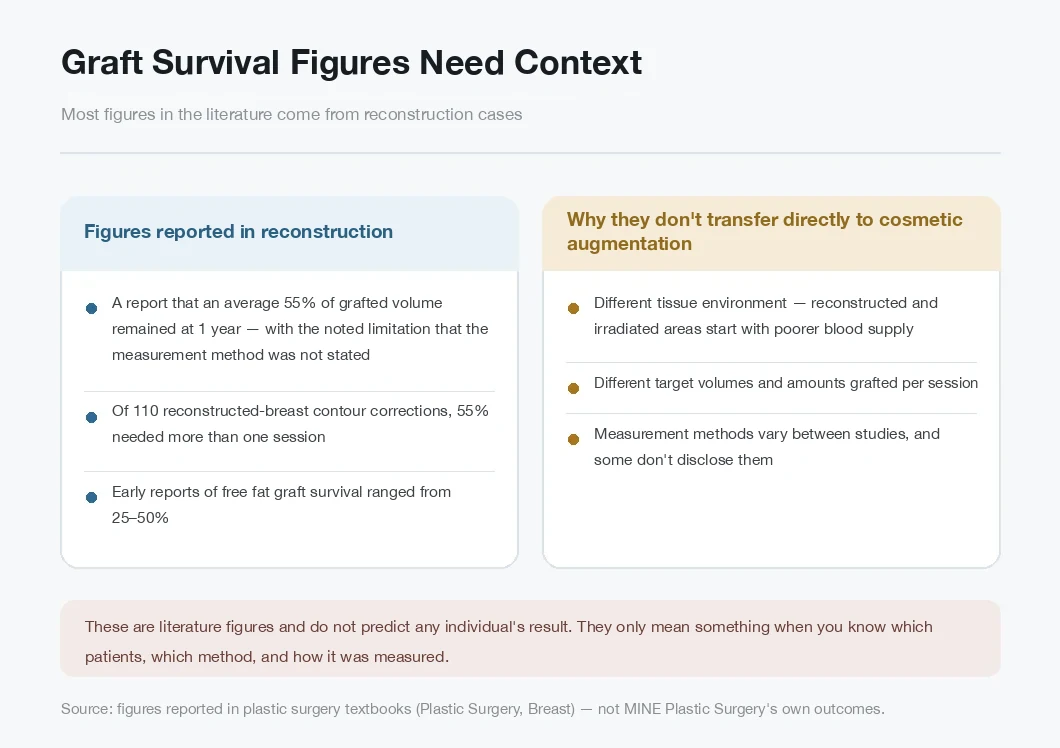
Reconstruction figures don’t map onto cosmetic augmentation
Many breast fat grafting statistics come from situations where the tissue is at a disadvantage: breast reconstruction after cancer, correction of congenital deformities, or areas treated with radiation. Radiated tissue has reduced blood flow, so the same technique can produce a different result there. In reconstruction, textbooks describe fat grafting as a routine secondary procedure to add soft-tissue coverage and refine contour — a very different starting point from a healthy breast.
Cosmetic breast augmentation starts from different tissue conditions altogether. Taking a number from a reconstruction study and using it as your own forecast simply isn’t accurate.
Follow-up imaging is part of the picture, too. A 2016 Annals of Plastic Surgery study reviewed 108 patients (167 breasts) who had fat grafting after reconstruction; imaging findings led to a biopsy in 4 cases (2.4%). Breast textbooks also state that any link between fat grafting and later breast cancer has not been proven or ruled out. This is why regular breast imaging after fat grafting is recommended — worth keeping in mind alongside your volume checks.
Why a promised “average survival rate” is a red flag
An explanation built around a single average figure creates expectation before evidence. Instead, I tell patients the range the literature reports and which group of patients that range came from. In my experience, patients who start with realistic expectations about fat graft survival take their six-month result far more calmly.
Dr. Lee’s Key Point: A survival figure means nothing unless you also know who was treated, how, and how it was measured.
Second Breast Fat Transfer: When and How the Decision Is Made
A second session is decided after the graft has settled — not at the moment your breasts look short of volume. Decide too early, and fat that is still going to survive gets counted as “missing,” so the amount needed is estimated wrongly.
Timing: at least 3 to 6 months after the first session
The decision about a second breast fat transfer is made no earlier than 3 to 6 months after the first. The reason follows directly from the breast fat transfer results timeline: until the first graft has settled, there is no reliable way to calculate how much is actually missing. That is exactly why the literature recommends this interval. Textbooks also note that touch-up procedures are possible precisely because swelling, injected fluid and unpredictable absorption make the final volume hard to judge on the day of surgery.
What we check in clinic
Whether you need more fat is hard to judge on your own. I check the following with measurements and an examination, then sit down with you to decide:
- Whether at least 3 to 6 months have passed since surgery
- How large the real difference is compared with your pre-surgery measurements and photos
- How symmetrical the volume and shape are between the two sides
- The gap between your goal and the amount that can safely be grafted in one session
- Whether you still have enough fat available to harvest
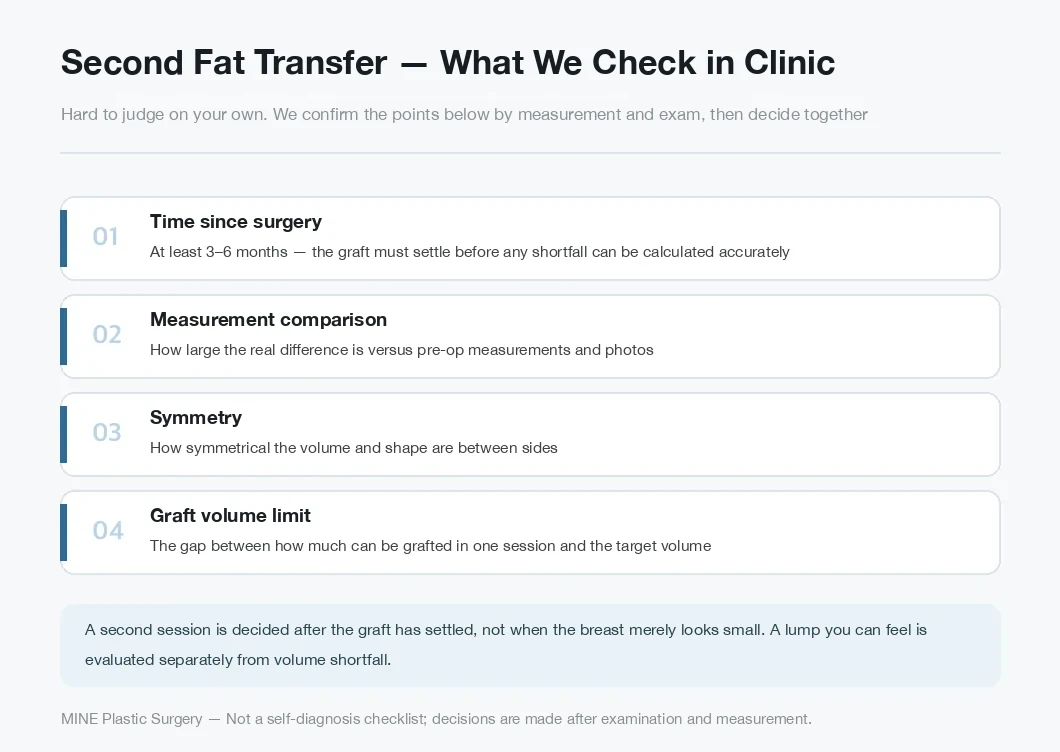
On the fourth point: how much fat one breast can take in a single session is limited by the space and blood supply available. In revision surgery, textbooks describe typical volumes of around 100–150 cc per breast, with larger amounts possible only when the breast’s capacity to receive the graft is respected. Overfilling a tight space crowds the fat and leaves less of it close enough to new blood vessels.
A lump you can feel after surgery is not a sign of insufficient volume — it is a separate finding that needs its own evaluation. These findings and how they are managed are covered in breast fat transfer side effects and lumps.
What happens when a second session is rushed
In a study of 110 patients who had contour corrections of reconstructed breasts, 55% needed more than one session to reach a satisfactory result. Breast textbooks similarly note that fat grafting often needs to be repeated. In reconstruction, we explain before surgery that patients should plan for at least two sessions: the first improves the tissue’s blood supply, and the second builds volume.
That is a reconstruction benchmark, though, and in cosmetic augmentation individual variation is much greater. What helps is knowing in advance that the amount of fat that can be grafted at once is limited, so depending on your goal, an additional session may become necessary. The situation I work hardest to avoid is booking the next operation before the first graft has even settled.
Dr. Lee’s Key Point: A second session is decided after the graft settles, not when you look short of volume. That’s why we wait 3 to 6 months.
When Another Fat Transfer Isn’t the Right Answer
A second session isn’t always the answer. Even when your final result falls short of expectations, there are clear cases where, once we measure in clinic, I can’t recommend more grafting.
Not enough donor fat left
Fat transfer moves your own fat, so it only works if there is fat left to harvest. If you have a slim build, or a large amount was already taken in a previous operation, reaching your target volume may be difficult. I don’t recommend pushing the harvest further in that situation. Textbooks warn that removing too much fat from one area can leave visible dents and irregularities at the donor site — trading one concern for another.
When your goal exceeds what fat transfer can deliver
If your target size is beyond what fat transfer can realistically achieve, repeating sessions won’t close the gap. Another approach may suit you better; you can compare the two in implants vs fat transfer for breast volume. With either option, outcomes such as volume loss or asymmetry between the sides can differ from what you expected, so the choice is safest when it is based on measurement and examination.
Dr. Lee’s Key Point: More fat isn’t always the answer. Measure your available donor fat and your target volume first.
Frequently Asked Questions
How long does it take for breast fat transfer to settle?
On a typical breast fat transfer results timeline, by around three months the fat that will survive and the fat that will be absorbed have largely separated. Final volume is assessed between 6 and 12 months. Before that, the size you see still includes swelling, so it is too early to treat it as your result. Individual timing varies with tissue condition.
How long until I know my final breast size after fat transfer?
At least six months — that is the earliest point on the breast fat transfer results timeline for a final assessment. If your treatment is planned in stages, the final shape appears only well after the last session, so the wait is longer. Judging success or failure from your size before that point usually does more harm than good. Comparing with your pre-surgery measurements gives the clearest answer.
Why do my breasts look smaller one month after fat transfer?
Right after surgery, the volume includes swelling and a planned extra margin on top of the grafted fat. The drop at one month is mostly swelling going down — it does not mean all the fat has disappeared. This dip is a normal stage of the breast fat transfer results timeline. Changes at this stage alone can’t predict your final result, so hold judgment until three to six months.
When should a second breast fat transfer be decided?
Only after the first graft has settled — at least 3 to 6 months after surgery. Before then, there is no reliable figure for how much is missing, so rushing leads to a decision without evidence. The decision should be made in clinic, with your pre-surgery measurements alongside your current ones.
How can I tell if not enough fat survived?
It is hard to tell on your own. In clinic, we compare your pre-surgery measurements with measurements and photos taken at six months, when the breast fat transfer results timeline reaches its stable phase. Findings unrelated to volume, such as a lump you can feel, are evaluated separately, and regular breast imaging is recommended after fat grafting as part of routine follow-up.
Checking Your Progress at 6 and 12 Months
To sum up the breast fat transfer results timeline: your result is decided over the 3 to 6 months after surgery, not on the day itself, and whether you need more fat is judged after that through measurement and examination. Whether the size you see in the mirror today is your final result depends entirely on how many months have passed.
If you’re worried about your progress, rather than comparing photos on your own, I recommend having your six-month status checked by a medical team that holds your pre-surgery measurements. For fat transfer breast augmentation at MINE, we keep pre-surgery measurements and follow-up records together so this comparison can be made properly. You can confirm whether a surgeon is a board-certified plastic surgeon through the Korean Society of Plastic and Reconstructive Surgeons.
The same breast size reads differently depending on how many months have passed and what your measurements were before surgery. At MINE Plastic Surgery on Nonhyeon-ro in Gangnam, Seoul, Dr. Lee Sung-wook personally compares your pre-surgery records with your progress at 6 and 12 months and explains what they show. If you’d like to understand where you are on your breast fat transfer results timeline, book a one-on-one consultation.
MINE Plastic Surgery & Dermatology · 813 Nonhyeon-ro, Gangnam-gu, Seoul, Korea · +82-2-516-1175
Written and reviewed by Dr. Lee Sung-wook, Board-certified Plastic Surgeon — MINE Plastic Surgery & Dermatology
※ This content is for informational purposes only and does not replace professional medical advice, diagnosis, or treatment. Individual results may vary, and side effects may occur. Please consult with a board-certified plastic surgeon for personalized advice.