EN
EN

Table of Contents
Does Breast Surgery Affect Breastfeeding? Understanding the Basics
Does breast surgery affect breastfeeding? Breast surgery is any operation that changes the size, shape or position of the breast — augmentation, reduction, lift, fat grafting or nipple surgery. Whether it affects breastfeeding depends mainly on how much milk-producing tissue is left in place, and on whether the milk ducts and the nerves supplying the nipple are preserved. Operations that stay away from the nipple and the duct system, such as breast augmentation through a breast-fold or armpit incision, generally leave the milk pathway intact. Operations that remove glandular tissue or detach the nipple carry a higher risk of reduced milk supply.
Five essential facts at a glance:
- Where the incision is placed matters more than the implant itself. Inframammary (breast-fold) and transaxillary (armpit) incisions do not cross the milk ducts; a periareolar incision made at the edge of the areola can divide them.
- Breast augmentation is the lowest-risk breast operation for lactation, because no milk-producing tissue is removed.
- Reduction and lift carry more risk, and the deciding factor is whether the nipple stays connected to the breast on a pedicle of living tissue or is moved as a free graft.
- A free nipple graft divides every duct and nerve running to the nipple, so breastfeeding is not expected after that technique.
- No surgeon can promise a specific breastfeeding outcome. Milk supply varies widely between individuals even without surgery, so it is sensible to plan for the possibility of supplementing.
This is one of the most common questions international patients ask before undergoing breast surgery in Korea, and it is a fair one: the breast’s milk production and delivery system is intricate, and surgery can affect it.

At Mine Clinic in Seoul, our board-certified plastic surgeons treat preservation of breastfeeding function as part of the surgical plan for women who may want children later. Korean plastic surgery technique has moved steadily toward approaches that protect the duct system and the nerve supply while still delivering the aesthetic result the patient came for.
The breast contains milk glands (lobules), milk ducts that carry milk toward the nipple, and the nipple-areola complex where milk is released. Successful breastfeeding requires:
- Intact milk glands that can produce milk in response to hormonal signals
- Functional milk ducts that can transport milk from the glands to the nipple
- Adequate nipple sensation to trigger the milk ejection reflex
- Preserved blood supply and nerve pathways, in particular the fourth intercostal nerve, which supplies most of the sensation to the nipple
Any breast operation can affect one or more of these elements. What modern technique does is reduce how often that happens — it does not remove the possibility, and any clinic that tells you otherwise is overstating what surgery can promise.
How Different Breast Procedures Impact Lactation
Different types of breast surgery carry very different levels of risk to breastfeeding. Understanding those differences helps you decide on both timing and technique.
Breast Augmentation and Breastfeeding
Breast augmentation adds volume without removing glandular tissue, which is why it is the breast operation least likely to interfere with lactation. The impact that does exist comes mainly from the incision location and, to a lesser degree, the implant pocket.
Incision Locations and Their Impact:
The inframammary fold incision (in the crease under the breast) is the most widely used approach in breast augmentation. Surgical texts describe it as giving the most direct access to and visualization of the implant pocket with the least disturbance of the surrounding structures, and it does not cross the areola or the milk ducts. This is the approach we most often use with Mentor implants, Motiva implants, and Sebbin implants at Mine Clinic.
The transaxillary incision (through the armpit) also reaches the pocket without cutting through breast tissue or the duct system, which makes it another lactation-friendly option. It is technically the more demanding route and is best performed endoscopically; Mine Clinic uses it in its HD endoscopic breast augmentation procedures.
The periareolar incision runs along the border of the areola, and the tunnel from there to the implant pocket may divide some of the lactiferous (milk) ducts. That has two documented consequences, and they are worth separating because they are often confused.
First, contamination and capsular contracture. The milk ducts normally contain bacteria. When they are divided, the implant comes into contact with those bacteria, and the plastic surgery literature links the periareolar route to a higher incidence of capsular contracture for exactly this reason — so much so that when a woman with a periareolar scar needs a second operation for capsular contracture, surgeons usually switch to an incision in the breast fold. This, rather than breastfeeding alone, is why the periareolar incision is recommended less often today.
Second, nipple sensation. The periareolar approach is traditionally listed as carrying a greater risk of altered nipple sensitivity. It is worth being precise here. When studies have compared the two, the periareolar incision has not reliably come out worse for sensation than an incision in the breast fold. The cause identified most often is a different one: injury to the intercostal nerves while the surgeon works out toward the outer edge of the implant pocket — not the skin incision itself. In practice, how carefully the pocket is opened up matters at least as much as where the skin is cut.
Implant Placement:
Submuscular placement keeps a layer of muscle between the implant and the glandular tissue, so it disturbs the glands and ducts less. When the implant is placed above the muscle, we go beneath the muscle fascia — a thin layer over the muscle — so that the implant does not sit directly against the breast tissue.

Breast Reduction and Breastfeeding
Breast reduction surgery carries a higher risk to lactation than augmentation, because it removes glandular tissue, reshapes the breast, and usually repositions the nipple-areola complex.
The deciding factor is whether the nipple-areola complex stays attached to the breast on a pedicle — a bridge of living tissue carrying its blood supply, nerves and at least part of the duct system — or is removed and replaced as a free nipple graft. In a free nipple graft, described in the surgical literature as taking the nipple-areola complex as a full-thickness skin graft and transferring it to a new site, every duct and nerve running to the nipple is divided. Breastfeeding is not expected after that technique, and it is normally reserved for very large reductions.
Pedicle techniques keep part of the duct system connected, so lactation remains possible — but the more glandular tissue is removed, the less milk-producing reserve is left. Mine Clinic’s surgeons prioritize tissue-preserving techniques whenever it is medically appropriate for the degree of reduction required.
You will find widely differing “success rates” quoted online for breastfeeding after reduction. We deliberately do not quote a single number, because published studies define “successful breastfeeding” differently — some count any breast milk at all, others count exclusive breastfeeding for a set number of months — and the figures are not comparable. The useful answer comes from your own surgeon, once your anatomy and the planned amount of tissue removal are known. For general background on breast procedures, the American Society of Plastic Surgeons also publishes patient information.
Breast Lift and Breastfeeding
Breast lift surgery (mastopexy) reshapes and raises sagging breasts without adding or removing significant volume. As with reduction, the impact on breastfeeding depends mostly on whether the nipple remains attached to its blood supply and duct system.
Lifts that involve only skin removal typically have little impact. The more extensive patterns, which move the nipple to a higher position, raise the same considerations as breast reduction. The incision pattern is chosen according to how much sagging has to be corrected, as shown below.
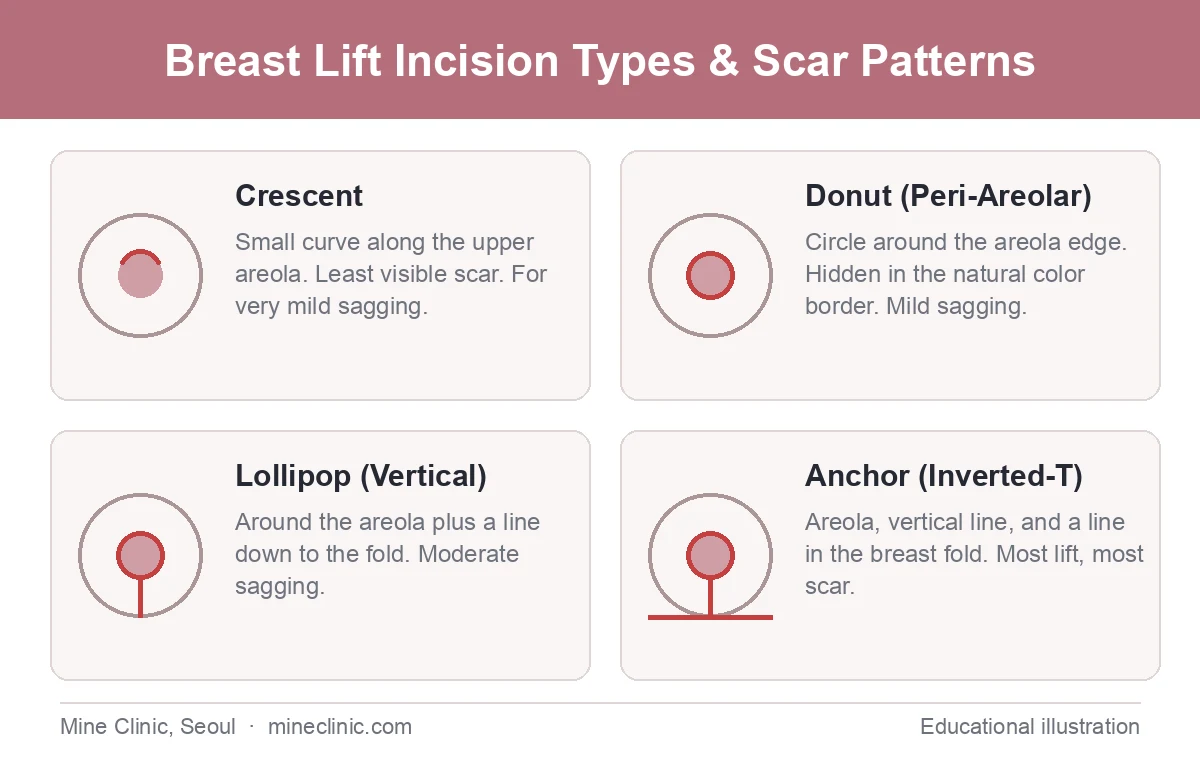
Note that the crescent and donut patterns stay at the edge of the areola, while the lollipop and anchor patterns extend down toward the fold. The wider the pattern and the further the nipple is moved, the more duct and nerve tissue is disturbed — which is the trade-off you and your surgeon are balancing against the amount of lift you want.
Breast Fat Grafting and Breastfeeding
Breast fat grafting harvests fat from another area of the body and injects it into the breast for natural volume enhancement. It generally has minimal impact on breastfeeding, because it does not cut milk ducts or remove glandular tissue — the fat is placed around the existing structures, which stay largely intact.
Nipple Surgery and Breastfeeding
Nipple surgery — correction of inverted nipples, or reduction of an enlarged nipple or areola — sits closest to the duct system of any breast procedure, so the technique used is decisive.
Duct-preserving techniques remove tissue from the side of the nipple or from the areolar margin while leaving the central bundle of ducts running through the nipple intact. The milk pathway stays open, so breastfeeding remains possible. Techniques that divide the ducts — for example a resection taken straight through the body of the nipple — close that pathway, and milk cannot pass through afterwards.
This is why we ask directly about future pregnancy plans at the nipple surgery consultation: the answer changes which technique we choose. In practice, most of our nipple surgery patients come to us after they have finished breastfeeding and do not plan to breastfeed again.
Why Choose Korea for Breast Surgery with Breastfeeding Preservation
Seoul, and in particular the Gangnam district where Mine Clinic is located, has become a destination for breast surgery that aims at both aesthetic and functional outcomes. Several factors matter for international patients concerned about future breastfeeding:
Advanced Surgical Techniques:
The HD endoscopic approach used at Mine Clinic places the implant through a small armpit incision under direct camera visualization. Seeing the pocket clearly means less working by feel, which matters here because blind dissection near the outer edge of the pocket is the most commonly identified cause of nipple sensory loss.
Experienced Surgeons:
Mine Clinic’s medical staff includes board-certified plastic surgeons who operate on the breast regularly and are used to adapting the approach for women who are planning future pregnancies, rather than applying one standard technique to every patient.
Comprehensive Pre-Operative Planning:
Our consultation for international patients covers your family planning goals explicitly, and the surgical plan is designed around both the aesthetic result and the function you want to keep. Bringing breastfeeding up at the planning stage, rather than after surgery, is what allows us to design the operation around it.
State-of-the-Art Facilities:
Mine Clinic’s facilities include advanced surgical technology and recovery spaces designed for international medical travelers, with real-time surgery monitoring and infection-control protocols intended to reduce complication rates.
Important: Risks, Side Effects & Safety Considerations
Breast surgery in Korea can produce very good results, but you should understand the potential risks and how they relate specifically to breastfeeding before you decide.
General Surgical Risks
All breast surgeries carry standard surgical risks including:
- Infection: Though uncommon with proper sterile technique and post-operative care, infections can occur and may require antibiotics or further treatment.
- Bleeding and Hematoma: Collection of blood under the skin may require drainage.
- Scarring: All incisions leave some degree of scar tissue, however carefully they are placed and closed.
- Anesthesia Reactions: General anesthesia carries small but real risks that will be discussed during your consultation.
- Capsular Contracture: Hardening of the scar capsule around an implant, which the surgical literature links in part to bacterial contamination — one reason incision choice is discussed above.
- Changes in Sensation: Temporary or permanent changes in nipple or breast sensation can occur after any breast surgery.
Specific Breastfeeding-Related Risks
Reduced Milk Production:
Any surgery that removes or damages milk-producing glands can reduce milk supply. This is most relevant to breast reduction, where tissue is deliberately removed. How much it matters depends on the volume removed and which parts of the breast are affected.
Impaired Milk Transfer:
Even when milk production is adequate, divided ducts can stop milk reaching the nipple. This applies to any procedure that cuts through the duct system, which is why the periareolar route and nipple procedures are singled out above.
Reduced Nipple Sensation:
The milk ejection reflex, or let-down, is triggered partly by nipple stimulation, so reduced sensation can make it harder to initiate. The nipple receives most of its sensation from the fourth intercostal nerve, and the surgical literature identifies aggressive dissection out to the side of the implant pocket — where that nerve runs — as the most common cause of sensory change after augmentation. Where sensation does recover, it usually does so gradually over the first 6 to 12 months after surgery, as the nerve regenerates. In some women, however, the loss is permanent. Many women with reduced nipple sensation still breastfeed successfully by relying on regular scheduled feeding or pumping rather than on the sensory cue.
Asymmetric Milk Production:
If one breast undergoes more extensive surgery, or has more post-operative complications than the other, milk production can be uneven between the two sides.
Safety Measures at Mine Clinic
To reduce these risks, Mine Clinic applies several protocols:
- Detailed Pre-Operative Assessment: Online consultation and in-person evaluation to understand your anatomy and goals.
- Customized Surgical Planning: Technique selection based on your specific anatomy and your future breastfeeding plans.
- Experienced Surgical Team: Board-certified surgeons with extensive experience in function-preserving breast surgery.
- Advanced Monitoring: Real-time surgery observation systems for quality control.
- Comprehensive Post-Operative Care: Dedicated after-care programs to monitor healing and address concerns early.
When Breastfeeding May Not Be Possible
Realistic expectations matter. Full preservation of breastfeeding ability cannot be promised with any breast operation, and the risk is highest in these situations:
- Extensive breast reductions where large amounts of glandular tissue are removed
- Procedures requiring a free nipple graft, in which the nipple is completely detached
- Surgery for severe breast asymmetry or congenital breast abnormalities, where glandular tissue may already be limited
- Cases with pre-existing breast tissue damage or significant scarring from earlier surgery
It is also worth knowing that some women cannot produce a full milk supply for reasons unrelated to surgery. If breastfeeding does not work out, that is not automatically the operation’s fault — and it is not a failure on your part either. Your surgeon should discuss the likelihood honestly for your specific situation at consultation.
Recovery and Planning for Future Pregnancy
Understanding the recovery timeline and how to plan for a future pregnancy is important for international patients considering breast surgery in Korea. Most international patients are cleared to fly home about 14 days after breast surgery, once the surgeon has confirmed that the wounds are healing normally.
Recovery Timeline in Seoul
Week 1 (Days 1-7):
- Rest at your accommodation in Seoul
- Manage post-operative swelling and discomfort with prescribed medications
- Wear surgical compression garment
- Avoid lifting arms above shoulder level
- Stitch removal: Typically occurs on day 5-7 at Mine Clinic
Week 2 (Days 8-14):
- Gradual return to light activities
- Continue wearing support garment
- Reduced swelling becomes noticeable
- Most international patients can fly home after this period with surgeon approval
Weeks 3-6:
- Progressive return to normal activities
- Avoid strenuous exercise and heavy lifting
- Swelling continues to subside
- Follow-up can be conducted via virtual consultation
Months 3-6:
- Final results become apparent as swelling completely resolves
- Scars begin to fade and mature
- Return to all normal activities including exercise
- Altered nipple sensation, if present, often improves over this period as nerves recover
Planning for Pregnancy After Breast Surgery
Timing Considerations:
Most surgeons, including Mine Clinic’s team, suggest waiting at least 6-12 months after breast surgery before becoming pregnant. This allows:
- Complete healing of internal tissues
- Final settling of implants (for augmentation)
- Stabilization of breast shape and size
- Time for any sensation changes to recover
Pregnancy and Breastfeeding After Surgery:
When you do become pregnant after breast surgery:
- Tell your obstetrician and lactation consultant about your surgical history, including the incision used and whether the nipple was moved
- Expect that pregnancy-related breast changes may alter your surgical result
- Work with a lactation consultant early rather than after difficulties appear
- Have a plan for supplementing if milk supply turns out to be insufficient
Revision Surgery Considerations:
Some patients choose breast revision surgery after completing their family, if pregnancy and breastfeeding have significantly changed the appearance of the breast. Mine Clinic offers revision services for patients addressing post-pregnancy changes.
Long-Term Monitoring
Continue with regular breast health check-ups, including mammograms, as recommended by your healthcare provider. Tell the radiologist about your breast surgery history and any implants, because extra imaging views are needed to see all of the breast tissue around an implant.
Frequently Asked Questions
Can I breastfeed with breast implants?
In most cases, yes — particularly when the implant was placed through an inframammary or transaxillary incision, because those routes leave the milk glands and ducts intact. On the safety of the implant itself, silicone is one of the most extensively studied implantable materials in medicine. The Institute of Medicine’s 1999 review of silicone breast implants found that connective tissue disease, cancer and neurological disease are no more common in women with implants. Later systematic reviews have not overturned that conclusion.
Evidence dealing specifically with breast milk is much thinner and mostly observational, so the honest position is that there is no established evidence of harm to a breastfed infant from an intact implant — not that the question has been settled by large trials. At Mine Clinic we choose incision placement and implant positioning with breastfeeding function in mind whenever a patient raises it.
How long should I wait to get pregnant after breast surgery?
We generally suggest waiting 6-12 months after breast surgery before becoming pregnant. That period allows incisions to heal fully, swelling to resolve, and breast shape to stabilize. If you are planning a pregnancy in the near future, say so at consultation — it can change both the surgical approach and the recommended timing.
Will pregnancy ruin my breast surgery results?
Pregnancy causes natural breast changes — enlargement, stretching and potential sagging — driven by hormonal shifts and milk production, and these can affect a surgical result to varying degrees. Many patients keep a good result after pregnancy and breastfeeding; where significant change does occur, revision is available. The team at Mine Clinic handles post-pregnancy breast revision for international patients.
Is breast reduction surgery in Korea safe for future breastfeeding?
Breast reduction carries a higher risk to lactation than augmentation, because glandular tissue is removed. The technique is what decides the outcome: a pedicle technique keeps the nipple attached to part of the duct system, so breastfeeding stays possible, while a free nipple graft divides all the ducts and nerves to the nipple, after which breastfeeding is not expected. We do not quote a percentage success rate, because published studies define success inconsistently. Your surgeon can assess the realistic likelihood for your case once your anatomy and the planned resection are known.
Can I have a consultation before traveling to Korea?
Yes. Mine Clinic offers online consultations where you can discuss breast surgery and breastfeeding with our medical team before you travel. You can share photos and medical history, and ask specific questions about which techniques preserve lactation function, so that you can make an informed decision before committing to a trip to Seoul.
Conclusion: Making an Informed Decision About Breast Surgery and Breastfeeding
So, does breast surgery affect breastfeeding? Sometimes — and how much depends on the type of procedure, the surgical technique, the incision location and your individual anatomy. Augmentation through a fold or armpit incision sits at the low-risk end; a reduction requiring a free nipple graft sits at the other. No surgeon can promise that your ability to breastfeed will be completely unaffected, but the approaches used in Korea are designed to give you a realistic chance of breastfeeding alongside the aesthetic result you want.
What matters most is choosing an experienced surgeon who understands your priorities, uses tissue-preserving technique where it is appropriate, and tells you honestly what is and is not likely in your case rather than what you would prefer to hear.
If preserving breastfeeding function matters to you, raise it explicitly at consultation. Ask which incision is planned, whether the nipple will be moved and how, and what that means for your milk ducts and nipple sensation. Those three questions will tell you most of what you need to know.
Interested in breast surgery that takes your future breastfeeding goals into account? Contact Mine Clinic for a personalized online consultation. We are ready to assist you on WhatsApp and guide you through your K-Beauty journey in Seoul, with care that considers both aesthetics and function.
Reviewed by Dr. Lee Sung-wook, Board Certified Plastic Surgeon at Mine Clinic.
※ This content is for informational purposes only and does not replace professional medical advice, diagnosis, or treatment. Individual results may vary, and side effects may occur. Please consult with a board-certified plastic surgeon for personalized advice.