EN
EN

An LDM microvibration facial is a non-thermal, non-invasive skin treatment that uses two ultrasound frequencies — 1MHz and 3MHz — alternating up to 500 times per second to gently vibrate the cells in your skin. Instead of heating the tissue, it sends tiny mechanical pulses deep into the dermis to wake up the cells that rebuild firmness, all with zero heat and zero downtime.
If you have ever been told that lasers or high-intensity ultrasound are “too strong” for your skin, you are exactly the kind of patient who tends to ask about LDM. Many people feel caught between two worries: intensive treatments sound intimidating, but doing nothing means watching the skin gradually lose its bounce. The LDM microvibration facial sits comfortably in between — effective enough to stimulate real collagen renewal, gentle enough for sensitive skin.
In this guide, Dr. Lee Sung-wook of MINE Plastic Surgery & Dermatology explains how the technology actually works at the cellular level, who benefits most, and how it compares to heat-based options. If you would rather read about results and recovery timelines, our companion LDM Facial in Korea: Effects & Recovery Guide covers what to expect after treatment.
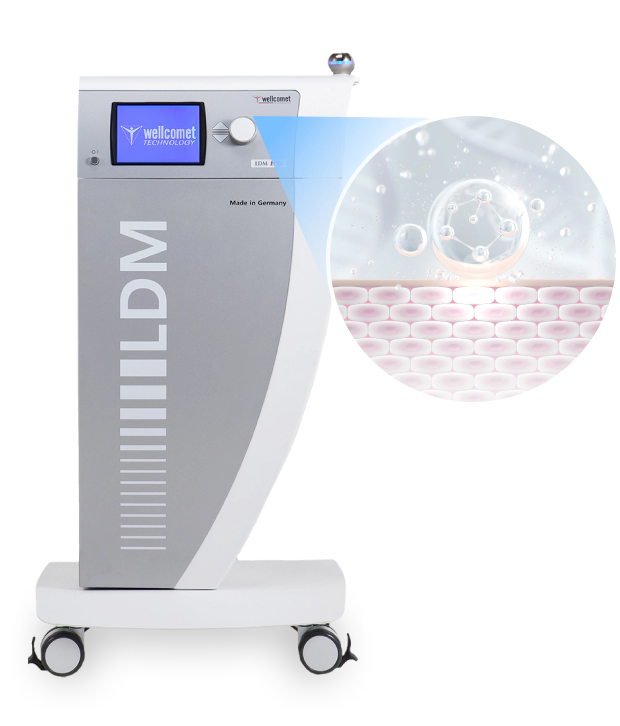
Table of Contents
- What Is an LDM Microvibration Facial?
- The Science: How Dual-Frequency Microvibration Works
- LDM Treatment by Skin Type: Who Benefits Most?
- LDM vs Ultherapy vs Titanium Lifting
- What to Expect: The LDM Treatment Process
- Contraindications & Safety
- Frequently Asked Questions
- Why Choose LDM at MINE Clinic, Seoul
What Is an LDM Microvibration Facial? (Definition)
LDM stands for Localized Dynamic Micromassage. Broken down, the name tells you exactly what it does: it delivers a localized, dynamic (constantly moving) micromassage to your skin. In plain terms, it gently shakes the individual cells beneath the surface to wake them up.

LDM: Localized Dynamic Micromassage Explained
The technology originated in Germany as a dual-ultrasound device, and it is CE-certified for non-invasive use. Where a standard ultrasound machine emits just one frequency, the LDM device rapidly alternates between a low and a high frequency. Switching back and forth like this lets the energy work across a wide range of depths — from the skin’s surface down into the deeper dermis — in a single session. At MINE Clinic, we offer this treatment under the name “Water Drop Lifting.” You can see an overview on our LDM Water Drop Lifting at MINE Clinic service page.
How LDM Differs from HIFU and Ultherapy
The single biggest difference comes down to one word: heat. Devices like Ultherapy use high-intensity focused ultrasound (HIFU) to concentrate strong heat energy deep within the skin. That approach is powerful, but it can bring discomfort during treatment and temporary swelling afterward.
LDM works in the opposite way. Rather than heating the tissue, it uses near-zero-heat microvibration — tiny physical pulses that stimulate cells mechanically. Because there is no thermal injury, it can be applied comfortably even to skin with a weakened barrier or active inflammation, which is where heat-based devices often cannot go.
The Science: How Dual-Frequency Microvibration Works
The heart of the LDM microvibration facial lies in two ideas working together: two different frequencies and microvibration. Here is how they combine to rebuild collagen inside your skin, step by step.
1MHz Low-Frequency: Surface Drainage & Puffiness Reduction
The lower-frequency ultrasound (around 1MHz) works closer to the skin’s surface. Its main job is to support lymphatic circulation — the body’s natural drainage system — which helps calm puffiness and that heavy, tired look. Think of it as encouraging stagnant fluid to start moving again.
3MHz High-Frequency: Deep Dermal Fibroblast Stimulation
The higher-frequency ultrasound (around 3MHz) penetrates deeper, into the dermis, where it stimulates the most important cell in this whole process: the fibroblast (the “factory” cell in your skin that manufactures collagen). When the two frequencies alternate up to 500 times per second, they create gentle cellular-level vibrations — almost like tapping the cells on the shoulder and signalling, “time to get back to work.”
Collagen Remodeling: What Medical Textbooks Confirm
As we age or as skin becomes fatigued, fibroblasts slow down. They produce less collagen, and the skin gradually loses its firmness. When the microvibration energy reaches the dermis, those dormant fibroblasts are stimulated back into activity.
This is well supported in the medical literature. Plastic surgery and dermatology textbooks describe how fibroblasts, once stimulated, respond to a chemical signal known as the PDGF pathway (a natural growth-factor message that tells cells to repair and rebuild). In response, they synthesize fresh building blocks of healthy skin: a new collagen scaffold — primarily collagen type III — together with glycosaminoglycans and fibronectin (the “filler” and “glue” molecules that give skin its plumpness and structure). As new collagen is laid down, old collagen is gradually replaced in a process called remodeling, and the skin becomes firmer over time. You can read more about how energy-based devices stimulate collagen in this medical research reference on PubMed.
The microvibration also triggers two helpful side effects. First, it encourages the production of heat shock proteins (HSPs) — protective proteins that help cells defend themselves and recover. Second, it improves the way hyaluronic acid (the skin’s natural water-binding molecule) is distributed through the dermis, which reduces moisture loss and improves hydration. So the treatment supports not only firmness but the skin’s underlying water balance as well.
LDM Treatment by Skin Type: Who Benefits Most?
The greatest advantage of LDM is how few skin types it has to exclude. Because it relies on almost no heat, it suits people for whom stronger treatments have always felt like too much.
Loss of Firmness & Early Aging Skin
Thanks to the collagen and elastin stimulation described above, an LDM microvibration facial can help with early sagging and loss of elasticity. Rather than a single dramatic change, the goal is steady, cumulative improvement — skin texture and firmness that gradually feel better as you continue the course.
Sensitive, Dry, or Reactive Skin (Acne & Rosacea)
Some people have a fragile skin barrier and flush, sting, or redden easily after lasers or aggressive treatments. Because LDM produces virtually no thermal stimulation, it can be applied to sensitive and dry skin with no downtime. Its effect on hyaluronic acid balance also makes it a useful option for dry skin that feels tight and dehydrated.
Heat-based treatments can aggravate inflamed skin, but LDM’s non-thermal approach means it can be applied relatively safely even to inflammatory acne or easily flushed, rosacea-prone skin. If inflammation is severe, however, a specialist will assess the skin first before deciding whether to proceed. Readers exploring gentle skin boosters may also find our Complete Rejuran Treatment Procedure Guide a helpful companion read.
Skin Undergoing Aesthetic Recovery
Because the 1MHz component supports lymphatic drainage, LDM can also help skin that is in a recovery phase — easing residual swelling and supporting tissue repair. For international patients in particular, the zero-downtime nature means you can return to activities, sightseeing, or social plans the same day.
LDM vs Ultherapy vs Titanium Lifting: A Science Comparison
Lifting treatments come in many forms, which makes choosing one confusing. Here is how LDM compares to two of the most common alternatives, viewed through the lens of how deep and by what mechanism each one works.
Depth of Action: Dermis vs SMAS
Ultherapy (HIFU) delivers strong, focused heat down to the SMAS layer (the muscle-and-fascia sheet that supports the face). Dermatology textbooks note that the new collagen produced by high-intensity focused ultrasound gathers mainly in the deeper reticular dermis. LDM, by contrast, works through mechanical vibration in the upper, more superficial dermis — it does not reach or heat the SMAS at all. The two treatments operate at genuinely different depths.
Thermal vs Non-Thermal Mechanism
Ultherapy is thermal: its results come from controlled heat. Titanium lifting stimulates the skin at yet another depth using its own energy-based approach. LDM is the gentle, non-thermal member of this family — strong on consistency and comfort rather than a single intensive session.
Choosing the Right Treatment for Your Skin Goals
These are not competing treatments so much as complementary ones. Because LDM and devices like Ultherapy or titanium lifting act on different layers of the skin, they can be combined for a more complete result. Whether you want one powerful session or comfortable, repeatable maintenance — and which combination suits your skin — is best decided through a consultation with a specialist.
What to Expect: The LDM Treatment Process at MINE Clinic
First-time patients often worry that the treatment will hurt or take a long time. In practice, an LDM session is simpler than most people expect.
Session Structure: Before, During & After
Before treatment, a specialist reviews your current skin condition and concerns, along with the skincare products and any medications you use. Together you decide whether LDM suits your skin and roughly how many sessions you might need. If you are unsure of your own skin type, that is established during the consultation, so there is no need to know it in advance.
The session itself takes about 30 minutes after a numbing cream is applied. Because the microvibration is gentle, most patients find it very comfortable. You can return to normal activities immediately afterward, with no separate recovery period required.
How Many Sessions? Course Protocol Guide
To build cumulative results, we generally recommend a course of 4 to 6 sessions, spaced once or twice per week. Improvement develops gradually as collagen rebuilds over the following weeks rather than appearing all at once.
Dr. Lee Sung-wook’s Clinical Perspective
In my clinical experience at MINE Clinic, I recommend LDM as part of a comprehensive skin-health protocol rather than as a one-time fix — particularly for patients who cannot tolerate heat-based devices, or who are between more intensive procedures and want to keep supporting their skin in the meantime. The goal is steady, accumulating improvement, and managing that expectation honestly is part of good care. My approach reflects the standards of international bodies such as the International Society of Aesthetic Plastic Surgery (ISAPS).
Contraindications & Safety: Who Should Avoid LDM?
For a safe treatment, there are a few situations to be aware of in advance:
- Pregnancy: avoided as a precaution.
- Cardiac pacemaker: not recommended, due to electromagnetic caution.
- Metallic implants in the treatment area: not recommended.
- Active, severe skin infection in the treatment zone: postpone until it has resolved.
If any of these apply to you, a specialist consultation is required before treatment, as the procedure may need to be limited. LDM is generally a stable treatment, but on rare occasions a brief, temporary redness or increased sensitivity can appear immediately afterward; this usually settles within a few hours. As with any procedure, individual results vary depending on your skin condition and the number of sessions.
Frequently Asked Questions About LDM Treatment
What is an LDM microvibration facial and how does it work?
An LDM microvibration facial uses two ultrasound frequencies — 1MHz and 3MHz — alternating up to 500 times per second to vibrate cells in the dermis. This mechanical stimulation activates fibroblasts, the cells that produce collagen, triggering natural collagen renewal without any heat or needles. It is non-thermal, non-invasive, and requires no downtime.
Is LDM treatment safe for sensitive or acne-prone skin?
Yes. LDM’s non-thermal mechanism makes it uniquely suitable for sensitive, dry, reactive, and inflammatory skin such as acne and rosacea, because there is no heat to irritate the skin. If inflammation is severe, a specialist will assess your skin first. It is contraindicated during pregnancy and for patients with a pacemaker or nearby metallic implants.
How many LDM sessions do I need to see results?
A typical course is 4 to 6 sessions, scheduled once or twice per week. Results are cumulative, with collagen gradually rebuilding over several weeks rather than appearing immediately. Many patients choose periodic maintenance sessions afterward to sustain the improvement, though the ideal schedule depends on your individual skin.
What is the difference between LDM and Ultherapy (HIFU)?
LDM uses gentle mechanical microvibration in the upper dermis with no heat and no downtime, making it well suited to sensitive skin. Ultherapy uses high-intensity focused ultrasound to heat the deeper SMAS layer for firmer lifting, which involves some discomfort and temporary swelling. They work at different depths through different mechanisms, so they can be complementary rather than competing.
Does LDM treatment have any downtime or side effects?
There is essentially no downtime, so you can return to normal activities right after the session. Side effects are rare and limited to brief, temporary redness that typically fades within a few hours. There is no bruising, swelling, or recovery period, which makes it convenient for international patients who may travel or attend events the same day.
Who should not get LDM treatment?
LDM is not recommended during pregnancy, for patients with a cardiac pacemaker, or where there are metallic implants in the treatment area. Any active, severe skin infection in the treatment zone should be resolved first. Otherwise, the treatment is considered broadly safe for most skin types, including sensitive and inflammatory skin.
Why Choose LDM at MINE Clinic, Seoul?
An LDM microvibration facial is a strong choice for anyone who wants to support their skin’s firmness consistently, without strong stimulation. That said, the right number of sessions and approach varies with your skin type and concerns. At MINE Clinic in Gangnam, Seoul, treatment is led by board-certified plastic surgeon Dr. Lee Sung-wook, using a medical-grade German Wellcomet LDM device, with English-language consultation available for international patients.
To find the LDM plan that fits your skin, book a consultation with Dr. Lee Sung-wook through our website or by phone at +82-2-516-1175 for a personalized, one-on-one assessment.
※ This content is for informational purposes only and does not replace professional medical advice, diagnosis, or treatment. Individual results may vary, and side effects may occur. Please consult with a board-certified plastic surgeon for personalized advice.